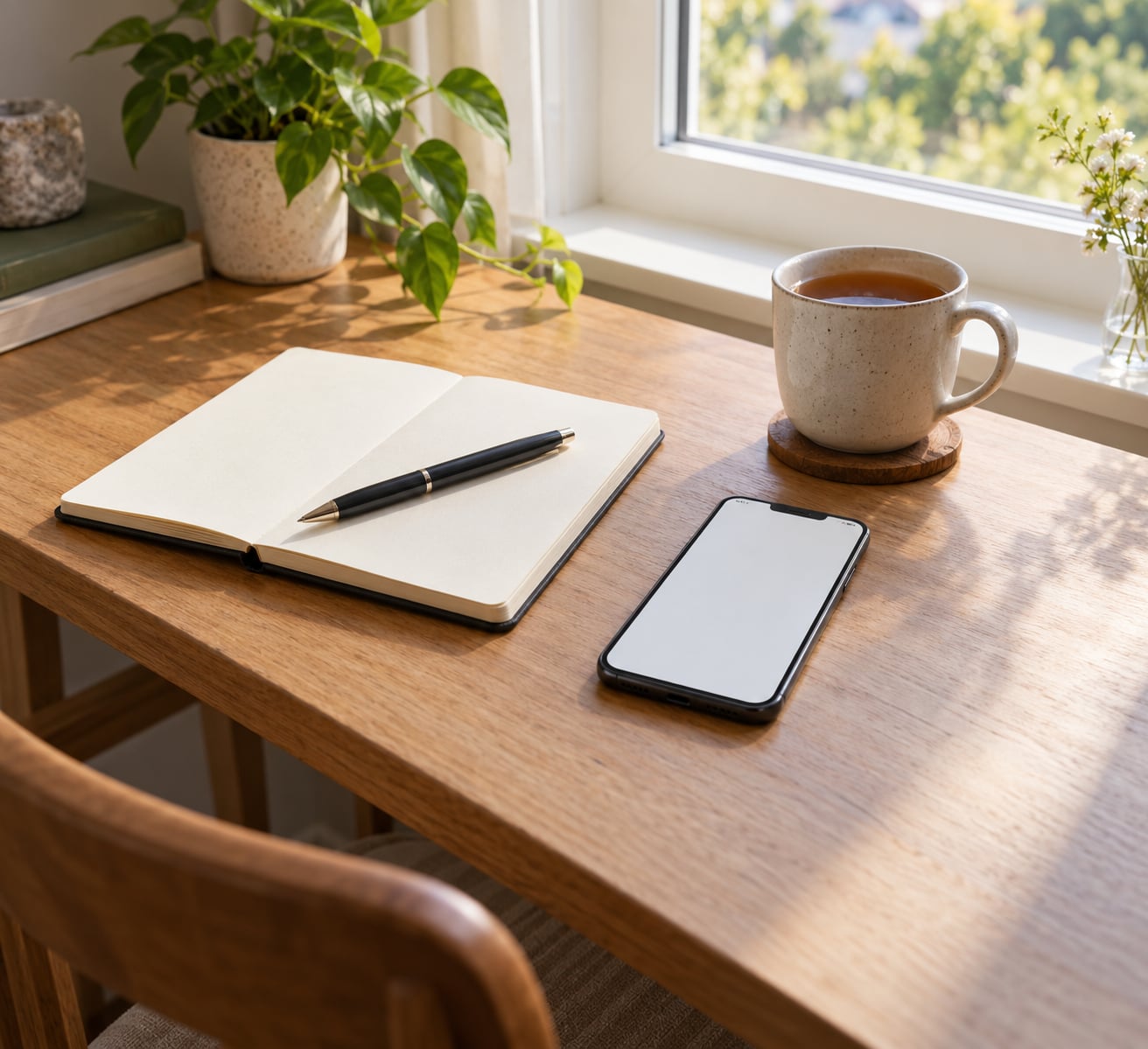
Learning how to start journaling for mental health takes about ten minutes a day and nothing more than a private notebook or a notes app you already have. Pick one simple prompt, set a timer, and write whatever arrives without editing it. That is genuinely the whole method, and it works for absolute beginners.
I say that plainly because the blank page puts more pressure on people than it should. Most of us have bought a journal, filled eleven pages of gratitude lists, and quit. The problem was never the writing. It was treating a low-stakes habit like a graded assignment.
This guide covers what you need, how to start journaling for mental health step by step, the prompts that help when you have nothing to say, and what to do when writing makes you feel worse instead of better. Everything here is general information, not medical advice. Journaling sits alongside professional care. It does not replace a doctor, a therapist, or medication.
Table of Contents
- What You Need
- Step-by-Step: How to Start Journaling for Mental Health
- Common Mistakes
- Frequently Asked Questions
- How long should I journal each day when I am a beginner?
- What should I write about in a mental health journal?
- Is it bad to miss several days of journaling?
- How do I keep my journal private and secure?
- Can journaling replace therapy or other mental health treatment?
- What if journaling makes me feel more upset?
- Conclusion
What You Need
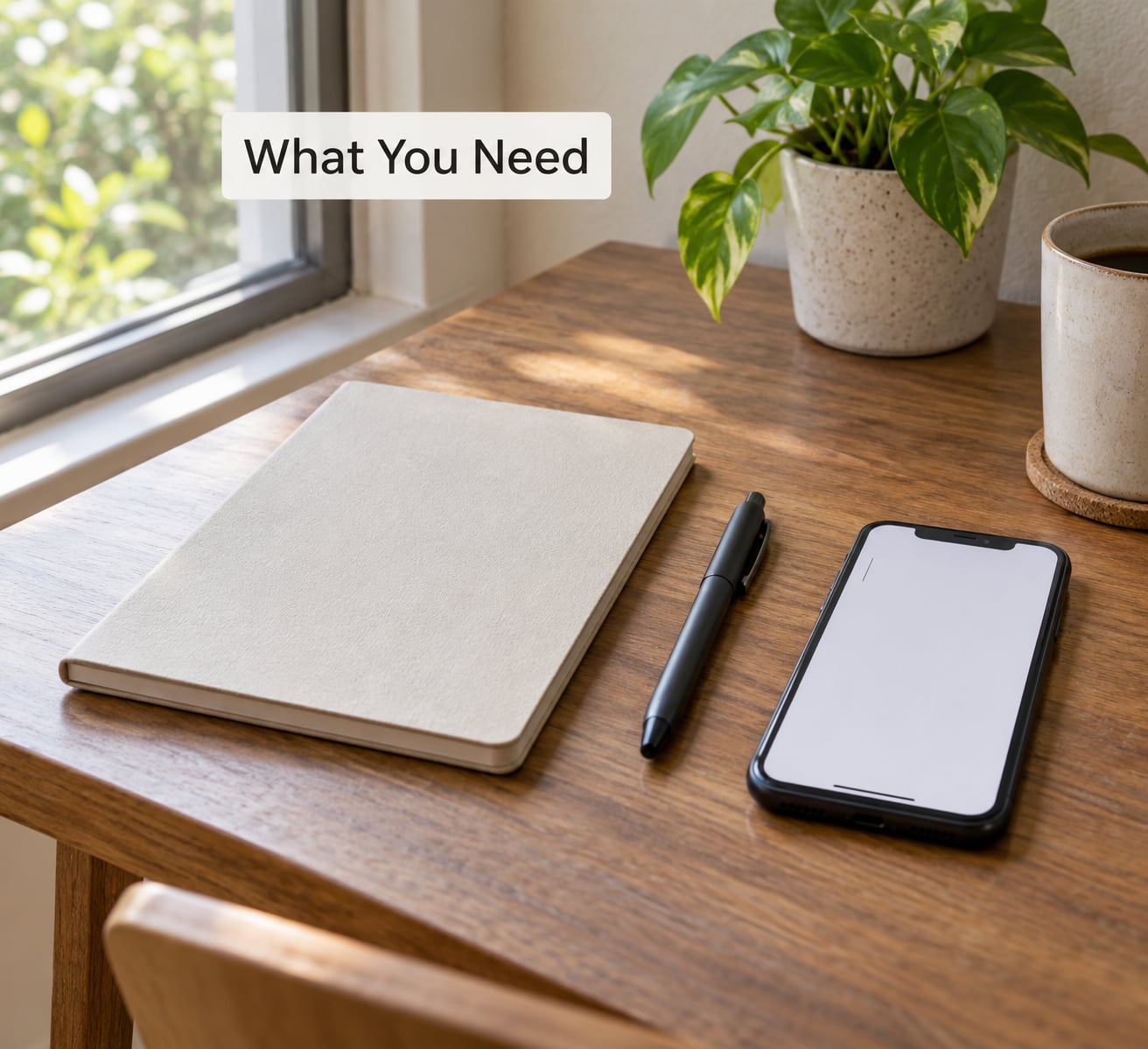
You need three things, and all three are free or nearly free. A private notebook or a notes app on your phone. A place where you can sit for ten minutes without being interrupted. And one question to answer, which removes the hardest part of starting, which is deciding what to write.
That is the full list. You do not need a guided journal, a nice pen, or a spare hour. You do not need writing skills, grammar, or a particular format. Nobody is grading this, and the only audience is the person reading it later.
Where you keep it matters more than what it looks like. If you share a home, a small locked drawer or a coded case beats a notebook on the kitchen shelf. If you type, turn on the app lock and check whether cloud sync is switched on for a device other people can reach.
Step-by-Step: How to Start Journaling for Mental Health
Here is the whole process in five moves: choose a format, set a small intention, answer one prompt, write for ten minutes without editing, and review what you wrote once a week. None of it takes more than fifteen minutes, and the order matters only the first time.
Choose a format that feels comfortable
Pick based on privacy, convenience and comfort with the tool. There is no best option, only the one you will actually open on your worst day, because your worst day is when you most need it.
Paper suits people who like being offline, who write fast, or who find it harder to spiral when the words are in ink. Handwriting slows you down a little, and readers often describe that as calming. Paper also cannot be searched, so add a few tabs or a contents page if you plan to look back.
Phone notes suit people who are out much of the time or who hate carrying a book. They are fast and searchable, and you can be writing in the car or in the queue at ten at night. The trade-off is screen distraction, so close everything else first, or use a plain notes app with no feeds in it.
A private document on your laptop works well if you already write long and type fast. Audio-to-text suits anyone who has dyslexia, a wrist injury, or handwriting they find painful. Speaking a page and cleaning it up afterwards still counts as journaling, and it is the lowest-friction version I know of.
Whichever you choose, test it for one week before deciding. People switch formats in month two and lose the entries they already wrote. Give the first one a fair run.
Set a small, realistic intention
Decide what this is for before you write the first line, because vague intentions turn into vague quitting. Good intentions describe a habit, not an outcome.
Noticing stress patterns: I write down what happened, how my body felt, and what came next, so I can see what sets me off. Processing difficult feelings: I get the thing out of my head so it stops looping while I try to sleep. Tracking sleep and mood: a one-line daily rating plus a note about the night before. Practising gratitude: three specific things, written as scenes rather than lists of nouns.
What not to write: that I will fix my anxiety, or process my trauma in a month, or become a different person by spring. Those are wishes dressed as goals, and when the wish does not arrive on schedule you blame the journal.
A useful framing: the practice is not about feeling better each session. It is about building a record you can read later, because patterns are invisible from inside a single day and obvious across twenty of them.
Use prompts when you do not know what to write
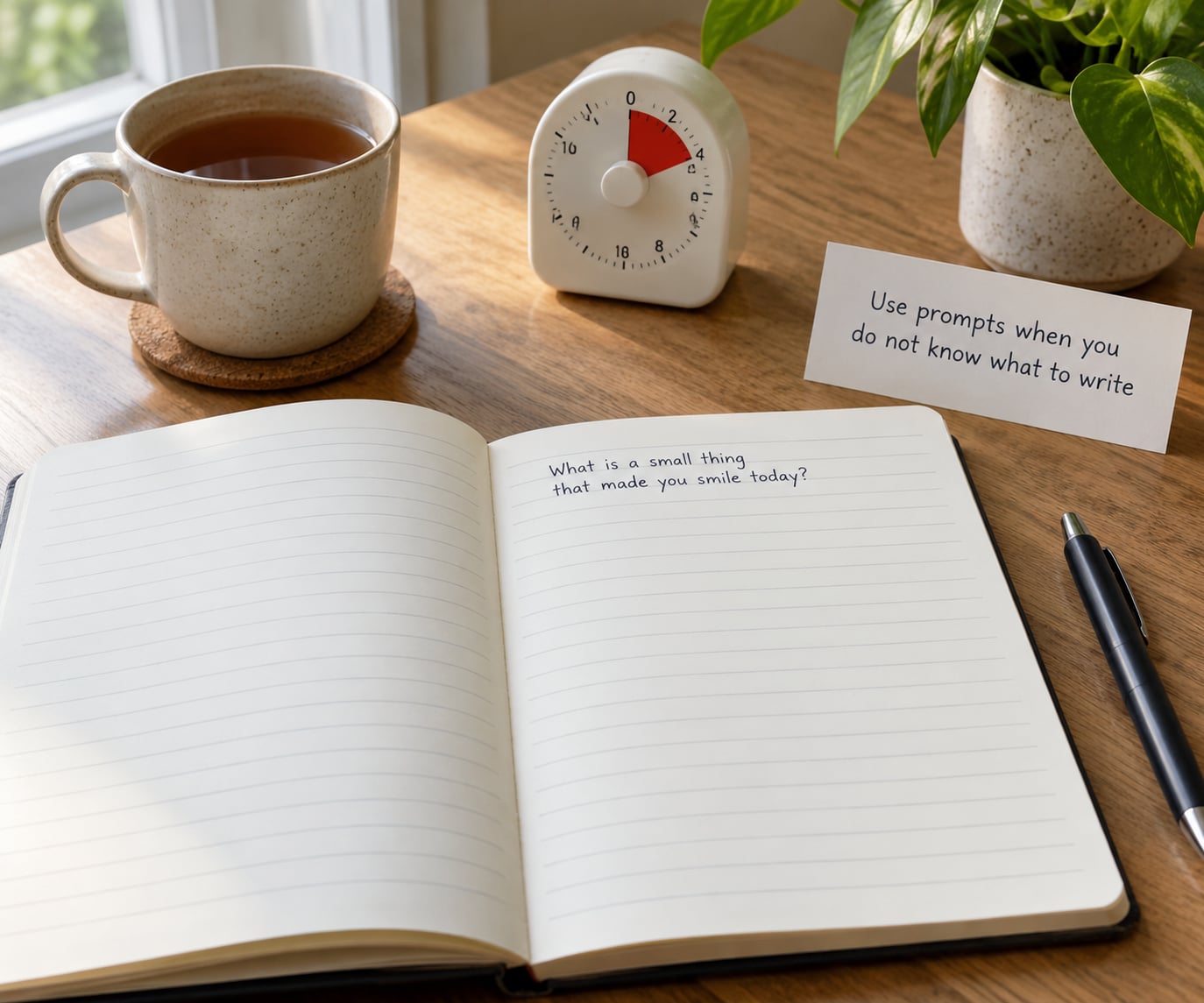
Blank-page paralysis is the most common reason people quit in week one. A prompt removes the blank page without removing the honesty. Answer briefly, write freely, or skip any prompt that does not fit the day.
For anxiety and racing thoughts: what is taking up the most space right now, and how would I say it to a friend? What is one fact, as opposed to one fear? What is the smallest next thing I could do about this in the next hour?
For low mood or a heavy day: what has been hard today that I did not say out loud? What did I need that I did not ask for? What is one thing still worth doing before bed, however small?
For anger or frustration: what did I expect, what actually happened, and where does the gap sit? What part of this is mine to act on and what is not?
For gratitude, skip the generic list. Try: one moment today I would not have noticed a month ago, one thing that made today lighter, one person who made my week easier without knowing it.
For self-criticism: if I were describing today’s version of me to someone I love, what would I say? What am I treating as evidence that I am failing that is actually just a hard day?
Carry one prompt forward for a week. Write it in the margin of the first page and answer the same question daily. The repetition is what turns scattered notes into something you can actually read later.
Write for ten minutes without editing yourself
Settle first. Put the phone in another room, put both feet on the floor, and take five slow breaths. If your mind is loud, run 5-4-3-2-1 grounding first: five things you can see, four you can touch, three you can hear, two you can smell, one you can taste. Grounding gives the body a signal that it is safe to start writing.
Name what is present, in one line. Something like: stressed, tight chest, dreading the call at four. Naming a feeling does not explain it or fix it, but it takes it out of the blur where it can grow.
Then write without stopping to correct yourself. This is stream-of-consciousness, often called freewriting, and it has been studied for decades as expressive writing. The research generally finds modest benefits that grow with repetition, particularly around processing difficult experiences, rather than an instant effect. People on journaling forums describe it more plainly: the benefit shows up after weeks, not after one good session.
What makes it work is cognitive offloading. A thought circling in your head stays fast and vague. On paper it slows down, becomes concrete, and turns into something you can look at from a small distance rather than something happening to you. It also stops the loop, which is why many people sleep better after writing before bed.
Stop when the timer ends, even mid-sentence. An unfinished entry is fine, because the point is not the artefact, it is the practice of returning tomorrow.
A real first entry can be this short: Tuesday. Tense all morning, shoulders up by my ears. Got snappy with my sister about dishes, felt bad after. Slept about five hours. Tomorrow: walk at lunch, phone off until three. That took four minutes and it is genuinely useful. Nobody on earth is grading your prose.
Review patterns without judging yourself
Once a week, usually Sunday evening, reread the last seven entries. Read them the way you would read a message from a friend having a hard week, not an examiner marking your work.
Look for four things: the same feeling appearing on the same kind of day, the time of day your entries cluster around, the situations that repeat, and the actions that helped. Write one line about what you noticed. That line is often the most valuable thing in the whole notebook.
One reframe that readers report as protective: my feelings are valid, but they are not always facts. It lets you keep the honesty while stepping out of the spiral.
On entries that are traumatic, painful or frightening, two rules. Do not reread them alone late at night, because old material resurfaces rather than sits still. And decide in advance what you want done with them: some people shred them, some keep them sealed and unread, some bring them to a professional. All three are fine. What is not fine is being ambushed by your own notebook.
If you are in crisis, or thinking about harming yourself, contact a doctor, a mental health professional, or emergency services. In the US you can call or text 988 for support.
Common Mistakes
Writing too much at the start. Twenty pages on day one builds a debt you cannot repay, and the gap is where habits die. Ten minutes, six days a week, beats a heroic Sunday and nothing until next month.
Treating the journal like a test. If an entry feels shallow you will start avoiding the book, and avoiding the book is the actual problem. One line counts. A sketch counts. A single word and the date count.
Forcing positivity. A gratitude journal is useful as one day a week. Run it on the bad days too and it stops being a practice and starts being avoidance, and you learn nothing about what you actually feel.
Rereading painful entries without a break. Ten minutes of the same worry written ten ways is rumination with better stationery. Notice the loop, stop, ground yourself with 5-4-3-2-1, and try listing facts instead of feelings for the next session.
Leaving the journal where someone can reach it. Privacy anxiety is a top reason beginners stop. Lock it, or code it, or use a locked app, and decide once where it lives rather than deciding each day.
Sharing entries online. Posting raw feelings for likes trades a private tool for a public performance, and it is hard to take back. Keep the mental health journal yours.
For consistency, attach the practice to something you already do: after the first coffee, before the shower, in the car before work. Five minutes after brushing your teeth at night is the version most people keep, because it needs no extra willpower and no extra time.
Track it on paper. A row of marks on a calendar is enough, and looking at a streak you have built makes quitting feel like throwing away something rather than skipping a day.
Frequently Asked Questions
How long should I journal each day when I am a beginner?
Ten minutes is enough for most beginners, and two minutes still counts on a hard day. Length matters far less than the habit of returning, so set a timer to give the session a clear end and stop when it rings. Writing without a defined stop is how ten minutes turns into an hour of overthinking. Extend later if ten minutes starts feeling too short.
What should I write about in a mental health journal?
Write about what is actually present: a feeling and where you notice it in your body, a worry that keeps returning, a conversation you have replayed all day, what you ate and how you slept, or one thing that went slightly better than yesterday. Specific beats profound. A single honest line about one tense afternoon is a real entry, not a failed one.
Is it bad to miss several days of journaling?
Missing days is normal and does not undo the practice. Almost everyone who keeps a journal long term has gaps, especially during busy or low weeks. Do not try to reconstruct what you missed and do not restart the notebook to get a clean streak. Pick up again with today’s date and one line. Chasing a streak is a fast way to convince yourself you have failed.
How do I keep my journal private and secure?
For paper, keep it somewhere only you open: a locked drawer, a coded case, or inside a bag rather than on a shared shelf. For digital notes, switch on the passcode or biometric lock, check whether cloud sync is on, and avoid apps that publish entries publicly by default. Keep the notebook out of a car and let nobody know the code or the location.
Can journaling replace therapy or other mental health treatment?
No. Journaling is a self-reflection tool, not a treatment. It can support you between appointments, help you spot patterns, and give you a private place to process a hard day. Therapy, medication and crisis services exist for reasons a notebook cannot meet. If you are struggling, talk to a doctor or mental health professional. In the US, call or text 988 for support.
What if journaling makes me feel more upset?
That happens, usually when a session turns into ten minutes of the same worry written ten ways. Stop and ground yourself instead: five things you can see, four you can touch, three you can hear, two you can smell, one you can taste. Next time try a lighter prompt or list facts instead of feelings. If low mood persists or deepens, tell a professional.
Conclusion
Here is the whole thing, starting today. Choose one private place to write, set a ten-minute timer, answer one prompt, and write whatever turns up without fixing it. Tomorrow, come back for five minutes only.
Then, once a week, read the last seven entries and note one pattern. That is how to start journaling for mental health in practice: small, private, and repeated, with no grade attached. Keep going for a few weeks before you judge it.
And keep it in its place. Journaling is one support alongside sleep, movement, people who check on you, and professional care when you need it. If you are in crisis or thinking about harming yourself, contact a doctor, a mental health professional, or emergency services. In the US you can call or text 988. Everything here was checked for 2026 and is general information, not medical advice.