An invoice that gets paid on time is usually a clarity problem, not a persuasion problem. Accounts payable cannot release money for a document that is missing a purchase order number, a due date, or a line item that matches the contract. Below is how to write an invoice that gets paid on time, field by field, followed by what to send when a due date slips past.
I have watched the same invoice sit in a queue for three weeks because it carried the client’s old company name. Ten minutes of care removes most of the delay.
Table of Contents
What You Need Before You Write an Invoice That Gets Paid on Time
Gather these before you open a template. If something is missing, find it now rather than leaving it off the document.
- Your business details. Legal business name, trading name if different, registered address, email, phone, and tax identifier (an EIN in the US, a VAT registration number in the UK, an ABN in Australia).
- The client’s billing details. Company name exactly as it appears on the contract, billing address, accounts payable contact email, and the purchase order number if the client raised one.
- A unique invoice number. Sequential and gapless, ideally a year plus a running number such as 2026-014. Never reuse a number.
- Line items. A description, quantity, unit rate, and line total for each piece of work or each product.
- Payment terms and a due date. Terms such as due on receipt or Net 14, and the calendar date payment lands.
- Payment instructions. Bank details or a payment link, plus the currency and the account name the payment must come from.
- Tax treatment. The tax rate applied, or a clear statement that no tax is charged.
- A tracking note. A simple spreadsheet with the invoice number, date sent, due date, amount, and status.
Two of those items deserve more attention than the rest. The purchase order number matters because larger companies cannot pay anything that does not reference their own paperwork. The account name matters because banks reject transfers that do not match the payee exactly, and a returned transfer is often treated as an unpaid invoice.
Step-by-Step: From Blank Page to Paid
Five steps, in this order. Roughly 20 minutes of work per invoice once the account details are stored in your template.
1. Add Your Business and Client Details
Put your business name and address at the top, the word “Invoice” and the invoice number underneath, then the client’s full billing details in a second block. Copy the client’s legal name and address character for character from the contract. A mismatch is the single most common reason an invoice bounces back from an accounts payable inbox.
Include your tax identifier on the face of the document. It looks like clutter, but it lets a client verify that the invoice is a real document from a real business, and it saves a round of verification emails for larger buyers.
2. Describe Each Service or Product So the Invoice Gets Paid
Each line item should let someone who was not in the room understand what they are paying for. Use a noun, a quantity, a unit rate, and a line total.
| Line item | Quantity | Rate | Amount |
|---|---|---|---|
| Twelve coaching sessions, 60 minutes, completed 6 to 24 September | 12 | 120 | 1440 |
| Progress notes and session recordings delivered | 1 | 180 | 180 |
| Subtotal | 1620 | ||
| VAT charged at 20 percent | 324 | ||
| Total due | 1944 |
Compare that with a line reading “Coaching services, September”. It tells nobody which client received what, how many sessions, or whether the work is finished. Payment gets held while someone goes hunting for the contract to check it.
If you bill by the hour, attach a timesheet or a breakdown by date and task. Freelancers report that hourly invoices get disputed far more often than fixed-fee ones, usually because nobody can verify the hours. State your rounding rule on the invoice: for example, time is recorded in 15-minute blocks.
State the currency explicitly on every invoice, especially for international clients. Cross-border payments also carry conversion costs and correspondent bank fees, so say whether those are yours or the client’s.
3. State the Due Date and Payment Terms
The due date is the field most often left vague. Write the terms and the resulting calendar date together, so the client never has to count days.
| Terms | What it means | Who it suits | Cash-flow risk |
|---|---|---|---|
| Due on receipt | Payable immediately | Small local clients, direct work | Low if agreed upfront |
| Net 7 | 7 days from the invoice date | Startups, small agencies, coaching clients | Medium |
| Net 14 | 14 days from the invoice date | Consultants and contractors | Medium |
| Net 30 | 30 days from the invoice date | Businesses with formal accounts payable | Higher |
| Net 60 | 60 days from the invoice date | Large companies and public-sector work | Highest |
Copy these lines and adjust the numbers to match your contract:
“Payment is due within 14 days of the invoice date, that is by 24 October. A late payment fee of 8 percent of the outstanding balance applies to any amount received after the due date, as agreed in our contract dated 3 September.”
“Pay by bank transfer to the account below, or use the payment link on this invoice. Payments must reference invoice 2026-014 so we can match them to your account.”
“Pay within 10 days and take 5 percent off the total.”
Late fees and interest rules vary by country and by the terms you signed, so check what is enforceable where you work before you rely on one. Two habits protect you either way: put the late fee in the contract before the work starts, not on the invoice afterwards, and send it to clients you want to work with again.
4. Number, Proof, and Send the Invoice
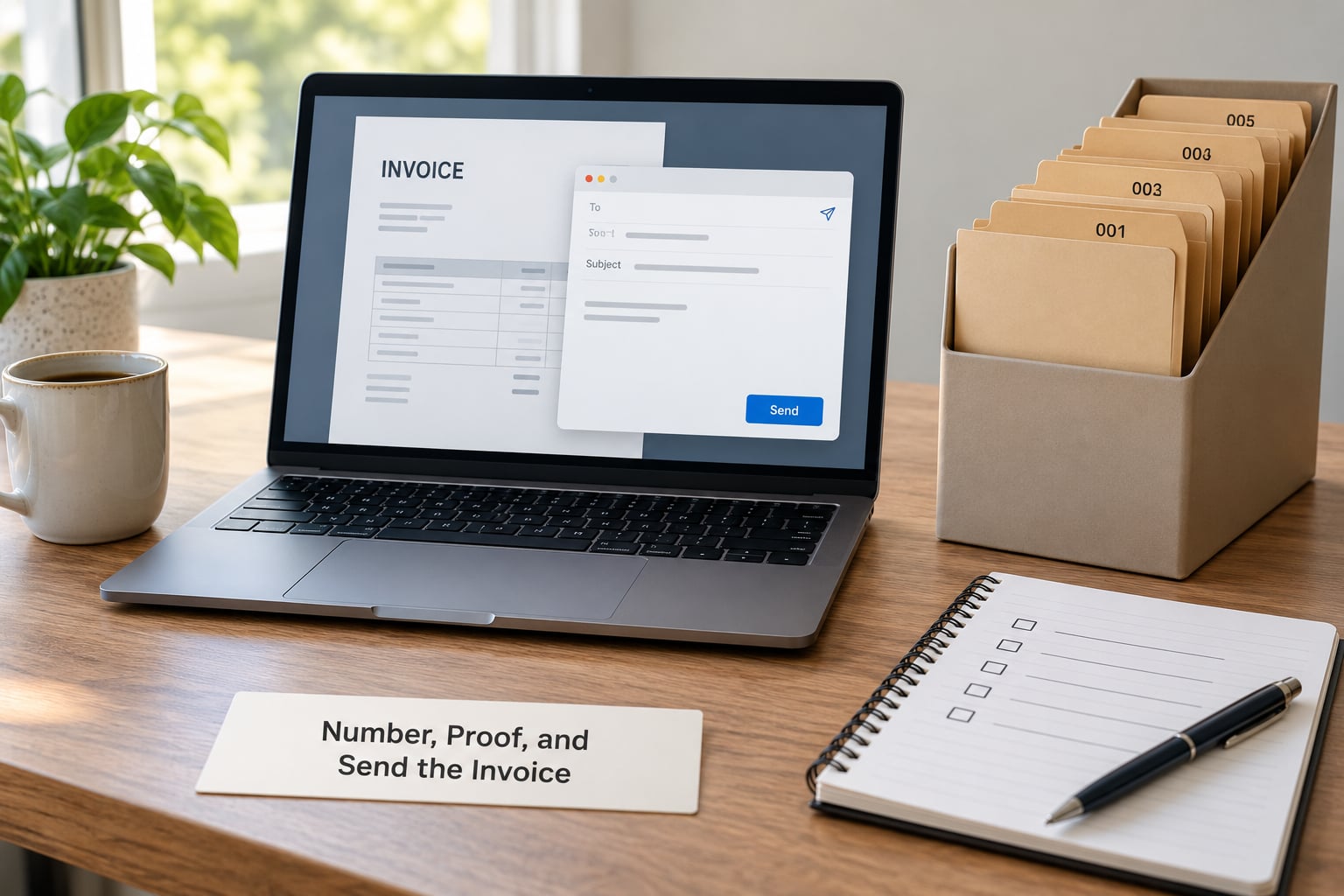
Number invoices sequentially and never reissue the same number, even for a correction. If you need to amend a total, send a credit note that references the original number and issue a new invoice with the next number in the series. Gaps in numbering make tax records harder to defend.
Then proof it like you would proof a contract. Check the arithmetic, the date, the currency, the account name, and the email address the payment will come from. Read the description line from the client’s point of view: would their finance team recognise this charge from the contract?
Most people looking up how to write an invoice that gets paid on time want a checklist rather than a lecture. This is the checklist: one unique number, the client’s exact legal name, itemised lines, both the terms and the calendar date, and payment details on the face of the document.
Send it as a PDF with a payment link or card option on the face of the document. Small-business owners consistently point to the pay-now route as the biggest speed lever, ahead of anything else on the page. Attach the PDF rather than pasting text into the email body, so nothing reflows or disappears on the client’s screen.
Use the channel your contract specifies, and match the subject line to the invoice number: “Invoice 2026-014, due 24 October”. Then send it to the accounts payable address, not to the person who commissioned the work, and cc the contact who knows the project.
5. Track the Due Date and Follow Up Professionally
Put the due date in your calendar when you send the invoice, not when it is late. Most payment delays are solved by one short, factual message on the day after the due date.
Follow a fixed schedule rather than improvising, which is what freelancers on forums tend to recommend:
- Day 1 after the due date. A short reminder. “Invoice 2026-014 for 1944 was due on 24 October. Here is the payment link again.” No apology, no explanation, no emotional weight.
- Day 7 of silence. Ask whether the invoice reached the right person and whether they need anything from you to release payment.
- Day 14. Apply the late fee from your contract, restate the total, and offer a payment plan if the amount is large.
- Day 30. Send a final notice that states you will refer the debt to a collection agency or a small claims process, and mean it.
Before escalating, check the contract for a “payment on satisfactory completion” clause. Practitioners on business forums point out that this is often the real reason payment is being held, and no reminder will fix it. If the client disputes a charge, ask them to name the disputed line item in writing, send your evidence, and correct only what is genuinely wrong by credit note.
Small claims procedures and debt collection rules differ by country and state, and many jurisdictions require a formal letter before you can file. Talk to a local adviser before sending a final notice.
Common Mistakes That Delay Payment
These come up again and again in invoicing threads, and each one has a simple fix.
- Vague line items. “Design services” gives the client nothing to approve. Name the deliverable, the quantity, and the date it was delivered.
- No due date. If the document does not say when payment is expected, a late payer has a defence. Write both the terms and the calendar date.
- Missing purchase order number. Accounts payable systems reject unmatched invoices. Ask the client for their PO number before you invoice.
- Inconsistent numbering. Duplicated or out-of-order numbers break your records and the client’s. Use a simple sequential series and never recycle one.
- Payment details buried in an attachment. If the bank details are not on the invoice face, the invoice is forwarded to someone else to read. Put them in the body and add a pay link.
- Late fee added only after the fact. A surprise charge invites an argument. Agree the fee in the contract and reference that clause on the invoice.
- Silence, then escalation. Going from nothing to a final notice in one step damages the relationship. Follow the day 1, day 7, day 14 schedule.
- Hourly billing with no timesheet. Attach the hours, the task breakdown, and your rounding rule so nobody has to guess.
Frequently Asked Questions
How long should I give a client to pay an invoice?
Standard terms are Net 14 to Net 30 from the invoice date, and Net 30 suits businesses with a formal accounts payable process. Shorter terms such as Net 7 suit small clients and direct work, while Net 60 fits large companies with slow approval chains. Whichever you use, write the terms and the resulting calendar date on the invoice so there is no room to argue about when the clock started.
Should I charge a late fee if a client pays late?
Yes, as long as you agreed it in writing before the work started and your local rules allow it. A fee of roughly 8 percent of the outstanding balance, or a simple daily interest rate, is proportionate and easy to defend. Put the clause in the contract, reference it on the invoice, and apply it the same way every time rather than as a one-off reaction to a client who annoys you.
What payment details should I include on an invoice?
Include the account holder name, bank name, account number or IBAN, sort code or routing number, SWIFT or BIC for international payments, and a payment link or card option if you have one. Also state the currency and ask that the payment reference include your invoice number. Transfers that do not match the payee name exactly are frequently returned, which then looks like non-payment.
How do I follow up when an invoice is overdue?
Send a short, factual reminder the day after the due date. If there is no response within a week, ask whether the invoice reached the right person and whether they need anything from you to release payment. After two weeks, apply the agreed late fee and offer a payment plan on a large balance. Keep every message brief and businesslike; politeness and clarity get results far better than frustration.
Do I need to send a new invoice for late payment?
No. Keep chasing the original invoice number, because that is what your records, your contract, and the client’s accounts payable system are linked to. If the amount changes because a late fee applies, send a credit note that references the original invoice number and then issue a new invoice for the corrected total with the next number in your sequence. Never reuse or edit a number that has already been issued.
Start with one invoice today. Write the due date, add the client’s purchase order number, put the payment details on the face of the document, and set a calendar reminder for the day after it is due. Those four habits do more for how to write an invoice that gets paid on time than any chasing technique that comes later.