
Hiring your first contractor means engaging a self-employed freelancer to do a defined piece of work for you: write the scope down, agree how you will pay, collect a W-9 before the first invoice, sign a short written agreement, and send a Form 1099-NEC if you paid that person 600 dollars or more during the calendar year. Done properly, the whole thing takes two to four weeks. Done by feel, it takes months, and the delay is almost always something nobody said out loud.
One thing to clear up first. People searching how to hire your first contractor want two very different jobs. Most want a freelancer or specialist for their business — a bookkeeper, a designer, a developer, someone who invoices them and handles their own tax. The rest want a licensed trade contractor for their house — a roofer, a deck builder, an electrician — where licensing, insurance, permits and lien waivers decide the outcome. This guide covers both, and I flag which rules belong to which.
If you take one thing from this, take the ordering: scope, budget, sourcing, estimates, references, agreement, management. Seven steps. Each one is cheaper to do now than to fix later.
Table of Contents
- What You Need
- How to Hire Your First Contractor: Step by Step
- Step 1: Define the Job Before You Contact Contractors
- Step 2: Set a Realistic Budget and Decision Criteria
- Step 3: Find and Screen Qualified Contractors
- Step 4: Request and Compare Written Estimates
- Step 5: Check References, Reviews, and Portfolio Work
- Step 6: Interview, Verify, and Negotiate the Best Candidate
- Step 7: Sign the Agreement and Manage the Project
- Common Mistakes to Avoid When You Hire Your First Contractor
- Frequently Asked Questions
- Conclusion: Start With a Written Scope
What You Need
Before you contact a single contractor, put seven things on paper. This is the boring part, and it is also the part that makes the rest of the process fast.
- Project brief. One paragraph on why the work exists and what a good outcome looks like in plain language.
- Itemized scope. Every task, material, dimension, quantity and exclusion written down, plus what you are explicitly not asking for.
- Budget range. A floor and a ceiling you can live with, not a single hopeful number.
- Schedule. Start date, hard deadlines, and which dates are immovable.
- Contractor criteria. The three things that matter most to you, so you are not comparing on vibes.
- Reference questions. Five questions you will ask past customers, written down so you ask all of them the same way every time.
- Document folder. A single place for your scope, estimates, correspondence, signed agreement, W-9 and payment records. For a business hire that means a W-9 with the taxpayer identification number, proof of insurance, references, and any signed agreement.
The itemized scope is the one that changes everything downstream. Experienced contractors tell clients to provide all relevant details up front and ask for a quote based on them, and the reason is self-interest: a contractor pricing a vague job is guessing, and guesses end up as change orders or vanished margins.
Give every contractor the same written scope and you get estimates you can actually compare. Give five contractors five different phone descriptions and you get five numbers that mean five different things.
How to Hire Your First Contractor: Step by Step
Seven stages, from deciding the work exists to walking the finished job. The sequence matters more than any single stage — comparing contractors before you have standardized the scope is the most common and most expensive mistake in the whole process.
Step 1: Define the Job Before You Contact Contractors
A written scope has seven parts: the existing condition, the desired result, the materials, the dimensions, the exclusions, site access, and the deadline. Miss one and you will hear about it later, usually at the worst possible moment.
Here is what vague versus specific looks like. “I need help with my bookkeeping” tells a bookkeeper nothing, so the quote is a guess with padding. “Reconcile this year’s QuickBooks file for a small design studio, fix the uncategorized transactions from the first two quarters, produce monthly P&L by department, and deliver it as a spreadsheet plus a short written summary by the 20th” tells them exactly what to price.
For home work the gap is even wider. “Redo the guest bathroom” can mean a 2,000 dollar refresh with the existing plumbing or a full gut remodel with new lines, and the two quotes will differ by five figures with neither contractor wrong. Write down the existing condition (1980s cast-iron plumbing, original electrical, plaster walls) and the desired result (shower over the tub, new vanity, code-compliant GFCI outlets) and the numbers become comparable.
Exclusions are the part people skip and regret. If you are not replacing the toilet, write that down. If you do not want anyone cutting into a load-bearing wall, write that down. Every assumption you fail to write becomes a line item someone else made for you.
Include access and logistics too: parking, a working bathroom on site, pets, working hours, who moves the furniture. That is where residential jobs quietly pick up thousands of dollars.
Step 2: Set a Realistic Budget and Decision Criteria
Most first hires fail on money because nobody separated the labor from the materials. Split your number in two before you talk to anyone.
Start with what you can actually spend, not what you hope the job costs. Then add a contingency of about 10 percent for anything hidden — a rotted joist, a code violation, a wall that turns out to carry more load than it looks like it does. For a defined business project the contingency can be smaller, but keep one anyway. Unknown conditions are not a failure of planning; they are the normal condition of construction work.
Now write your decision criteria before the first estimate arrives, in priority order. Mine is usually: relevant experience on this exact type of job, then communication, then schedule, then warranty, then total price. Put price last and the comparison becomes much easier, because price is the only criterion that is always available and therefore the easiest one to over-weight.
The lowest bid is not automatically the best offer. It is often the bid that quietly left out the thing you most cared about — disposal, patching, permits, the second coat of paint. Sometimes it is just a bid from someone who has not priced this work before and will discover the gap mid-job, and that discovery becomes your change order.
What you do with the lowest bid is not ignore it. You ask what makes it lower. A clear, specific answer is reassuring; a vague one is a warning.
Step 3: Find and Screen Qualified Contractors
Build a list of eight to ten candidates and deliberately mix your sources. Referrals from people whose work you have seen are the highest-signal source, and the advice in r/FirstTimeHomeBuyer about simply asking your neighbours who they used outperforms any directory. For business hires, verified profiles on contractor marketplaces and professional associations give you something a word-of-mouth tip cannot: a documented work history.
Then screen before you interview. For home improvement, r/Decks threads converge on the same consensus list: check the license, check bonding, check insurance, get multiple bids, and require a detailed statement of work for materials. Trade licensing is state-specific, so search your state licensing board rather than trusting a general claim.
Ask every candidate the same seven questions:
- Are you licensed for this work in this state, and can you pull the license number?
- Do you carry general liability insurance, and how much? For trade or site work, do you carry workers’ compensation?
- Have you done this exact type of job in the last two years, and can I see two recent examples?
- Who pulls the permits, and who is responsible for scheduling the inspections?
- Do you subcontract any part of this, and who is responsible for their work?
- What is your warranty on labor, and is it in writing?
- Do you use your own employees and equipment, or do I have to provide anything?
That last question sounds small and is not. A genuine independent contractor brings their own tools, insurance, taxes and judgment. Someone who asks you for your company laptop, your staff badge and a fixed 9-to-6 schedule is drifting toward employee status fast, and that drift is your problem, not theirs.
Step 4: Request and Compare Written Estimates
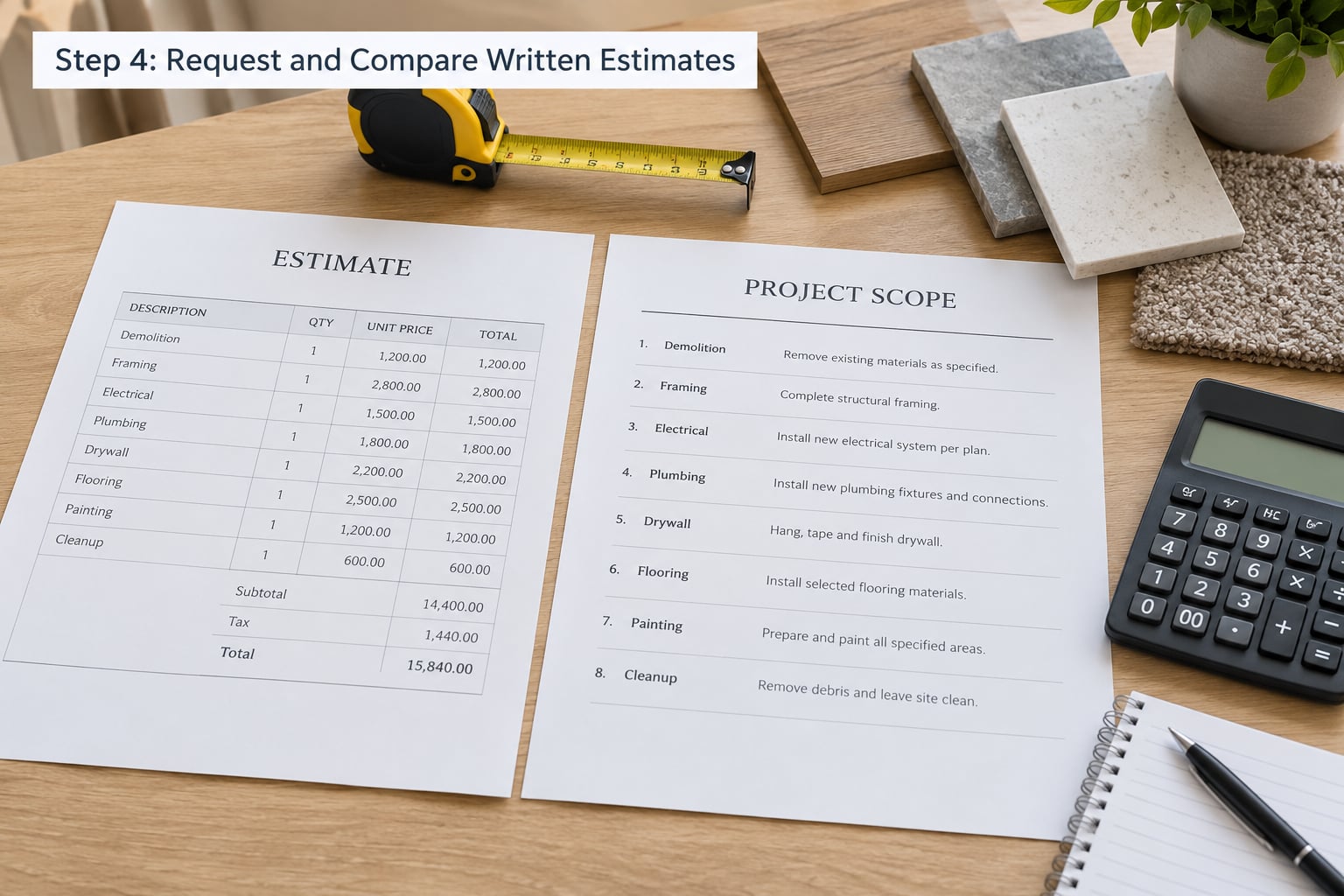
Send every candidate the same short message so the responses are comparable:
“Attached is the scope for [project]. Please send a written estimate broken out by labor, materials, permits, disposal and any exclusions, with your availability and warranty. Three questions for you: [question one], [question two], [question three]. I need all estimates by [date].”
Comparing is where discipline pays. Check every estimate for the same ten things:
- Does the scope match mine, line by line?
- Are quantities stated, or just lumped into a single number?
- Which materials, and which grade or brand?
- Is labor separated, and is the crew yours or a sub’s?
- Who pulls permits and handles inspections?
- Is demolition, hauling and disposal included?
- What is the start date and the duration?
- What is the payment schedule — deposit, milestones, final?
- How are change orders priced and approved, in writing?
- What warranty applies, and for how long?
Two estimates that differ by 30 percent often turn out to include the same work, described differently. One lists “framing and drywall patch” as a line and another buries it inside “general carpentry.” Normalize before you compare: build a column for the same categories across all bids and move each number into it.
Then normalize the risks too. A bid with no disposal allowance and a 20 percent down payment has a different risk profile from one that includes both, even when the totals are identical.
Step 5: Check References, Reviews, and Portfolio Work
References are where first-timers get fuzzy, because most people do not know what to ask. Ask these five, in this order:
- Did they show up when they said they would, and did they communicate without chasing?
- Did the final cost match the estimate, and if not, what changed?
- How did they handle a problem or a change request once work was underway?
- What was the cleanup and site condition like at the end of each day?
- Would you hire them again, and what is the one thing you would do differently?
That last question is the useful one. It gets you the thing they were too polite to volunteer, which is usually a pattern you would rather hear now than in month two.
Actually call. A reference that is a friend of the contractor, answers only with praise, or cannot remember the project is not a reference — it is a favour. Two solid, detailed conversations are worth more than fifteen one-line reviews, and the phone calls are the step most people skip when they search how to hire your first contractor.
For portfolio work, look for recent projects of the same type and then ask about them the way a client would. Look at a full project rather than a hero shot: joints, edges, the messy corners behind finished surfaces. Vague reviews with no job description, stock photos, a portfolio that is five years old, or a refusal to let you speak to anyone are all reasons to move on.
Step 6: Interview, Verify, and Negotiate the Best Candidate
A first interview is not a vibe check. It is verification with a conversation attached. Confirm identity and that the person on the call is the person who will do the work, check the insurance certificate and license number against the issuing body yourself, confirm references independently, walk through the schedule week by week, and ask what happens if a subcontracted part falls through.
For a business hire, also settle the paperwork in the room: a W-9 before any payment, the entity or sole proprietor name, whether they carry professional liability coverage, and how they invoice you.
Negotiate on scope and terms, not on the number. “I cannot meet that total, but I can drop the second phase and revisit it in 90 days” is a real negotiation. “Take 10 percent off” just moves the shortfall into whatever gets cut later.
On payment: never pay in full before the work is finished and accepted. Typical residential structures are a deposit at signing, progress payments at defined milestones, and a final payment after the walkthrough and after you receive lien waivers where relevant. For business work, monthly or milestone invoicing against a signed statement of work keeps both sides clean.
Paying cash with no invoice and no W-9 is the one option with no upside. It creates a paperwork problem, it complicates your own deductions, and it is the exact scenario experienced 1099 workers describe as a warning sign of a client who will not pay on time.
Step 7: Sign the Agreement and Manage the Project
Sign before work starts, not after something goes wrong. The agreement should carry all of this:
- Both parties, identified precisely, including the contractor’s legal entity or sole proprietor name
- The detailed scope, attached as a document both signatures cover
- An itemized price and the payment milestones
- Specified materials and who supplies them
- Start date, duration and deadlines
- Who pulls permits and who is responsible for inspections
- The change-order process: written request, written approval, priced in advance
- Insurance requirements and evidence
- Subcontractor disclosure and responsibility
- Warranty period and what it covers
- Cancellation terms on both sides
- Dispute process and governing jurisdiction
For a business hire, add the clause the IRS and state agencies care about most: a plain statement that the relationship is an independent contractor arrangement, not employment. Also nail down intellectual property ownership, because absent a work-for-hire clause a contractor can keep ownership of what they created for you, and confidentiality terms covering your customer data, pricing and credentials.
Management is mostly boring consistency. Set a communication cadence on day one — a weekly check-in call works better than constant pings. Keep one channel for instructions and decisions so there is a record. Keep photos or written notes of daily progress on any job where scope matters. Protect access logistics. Confirm cleanup is part of each day, not the last day.
Then do the final walkthrough properly before releasing the last payment: everything on the scope list plus what was added, warranties and documentation in one folder, permits and inspection sign-offs collected, lien waivers where applicable. Most disputes end here, in a ten-minute conversation, when nobody is angry.
Common Mistakes to Avoid When You Hire Your First Contractor
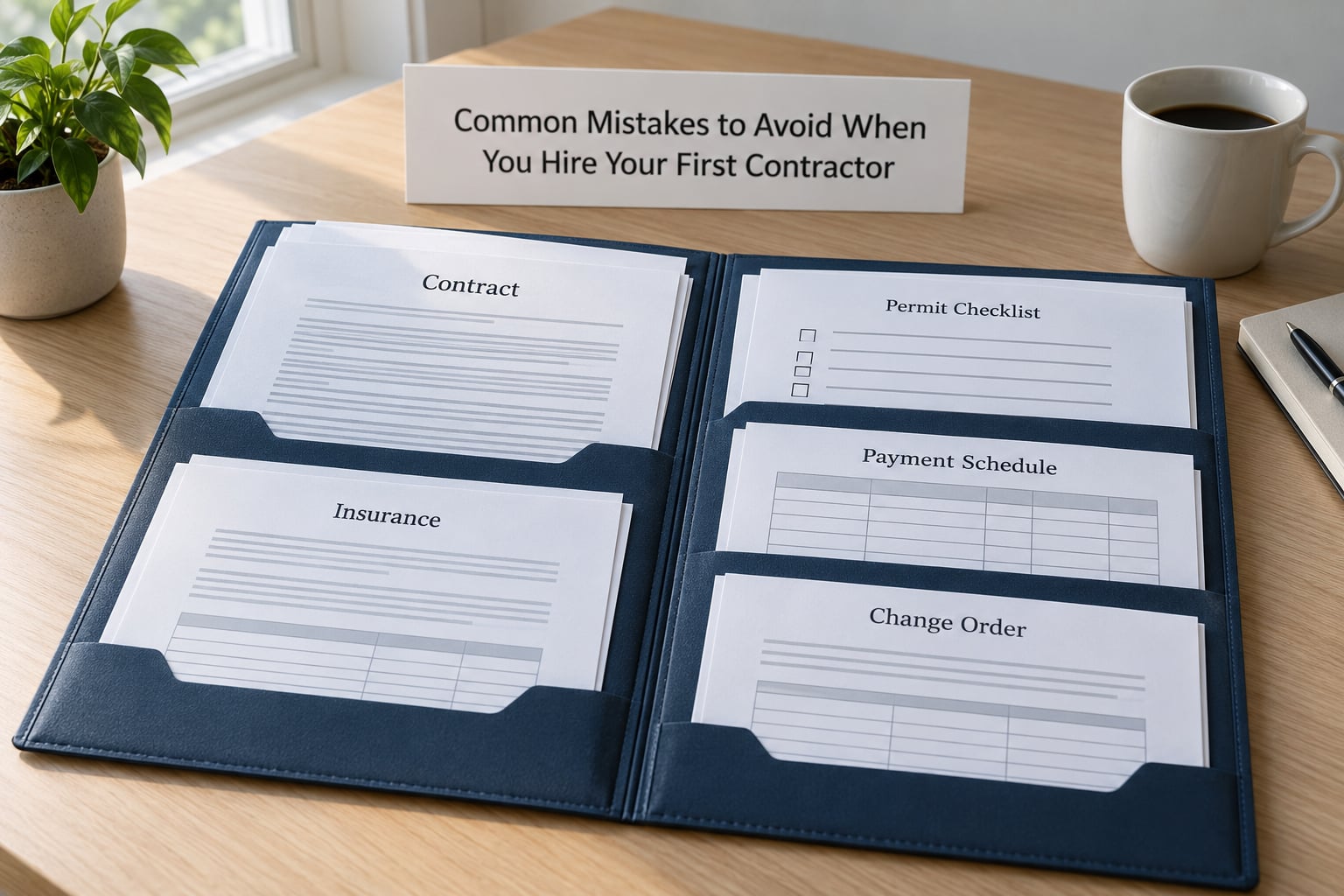
Almost every expensive first-hire story involves one of these.
Starting without a written scope. The fix: do not request a single estimate until Step 1 is finished. The tip: the scope document is worth more than any template agreement, because it is the thing that ends every argument about what was included.
Comparing totals without normalizing the quotes. The fix: build the same category columns for every bid before you look at the bottom line. The tip: ask two shortlisted candidates to walk you through their estimate line by line. The differences explain themselves out loud.
Choosing purely on price. The fix: rank your criteria in writing before the estimates arrive and use them in order. The tip: if a bid is far below the others, the question is never “why is it so cheap” but “what is not in it.”
Skipping references. The fix: require two references and call both without the contractor on the line. The tip: ask what changed on the final invoice. That single question separates most candidates.
Paying too much upfront. The fix: tie payments to completed, inspectable milestones and hold the balance until the walkthrough. The tip: no credible contractor objects to a final payment after accepted work. The ones who do are telling you something.
Accepting verbal changes. The fix: no work changes and no money moves without a written change order that both sides sign. The tip: say out loud at kickoff that this is the rule, so nobody is offended later.
Leaving the paperwork until January. The fix: collect the W-9 and signed agreement before the first payment, and set a calendar reminder in mid-January for year-end reporting if you paid anyone 600 dollars or more. The tip: pay contractors on a schedule you set, not one you promise over email.
Frequently Asked Questions
How many contractors should I contact for a home project?
Get three to five written estimates for a normal residential project, and at least three for anything involving structural work, electrical, plumbing or permits. Fewer than three leaves you with no basis for comparison; more than five wastes weeks chasing quotes you will not use. Send every one of them the identical written scope so the numbers mean the same thing. For smaller business hires, two strong candidates plus a paid test task is usually enough.
Should I hire the contractor with the lowest estimate?
Not automatically. The lowest bid is often the bid missing something, and you will find out which something halfway through the job. First check whether the scope, materials, permits and disposal are actually included and identical. Then weigh experience, communication, insurance and warranty. If the lowest bid matches every line of a higher one and the contractor has done this work before, it is simply the better offer.
How much should I pay a contractor upfront?
Keep it modest and tie it to something real. Residential jobs commonly start with a small deposit at signing and progress payments tied to completed stages, with the balance released after the final walkthrough. Never pay the full amount before the work is finished and accepted. For business freelancers, monthly or milestone invoicing against a signed statement of work works well and keeps both sides’ records clean.
Do I need a written contract when hiring a contractor?
Yes. For home work, a written contract and a detailed scope protect you from scope creep, surprise charges and lien claims, and they are what let you enforce a warranty. For a business contractor, the written independent contractor agreement is your main protection on classification, payment, intellectual property, confidentiality and termination. Keep it short, attach the scope as a signed page, and have both copies in the same folder before work starts.
How long does it take to hire a contractor?
Two to four weeks is realistic for a small business hire, and three to eight weeks for residential work once permits, scheduling and weather are involved. The longest part is almost always finding and vetting good candidates, not signing anything. Add time for a paid test task if you want to be sure before committing. Projects that get signed in a day usually move slowly later, because nobody had time to define the scope.
Conclusion: Start With a Written Scope
The first half of how to hire your first contractor takes an hour, not a budget. Write down what you want done, what you can spend, and the three details that matter most to you, and you will have something you could send to a contractor tomorrow morning.
From there, follow the order: three comparable written estimates off the same scope, two reference calls that you actually make, and a signed agreement that covers the scope, the price, the milestones and the paperwork. Most first hires go fine. The ones that go badly almost always skipped one of those three things, and you now know which one.
This is general information about hiring a contractor, not legal or tax advice. Licensing, classification and reporting rules vary by state and change over time, so confirm the specifics that apply to your project with your state labor department or a qualified accountant before you sign.