
Knowing how to become a better listener in a marriage is mostly a matter of structure: pick a calm moment, drop your own agenda, reflect back what you actually heard, and only then think about solutions. Most couples already know they should listen better, so the gap is rarely knowledge. It is the handful of repeatable habits that survive a bad day.
This guide is for married or long-term couples who feel unheard, who are tired of handing out advice nobody asked for, or who want to cut the number of arguments that end with somebody replaying the conversation at 2am. It is not marriage therapy, and it will not fix a relationship where something bigger is going on. It will change how a single conversation goes tonight.
Allow about 20 minutes of practice to read this, then try one step before anything else. The steps below work in any order, but they build on each other, and the first three do most of the heavy lifting.
Table of Contents
- What You Need
- Step-by-Step: How to Become a Better Listener in a Marriage
- 1. Create a calm moment for the conversation
- 2. Set an intention to understand, not to respond
- 3. Listen for feelings and needs underneath the words
- 4. Reflect what you heard without interrupting
- 5. Ask clarifying questions instead of making assumptions
- 6. Validate the emotion before discussing the solution
- 7. Follow through and review the conversation later
- Common Mistakes
- Frequently Asked Questions
- What are the 7 clear signs that someone is a bad listener?
- What are the qualities of a good listener?
- Why do I have a hard time listening to my partner?
- What to do when your spouse never listens to you
- Is listening considered a skill?
- How do I listen when my spouse is upset and I have no idea what to say?
- Start With One Better Question Today
What You Need
You need very little. A shared quiet moment, an agreement that both of you are willing to honour, and a way to remember what was said once the conversation is over. That is the whole list.
Find a time when neither of you is cooking dinner, driving, on a work call, or about to walk out the door. Kitchen-table conversations at 8pm with a toddler at your elbow are not listening conversations. They are triage.
Agree out loud on a simple signal for “I am listening right now.” Some couples use “Do you want me to just listen, or do you want help?” Others use a phrase like “tell me more” as a hand-off so the other person knows the floor is theirs.
Keep a pen nearby or a notes app open. Not to catch mistakes, but because people say the important thing in the last thirty seconds, and neither of you will remember it in the morning.
Step-by-Step: How to Become a Better Listener in a Marriage
Better listening is a repeatable practice built from attention, reflection, empathy, clarification and follow-through. Here are the seven steps, in the order that tends to work best in a real conversation.
1. Create a calm moment for the conversation
Choose a window when neither of you is rushed, distracted, or emotionally overloaded, and open it by naming what you are about to do. “I have ten minutes and I want to hear how your day went” does more work than any technique that follows.
If you notice yourself scrolling, half-listening while loading the dishwasher, or mentally drafting your reply, say so out loud instead of pretending. Most bad listening starts as a small dishonesty about attention, and naming it resets the conversation faster than pushing through.
You will know this step worked if your spouse starts saying more than the summary line they came in with.
2. Set an intention to understand, not to respond
Approach the conversation as curiosity rather than arbitration. The goal is not to win, agree, or produce a plan in the first ten minutes. The goal is to find out what your spouse actually means.
This is harder than it sounds, because most of us enter a spouse conversation already drafting a response. A common fix is to listen to learn something specific rather than to wait for your turn: what happened, who was involved, and what they wish had been different.
Ask yourself one question before you open your mouth: what would I need to hear for this to be true, even if I disagreed? Holding that frame keeps defensiveness from setting up shop in your chest.
3. Listen for feelings and needs underneath the words
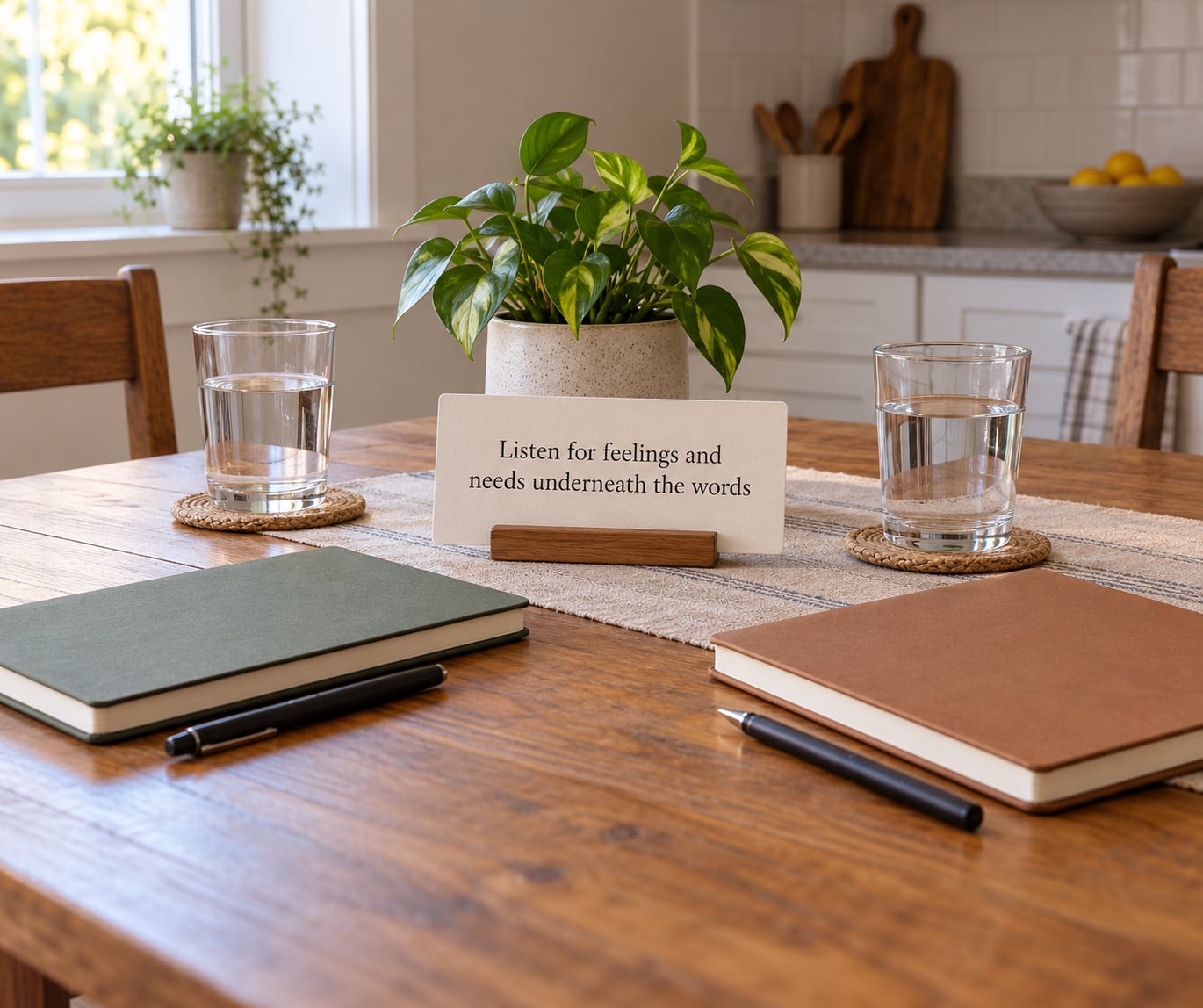
What people say is rarely all they mean. “You never asked me” is usually about being left out, not about a missing question. Watch tone, shoulders, eye contact and pace, because the feeling arrives before the sentence does.
Underneath most complaints sits a need: to be respected, to be included, to not carry everything, to be told the truth earlier. Listening for the need stops you from arguing with the symptom.
Aim for one honest reflection per minute of talking. If you cannot tell what the need is, that is normal, and it is a good reason to ask rather than guess.
4. Reflect what you heard without interrupting
Summarise the main point in your own words and check whether you got it right. “So the deadline moved twice and nobody told you, and you found out in front of the client” gives your spouse a chance to correct you in one sentence instead of starting over.
Use the reflective phrases that keep a conversation open: “Tell me more about that,” “What I hear is,” and “Have I got that right?” None of them are fancy. They work because they hand control back without arguing.
Let silence sit for a few seconds after a hard sentence. The urge to fill it comes from your own discomfort, not from theirs, and a pause often produces the more honest half of the story.
5. Ask clarifying questions instead of making assumptions
Questions keep you out of the mind-reading trap. Open ones like “What was that like for you?” or “What do you need from me right now?” get better answers than “Why did you do that?”
Watch the tone. Three questions in a row can sound like an interview, and an interview is not curiosity. Follow a question with a small disclosure of your own, and the exchange stops feeling like an interrogation.
If your mind jumps to a conclusion, park it. “Let me make sure I understand” buys you the time to check instead of defend.
6. Validate the emotion before discussing the solution
Acknowledge the feeling first, then ask permission to offer input. “That sounds exhausting, and I can see why you’d be frustrated” does not require you to agree with the conclusion.
The step most people skip is asking. “Do you want me to just listen, or do you want me to think about this with you?” is a phrase worth memorising, because it targets the most common complaint couples bring up, which is advice they never requested.
Validation is not agreement. You can say a feeling makes perfect sense and still think the plan is wrong, and saying both out loud is more honest than picking one.
7. Follow through and review the conversation later
Listening that leaves no trace does not build trust. Before you move on, summarise what you agreed: who does what, and by when. Even a two-line note that evening protects both of you from the version that gets retold a week later.
Check in again the next day. A short “did you get a chance to do the thing we talked about?” shows the conversation mattered, and it is the cheapest habit on this list.
John Gottman’s research on couples describes small everyday moments as turning points, where the partner either turns toward the bid for attention or away from it. Researchers and clinicians often suggest a behavioural snapshot of a real conversation, with each partner tracking their own responsiveness for a couple of weeks, since a recording-style review is far more useful than memory. If patterns like constant interruption, eye-rolling or contempt keep repeating despite effort, that is worth taking to a marriage counsellor rather than a self-help book.
Common Mistakes
Almost every couple who struggles with listening is making at least one of these five moves, and each has a specific correction.
Rehearsing your reply. You stop hearing at about the eight-second mark and start assembling your response. Correction: decide before the conversation starts that you will not respond until you can summarise their point in one sentence.
Interrupting to ask questions. It feels like engagement, but it splits the story in half. Correction: write the question down, ask at the end, and notice how often the answer is not what you predicted.
Fixing instead of feeling. A suggestion lands as a verdict, and the person who raised the problem stops talking entirely. Correction: ask the hand-off question from step 6 before you offer anything.
Minimising. “You’re overreacting,” “It’s not that serious,” and “At least nothing happened” all tell the same thing: your reaction is too big. Correction: replace the ranking with a name for the feeling.
Unsolicited advice and one-upmanship. Turning every confession into a contest over who has it worse guarantees the topic closes. Correction: if the story is not a request, respond to the story.
A sixth pattern deserves naming because so many couples recognise it instantly. People often call it woodpecker syndrome, the habit of peeking in with “but” the moment a partner reaches the end of a sentence, so the conversation becomes three side arguments instead of one conversation. The fix is a rule you both agree to in advance: one person speaks, the other responds, then you swap.
Frequently Asked Questions
What are the 7 clear signs that someone is a bad listener?
Seven signs show up most often: rehearsing replies instead of hearing, interrupting with your own story, advising when nobody asked, minimising the other person’s feelings, bringing up a phone or a screen mid-conversation, asking questions that sound like an interrogation, and walking away mentally while still nodding. Any one of them on a bad day is nothing. All seven, most days, is a communication pattern worth naming out loud, without blame, the next time the two of you are calm.
What are the qualities of a good listener?
The core qualities are full attention, patience, curiosity, humility, and the ability to reflect feeling without jumping to a fix. A good listener puts the phone down, lets a silence sit, restates what they heard to check accuracy, and can hold a feeling that is uncomfortable without rushing to resolve it. Underneath those, the real quality is humility: being willing to discover something you did not expect instead of confirming what you already assumed.
Why do I have a hard time listening to my partner?
Most people are not deliberately ignoring their spouse. You are hearing a private commentary instead of their words, or you are tired, distracted, or bracing for a topic that always ends badly. Mid-argument this gets worse because the body is already in defense mode. All three are normal and all three are trainable. The fix is small and immediate: name the distraction, name the feeling, and ask for ten minutes when you genuinely have nothing left to give.
What to do when your spouse never listens to you
Say it at a neutral moment, using specifics and a request rather than a verdict. Try: when I tell you about work at the end of the day, I need about ten minutes of you listening without solutions, and could we try it after dinner instead of while cooking. Then ask what listening looks like from their side, because the two of you may be on completely different definitions. Practise the listening yourself for a week first, and raise it only after your partner can feel the difference.
Is listening considered a skill?
Yes, and it is a teachable one rather than a personality trait. Some people are naturally more attentive, but attention, paraphrasing, validation and withholding advice are behaviours you can practise until they are habits. That is the useful part of the question: if it were purely a personality trait, there would be no point in a guide like this one. Couples who practise together usually see the change in a few weeks, mostly because the other person starts talking more freely.
How do I listen when my spouse is upset and I have no idea what to say?
You do not need the right words. Three short sentences cover almost every hard moment: I am listening, tell me more, and that sounds really hard. Add a question about what they need, and resist the urge to mention your own similar experience for at least a minute. Grief, illness and bad news need the same thing, which is presence without a plan. Being heard is the task; the solution can wait until they ask for it.
Start With One Better Question Today
Pick one calm moment this week and ask one open-ended question: what was the hardest part of your day, or how do you want me to listen right now. Then say nothing else for as long as it takes. When they finish, reflect back what you heard in one sentence and check whether you got it right.
That is the whole method in miniature, and it is enough to change how a marriage sounds. Seven steps is just the version you can fall back on after a long week.