A monthly budget that actually works is built from the money you really receive and the spending you really do, funds a set-aside for annual bills before they land, and gets a ten-minute check-in every week. That is the whole difference between a budget that survives month two and one that quietly dies there.
Most budgets do not fail because the reader lacks discipline. They fail because they were built from an idea of life rather than the one being lived. Somebody assigned 400 for groceries who shops for a family of four, forgot the 340 car registration, and never gave saving a single line. By week three the plan was fiction, and the word budget started to feel like a personal failing.
The repair is boring and takes an evening. Below is the exact process we use with households who have tried budgeting twice and quit twice: real numbers first, sinking funds second, a flexible rule for what remains, and a weekly look that catches drift while it is still small.
One note before we start. This is education, not personalised financial advice. Tax rules, debt rules and benefit programs differ by country and state and change often, so check the details that apply to you before you act on them.
Table of Contents
What You Need
You need roughly one evening for the first build and ten minutes a week after that. Before you open a spreadsheet or an app, gather these five things.
- Your real take-home income. The number on your deposit slip, not your gross pay. Pull three months of pay statements so deductions, overtime and changes in deductions are visible.
- Sixty days of actual spending. Bank or card statements, not memory. Sixty days catches the quarterly and odd-numbered bills that a single month hides.
- Your full bill list with due dates. Rent, utilities, insurance, phone, school or childcare, minimum debt payments, subscriptions, memberships, everything that asks for money on a schedule.
- Your debts with balances and rates. The minimum payment is the floor. The balance and the interest rate are what tell you whether extra money should go to debt or to a fund first.
- The annual costs nobody bills monthly. Car registration, car tags, property tax, annual premiums, gifts, tuition, dental and vision, home maintenance, a driver’s licence renewal.
- A decision about your savings goal. One number, one deadline. An emergency fund and a vacation fund are not the same goal, and trying to fund both at the same rate is how both end at zero.
If your pay date is not the 1st, note it. Plenty of people budget by calendar month and then wonder why month one always looks broken, because the money arrives after half the bills have already come due.
How to Make a Monthly Budget That Actually Works
Here is the method in full. Work through the seven steps in order, because each one depends on the number the previous step produced.
1. Gather Your Real Take-Home Income
Add up everything that lands in your account, then subtract the volatility. If two paychecks are 1,800 and a commission of 300 shows up some months, budget the 1,800 plus a conservative slice of the commission rather than the best month you have ever had.
For a paycheck that does not match the calendar month, budget by pay period instead. Two paychecks of 1,600 is 3,200 a month, and you divide that by four weeks to get a weekly number of 800 that does not care what day you get paid.
Set aside a portion of every payment for taxes if you are freelance or on commission. A common split is 25 to 30 percent moved into a separate account the day the payment clears. Rates vary by situation and by jurisdiction, so treat that range as a starting point to research rather than a rule.
2. List Fixed and Variable Expenses
Sort the list into two piles. Fixed expenses keep the same amount and the same date each month: rent, car payment, phone, insurance. Variable expenses move: groceries, gas, eating out, household supplies, personal care.
Now do the audit nobody likes. Search sixty days of statements for recurring charges and ask one question about each: am I actually using this? Cable, unused apps, a gym membership, three streaming services, a premium you forgot renewing. Canceling one 15 dollar service for the rest of the year is the fastest money in most budgets.
Credit card payments are not an expense category, they are a payment method. Charge a bill to the card, and budget that bill once under its real category. Budgeting the card payment separately is how people end up with a budget and a balance at the same time.
3. Separate Needs, Wants, Debt, and Savings
Split the variable pile into needs and wants, then add two more columns most beginners forget: debt and savings. Those last two are not leftovers. If saving has no line and a number, it never happens.
Here is the same structure applied to a household with 3,200 a month in take-home pay, so you can see the proportions rather than abstract rules.
| Category | Monthly amount | Share | What sits here |
|---|---|---|---|
| Fixed essentials | 1,350 | 42% | Rent, utilities, phone, car payment, insurance |
| Variable needs | 560 | 17% | Groceries, gas, household supplies, personal care |
| Sinking funds | 230 | 7% | Annual bills divided by twelve |
| Debt above minimum | 300 | 9% | Extra to the highest interest balance |
| Savings | 400 | 13% | Emergency fund, then the next goal |
| Wants | 360 | 11% | Dining out, subscriptions, events, hobbies |
| Total | 3,200 | 100% | Every dollar has a job |
The wants line is what keeps this honest. Cut it to zero and the plan breaks in week two; leave it generous and it will get quietly raided. A modest number you will not miss beats an ambitious one you will abandon.
If you share money with a partner, split the sheet into three columns rather than two: shared, his, hers. Shared covers rent, groceries, utilities and the car. Personal columns cover everything each of you decides alone. Couples who have never written that split down tend to have two people guessing, and one of them is usually wrong about which costs are joint.
4. Build Sinking Funds for Irregular Bills
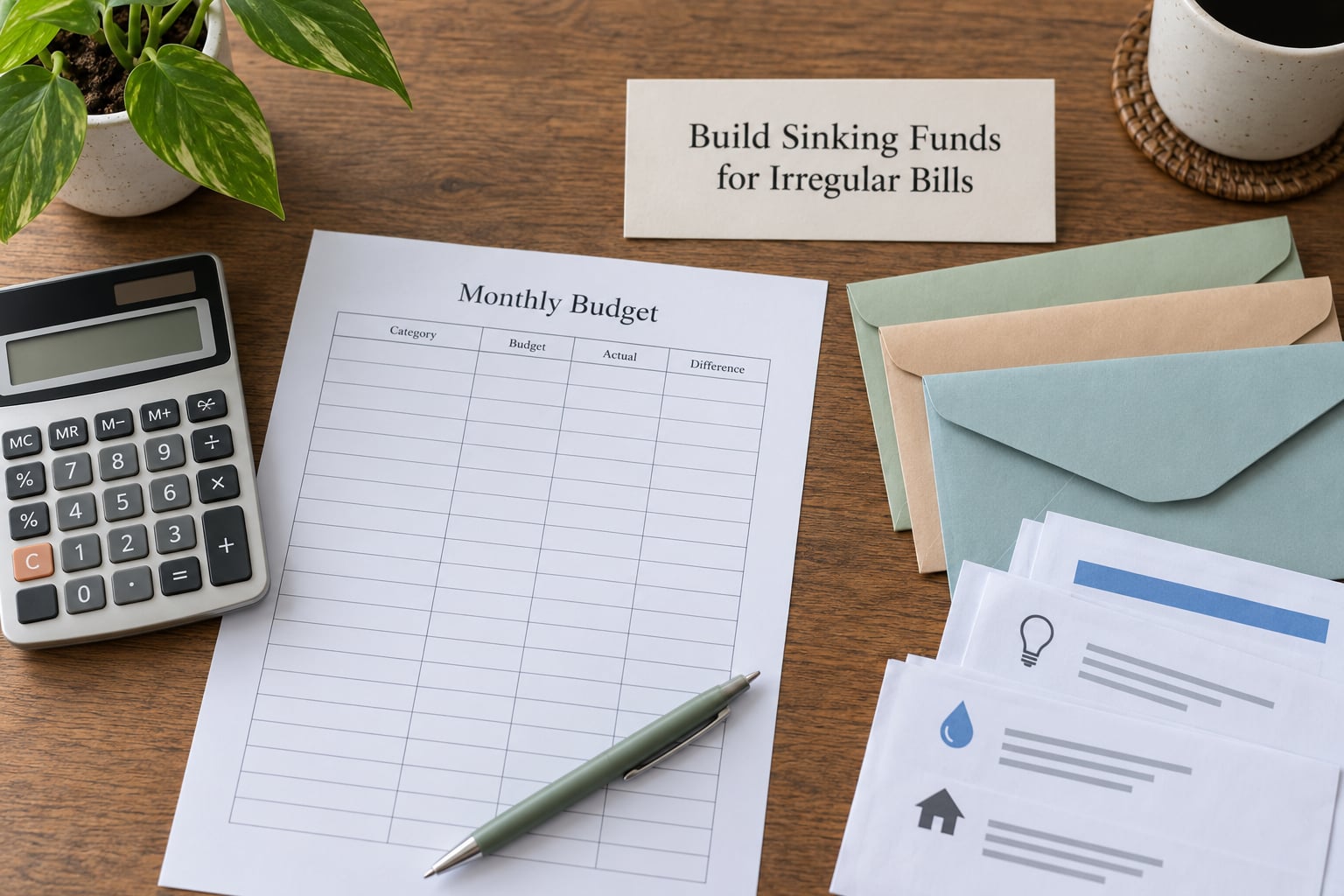
A sinking fund is a category that exists because a bill arrives once or twice a year and you refuse to let it ambush you. The arithmetic is simple and worth doing in writing: take the annual cost, divide by twelve, and contribute that amount every month.
| Sinking fund | Annual cost | Set aside monthly | Lands in |
|---|---|---|---|
| Car registration and tags | 360 | 30 | October |
| Auto insurance premium | 1,140 | 95 | Every six months |
| Home maintenance and repairs | 600 | 50 | Whenever it is needed |
| Birthdays and holidays | 480 | 40 | December |
| Dental and vision | 720 | 60 | Twice a year |
| Licence, passport, school fees | 360 | 30 | Scattered |
| Total | 3,660 | 305 | Spread across the year |
Thirty a month turns a 360 registration into a non-event. It also stops the pattern people on Reddit r/personalfinance complain about most: a good month, then a bad one, then a credit card balance that quietly becomes the budget.
5. Assign the Remaining Money With a Flexible Rule
After essentials, sinking funds and minimum debt payments, whatever remains gets a name. Most people split it three ways: a set amount to savings, a set amount to debt above the minimum, and a spending number with room in it.
Several budgeting systems do this well and none of them fits everybody. Pick by habit, not by trend.
| Method | How it works | Best for | Fails when |
|---|---|---|---|
| 50/30/20 rule | 50% needs, 30% wants, 20% saving and debt | Steady pay, roughly average housing costs | Rent alone exceeds half your take-home pay |
| Zero-based budgeting | Assign every dollar a job until income equals spending | Readers who like detail and control | Income genuinely changes month to month |
| Envelope system | Cash per category, spend the envelope, stop | People overspending on cards without noticing | Card-heavy income and bill-pay-heavy months |
| Pay yourself first | Move saving and debt money out on payday, spend the rest | Chronic paycheck-to-paycheck households | Nothing if income is under the essentials |
People often ask about the 70/20/10 and 70/10/10/10 rules. Both are looser cousins of 50/30/20: 70/20/10 splits needs, saving and wants, while 70/10/10/10 adds a 10 percent slice for debt, 10 for long-term saving and 10 for what you want. The 3-6-9 emergency fund rule is separate again: three months of expenses for stability, six for a household with dependents or variable income, nine for freelance work and single income. All of them are guidance, and all of them bend when your rent or your debt says so.
6. Automate and Track the Budget
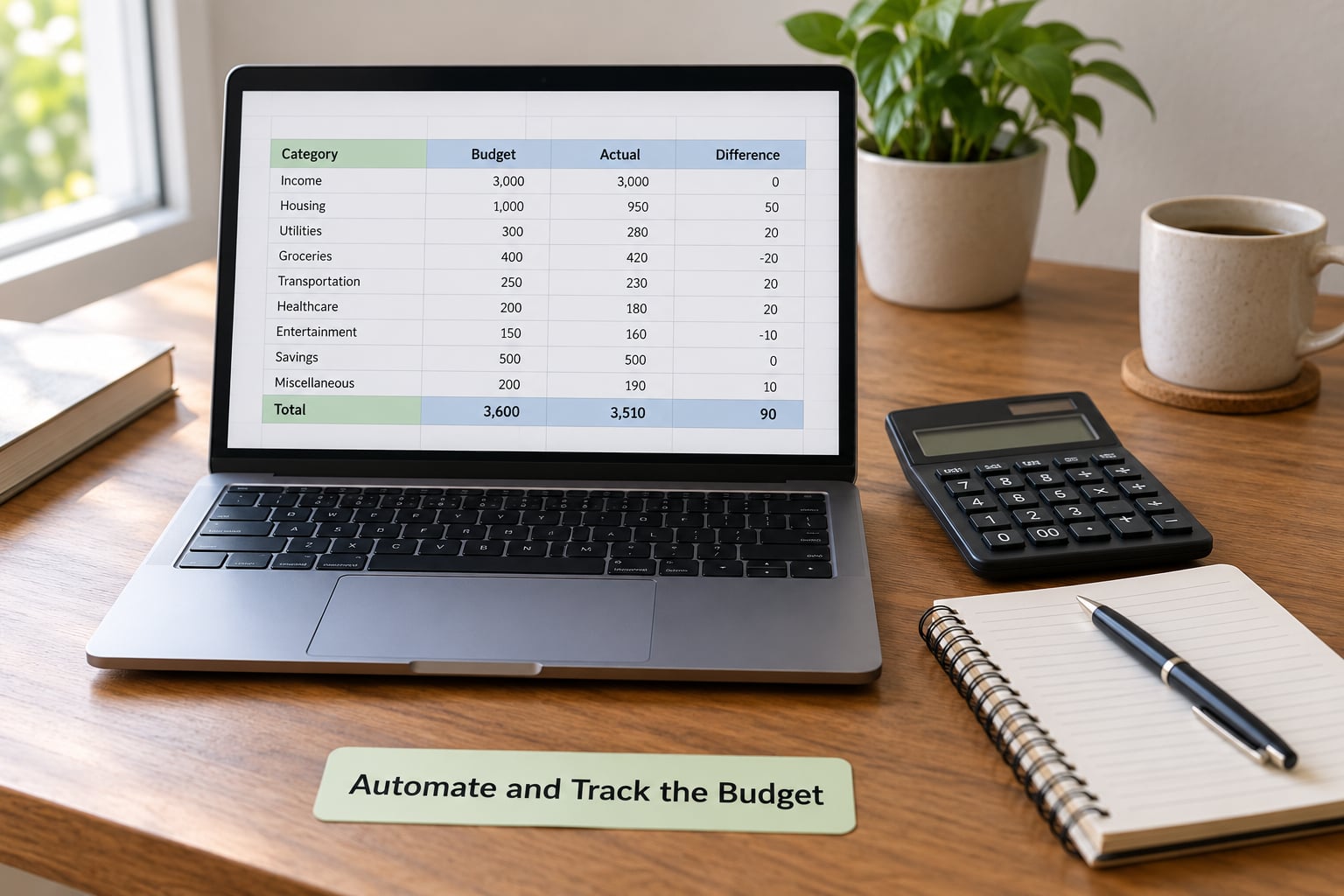
On payday, move the money before you spend any of it. Pay the sinking fund contributions, the debt above the minimum and the savings amount the same morning the deposit clears. What survives in the checking account is what the month is actually built on, and spending from what survives is a lot harder to argue with.
Pick the tracker that matches how you already behave. A spreadsheet wins for people who want custom categories and can see the maths; it also wins because it is free and you own it. A banking app wins for automatic categorisation and for people who will not maintain a sheet. Cash envelopes win for the two or three categories where you have a history of overspending, and only there.
Then run a ten-minute weekly check-in on a fixed day. Look at what has cleared your accounts since the last one, mark it against the categories, and note anything that looks off. That is it. Ten minutes a week catches a drift in week three instead of at the end of the month.
7. Review the Budget After 30 Days
At the end of the first month, compare plan against actual in three columns: budgeted, spent, difference. The gap in each category is your budget variance, and it is the only honest measurement you have.
Categories you always underspend on should have their number reduced, because an unused allocation is not a win, it is a number you made up. Categories you always blow past need either a bigger number or a smaller habit, and the honest answer differs by category. Cut a streaming service. Do not cut the health visits you keep skipping.
Month two is where budgets die, so plan the repair before it happens. When an unexpected cost lands, do not tear the whole thing up. Take it from the wants line if you have one, take it from the buffer, and if neither is enough, raise next month’s sinking fund contribution for that bill and carry on. A budget that gets adjusted survives. A budget that gets abandoned teaches you that budgeting does not work.
If your income changed, rebuild rather than patch. Drop or add a sinking fund, re-run the variable categories against the new take-home figure, and keep the same method so the only variable is the numbers.
Common Mistakes
- Budgeting gross income. Fix it by budgeting what the deposit says. Gross budgeting is the most common reason a carefully built plan fails in the first week.
- Ignoring annual costs. Fix it with sinking funds and the divide-by-twelve arithmetic on page one of your sheet.
- Saving whatever is left at the end. Fix it by setting the savings transfer to happen on payday, before spending starts.
- Using only a spreadsheet, or only an app. Fix it by choosing the tool you will actually open. A beautiful system you skip is worth nothing.
- Cutting every enjoyable expense. Fix it by keeping a wants line you genuinely defend. Restraint that lasts is better than perfection that quits.
- Never reviewing the plan. Fix it with the ten-minute weekly check and a thirty-minute monthly one. Drift is invisible until you look for it.
- Budgeting by calendar month when payday is mid-month. Fix it by budgeting by pay period so both paychecks are counted before the bills are paid.
- Applying 50/30/20 to a take-home pay that is mostly rent. Fix it by using percentages as a diagnostic. If needs run past 70 percent, the fix is housing and debt, not a stricter wants line.
Frequently Asked Questions
Will budgeting work if my income is irregular?
Yes, if you budget by pay period instead of by calendar month. Take the average of your last six months, budget a pay period from that average, and treat anything above it as buffer or debt payoff. Move a set percentage of every payment to a tax account the day it clears. The method that fails for irregular income is percentage-of-total, because there is no stable total to take a percentage of.
What do I do with money left at the end of the month?
Move it in a planned order: emergency fund first until it covers your expenses, then the goal you named when you started, then debt above the minimum. Do not leave it sitting in checking, where it becomes next month’s spending by default. Build that transfer into the budget as a line so it happens whether or not you feel disciplined that month.
How do I budget when I already have debt?
Pay every minimum first, since a missed minimum hurts your credit and often carries a penalty. Put any extra toward the balance with the highest interest rate, not the smallest balance, because interest is charged on the balance. Keep the minimum on the others. Once the high-interest balances are gone, direct the extra money to your savings goal instead.
What is a sinking fund and how much should I save monthly?
A sinking fund is a category that holds money for a bill that lands once or twice a year. Divide the annual cost by twelve and contribute that amount every month, so a 360 registration becomes 30 a month. Car insurance, home repairs, gifts, dental work and school fees all belong here. The set-aside is small enough to be boring and large enough to prevent a crisis.
Does cash envelope budgeting actually work?
It works well for the few categories where card spending goes unnoticed, because a physical envelope runs out. It works badly for a household paid electronically with bills autopaying from checking, because there is no cash to stuff. A middle path many people prefer is digital envelopes in a banking app for everything, plus cash for two categories such as groceries and dining out.
What do I do if my budget starts in the negative?
Start with sinking funds removed from the current month and move them to a list of bills you will fund over the next year. Then cut back only on wants, never on needs. Pay minimums on everything and put extra toward the highest interest balance. A negative starting point still becomes workable within one month because sinking funds are the largest phantom expense most people carry.
A Budget You Can Use Starting This Month
Do one thing this week: pull sixty days of statements and total your actual spending by category. Nothing else on this list produces as much change, and readers on budgeting forums describe the same thing, that the real numbers turned out to be less frightening than the guess.
From there, run the thirty-day sequence. Days one and two are take-home pay and the sixty-day spending pull. Day three is the bill list with due dates and the debt table. Day four is the category split with saving and debt as their own lines. Day five is the sinking fund table with the divide-by-twelve arithmetic filled in. Day six is choosing your tracker. Day seven is scheduling the payday transfers.
Then ten minutes every week, and thirty minutes at the end of the month comparing plan against actual.
Treat the first month as data collection, not a test you pass or fail. If you know your real numbers at the end of it, the budget did its job even if the numbers were ugly. Adjust the plan, keep the method, and run it again.
Updated for October 2026.