To answer tell me about yourself in an interview, use a Present-Past-Future structure and keep it to 60-90 seconds. Present: your current role and what you specialise in. Past: two achievements that match the job description. Future: why this company and this role. The interviewer is not asking for your biography, they are asking whether you can explain your own value clearly.
That framing matters because most people answer this question wrong in one of two ways. They recite the resume in chronological order, which tells the hiring manager nothing about priorities, or they give a warm personal story that leaves no trace of what they can actually do.
Here is the method, step by step, with sample answers you can adapt and the delivery habits that separate a scripted answer from a natural one. It takes about 30 minutes of preparation the night before any interview.
Table of Contents
- What You Need
- Step-by-Step: How to Prepare a Strong Interview Answer
- Common Mistakes and Quick Fixes
- Frequently Asked Questions
- How should I answer tell me about yourself in an interview?
- How long should my tell me about yourself answer be?
- What should I say if I am changing careers?
- How do I answer when I do not have experience for the job?
- Should I tell the interviewer personal information about myself?
- How can I sound natural instead of memorized?
- Conclusion: Build Your Answer Before the Interview
What You Need
You cannot tailor an answer without knowing what it is tailored to. Before you write a single word, gather five things.
- The job description, read twice. Mark every responsibility and every skill listed more than once. Those repeats are the priorities.
- Your resume highlights. Pick three lines, not your whole history.
- Two relevant stories. Each with a clear beginning, the problem you solved and the outcome.
- Measurable achievements. Numbers, percentages, volumes, time saved, people trained, money recovered.
- The role’s core priorities. Read between the lines of the ad: what problem is this hire solving?
A former recruiter who has sat in on hundreds of interviews puts the ideal content simply: main duties at your last job, biggest projects, biggest results with a number attached to each one.
One quick clarification. In many workplaces, tell me about yourself and introduce yourself are treated as the same question, but there is a difference in intent. Introduce yourself leans toward pleasantries and context, often in a networking or phone-screen setting. Tell me about yourself leans toward relevance and evidence. If you are not sure which one you have been asked, answer the evidence version, it works for both.
Step-by-Step: How to Prepare a Strong Interview Answer
How to Answer Tell Me About Yourself in an Interview: Start With Your Role
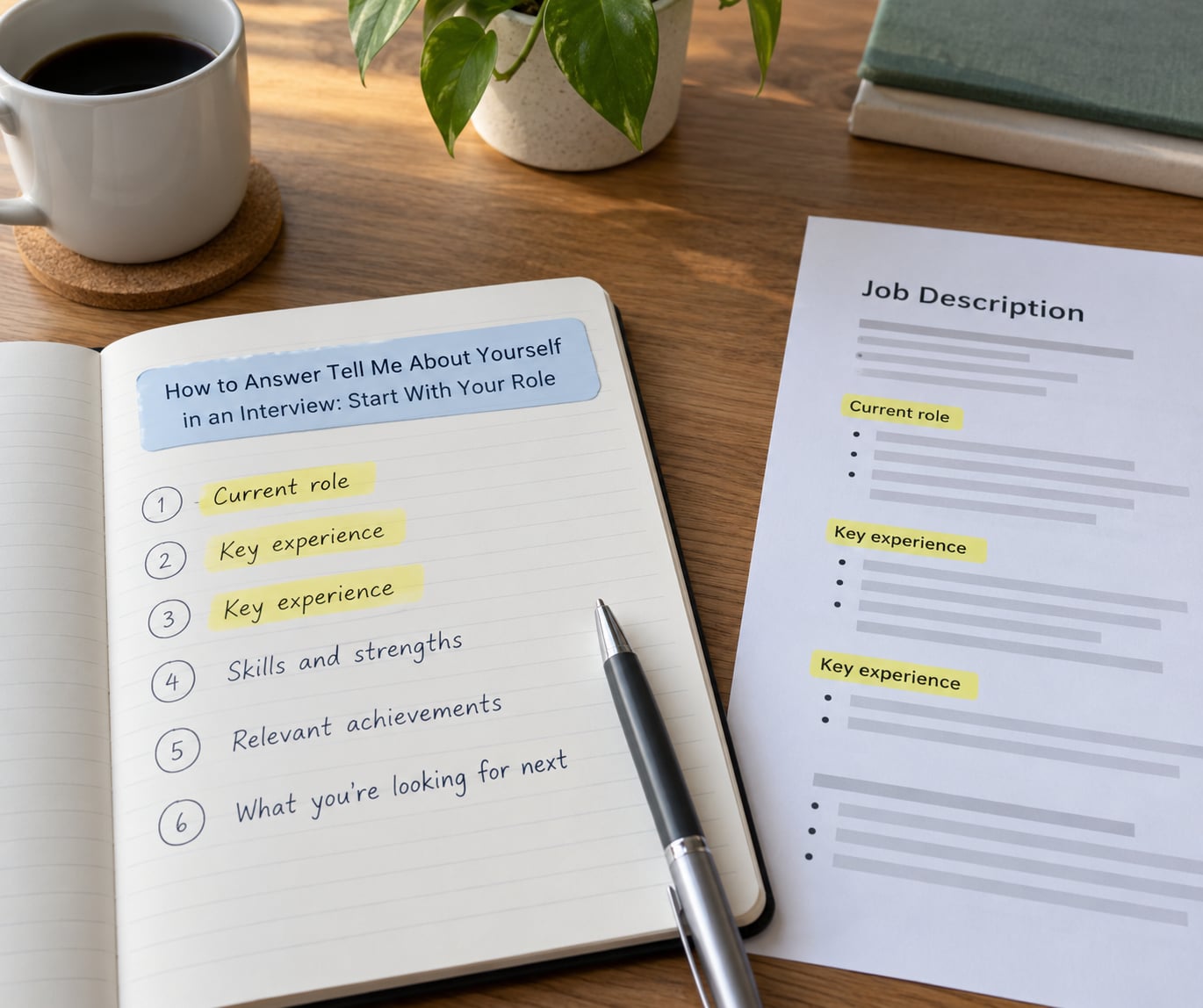
Open with a role-specific professional identity, not a life story. One sentence, roughly 15 words, that tells the interviewer what you do and where you do it best.
A weak opening: “I’m a hard worker and a team player from Manchester, and I’ve always been passionate about many things.”
A stronger opening: “I’m a commercial accountant with four years in manufacturing, and the part of the job I’m fastest at is month-end close.”
That second version already narrows the interview. It tells a finance manager you have done month-end before, and it tells a marketing recruiter to redirect you somewhere else. Specifics do the filtering for you.
The rule is simple: your opening sentence must contain a job title, a sector or a specialism. If a stranger could paste your name over it and nobody would blink, rewrite it.
Add Relevant Experience With Proof
The middle of the answer is evidence, not a list of duties. Choose two achievements and give each one an action and an outcome.
“I was responsible for the month-end close” is a duty. “I rebuilt the close checklist after two late filings and got the process down from nine days to five” is evidence. Same job, completely different weight.
Give roughly 20 seconds to each story, so about 40 seconds for the whole middle section. Link each story back to the job description in plain words: “That’s the part of your role where I’d be useful fastest.”
If you lack numbers in a given field, use volume or scale instead. Team size, number of clients, number of sites, budget, deadline pressure, hours per week. “Managed a caseload of 60 clients” is just as concrete as “cut costs by 12%”.
Explain Your Motivation for This Role
The future section is the one candidates fumble most, because they think it should be enthusiasm. Enthusiasm is fine, but it is not what the hiring manager is scoring.
What they are scoring is fit and preparation. Name something specific about this company or this team, and connect it to a strength the role needs. “Your team is expanding into two new regions and I’ve run a launch in each of my last two roles” is worth more than any sentence about how passionate you are.
What to avoid is praise you could paste into any application. “I love your company culture and I think I’d be a great fit” tells the interviewer you may have sent the same words to forty other people. One specific detail is enough.
You do not need to have researched a private company’s financials. Their site, their recent news, the job ad’s own language, and the name of the person interviewing you are all fair game.
Close With Your Value and Next Step
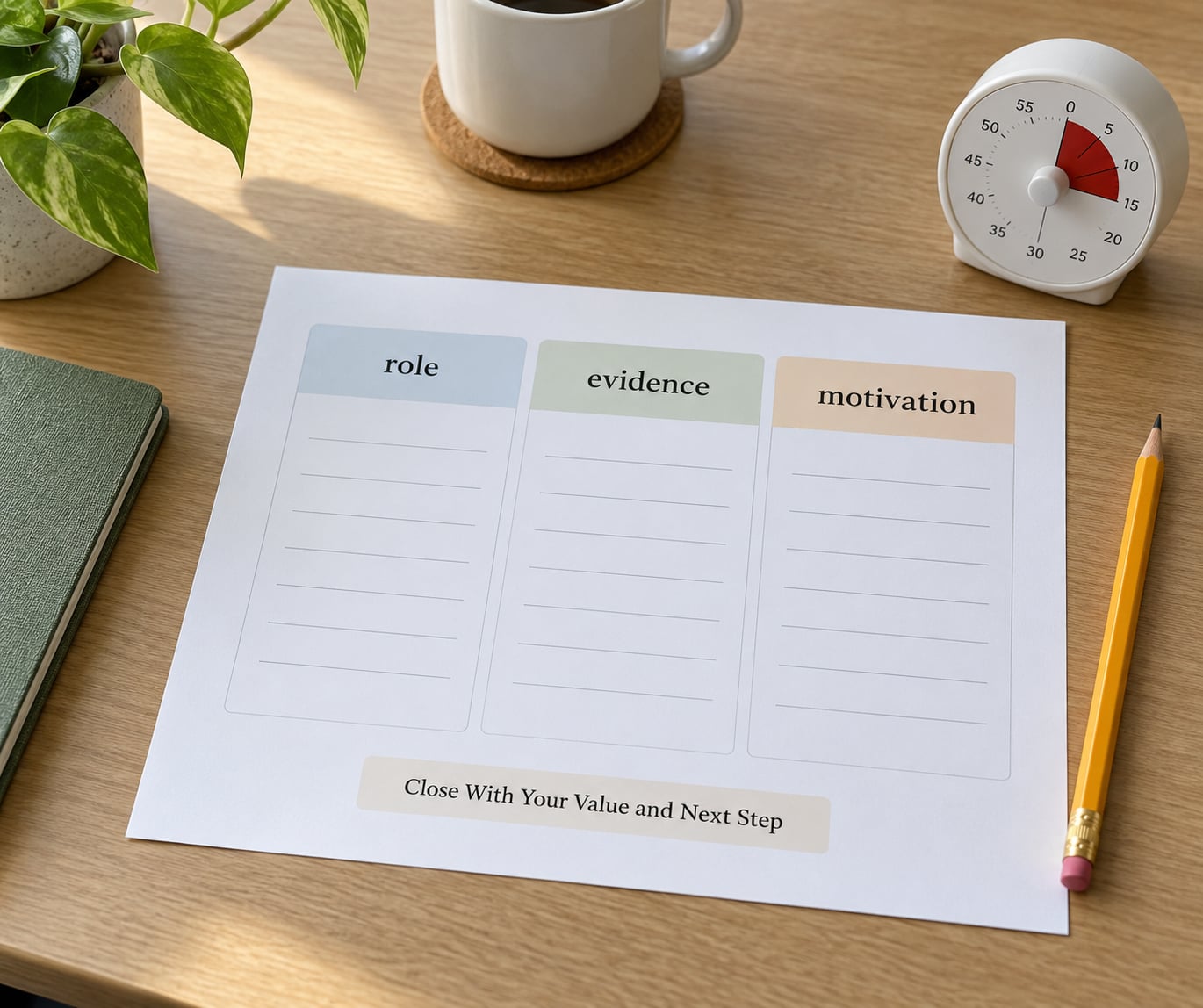
End by pointing at the future. One sentence that says what you would do in the first six months, or why this role moves your career in a direction you want to go.
“From what I’ve read, onboarding here takes about a month, and I would want to understand your reporting process before I touched anything. That is the part I enjoy most in any finance team.”
That close does two useful things. It shows you are already thinking like an employee, and it hands the interviewer an obvious follow-up question. That is not a risk, it is the point. A good opener gives them something specific to ask, which makes the rest of the interview a conversation instead of an interrogation.
Never end with a question like “So, what do you do?” It reads as nerves and it hands control back to them mid-answer.
Adapt Your Answer to the Interview Situation
How long to answer tell me about yourself in an interview depends on the stage. Online advice splits between 60 seconds and three minutes, so here is the rule I use, by stage:
- Phone or video screen with a recruiter: 45-60 seconds. Lead with your current role, one achievement, and why you applied.
- First round with the hiring manager: 60-90 seconds. Two achievements and a specific fit with the team.
- Final round or panel: 90-120 seconds. Leadership, ownership and results at a larger scale.
- Internal promotion interview: about 90 seconds. What you have changed here, and what you want next.
Then adapt the content to your situation.
- Fresher with no work experience. Your degree or course, projects, internships, part-time work, and group work, plus what you personally contributed to it.
- Experienced professional changing roles. Transferable skills stated in the target industry’s language, plus one recent result.
- Career changer. The through-line that connects your old and new work, and why now.
- Returning after a career break. What you have done since the break: study, volunteering, care work, freelance work.
- No relevant experience at all. One genuinely transferable behaviour, plus proof you learn fast. Say it plainly rather than dressing up unrelated work.
That last point matters most. People with only retail or warehouse experience feel they have nothing to offer, so they pad. Better to name two real skills you have demonstrated under pressure and tie them to the job, than to pretend a two-week supermarket job was a career.
Practice Until It Sounds Natural
Most people rehearse by reading silently, which is why their answers sound recited. Rehearse out loud instead, with a timer.
- Set a timer for 60 seconds and speak the answer in full without stopping.
- Record it on your phone and listen back once. You will hear the filler words and the speeding up.
- Change the wording each time. You are memorising the beats, not the script, and that is what makes it sound live.
- Practise standing up and at normal volume. Voice matters more than people think.
- Ask one friend to interrupt you with a random question after the first minute. That is your follow-up going badly, which is far better than the real interview.
If you only memorise three beats, make them these: who I am professionally, the one result I am proudest of, why this role. Everything else can be improvised around that spine.
On delivery, keep your pace slightly slower than normal conversation. Interview nerves speed people up, and speed reads as anxiety. Look at the person, not at your notes, and pause for a second after your final line instead of trailing off.
Common Mistakes
Draft-stage errors are easy to fix once you see them.
- Chronological resume narration. Fix: reorder into Present-Past-Future and keep only two past points.
- A generic opening with no title. Fix: add your role and specialism in the first sentence.
- Too many achievements. Fix: two well told beats outrank six rushed ones.
- Praise that fits any employer. Fix: replace with one specific detail you researched.
- Refusing the question or saying “you have my CV in front of you.” Fix: treat it as the easiest question you will get all day.
- Aiming for two minutes of solid delivery. Fix: cut every sentence that does not contain a fact.
Common Mistakes and Quick Fixes
Here is what goes wrong in delivered answers, with a straight fix for each. People on r/jobs describe the usual failure modes as rambling, full life stories, or answers so generic they could belong to any candidate on the schedule.
The life story
You start at university, list every job including the summer one, and arrive at the present somewhere around the two-minute mark. Fix: delete your entire background and begin with your current role. Nobody else in the room has that history in their head yet.
The generic answer
Everything you say is true of half the applicants. “I’m a hard worker, a team player, I love to learn” could be printed on any card. Fix: swap one abstract adjective for one concrete number or named tool in the same sentence.
The rehearsed delivery
You speak in the exact same rhythm and tone as your script, all the way through, with no pauses. Fix: deliver your three beats in a fixed order but write the connecting lines fresh each time.
The irrelevant personal detail
You mention your dog, your marathon training or a wedding in detail, and the room goes quiet. The hobby question from the FAQ comes later, so answer it there. Fix: keep the opener professional and let rapport build through the rest of the interview.
The answer that invites the wrong question
You highlight something interesting but tangential, and now you are defending an hour of your life you did not want to spend there. Fix: choose beats that lead to questions you would enjoy answering.
A quick rewrite shows the difference. Weak: “I am a marketing executive with experience in digital and print, and I am looking for a new challenge in a forward-thinking company.” Strong: “I’m a marketing executive with five years in B2B digital. I rebuilt our email programme last year, which lifted open rates from 18% to 34% and added roughly 40 qualified leads a month. I’m applying because your role needs someone who can own campaigns end to end rather than hand off at the design stage.”
Same person. The second one has a role, a number and a reason, so it can be scored.
Should you mention personal details? Only in two situations: the setting is genuinely informal, such as a coffee meeting or a recruiter call, and the detail connects to the work. Ceramics, chess or cycling can open a conversation with a creative or analytical employer. Family, finances, health and relationships stay out of it unless you have an established relationship with the interviewer.
Frequently Asked Questions
How should I answer tell me about yourself in an interview?
Use Present-Past-Future. Open with your current role and specialism in one sentence, give two achievements from your history that match the job description, then explain why this company and this role fit where you are heading. Aim for 60-90 seconds and finish with a sentence about the value you would add in the first six months. Practise out loud so the delivery sounds conversational rather than recited.
How long should my tell me about yourself answer be?
Sixty to ninety seconds for a first-round interview with the hiring manager. Keep it to 45-60 seconds on a recruiter phone or video screen, and allow 90-120 seconds in a final or panel round. A good test is roughly 130 to 180 words spoken at normal pace. If you are over two minutes, you are almost certainly narrating your resume instead of making a case.
What should I say if I am changing careers?
Lead with the transferable skill that connects your old field to the new one, then prove it with a result from your previous work. Name the reason for the change in one honest sentence, without complaining about your last employer. Then explain what you have done to prepare: relevant study, projects, certification or volunteering. Interviewers are listening for whether the change is deliberate rather than accidental.
How do I answer when I do not have experience for the job?
Say so plainly and pivot to evidence of how you work. Pick two examples from any job, study or volunteer setting where you solved a problem and describe your own contribution with a number, a deadline or a result. Close by naming one skill in the job description you have already partly built and how quickly you learn. Trying to disguise unrelated work as relevant is far more damaging than admitting the gap.
Should I tell the interviewer personal information about myself?
Keep the opener professional. Hobbies, family and personal circumstances belong in later questions or in genuinely informal settings such as a coffee meeting. The exception is a detail that connects to the work, such as a sport that shows discipline or a club that shows leadership, and only when the conversation has room for it. Financial details, health stories and relationship drama stay out entirely.
How can I sound natural instead of memorized?
Memorise three beats rather than a script: who you are professionally, the result you are proudest of, and why this role. Write the connecting sentences fresh each time so the wording varies. Practise out loud, standing up and at normal volume, because silent rehearsal is what creates a robotic tone. A slight pause before your last line and normal conversational speed do more than any amount of extra practice.
Conclusion: Build Your Answer Before the Interview
Start tonight, not in the car outside the office. Read the job description and highlight what it repeats, choose the two achievements from your resume that prove you can do that work, and draft a 60-90 second Present-Past-Future answer around them.
Then say it out loud twice with a timer. If you can deliver it in a normal conversational voice with one specific detail about the company, you are ready. The rest of the interview is easier once the hardest question is already behind you.