
If you are wondering how to tell your kids you are getting divorced, the short answer is this: sit down together, both parents in the same room, and give them a calm, simple, age-appropriate explanation. Tell them it was an adult decision, tell them nothing they did caused it, and tell them both parents will keep loving them and keep showing up. Then keep checking in, because that conversation is a beginning, not a finish line.
If you have been rehearsing this in the shower for two weeks and still cannot find the words, that is normal. Parents freeze for this one. The preparation matters far more than the smoothness, and the version of this talk that goes well is usually the one that was written down beforehand.
What follows is a plan you can work through in an evening: what to gather, when to do it, what to actually say for each age group, and what to say when your child asks the questions you were hoping they would not ask.
Table of Contents
- What You Need
- How to Tell Your Kids You Are Getting Divorced: Step-by-Step
- How to Tell Your Kids You Are Getting Divorced: Prepare the Message
- How to Tell Your Kids You Are Getting Divorced: Choose the Right Time
- How to Tell Your Kids You Are Getting Divorced: Use Simple, Honest Words
- How to Tell Your Kids You Are Getting Divorced: Answer Questions Without Blaming
- How to Tell Your Kids You Are Getting Divorced: Keep Routines Stable
- Common Mistakes
- Waiting for a calmer time that never arrives
- Having the conversation in front of children
- Telling different stories
- Asking children to choose, carry messages, or comfort you
- Promising nothing will change
- Warning them about the other parent
- Letting it be one conversation
- Frequently Asked Questions
- What age should I tell my child that we are getting divorced?
- How do I explain divorce to a young child?
- What if my child asks whether the divorce is my fault?
- Should my child know the legal or financial details?
- How can parents tell children the same story?
- When should I seek counseling for my child after the divorce?
- A Calm First Step After the Conversation
What You Need

You do not need a lawyer in the room or perfect phrasing. You need four things, and one firm boundary.
- A private setting. Not the car, where nobody can leave and everybody can hear you. A room where the children are comfortable, you are not going to be interrupted, and it is fine if they cry.
- An agreed message. Before you speak to the children, you and the other parent need roughly the same version of events: the decision, the reason in one sentence or none at all, and what stays the same. Twenty minutes on the phone is enough for most families.
- A written script. Four or five sentences, on paper, that you can read. You are not going to remember anything you did not write down.
- Practical answers to three questions. Where will I live? Will I stay at the same school? How will I know when I see the other one? You will not have every detail. Say that clearly rather than guessing.
- Support for yourself. A friend, a sibling, a therapist, someone who is not your co-parent. You will be carrying a lot of emotion into that room, and children read faces faster than they read words.
The boundary: your children are never the messengers, and they are never the reason you are deciding anything. Parents on Reddit describe the same two things constantly, that the children were left to pass along information between homes, and that they were asked to take sides. Both of those land badly, and both are avoidable.
One more practical detail. Decide now, before the day, whether you are telling them you are separating or that you are getting divorced. If the legal process has not started, say separating, and explain that you both decided to live apart. Children handle a finished decision much better than an open question.
How to Tell Your Kids You Are Getting Divorced: Step-by-Step
How to Tell Your Kids You Are Getting Divorced: Prepare the Message
Write the shortest version that is still true. The instinct is to explain more, and the explanation is usually where the damage happens, because reasons turn into sides.
A structure that holds up at most ages: what has changed, who decided, that it is not their fault, what stays the same, and that you will keep talking. Five sentences, in that order.
If the other parent will not sit down with you, write your own version anyway and keep it to those five sentences. Then write a second short script for what you will say if the children come back to you with a different story. On r/Separation, parents argue honestly about whether to describe a one-sided decision as mutual. Most of that thread lands in the same place, that the children need a version they can carry without being asked to defend it, and that a false story is the thing they find out about later.
How to Tell Your Kids You Are Getting Divorced: Choose the Right Time
Pick a calm afternoon or evening when nothing else is happening. Not a birthday, not a holiday, not the week of exams, not the last day of the school term, not before a sports final. You are not optimising for the perfect moment, because there is not one. You are trying to avoid stacking it on top of something else.
There is a real argument for telling before you physically separate, rather than after. Children in r/AskReddit describe finding out sideways, overhearing an argument, spotting a car parked at a relative’s house, or being told months later once the move was already done. Every one of those memories is worse than an uncomfortable conversation in a kitchen.
Tell them as soon as the decision is made and you can hold it together. Waiting to be certain, or waiting for a nicer moment, tends to produce the delayed version. The risk in telling early is that the news outruns your own certainty. The risk in waiting is that your child works it out alone.
Tell siblings together unless the age gap is large, six years or more, or one child has a specific vulnerability. Start with the older ones and let them hear it from you rather than from a younger sibling first.
How to Tell Your Kids You Are Getting Divorced: Use Simple, Honest Words
The Child Mind Institute, HelpGuide, and most child-development authorities make the same point: children cope best when the message is short, neutral, and delivered by a parent who is visibly calm. Here is language you can adapt by age.
Ages 2 to 5. Keep it to presence and care. These children understand that people live in different houses far better than they understand the word divorce.
Mummy and Daddy are going to live in different houses now. It is a grown-up decision and it is not about you. Both of us will still see you every week, and both of us love you exactly the same.
Ages 6 to 9. Add a sentence about what stays the same and one about the schedule.
Your dad and I have decided not to live together any more. We are not unhappy with you, and nothing you did made us do this. You will stay at the same school, you will see both of us, and the parts of your week that look the same are going to keep looking the same.
Ages 10 to 12. They can handle the word divorce and they will notice a changed tone at home. Name the change, do not explain the cause.
We are getting divorced. We have been unhappy for a while and we both decided it was better for the two of us to live apart. It is not your fault and you did not have anything to do with it. Here is how the week is going to work, and here is when we will talk about it again.
Teenagers, 13 to 17. Respect the intelligence. Teenagers usually know something is wrong and they have already built a theory, often that one parent is at fault.
You have probably noticed things have been tense. We are separating, and it is a decision we made together. I am not going to give you a tidy reason, because the real reason is a long adult story that is not yours to carry. If you want the short version, it is that we stopped being able to do this well, and staying together was hurting both of us more.
Adult children still at home. Treat them as an adult who is losing something. Tell them early, tell them the financial position honestly but briefly, and do not lean on them for support.
Whichever band you are in, land the same three sentences: it is not your fault, we both love you, and you will keep seeing both of us. Repeat those three things across weeks and months rather than once. Children who are struggling often go quiet instead of asking again, so repetition is doing the work, not nagging.
How to Tell Your Kids You Are Getting Divorced: Answer Questions Without Blaming
The questions come later, often at 9pm, often in a car. Have answers ready. Most of them fall into four groups.
Whose fault is it? Child: whose fault is it? You: Neither of us did this on purpose. Grown-up problems are not yours to fix, and you are not being asked to decide anything. That last part matters. A child who thinks the divorce is their verdict will spend months waiting to be told they were right.
Do you still love each other? You: We still care about each other, but we are not in love the way we were, and that is why we are doing this. Do not say yes just to end the conversation. Teenagers can hear it, and the discovery later costs you trust you will not get back quickly.
Why? You: We have been unhappy for a while and we could not work it out. If the cause was a betrayal, a more honest version is: your dad had an affair, that was the end for me, and it is a grown-up betrayal. It was not about you and it was not your job to protect anyone.
Where will I live, and when do I see the other one? You: Here is what we know so far, and here is the part we are still sorting out. We will tell you the moment it is decided. The Child Mind Institute suggests writing the schedule up where everyone can see it, even a rough one, because a visible answer beats a repeated promise.
Two rules while you answer. Never criticise the other parent, not once, not even in front of a sympathetic teenager, because the message lands as a demand to join your side. And when you do not know, say that you do not know. Parents on r/Parenting describe being handed far too much adult truth as children, and being expected to process it. Calibrated honesty beats a full debrief.
How to Tell Your Kids You Are Getting Divorced: Keep Routines Stable
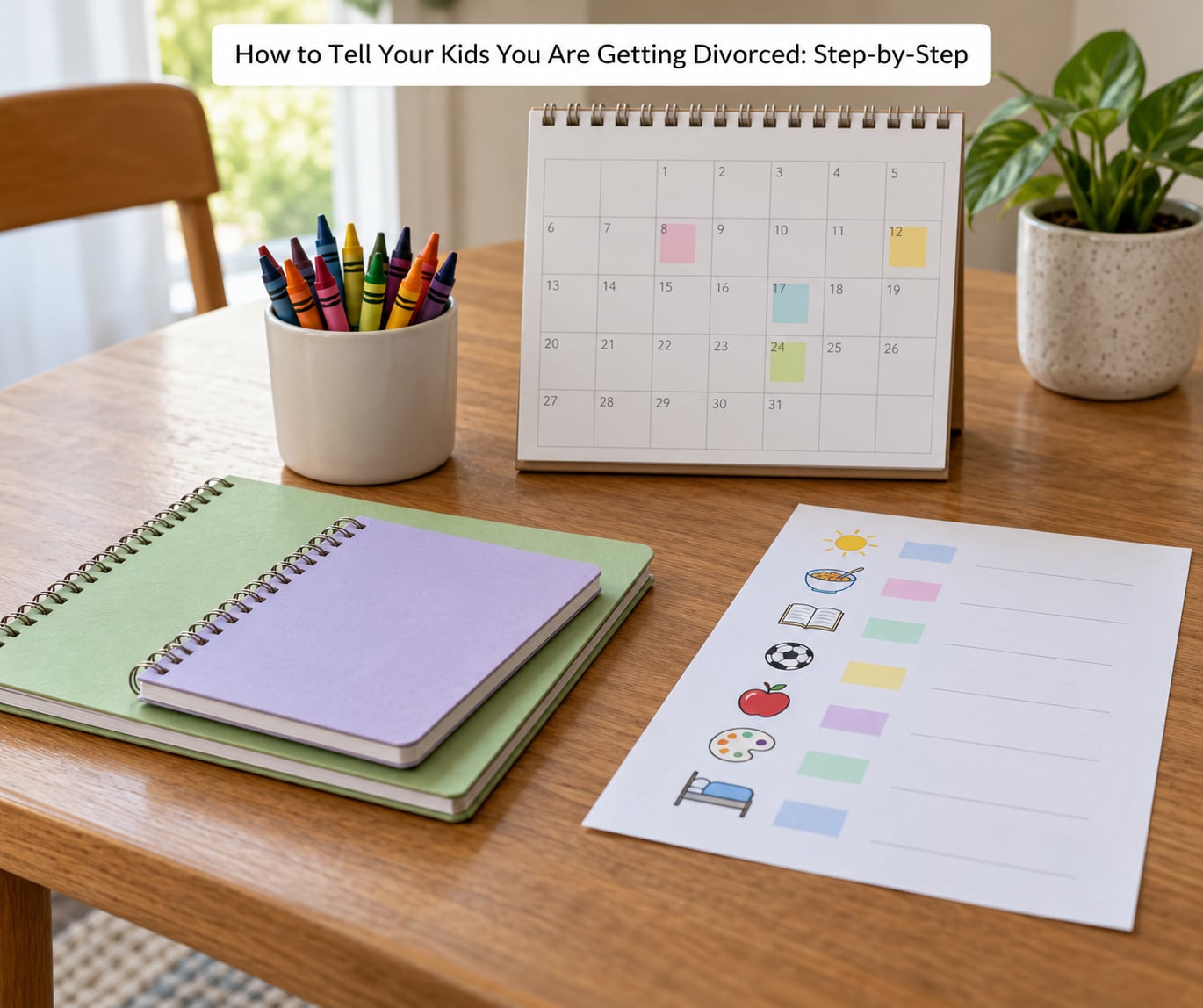
Children take the change best through the calendar, not through reassurance. Write the week down: mornings, school, meals, bedtime, which parent does pick-up, which days are at the other house, when the next call happens. Put it on the fridge. Update it in writing when anything changes.
Keep the anchors that do not depend on which house the child is in. Bedtime stays at the same time. Saturday stays Saturday. The same people do the same jobs, so a child who wants to ask their dad about something knows it is the evening he asks.
Tell the school. A short email to the teacher, the office, and the school counsellor saying the family situation has changed and that the schedule is attached is enough. Ask them to watch for withdrawal, dropped grades, or a change in who the child eats lunch with, and check in once a term rather than every week.
Then keep going yourself. HelpGuide uses the oxygen mask framing, and it is accurate. A parent running on empty for months cannot read a child’s face, and the face is the information you need. Book something in your own calendar this week that is not about the divorce.
Common Mistakes
Nearly every mistake parents make here is a well-intentioned one.
Waiting for a calmer time that never arrives
The correction is to pick an ordinary Tuesday and go. A gap of six months does not make the conversation gentler, it just makes the news more confusing and lets the child build their own version of it.
Having the conversation in front of children
Arguments in front of kids teach them that the safest way to get what they want is to push two adults until something cracks. If the separation is already loud, the single most useful thing you can do is stop explaining it in their hearing and explain it in one calm sitting instead.
Telling different stories
One parent says the move is temporary, the other says it is final. Children find these gaps fast and start managing them, which is a job no child should be doing. Agree the five sentences in advance, or if you cannot agree, keep both versions so short and factual that there is no room to contradict.
Asking children to choose, carry messages, or comfort you
None of those three is a child’s job. On r/Separation, the line that comes up most often is blunt: your kids are not a lever and they are not a way to bring your partner back. Give them one job, which is to be a kid, and take the adult work yourself.
Promising nothing will change
It will change, and a promise you cannot keep gets cashed in at the worst moment. Promise what you can control instead: both parents will see you, both parents will tell you the truth, and you can ask either of us anything.
Warning them about the other parent
It buys you a short-term ally and costs you a relationship you will need for the next fifteen years. Children split their loyalty, and the ones who end up in the middle of a parent’s fight are the ones who were told something they could not carry.
Letting it be one conversation
The first talk goes better than you fear, and the real work starts the following week. Set a check-in rhythm, even a five-minute one on Sunday nights, so your child has a predictable place to raise the things they have been thinking about for four days.
One more that gets overlooked: what happens six to twelve months later, when the initial relief has worn off and the practical reality lands. Grades slip, a friendship ends, the novelty of two homes fades. A quiet child at that point is a normal child at that point, not a child in trouble.
Frequently Asked Questions
What age should I tell my child that we are getting divorced?
Tell as soon as you know and can say it calmly, with no lower age limit. A three-year-old understands that two people now live in different houses. Older children are far more damaged by guessing or by hearing it late than by the conversation itself. The one exception is a baby with no concept of time, where a few months of stable care changes nothing.
How do I explain divorce to a young child?
Keep it short and about care, not causes. Say that both grown-ups decided to live apart, that it is not about anything the child did, and that both parents will still see them and love them. Do not use the word divorce with a preschooler unless they have heard it somewhere; separate houses is the concept they actually understand.
What if my child asks whether the divorce is my fault?
Answer with a flat no, and then explain that grown-up problems are not the child’s job to fix. This is the single most important sentence in the whole conversation, because a child who thinks the divorce is their verdict will wait months to be told they were right. Say it in those words, then move on without a long explanation.
Should my child know the legal or financial details?
No. Keep children out of settlements, custody negotiation, account balances and the family lawyer. Older children do need the functional version: which house they sleep at, how they get to school, and what it costs them personally, such as activities. Give the information a child uses to run their week and hold back the information a child would only worry about.
How can parents tell children the same story?
Agree five sentences in advance before you speak: what changed, who decided, it is not the child’s fault, both parents love them, and contact continues. Write them down and read the same version. If you cannot agree, keep both versions to those same five short factual points so there is nothing for a child to catch you on later.
When should I seek counseling for my child after the divorce?
Go sooner rather than later if changes persist past six weeks: sleep loss, withdrawal from friends, a sustained drop in schoolwork, physical complaints with no cause, or talk of self-harm. A child therapist or school counsellor works best when it is a routine support rather than a response to crisis, so booking early is not overreacting. You can also get help just for yourself.
A Calm First Step After the Conversation
Here is what to do in the week that follows, and it is a short list. Write down the questions your children actually asked and answer the ones you can this week. Put the new weekly schedule somewhere visible and mark the next check-in on a calendar. Keep one anchor routine exactly as it was. Send the school the short email. Book something for yourself that has nothing to do with the divorce.
Do not chase a perfect response. Parents who have prepared, told their kids together, and then kept checking in are the ones who get through it well, and how to tell your kids you are getting divorced is mostly a question of doing those three ordinary things repeatedly rather than perfectly once.