Mindfulness is intentional, non-judgmental awareness of present-moment experience. To practice mindfulness for anxiety as a beginner means sitting or standing for five to ten minutes, placing your attention on one simple anchor such as the breath, noticing when your attention has wandered, and gently bringing it back. Each time you return is a repetition of the practice. You need no experience, no equipment and no special belief system to start.
The part beginners get wrong is expecting a blank mind. That is not what the practice produces. What it produces, slowly, is the ability to notice an anxious thought arriving without getting dragged off with it.
Below is a beginner sequence you can use tonight, plus what to do on the days your brain refuses to settle.
Table of Contents
- What You Need
- Step-by-Step: How to Practice Mindfulness for Anxiety for Beginners
- Start With a Grounding Exercise
- Use a Simple Breathing Pattern to Practice Mindfulness for Anxiety
- Notice Thoughts Without Following Them
- Try a Brief Body Scan
- Build a Consistent 10-Minute Routine
- Common Mistakes
- Frequently Asked Questions
- How quickly does mindfulness help with anxiety?
- What should I do during a panic attack or anxiety spike?
- How often should a beginner practice mindfulness?
- Why does meditation sometimes make my anxiety worse?
- Is meditation a grounding technique?
- When should I see a therapist instead of relying on practice alone?
- Where To Start Tonight
What You Need
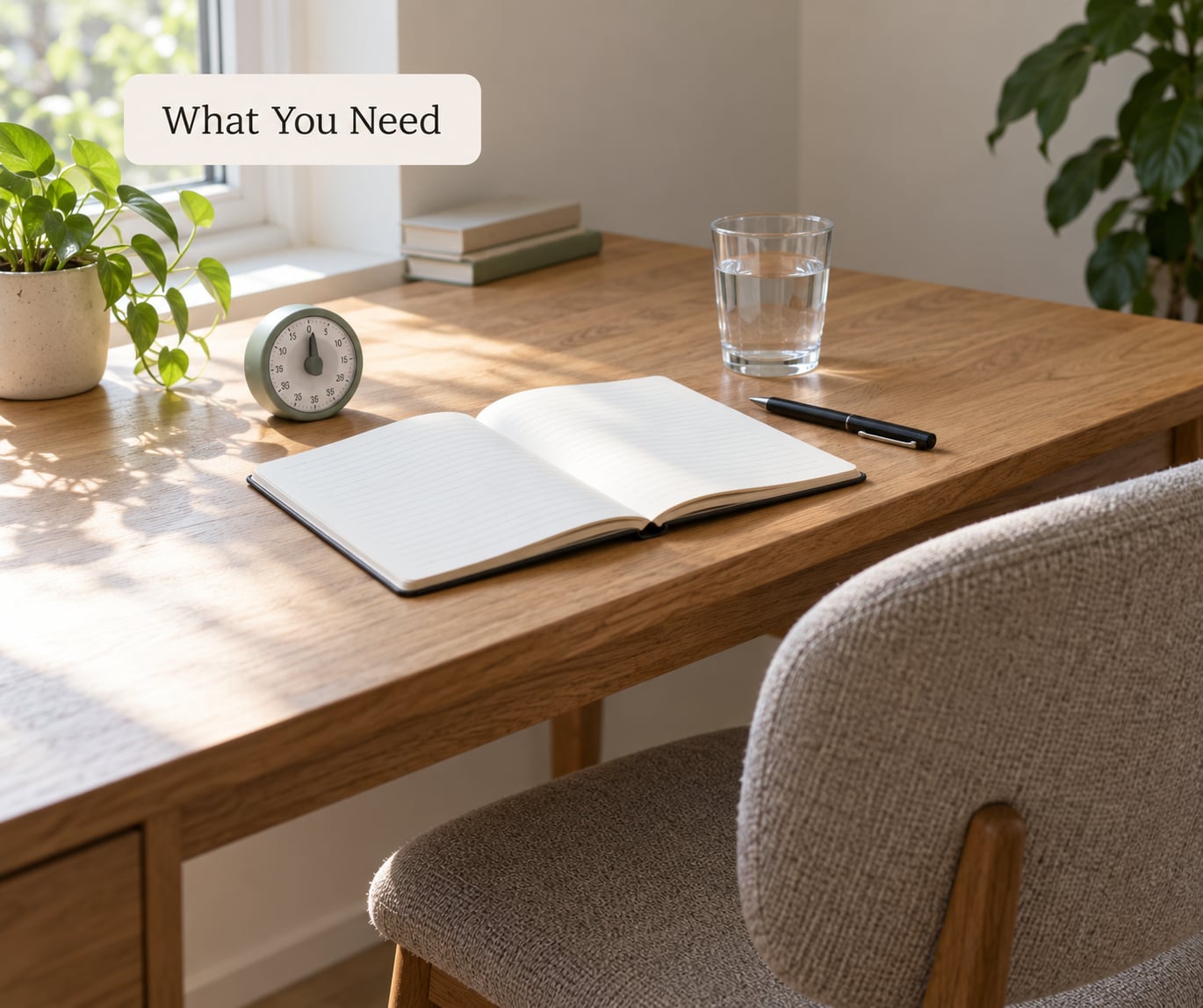
Almost nothing. That is worth saying plainly, because a lot of beginners put off starting until they have the right cushion, the right app or a quiet house they will never have.
What you genuinely need is a place where nothing is asking you to respond for a few minutes, and a willingness to be a beginner at something. A chair, a bed, the floor, or standing at a kitchen counter all work. The quality of the spot matters far less than whether you will actually sit there tomorrow.
Optional supports, in rough order of usefulness:
- A timer. Most phones have one, and it removes the negotiation of deciding when to stop. Without one you will either open the session hoping for a short one or sit far longer than you meant to.
- A notebook. A single line after each session, such as “racing thoughts, tight jaw” is enough. Beginners who write something down tend to spot patterns faster than beginners who rely on memory.
- A chair or cushion that supports you. Uncomfortable posture pulls attention to the back of your legs and back pain rather than to the practice.
- Headphones and a quiet room. Helpful if you are using a guided meditation, less important for unguided practice once you can sit with some noise.
- A glass of water. Dry mouths happen more often than people expect, and it gives your hands something to do when restlessness arrives.
Guided audio is worth having in your first two weeks, not as a dependency but because a voice that knows when to pause is doing the part beginners find hardest. After that, unguided ten minutes will carry you further than any app.
Step-by-Step: How to Practice Mindfulness for Anxiety for Beginners
The order matters. Grounding first, because an anxious nervous system cannot settle onto the breath on demand. Breath second, because it is the anchor you will use most. Then noticing thoughts, then the body, then a routine that makes all of it stick.
Start With a Grounding Exercise
Before you ask your attention to do anything subtle, put it on the room. Name five things you can see, four things you can feel, three things you can hear, two things you can smell and one thing you can taste. Go slowly enough to actually find them.
This is the 5-4-3-2-1 grounding technique, and it works by taking attention out of the future, where anxiety lives, and putting it on the present, where your senses are. Most people find the smell step is the hard one, which is a good sign. It means you are actually doing it rather than reciting.
There is a shorter version people call the 3-3-3 rule: three things you can see, three you can hear, three you can feel. It fits into a stoplight or a bathroom queue, and for a beginning practitioner it does the job just as well as the full sequence.
You can also ground through movement, which matters for readers whose anxiety climbs when attention turns inward. Walking and feeling your feet land on the pavement counts. Running cool water over your wrists counts. Holding a cold mug and attending to the sensation counts. The anchor can be anything outside you.
Use a Simple Breathing Pattern to Practice Mindfulness for Anxiety
Once you feel reasonably settled, put attention on the breath. Not on breathing deeply. On the breath as it already is, wherever it is comfortable.
Try this rhythm: inhale for a count of four, exhale for a count of six. The longer exhale is the part doing the work, because a longer out-breath supports the parasympathetic side of your nervous system, the branch responsible for slowing you down. Five or six rounds is usually enough to notice a shift.
Counting out loud helps more than people expect, because it gives the wandering mind a second job. If four feels like too much to count, use three in and five out, or simply breathe out slightly longer than you breathe in.
If your breath feels uncomfortable, that is information, not failure. Two common reasons: tight focus on the breath amplifies the sensation of the chest for people who already notice their breathing, and some people quietly hold their breath when anxious. In both cases, drop the count and go back to the external anchor from the grounding step.
Notice Thoughts Without Following Them
Your mind will wander. In the first weeks it will wander constantly, and you will spend most of the session noticing it has wandered.
That is the practice, not a deviation from it. Researchers who track mind wandering in daily life find people are actually in task-unrelated thought a large share of waking hours, and long-time practitioners report the wandering dropping. The change comes from the noticing, not from a successful blanking-out that beginners keep waiting for.
Here is the simple method. Notice the thought. Label it in one or two words, quietly, like “planning” or “worry” or “memory.” Then return your attention to the breath or to a sound in the room. No arguing with the thought, no pushing it away.
Pushing a thought away creates a second layer of activity, which is why beginners who try to stop thinking end up more tense at the end of a session than at the start. Letting a thought be there and not acting on it is a different skill entirely, and it is the one that changes how anxious you feel over weeks.
Racing thoughts during practice are common and not a sign you are doing it wrong. A useful variation is to name the pattern rather than each thought, such as “planning again,” which takes one word instead of a paragraph.
Try a Brief Body Scan
Move attention slowly through the body, checking for tension rather than trying to remove it. Forehead, jaw, shoulders, hands, stomach, legs. Spend ten seconds or so in each area and note what is there.
For people with anxiety, the jaw, the shoulders and the space between the shoulder blades are almost always holding something. Naming a sensation without judging it often loosens it slightly on its own, which surprises people.
Do not try to make a sensation disappear. If you sit for ten minutes trying to make your stomach relax, you have turned a body scan into a second thing to fail at. The goal is accurate reporting, not repair.
A short body scan is also the most useful practice for falling asleep, and the least useful one if you are in a full panic. In that state, eyes-open sitting or grounding works better than lying down and scanning.
Build a Consistent 10-Minute Routine
Consistency beats intensity for beginners, and by a wide margin. Five minutes on most days for two weeks builds a habit that twenty minutes on Sunday does not.
A workable plan:
| Period | Minutes per day | Focus | Daily anchor |
|---|---|---|---|
| Week 1 | 5 | Grounding, then breath | Full 5-4-3-2-1 once a day |
| Week 2 | 5 to 10 | Breath plus noticing thoughts | Three sounds at any stoplight |
| Weeks 3 to 4 | 10 | Add a body scan, three days a week | Feet on the floor for one full minute |
| Month 3 onward | 10 to 20 | Longer sits, less labeling | One everyday ritual, such as tea or dishes |
Attach the practice to something you already do. Sit after your first cup of coffee. Practice before you open your laptop. Same time, same place, and the habit starts to run on its own.
Write one line afterward about what felt difficult. Beginners consistently report the calm feeling is cumulative and rarely shows up in the first two weeks. The practice is working before it feels like it is.
Formal sitting is only half of it. The informal version is faster, smaller, and where most of the hours go: feeling the temperature of the shower water, eating the first three bites of lunch without a screen, single-tasking on the dishes. Those are the same attentional muscle, trained in a lower-stakes setting.
Common Mistakes
Trying to feel relaxed. Feeling calm is a result, not a requirement. Sessions that feel neutral, even dull, are still practice. You are training attention, not chasing a mood.
Trying to stop your thoughts. A blank mind is not the target and forcing it produces frustration. One return after a thought counts as one full repetition of the practice.
Practicing too long too soon. Long sits amplify discomfort in beginning practitioners, especially those with panic in their history. If ten minutes leaves you wired, do five, and do them for a month.
Judging the session afterwards. Rating yourself good or bad on a scale is the opposite of the non-judgmental stance the practice rests on. Notice it, write one line, close the notebook.
Skipping the hard days. The days you most need the practice are the ones you will most want to skip. Missing is fine. Missing repeatedly because of a rigid rule is what breaks the habit, so lower the target on bad days instead of quitting.
Treating it as a substitute for care. Mindfulness is a support, not a treatment for an anxiety disorder, and it does not replace therapy, prescribed medication or a doctor’s advice. If anxiety is disrupting work, sleep or relationships, that is a signal to talk to a clinician, not a technique problem to solve alone. A doctor or therapist can also tell you whether a particular practice is suitable for your history.
One more that deserves naming: if sitting practice reliably leaves you more agitated, that is not stubbornness and it is not something to push through. A meaningful minority of people get more anxious with inward attention, and some describe a detached, unreal feeling afterward. When that happens repeatedly, open your eyes, orient to the room, and switch to external anchors: walking, sensory grounding, hands on a cold object, single-tasking. Lengthening the exhale and grounding outward is often enough to keep the benefits without the cost.
Frequently Asked Questions
How quickly does mindfulness help with anxiety?
Honestly, not as fast as most people hope. Many beginners notice a small shift in how quickly they recover from a stressful moment within two to three weeks, and longer-standing changes in anxiety typically take closer to eight weeks of daily practice. Structured programs such as MBSR run for eight weeks for that reason. The first fortnight mostly builds the habit, and that is real progress even when nothing feels different yet.
What should I do during a panic attack or anxiety spike?
Do not turn to breath focus first. When a panic attack is already underway, attention to the breath and chest often makes it worse. Use an external anchor instead: name five things you see, four you feel, three you hear, two you smell, one you taste. Add movement, such as slow walking or splashing cool water on your face. Paced breathing with a longer exhale, three counts in and five out, helps once the peak has passed.
How often should a beginner practice mindfulness?
Five minutes a day, most days, is enough to start, and consistency matters more than length. Daily short practice beats occasional long sessions because the skill you are building is returning attention, and that repeats many times a day. After two consistent weeks, extend to ten minutes. If you miss a few days, resume at five minutes rather than doubling up or writing the week off.
Why does meditation sometimes make my anxiety worse?
It usually happens because attention turns inward onto sensations that were already there, and for a while you notice them more than you used to. That increase in awareness gets read as a practice failure, when it is closer to the practice working. Intense focus on the breath can also amplify chest sensations in people prone to panic. If this happens repeatedly, keep the practice but switch the anchor outward to the senses, movement or hands on a cool object.
Is meditation a grounding technique?
They are related but not the same thing. Meditation trains sustained, non-judgmental attention over minutes. Grounding is a short technique that pulls attention into the present during distress, usually through the senses or a slow walk. Grounding is what you reach for in an anxiety spike, because it works in under a minute and does not ask you to observe your own internal sensations. Many people use grounding to finish a meditation session.
When should I see a therapist instead of relying on practice alone?
Speak to a doctor or therapist when anxiety regularly disrupts sleep, work, school or relationships, when it comes with panic attacks, or when you avoid situations because of it. Self-practice works well for everyday stress and mild worry, but it is not designed to treat a diagnosed anxiety disorder. A clinician can also help with the harder cases, including trauma history, where a generic breath practice is sometimes the wrong starting point.
Where To Start Tonight
Pick a time, set a timer for five minutes, and begin with the 5-4-3-2-1 grounding exercise before you touch the breath. Keep the notebook beside you and write one line afterwards about what felt difficult.
Do that for a week before changing anything. If your anxiety climbs when attention turns inward, swap the breath anchor for walking or a sensory count and keep going, because the practice still works that way. If anxiety is affecting your sleep, your work or your relationships in a way that practice is not shifting, that is the point to talk to a doctor or therapist rather than keep tuning the technique on your own.