
How to parent a teenager who shuts you out comes down to three moves: stop pressing for answers, quietly check that they are safe, then rebuild trust with small consistent contact instead of one big heart-to-heart. Most withdrawal is ordinary adolescent development, and it usually takes weeks to months to reverse, not a single conversation.
This guide is written for parents, guardians, and caregivers of kids roughly 12 to 19, including single parents, co-parents, multigenerational households, and families raising a neurodivergent teen. You will not find a script that fixes this over a weekend, but you will find language you can use tonight. It was checked against current pediatric guidance for 2026.
Table of Contents
- What You Need
- How to Parent a Teenager Who Shuts You Out: Step-by-Step
- 1. How to parent a teenager who shuts you out without pushing
- 2. Check for safety and serious underlying problems
- 3. Choose a calm time instead of chasing the moment
- 4. Listen without trying to win or correct
- 5. Repair trust through consistent follow-through
- 6. Give appropriate privacy while staying present
- 7. Keep a connection the teen can return to
- Common Mistakes
- Frequently Asked Questions
- How long does it take to reconnect with a teenager who shuts you out?
- What if my teenager only communicates through text or social media?
- When should a parent seek help for a withdrawn teenager?
- How do I set boundaries with a teen without making them shut down?
- What should I say after a parent and teenager argue?
- Conclusion
What You Need
None of this needs equipment. It needs a parent who is regulated, because a withdrawn teenager can read panic in a question and shut the door harder.
- A settled adult. If you are hurt, angry, or desperate for an answer, this is not the hour to start.
- A private, convenient time slot. Ten minutes in the car on a Saturday works better than a forced talk at 10pm on a school night.
- Reliable routines. The same meals, ride times, and check-ins, so your teen can predict you without having to perform.
- A short safety list. The handful of changes that would move this from normal adolescent privacy into something urgent.
- A realistic timeline. Trust is rebuilt through repeated small actions over weeks or months.
- One side-by-side activity. Driving, walking, cooking, a grocery run, a show you both watch badly. Something with hands and eyes occupied.
If you only manage one item on that list, take the safety list. Everything else in this guide assumes your teen is physically and emotionally safe.
How to Parent a Teenager Who Shuts You Out: Step-by-Step
Work through these in order. Most parents start at step five, which is why nothing changes.
1. How to parent a teenager who shuts you out without pushing
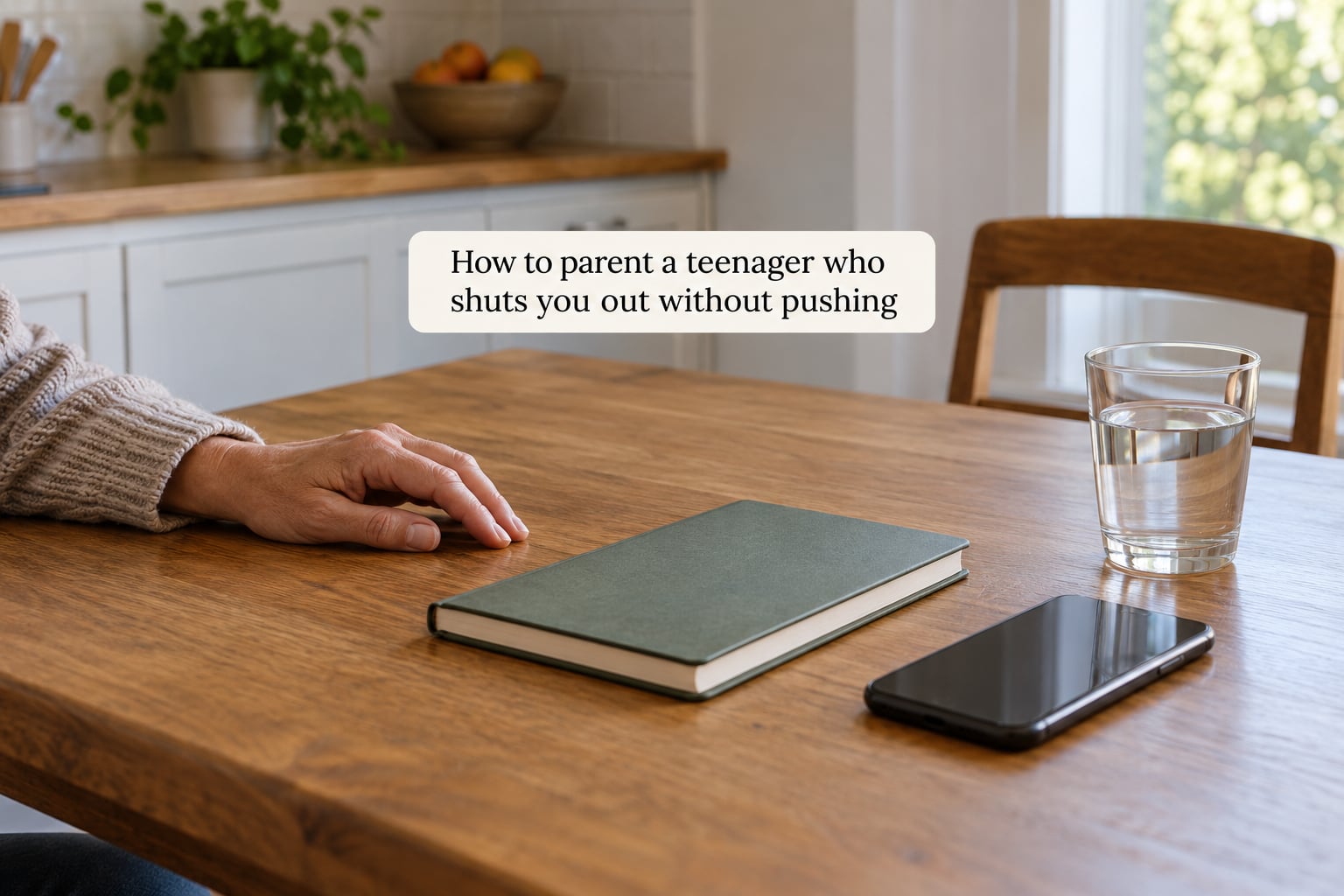
Stop repeating the question. A seventh round of what was your day today teaches your teen that the correct answer is any answer that ends the questioning.
Also stop treating silence as a verdict on you. A closed door, a three-word text, and a missed question are usually a teenager protecting something private, not a teenager rejecting their parent. When your read of the situation is that you are being rejected, the words that come out of your mouth get sharper, and sharper is what closes the door.
Say the availability out loud instead. A phrase that works: “You do not have to tell me anything. I am in the kitchen most evenings if you want company.” That sentence takes the demand off the conversation and leaves the door open on your terms.
You will know it is helping when the tension at the door drops, not when you get an answer. A teen who says “later” instead of “no” has moved a long way.
2. Check for safety and serious underlying problems
Some privacy is normal. A bedroom door that closes, a preference for friends over family, one-word answers, and a sudden interest in privacy are all ordinary parts of adolescent development and need no intervention.
What matters is withdrawal stacked on top of other changes. Watch for shifts in sleep or appetite, grades dropping sharply, losing interest in everything they used to enjoy, constant physical complaints, giving away possessions, spending money they do not have, secretive behavior about who they are with, skipping school, talk of self-harm or of not being around, or a sudden increase in substance use.
Any sign that someone may be in immediate danger deserves action, not patience. If your teen talks about hurting themselves, describes a plan, is being abused, is severely intoxicated, or threatens someone else, contact emergency services or a crisis line in your area right away. If the concern is ongoing rather than immediate, schedule a visit with a pediatrician or a licensed mental health professional. That is a referral, not a diagnosis, and this article is general information rather than medical advice.
Approach it with an observation, not an interrogation. “I have noticed you are sleeping at two and skipping breakfast. Is something heavy going on?” gives them something specific to answer without accusing them of anything.
If your teen is autistic or has ADHD, add this: a shutdown in a neurodivergent kid can look exactly like defiance and is often nervous system overwhelm. Reduce sensory load, shorten the conversation, and come back later. Talk to that teen’s clinician about what overload looks like for them specifically.
3. Choose a calm time instead of chasing the moment
Timing is most of the battle. Do not open a hard conversation at bedtime, in the car line at school pickup, ten minutes after an argument, or when anyone is hungry.
For a lot of teens, side-by-side beats face-to-face. Driving, walking the dog, stirring something on the stove, or riding to practice gives them eye contact free and lets them talk while technically not talking to you. Parents on r/Parenting describe the car as the single most productive place they have ever had a real conversation with their kid.
Make the invitation low pressure and about participation, not disclosure. “I am making gumbo Saturday. You do not have to talk. Want to set the table or would you rather stay in your room?” A yes to the activity is often a yes to being near you, and near is where the real conversations start.
Watch for the small signals that it is landing: they stay in the room, they ask you a question back, they bring up something themselves later in the week.
4. Listen without trying to win or correct
Put down the debate. If you enter the conversation already building your rebuttal, your teen can hear it, and they will manage the conversation instead of participating in it.
Use open questions, reflective statements, and pauses. “So the whole team found out you were not going, and you found out last night?” is harder to argue with than “why did you lie.” Then stop talking. The silence after a reflective statement feels unbearable to you and useful to them.
Three words do most of the work when your teen says something like “you always take her side” or “I hate you”: I know that. It names what you heard without agreeing with it.
Validation is not agreement. You can say “that makes sense that you are furious” and still hold a line, out loud: “I still am not going to let you hit your brother.” Teens can tell the difference, and the line is what makes the validation believable.
One more thing: if your teen tells you something hard, give yourself a night before you respond to the hardest part. Rushing to respond teaches them that honesty gets an argument.
5. Repair trust through consistent follow-through
This is the step that does the actual work. Trust is not repaired by a good conversation; it is repaired by a long run of small promises kept.
Keep the small ones. If you said you would be at the game, be there. If you said you would not read their messages, do not read them. If you said you would call their grandmother, call. A teenager keeps score of what you actually do, not what you said you would do.
Never criticize them in front of other people, and that includes relatives. In households where a grandmother or aunt gets the full report at dinner, agree as a family on what stays private before a problem shows up, not after.
When you lose control, apologize first, once, and specifically. “I raised my voice and called you disrespectful. That was on me” lands. Adding “but you started it” cancels the whole sentence. Parents who go first report that the door opens faster than expected.
Protect what they tell you, with one clear exception: you will always act on information about safety. Telling them that boundary out loud, in plain words, is what makes the confidentiality believable.
6. Give appropriate privacy while staying present
Decide the rules together where you can, and state them where you must. A teenager who helped write the expectations argues with them less than one who had them imposed at midnight.
Cover the usual ground: phone charging in the kitchen overnight, bedroom door closed unless someone is sick or there is an emergency, a text when they arrive somewhere, and who at school may contact you. Give the reason once, in a sentence, then stop justifying it.
Consistency beats severity. A rule you hold every time without drama does more for safety than a harsh rule you enforce once and drop. If it is going to slip, do not announce a consequence you will not carry out.
Keep adjusting as they get older. A seventeen-year-old who wants the door closed and the phone in the kitchen is not the same situation as a thirteen-year-old, and treating them the same guarantees the fight. An eighteen-year-old is a legal adult living in your home, and the terms of that arrangement are a negotiation, not an order.
7. Keep a connection the teen can return to
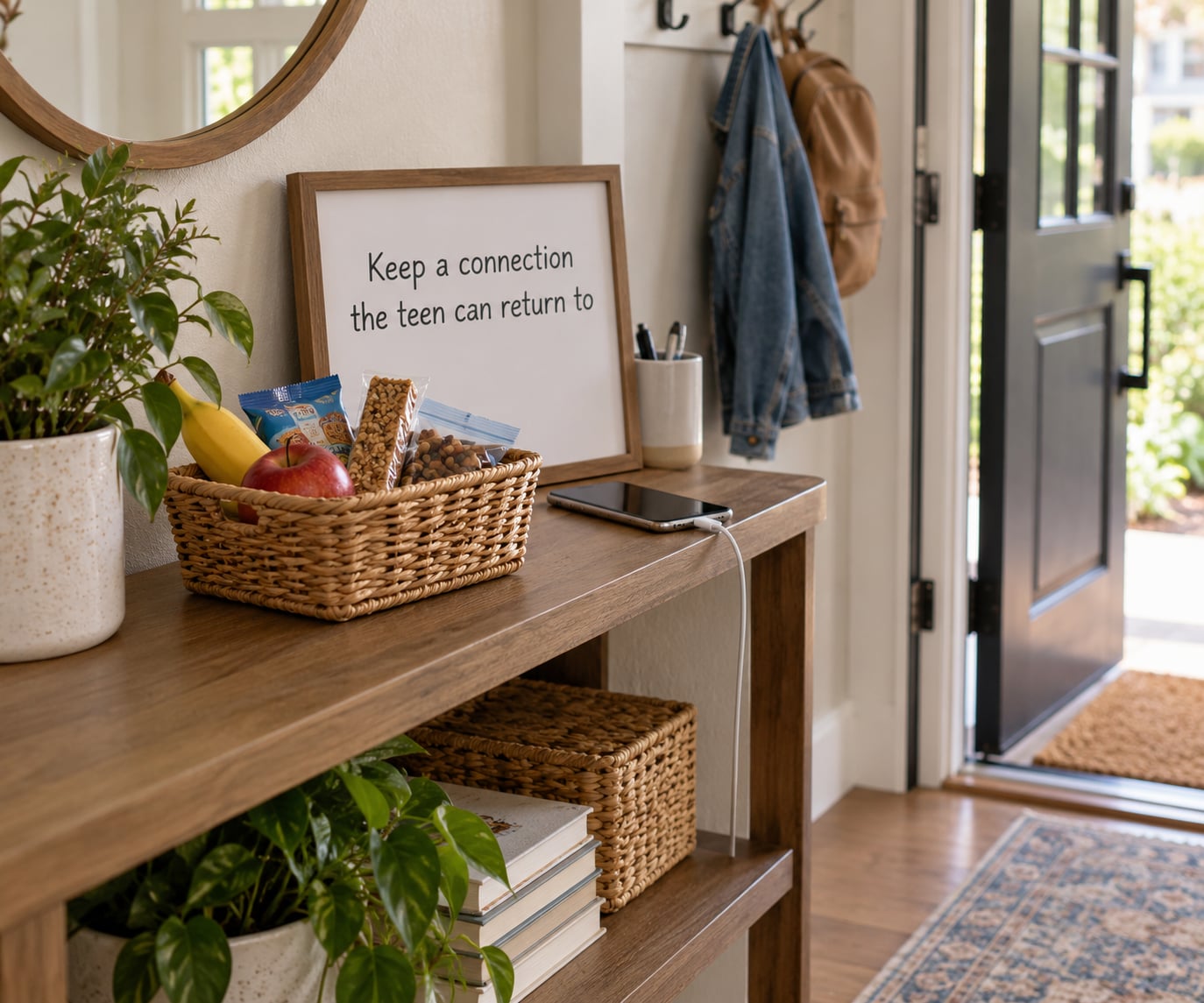
Most of what works here is dull and repeatable. A shared dinner most nights, a ride they know you will make, a standing check-in at the same hour. The routine is the message: my door is not conditional on how you are performing today.
A simple daily framework that families report helps is 7-7-7: seven minutes in the morning, seven after school, seven at bedtime. No agenda, no debrief. Ask about one ordinary thing, not the day’s decisions. The value is not in the minutes, it is that the teen knows the connection is coming whether or not they earned it.
Show interest without interrogating. “I saw you played three matches this weekend. How is the team doing?” is a door. “Why did you not tell me the score” is a demand. One gets answers over time; the other gets a locked screen.
End exchanges respectfully when they are not going anywhere. “I am starting dinner. Door is open.” Then actually go, and do not hover in the hallway. Respectfully closing a conversation is how you teach that talking to you does not have to mean being trapped.
Encourage other caring adults. A coach, an aunt, a youth leader, a counselor, a grandparent they actually like. A teen opening up to someone other than you is healthy, not a rejection of you, and the wider your teen’s support village, the less pressure sits on any one relationship.
Common Mistakes
Almost every stuck family is running one of these, usually several at once.
- Rapid-fire questioning. “Where are you going, who is driving, why are you texting, did you eat?” A dozen questions is an interrogation. Ask one, then let it sit.
- Lecturing during the conversation. A ten-minute speech about responsibility cannot compete with a moment of being heard. Save the lecture for a calm hour, and shorten it.
- Taking the phone away impulsively. A sudden confiscation the same night reads as panic and gives them a grievance. Set phone expectations in advance, and follow through on the version you set.
- Discussing your teen with relatives. Aunts, grandparents, church families, and the group chat hear everything, and your teen will know within a day. What gets shared privately stops being shared privately.
- Arguing by text. Typing removes tone and lets both of you say things you would not say out loud. Nothing past a few logistics should be argued in writing.
- Treating every independent choice as danger. New friends, new clothes, new music, a locked door are not symptoms. Judge each one on what it actually is, not on how unfamiliar it feels.
A few habits that hold up over months. Keep the ratio of your life wider than the problem, so the relationship is not only about the issue. Never compare your teen to a cousin, a neighbor’s kid, or a sibling. Let them come to you twice before you go to them again. And if nothing is moving after a few weeks in a situation that is otherwise safe, that is a reason to call the school counselor or the pediatrician, not a reason to push harder.
Frequently Asked Questions
How long does it take to reconnect with a teenager who shuts you out?
For a generally safe teen, expect weeks rather than days, and sometimes two to three months of consistent effort before you see real change. The first sign is usually behavioral, not verbal: less tension, a door left open, a question asked back. The most common mistake is judging progress after one conversation and concluding that nothing is working.
What if my teenager only communicates through text or social media?
Meet them where they are instead of demanding they meet you in person. Short texts, voice notes, memes, and shared links are real contact, and some teens find writing easier than speaking. Reply in the same medium they used, keep it light, and ask one ordinary question at a time. If a conversation needs depth, ask for a voice note or a walk rather than a face-to-face talk.
When should a parent seek help for a withdrawn teenager?
Seek professional help when withdrawal lasts more than a couple of weeks alongside changes in sleep, appetite, grades, or interest in anything they used to enjoy, or when there is any mention of self-harm, abuse, or substance use. Call emergency services or a crisis line if safety is at risk right now. Otherwise start with a pediatrician or school counselor, who can refer you to a qualified mental health professional.
How do I set boundaries with a teen without making them shut down?
Set the boundary once, state the reason in one sentence, and then hold it the same way every time. Involve them in the details where you can, such as phone charging times or check-in texts, so the rule belongs to both of you. Boundaries are not punishments, and a boundary you enforce calmly is often what makes a teenager relax enough to talk.
What should I say after a parent and teenager argue?
Go first, keep it short, and own your part without the word but. A simple version: I was too loud and I should not have said that. I am still your parent and I am not going anywhere. Then give it time, and keep showing up. How you parent a teenager who shuts you out is decided less by the words in that apology than by what you do over the following month.
Conclusion
Start by stopping. Put the questions down, notice whether anything in the safety list applies, and offer one calm predictable moment of connection this week, side by side, with no agenda.
Then keep showing up for months, not minutes. That is the unglamorous part, and it is the part that works.