
The fastest way to start a side hustle while working full time is to pick one skill you already have, get a real buyer in week one, and grow on a fixed weekly hour budget while your salary absorbs the risk. Most people do not fail on the idea. They fail on scheduling, employer rules, and a tax bill nobody warned them about.
The ideas that survive contact with an 8-to-5 job share three traits: flexible hours, low overhead, and a shape that fits into evenings or weekends without wrecking your sleep. Anything that needs 25 unpaid hours a week to get going is the wrong fit right now, however good the idea sounds.
Below is the plan I would hand a colleague on a Tuesday evening. It takes about two weeks to run the first cycle, and every number in it is a decision you make in advance rather than a promise the internet makes for you. This version is current for 2026.
Table of Contents
- What You Need
- Step-by-Step: How to Start a Side Hustle Without Overloading Your Schedule
- 1. Set a Time and Money Limit You Can Keep
- 2. Choose a Side Hustle That Fits Your Skills
- 3. Check Your Employer Rules and Personal Limits
- 4. Validate the Idea Before Buying Equipment
- 5. Create a Simple Business and Money System
- 6. Build a Weekly Schedule That Protects Your Job
- 7. Launch Small, Track Results, and Improve
- Common Mistakes
- Frequently Asked Questions
- How many hours a week should a side hustle take?
- Can I get fired for having a side hustle?
- What is the lowest-cost side hustle I can start this week?
- How much can I realistically make in the first 90 days?
- When should I quit my job to go full time on a side hustle?
- Conclusion
What You Need
Six things, and none of them expensive. The list matters because most failed side hustles were missing one of these and quietly drifted back into a hobby.
- A realistic time budget. The hours you can protect for eight straight weeks, not the hours you wish you had. Most employed people can hold five to ten a week; a demanding or shift job may allow less.
- An emergency cushion. Two months of living costs at minimum, kept separate from your side-hustle money. Your side hustle should never be the reason you cannot handle a car repair.
- A copy of your employment contract and handbook. The sections on outside work, conflicts of interest, solicitation and use of company resources.
- A simple setup. A separate bank account, a way to invoice or get paid, and a spreadsheet. You do not need a website, a logo or a registered company to test an idea.
- A named buyer. Not “small businesses” but “three-person dental practices in my area that need evening bookkeeping.”
- A tracker. One page with hours, leads, sales, expenses and money in the bank. If you are not measuring it, you are guessing.
One warning before you start: tax treatment, business registration and workplace rules all vary by state and by employer. What follows is how the process generally works in the United States, not personal tax or legal advice.
Step-by-Step: How to Start a Side Hustle Without Overloading Your Schedule
Seven steps, in order. Each one has a time cost and a signal that tells you it worked. Do them in sequence and you will have either a paying customer or a clear no within a month.
1. Set a Time and Money Limit You Can Keep
Write down your fixed weekly capacity before you pick anything. Subtract sleep, the commute, family commitments, exercise and recovery from the week, and round the remainder down. Five honest hours beat twelve optimistic ones, because twelve gets abandoned by week five.
Then set three numbers. Your weekly hour cap, your initial spend cap (most people need nothing at all for a service idea), and the hourly rate below which you stop. If a project would pay you under your floor rate, it is not a client, it is a distraction.
Budget roughly ten percent of what you make back into proof and pricing power: a portfolio sample, a better rate, a small ad test. And set a stop-loss: if you have spent your cap with nothing to show, you pause and re-validate instead of buying another tool.
How you know it worked: eight consecutive weeks pass and the plan still feels realistic. Not exciting. Realistic.
2. Choose a Side Hustle That Fits Your Skills
Start from what people already ask you for, because selling a known skill is dramatically cheaper than selling a new one. Sort your options into four groups and compare them honestly on cost and time to first sale.
- Service work: virtual assisting, bookkeeping, tutoring, pet care. Near-zero upfront cost, first sale anywhere from a few days to three weeks, and it grows through more hours and then a higher rate.
- Skill-based freelancing: writing, editing, design, development. Near-zero upfront cost, three to six weeks to a first sale, and it grows through price and productized offers.
- Digital products: templates, printables, short courses. Under a couple hundred dollars to start, one to three months to a first sale, and it grows through an audience rather than hours.
- Physical products: handmade goods, resale, print on demand. The highest upfront cost of the four, two weeks minimum before a first sale, and it grows through inventory and systems.
Check each candidate against the day job too. If your employer sells the same thing, works in the same industry or serves the same clients, you have a conflict question before you have a business question. If the work needs your laptop at 9 a.m. on a Tuesday, it is not available to you.
Pick one. Combining two ideas halves your attention on both and is the most common way people end up with neither.
3. Check Your Employer Rules and Personal Limits
Read four documents before you earn a cent: your employment contract, the employee handbook, the conflict-of-interest policy, and any rule on outside work, solicitation or use of company resources. Search for “outside,” “moonlight,” “secondary employment,” “conflict” and “non-solicit.”
What you are looking for is rarely a blanket ban. It is usually a clause about competing work, about soliciting your employer’s clients or staff, or about using company time, equipment, email or data. Those three categories are where problems actually start.
If the language is unclear, ask HR in writing and keep the reply. A short email is a cheap permanent record. Then apply your own limit: never work during paid hours, never use company tools or data, never take a client you met through work.
There is a real ethical line about down time as well. People in caretaker, security and warehouse roles often have slack hours on the clock. Billing a client for time your employer is paying you for is not a side hustle, it is a reason to be disciplined.
4. Validate the Idea Before Buying Equipment
Validation is boring and it works. Narrow the problem until it is specific, name one buyer who feels that problem weekly, and then go find evidence that they already pay to solve it.
Four cheap ways to test:
- Search existing demand. Look at the services and jobs sections on freelance marketplaces and local task apps. Three or more active listings for the same service is a signal, not proof.
- Talk to five buyers. Two questions: how do you handle this now, and what did you pay last time? People describing a painful workaround are telling you what to sell.
- Make one sample. One rewritten bio, one edited document, one design mock-up. Do it free or nearly free so you can show it, but do not build a whole portfolio.
- Run a small paid pilot. Sell the work at a deliberately low introductory rate to one real buyer. A payment is the only validation that cannot be argued with.
Direct outreach beats waiting on a platform. In r/sidehustle the most repeated advice is to skip the queue: call the shop, message the owner, email the practice manager. Cold contact feels awful and works faster than any algorithm.
How you know it worked: you have confirmed interest, an inquiry, a preorder or a first sale, and you have not bought equipment to get there.
5. Create a Simple Business and Money System
Do the boring setup once so tax season is not a surprise. It takes an afternoon.
- Registration and licensing. Check whether your city or state requires a business license for what you are doing. Many small service businesses need one; many freelancers do not until they cross a revenue threshold.
- A separate bank account. A second checking account, even a no-fee one, keeps business money out of your personal balance and makes quarterly math trivial.
- Bookkeeping from day one. Date, client, amount, category. Ten minutes a week prevents the single most common side-hustle failure, which is discovering in April that you owe more than you thought.
- A price and a contract. A one-page service description, a rate or project fee, a deposit term for larger jobs, and a simple invoice. Repeat business comes from reliability more than from low prices.
- Sales tax and estimated payments. Some states and localities tax services. And the tax you owe is based on profit, not on what lands in your account.
Two points people consistently get wrong. First, side income is taxable when you earn it, whether or not anyone sends you a form. Second, the reporting threshold that decides whether a payer must issue you a 1099 does not create an exemption below it. All of it is reportable income.
If your earnings grow past a few thousand a year, or you have employees, contractors or inventory, talk to a qualified tax professional. For a small side line, a bookkeeper and annual software are usually enough.
6. Build a Weekly Schedule That Protects Your Job
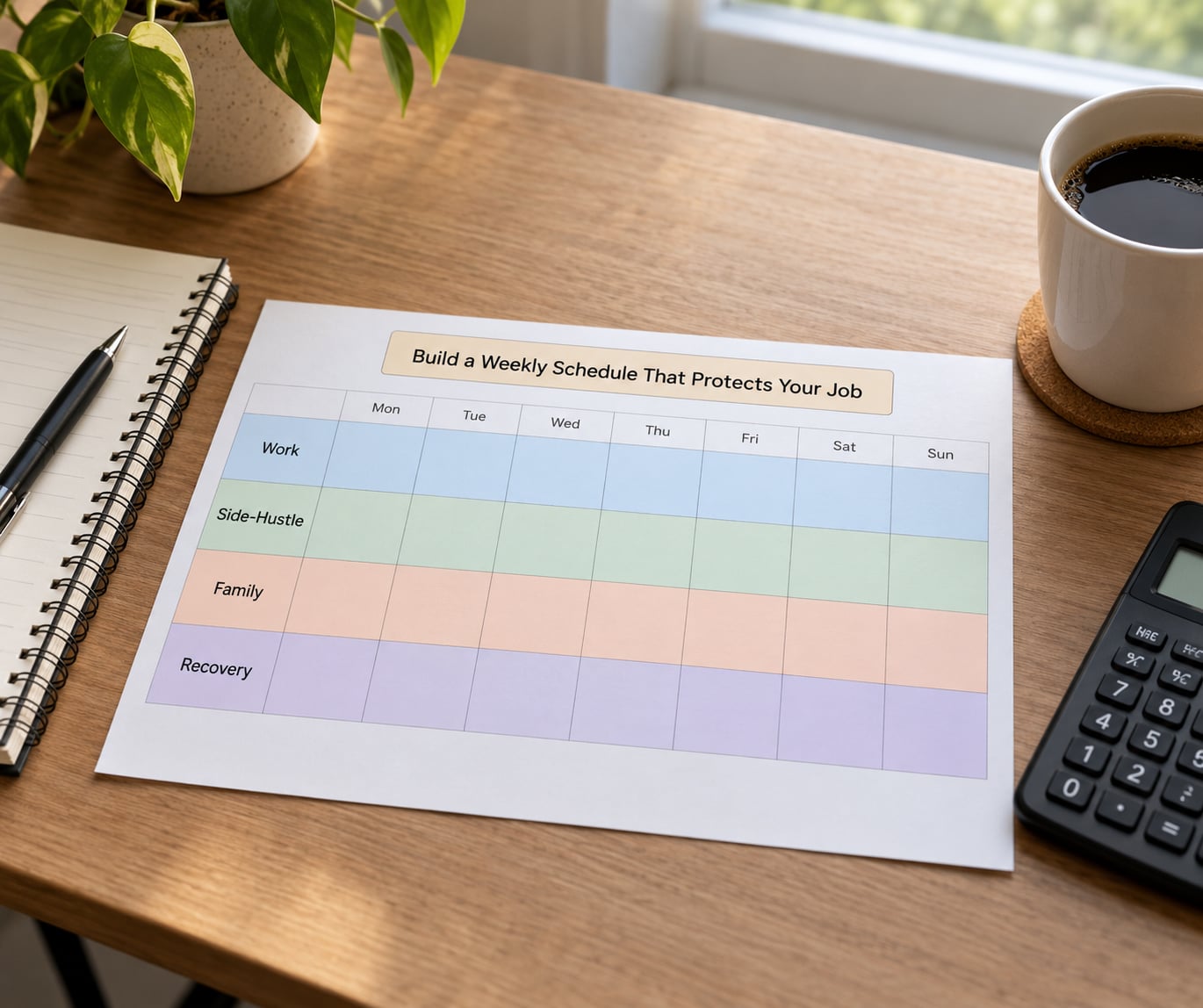
Time blocking is the difference between a side hustle and a hobby that annoys you in March. Two protected blocks a week beat five stolen half-hours.
A workable shape: one weekday block of ninety minutes for the work that requires thought, and one weekend block of two to three hours for delivery, admin and marketing. Everything else is a bonus. People who run their hustle on fragments of ten minutes produce nothing shippable, which is the most common complaint in r/sidehustle and r/Entrepreneur threads.
Protect one evening completely. Not for admin, not for “just checking messages.” Burnout ends more side hustles than bad ideas do, and the fix is structural, not motivational.
Review the numbers every Sunday: hours worked, revenue booked, money actually received, and how you felt. If energy drops for two weeks running while revenue does not move, cut hours rather than pushing harder. The schedule is a budget, and budgets get revised.
How you know it worked: eight weeks of finished work with no impact on your performance review, your attendance or your evenings.
7. Launch Small, Track Results, and Improve

Launch a narrow first offer: one service, one audience, one price. “I do monthly bookkeeping for independent consultants, fixed fee” beats “financial services for small businesses.” You can widen once something sells.
Price it with the math, not the feeling. Take your target monthly income, divide by the number of billable hours you actually have, and add a margin for the non-billable half of every project. Beginners usually charge too little and then take on too many clients to compensate, which is the least profitable mistake on this list.
Tell people where you are. One relevant audience beats ten general ones: an industry group, a local association, a former colleague’s company, a neighborhood network. Then ask every buyer what to improve and what they would pay for next. Specific feedback beats compliments.
Track five things weekly: leads, sales, profit, hours, and what the client actually got. Then change one part every two weeks, not everything at once. Doubling your price, rewriting your offer and switching platforms in the same month tells you nothing about any of them.
Scale by raising prices and productizing, not by adding hours. A productized service is a fixed-scope offer sold at a fixed price, and it turns your hours into a repeatable unit. That is the path from hustling to a real business.
Common Mistakes
Every one of these shows up repeatedly, and most are cheap to fix once you can name them.
Choosing a passion without checking demand. Loving a topic is not a market. Fix: run the marketplace search and the five-conversations test before you build anything.
Buying tools before the first sale. Courses, plugins and monthly software add up faster than revenue. Fix: a strict spend cap and nothing recurring until you have billed someone twice.
Underpricing. Cheap feels safe and attracts the hardest clients. Fix: set a floor rate, charge it without apologizing, and raise it after every three successful projects.
Working inconsistent hours. Two all-nighters a month produces nothing and feels terrible. Fix: the two protected blocks, held every week whether or not you feel motivated.
Ignoring taxes. The first estimated payment or surprise form is what shocks people. Fix: separate account, weekly records, and a quarterly check.
Using employer resources. Company time, laptop, email or data for outside work is the fastest route to a conversation you do not want. Fix: your own equipment, your own accounts, never on the clock.
Taking on more clients than you can serve. Five clients at a low rate is a schedule that fails by month four. Fix: raise the price, cap the roster, or move to retainers that need less coordination.
Growing without a written process. If your repeat work depends on memory, you cannot grow it. Fix: a one-page checklist for every recurring task, written at low volume while you still have time.
Prioritization is simple. Protect the job first, then the relationships at home, then the side hustle. It is the only order that survives a bad month, and a bad month always comes.
Frequently Asked Questions
How many hours a week should a side hustle take?
Most employed people can sustain five to ten hours a week for a service side hustle, and less for anything with inventory or build time. Pick a cap you can hold for eight straight weeks, schedule it as two protected blocks, and treat anything above the cap as a decision you make deliberately. Capacity, not motivation, is what limits most people.
Can I get fired for having a side hustle?
Usually not on its own, but employer rules matter more than you would expect. Contracts and handbooks often address outside work, competing activity, client solicitation and use of company time or equipment. Read those sections, get anything unclear in writing from HR, and never work during paid hours or with employer tools. Your job is your funding source, so treat the contract as a real constraint.
What is the lowest-cost side hustle I can start this week?
The cheapest ones are service work using skills you already have: virtual assisting, bookkeeping, tutoring, proofreading, pet care or event staffing. They need no inventory, no website and no advertising spend, and they can be tested with one sample and a few direct messages to real buyers. A platform account and a separate bank account is a realistic starting budget.
How much can I realistically make in the first 90 days?
Most first quarters are slow. A reasonable expectation for a beginner doing five to ten hours a week is a handful of small projects rather than a full extra salary, with income arriving unevenly and often much later than the work. Run the math before you start: target monthly income divided by real billable hours, then multiply by the number of clients you can realistically serve.
When should I quit my job to go full time on a side hustle?
Treat it as a ramp rather than a leap. First phase is a first paying client. Second is side income near a quarter of your salary for three months running. Third is half, with six months of living costs saved. Only consider leaving when the business covers your salary reliably and you have a genuine cash reserve, because one strong month is weather, not a trend.
Conclusion
Here is the whole plan in four moves: choose one idea that costs almost nothing and does not compete with your employer, write down the hours you can protect for eight weeks, read the outside-work clauses in your contract, then test demand with one sample and five direct messages before you spend anything on equipment.
Run it as a two-week experiment with a pass-or-fail test at the end. A real payment means you continue. Silence means you change one variable, not five. Most people who succeed at this are not busier than you. They just protected two evenings a week and did the boring paperwork early.