
When you feel stuck, the problem usually isn’t that you have no purpose. It’s that your days have quietly stopped matching your values, and you’re too close to see the gap. The fix is a process: name what’s stuck, rank what matters, then test small real-world experiments until something holds up under real life.
If you’re searching for how to find your purpose when you feel stuck, skip the inspiration and the five-step morning routine. People in that situation are rarely lacking motivation. They’re short on signal — clear information about what actually gives their life weight — and most advice stops before that part. Six steps get you there in about 30 days, with the work fitting around a job and a family rather than instead of them.
The good news is that purpose isn’t a single discovery waiting to happen. It’s a direction you build, and you can start building it this week with almost nothing.
Table of Contents
- What You Need — and the Honest Preparation Nobody Mentions
- Step-by-Step: How to Find Your Purpose When You Feel Stuck
- 1. Name What Feels Stuck
- 2. Look Back at Moments of Energy and Fulfillment
- 3. Identify Your Values and Needs
- 4. Brainstorm Several Possible Purposes
- 5. Test Your Ideas in Small Real-World Experiments
- 6. Choose a Direction and Review It Regularly
- Common Mistakes That Keep People Stuck
- Frequently Asked Questions
- How long does it take to find your purpose when you feel stuck?
- What if I cannot identify any interests or strengths?
- Is purpose supposed to stay the same for the rest of my life?
- How do I find purpose without quitting my current job or changing my career?
- What is the difference between purpose, passion, and a personal goal?
- What should I do if I try something new and do not enjoy it?
- Conclusion: The One Thing to Do Today
What You Need — and the Honest Preparation Nobody Mentions
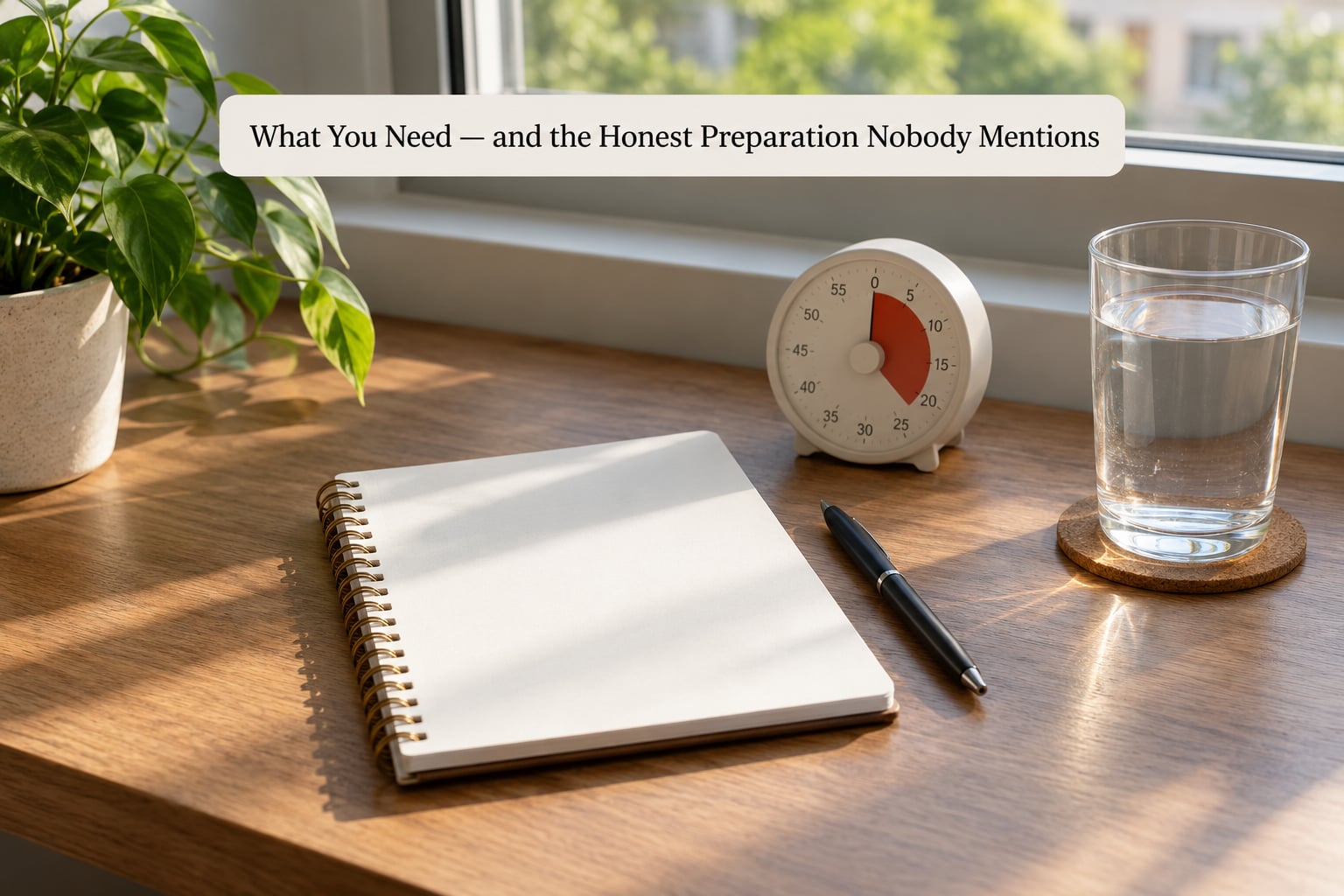
You need four things, and three of them are not gear.
- Twenty uninterrupted minutes, twice a week for a month. Not a weekend retreat.
- A notebook or notes app you write in by hand if you can. Handwriting slows you down enough to notice when you’re writing something you actually believe.
- A timer for the free-association exercises. Give yourself ten minutes, set the timer, and keep writing after the interesting part ends.
- A willingness to be unflattering in the notes. The first answers tend to be the polite ones — what you’d say at a dinner party.
One preparation matters more than the others: block out the time before you start, not after. The most common reason people quit this process at week two is that they scheduled it in the gaps that were already gone.
You’ll also need a way to remember your answers. Nothing fancy. A page titled “evidence” at the back of the notebook works better than a folder system you’ll abandon by mid-year.
Step-by-Step: How to Find Your Purpose When You Feel Stuck
1. Name What Feels Stuck
Write one paragraph about what is actually going on. Not “I need purpose” — that is a conclusion, and conclusions hide the useful detail. Write what happened, when it started, and what it changed. “I got promoted a few months back and have been disengaged since” is a starting point. “I need to find my purpose” is a dead end.
Then place yourself in one of five patterns. Almost everyone reading this fits one of them, and each needs a different first move.
- The burned-out achiever. You hit the milestone and the feeling never came. You need recovery and evidence of meaning, not another goal.
- The drifter. Nothing is wrong, nothing is urgent, and nothing is pulling you either. You need a source of interest to test, not a decision.
- The anxious one. You’re sure you’re meant for something specific but terrified of choosing wrong or wasting years. You need small experiments, because only real data ends the loop.
- The numb one. Life looks fine on paper — steady job, decent routine, few problems — and still feels flat. This is the most common case and the least discussed.
- The comparer. Someone your age seems further along and the gap feels like evidence about you. This one is rarely a purpose problem at all.
How to tell which you are: the burned-out achiever feels tired, the drifter feels bored, the anxious one feels torn, the numb one feels flat, and the comparer feels behind. Say yours out loud. Naming the pattern correctly prevents you from applying the wrong fix for months.
2. Look Back at Moments of Energy and Fulfillment
Purpose research has a name for this: life crafting, the hands-on process Schippers and Ziegler described in 2019 — building a good life out of small deliberate moves rather than waiting for the right one to appear. Their method starts with what you already do well, not with what you wish you did.
Set a ten-minute timer and write every moment from the last five years when you lost track of time. Include the ordinary ones. For me that was editing a document until 1am and a three-hour conversation about career timelines with a friend who works in the trade.
Beside each one, write two things: what you were doing, and who or what it was for. Then mark each for how you felt — absorbed, useful, curious, or drained. The mark matters more than the activity, because plenty of people are good at things that leave them flat.
Look for repeats. Three or four mentions of the same kind of problem, task, or group is a signal. One entry is an accident; four is a pattern worth testing. You’ll usually find that the moments you lost time in involved either fixing something other people have to deal with, or explaining something you know well to someone who doesn’t.
3. Identify Your Values and Needs

This is the step that separates purpose from status, and most people skip it. Values are the qualities you refuse to trade away even when trading would pay. Status is what other people can see. When the two collide, status wins every time, which is why chasing the next title feels hollow.
Write ten values — creativity, service, stability, freedom, belonging, learning, honesty, contribution, beauty, independence — then cut to your top three. Cutting is the whole exercise. Fifteen values is a list of preferences; three is a filter.
Next, rank your needs against a real week, not an ideal one. Take the last seven days and mark 0, 1, or 2 next to each need: enough money, enough sleep, control of your time, connection with people who matter, physical challenge, time alone, chance to learn, something you built. Add the numbers.
Two things to expect. First, your lowest scores are usually in the categories that feel least urgent, which is exactly why they’ve gone unfilled. Second, the gap between your top three values and your lowest need is where your stuckness usually lives. If belonging scores 0 and stability scores 2, no job title is going to fix that.
4. Brainstorm Several Possible Purposes
Do not pick one answer here. Write between five and eight imperfect purpose statements, using this formula:
I use my strengths in ___ to help ___ achieve ___, which matters to me because ___.
The blanks are the work. Weak statements hide everything: “I want to help people.” Strong ones commit to a specific group and a specific change — “I use my editing skills to help first-time nonprofit founders submit grant applications that don’t get rejected on formatting.”
Write all eight before you evaluate any. The first three tend to be versions of what you admire in someone else, and they need company before you judge them. When you finish, highlight the two that made you slightly uncomfortable, because discomfort usually signals the values they touch.
If every statement feels equally valid, run them through two filters. Which one uses something you’re already decent at? Which one could you test within 30 days without quitting anything? The right direction usually survives both. The one you picked because it sounds impressive rarely does.
5. Test Your Ideas in Small Real-World Experiments
This is where the process stops being thinking and starts being evidence. For each of your two surviving statements, design one test that’s cheap, real, and slightly uncomfortable — the discomfort is what tells you something.
Some that work: shadow someone who already does the thing for half a day; take a class or a weekend workshop; volunteer once for the organisation; start the smallest version of the project and let a stranger react to it; ask three people who already work in that field what the first year actually looks like, including the parts nobody advertises.
Give each test a scorecard written down beforehand. Energy before and after, whether you wanted more of it, whether the people involved seemed engaged, and one sentence on what surprised you. Take a photo of your notes on the same day — a week later your memory will smooth it into a rosy version.
Set a deadline of two to four weeks per test. Long enough to get past the newness, short enough to stop something that isn’t working.
6. Choose a Direction and Review It Regularly
You are not choosing a life label. You’re choosing a direction to walk for 30 days, with a scheduled review date in your calendar before you leave this page.
Write the direction as a sentence about what you’ll do more of, not what you’ll become: “More mentoring for junior designers, one session a fortnight, starting next month.” Then write what you’ll do less of. Purpose usually shows up as a subtraction first.
Book the review now, for day 30. On that day ask three questions: which of my values is being expressed more, which need moved off zero, and what did the last month teach me that I had guessed wrong? Rewrite the direction based on answers, not feelings. Mood on a given day is not evidence.
Viktor Frankl called the modern condition the existential vacuum — a sense of emptiness that arrives when the work no longer answers why. Purpose, in his framing, is something you build from what you contribute and whom you serve, not something you locate.
Then let the 30-day cycle repeat. People who keep a sense of purpose don’t do it by finding the right thing once; they maintain it. The Greater Good Science Center’s widely cited figure captures the gap many people live in: roughly 90% say purpose matters in their lives, while only about 25% say they feel they have it. That gap closes through maintenance, not a single decision.
Common Mistakes That Keep People Stuck
Waiting for certainty before acting. Certainty doesn’t come first; it comes after evidence. The anxious reader in Step 1 will wait for a guarantee that does not exist, and the guarantee is not available at any age. Every experiment you run is a partial answer, and partial is enough to move.
Believing purpose is a perfect job. Almost nobody finds one. Purpose survives across roles — a teacher who loves the classroom and hates the paperwork still has a purpose. If you wait for a role that satisfies every value at once, you’ll wait a long time.
Copying someone else’s path. The comparer in Step 1 is the usual culprit. A friend’s career can be a data point, not a template. Their path was built on their values, their constraints, and their starting line, none of which are yours.
Setting goals before values. Goals without a values filter produce motion, not direction. You end up busy in a direction you didn’t choose, which feels worse than being idle because now the emptiness has company.
Taking on too much at once. Five experiments is zero experiments. Pick two, run them well, and let your attention be the scarce resource it actually is.
Abandoning the process after one bad week. A disappointing test is data, not a verdict on the direction. One week tells you very little; two to four tells you something. The most common advice on forums is to do something small and physical, talk to people about what they see in you, and stop while you’re still figuring it out.
Treating the search as the work. Reading more books about purpose can become a way of not choosing. If you’ve read twenty of them and feel more lost, that’s not a knowledge problem — it’s a scheduling one. Put a date on the next experiment and stop reading about purpose for a month.
One last thing. If the flatness has lasted months and comes with sleep changes, appetite changes, or an inability to enjoy anything at all, that’s not a purpose question. Talk to a doctor or a therapist, and if you’re having thoughts of harming yourself, contact a crisis line or emergency services in your area. Getting support is not quitting the process; it’s the rest of it.
Frequently Asked Questions
How long does it take to find your purpose when you feel stuck?
Thirty days is enough to get real signal and choose a direction, though most people run the 30-day cycle two or three times before something holds. The first month clears the fog: what feels stuck, which values rank highest, and which gaps matter most. Purpose is not finished at the end of it. Treat the direction as provisional and review it monthly.
What if I cannot identify any interests or strengths?
Start with evidence instead of declarations, because most people are far better at recognising strengths than naming them. Re-read your five-year energy log and mark every task that others sought you out for. Then test one skill for a fortnight. Strengths are usually built, not found, so a task you can tolerate and improve at counts far more than an interest you feel confident about from the start.
Is purpose supposed to stay the same for the rest of my life?
No. Most people revise their direction several times as their circumstances and values change — a new job, a child, a health scare, a move. What stays steadier is the values underneath, like service or learning or autonomy. Treat the direction as a 30-day commitment you review, not a permanent identity. People who keep a sense of purpose are the ones who keep tending it.
How do I find purpose without quitting my current job or changing my career?
Most purpose sits outside a job title. Test a direction in the two hours a week you already have: shadow someone, take an evening class, run a small project, mentor junior colleagues, volunteer once a month. Keep the experiments low-risk and reversible. A side experiment also tells you more than a job search, because it tests whether you like the work without the stakes.
What is the difference between purpose, passion, and a personal goal?
A goal is a finish line you can complete — a promotion, a qualification, a saved amount. Passion is a strong feeling of interest that tends to fade once you’re competent at something. Purpose is the reason underneath: the contribution you want to keep making and the people it serves. Goals finish, passions flicker, purpose persists. Most confusion comes from expecting a goal or a passion to do the work of a purpose.
What should I do if I try something new and do not enjoy it?
Write down why before you drop it — the commute, the group, the stage of learning, or the work itself. Disliking something new is normal for the first few weeks, and a poor fit shows up as flatness rather than dread. If it’s flat after a fair trial, tick it off without judgement and run the next one. An experiment that ends is not a failure; it is a row completed in a table.
Conclusion: The One Thing to Do Today
Write one paragraph about what feels stuck. Then name your top three values and find one recurring strength from the last five years. Design one experiment you could run within 30 days without disrupting your job or your family.
That’s the whole entry point into how to find your purpose when you feel stuck — not a revelation, not a new belief about yourself, just three lines in a notebook and a date in the calendar. Purpose arrives the same way most lasting things do: through attention and repeated action, not through a single lucky moment. Start with the paragraph. The rest follows.