
Short answer: there is no such registration. In the US, a sole proprietorship is not formed by filing with any agency. It exists the moment you start earning money for yourself, which is why searching for how to register a small business as a sole proprietor mostly turns up LLC and corporation paperwork that does not apply to you.
What you actually file is a small stack of supporting documents: a DBA or assumed name if you trade under something other than your legal name, a business tax account if your state or city requires one, and licenses for your specific industry or location. The whole setup takes an afternoon and often costs nothing beyond a state filing fee.
Below is the plain version, step by step, including what you can skip. Rules differ by state and city and change over time, so treat this as a working map rather than legal or tax advice, and confirm the details with your official state agencies or a qualified professional.
Table of Contents
- What You Need
- What you do not need to file
- How to Register a Small Business as a Sole Proprietor: Step-by-Step
- 1. Confirm That a Sole Proprietorship Fits Your Business
- 2. Choose Your Legal Business Name
- 3. Gather Your Business and Owner Information
- 4. Register With Your State if Required
- 5. Get an EIN if You Need One
- 6. Open Business Bank and Payment Accounts
- 7. Complete Federal and State Tax Setup
- 8. Save Your Registration Records and Set Reminders
- Common Mistakes
- Frequently Asked Questions
- How much does it cost to register a small business as a sole proprietor?
- Do I need an EIN to register a sole proprietorship?
- Is a sole proprietor personally liable for business debts?
- What is the difference between a sole proprietorship and a DBA?
- When should a sole proprietor consider forming an LLC or getting professional help?
- Conclusion
What You Need
Before you file anything, gather seven things. Having them ready turns the process into a single focused session instead of a week of hunting for documents.
- Your legal name and contact details. Your full legal name, the address where you personally live, a phone number and an email you actually check.
- Your Social Security number or an Individual Taxpayer Identification Number (ITIN), if you have one. The IRS needs this to issue you an EIN.
- A business name. Either your own full name or a name you invent and want to trade as.
- A physical business address and a mailing address if they differ. Many states want the address where work actually happens, not a post office box.
- A one-line description of your business activity, such as freelance graphic design or residential cleaning. Keep it general and honest.
- A way to pay a filing fee if your state charges one. Most state offices take a card or an online payment.
- Notes on your local rules. Your city or county licensing office, your county clerk, and any homeowners association (HOA) rules if you work from home.
What you do not need to file
Plenty of new owners assume they need a stack of corporate paperwork. They do not, and filing documents that do not apply to your structure creates real problems, not protection.
- No articles of organization. That document creates an LLC or a corporation, not a sole proprietorship.
- No registered agent. That is an LLC and corporation requirement. You are your own agent.
- No federal formation document. No federal agency approves or records a sole proprietorship.
- No annual report or franchise tax to a state revenue department, because you are not a separate entity.
- No EIN by default. It is optional unless you hire employees, file certain tax forms, or a bank or client wants one.
- No incorporation paperwork of any kind unless you deliberately decide to form an entity later.
How to Register a Small Business as a Sole Proprietor: Step-by-Step
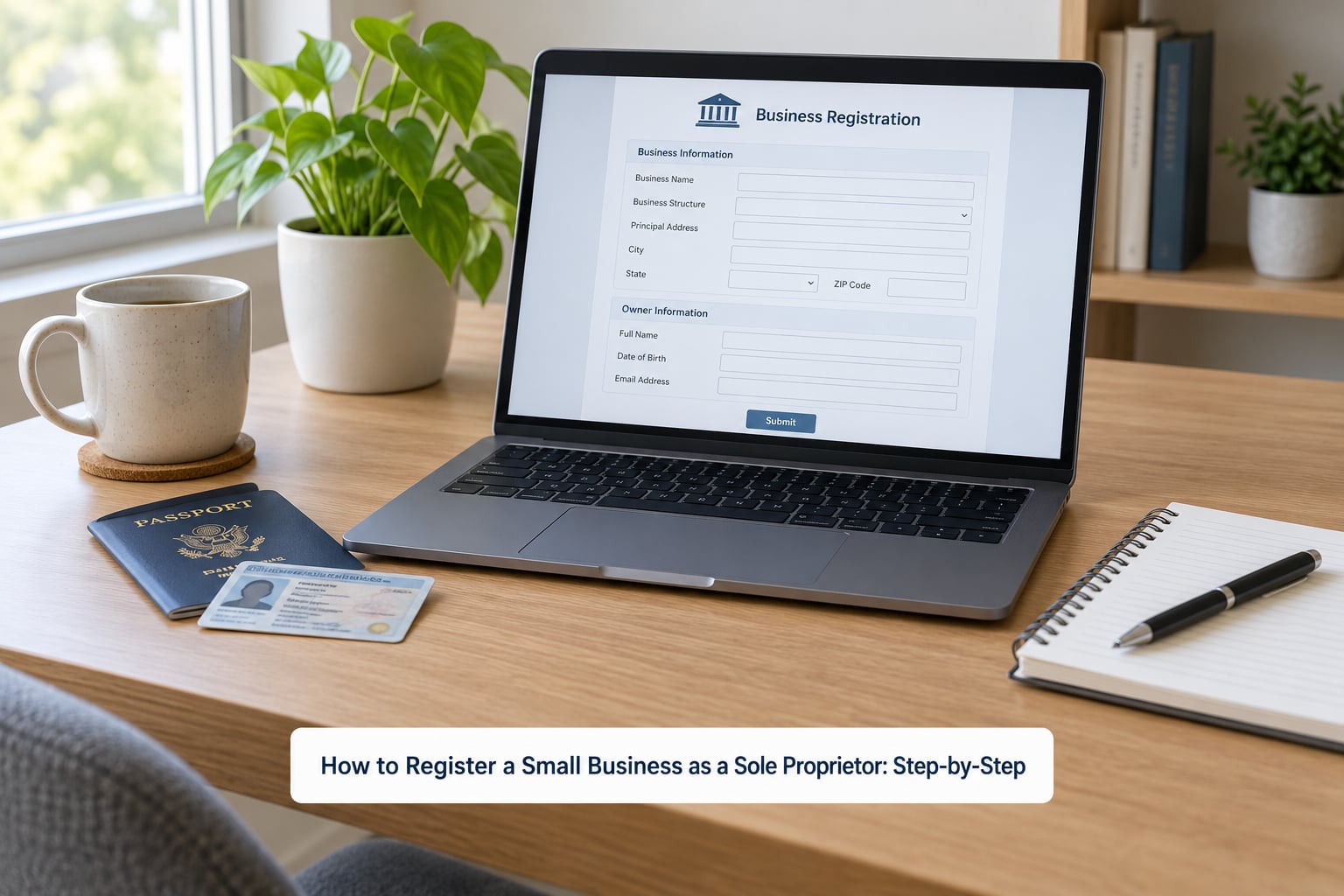
Work through these in order. Steps one through three are decisions, four through seven are filings, and step eight is what keeps you out of trouble next year.
1. Confirm That a Sole Proprietorship Fits Your Business
A sole proprietorship suits one owner who wants simple setup, full control, and no separate filings. You keep every dollar of profit, and you report the business on your own personal tax return using Schedule C (Form 1040). The trade-off is real: there is no legal separation between you and the business, so business debts and business lawsuits can reach your personal assets. That unlimited personal liability is the deciding factor for many people.
Consider an LLC when you are working in a field where a client dispute is plausible, when you have employees, when you work with hazardous materials, or when you are signing leases and equipment contracts. Also worth considering if you want to raise outside money or buy the business from a seller later. If none of that sounds like you, staying a sole proprietor is the cheaper, simpler path.
One limit to know up front: you cannot use this structure if you have a co-owner. Two or more owners with no formal entity is a partnership by default, which changes the paperwork completely.
2. Choose Your Legal Business Name
You have three naming options, and picking the right one decides how much paperwork follows. Using your own full legal name, such as Jordan Reyes, requires no name filing anywhere. Using a fictitious or assumed name, such as Reyes Design Studio, usually requires a filing with your state or county. Some industries also carry trade name rules from their licensing board.
Check availability before you commit. Search your state Secretary of State or county clerk’s business name registry, then search the USPTO trademark database so you know whether the name is already in federal trademark use. Buying the matching domain name at the same time stops someone else grabbing it. A name that reads well aloud and fits in a business card is worth a slow afternoon of checking.
One warning worth repeating often: a registered DBA changes the name you operate under. It does not create a separate legal entity, and it does not protect you from liability. Businesses treat the certificate as if it were a shield, and it is not one.
3. Gather Your Business and Owner Information
Every filing form asks for a similar set of data, so write it down once. Expect to supply the business name, the physical address where the work happens, a mailing address, the principal place of business, your activity description, your owner name, your Social Security number or ITIN, and contact details such as phone and email.
Requirements shift depending on the agency and your tax classification. A state fictitious name form typically asks for the county where the business operates, and some states ask for the signature of a local official or a notary acknowledgment. Have the exact numbers ready rather than approximations, since corrections slow filings down by days.
Write down whether you are starting fresh or adding this to an existing activity, because that decides how you label the business on future tax filings.
4. Register With Your State if Required
Many states have no general business registration, so the honest answer is that many owners skip this step entirely. You register only when a specific rule applies to you, usually a fictitious name different from your own, a state sales tax permit, or an industry licence issued at the state level. Confirm by searching your state Secretary of State or Department of Revenue site for sole proprietor registration requirements, then check your city or county clerk’s office for local business licences.
Florida is a useful example of how this works. Because it has no general statewide business licence, a sole proprietor trading under a name other than their own files a Fictitious Name Registration with the Division of Corporations. That filing carries a fee, runs for a set number of years, and triggers newspaper publication requirements in many counties.
Nevada works differently again. There is no statewide general business licence there either, and obligations sit mostly with counties and cities, such as Clark County and Washoe County, alongside state fictitious name registration. This is exactly why generic state advice fails, so look up your own county. Once you file, keep the stamped confirmation, and confirm success by checking that your business name now appears in the state’s public business name search.
5. Get an EIN if You Need One
An Employer Identification Number is a nine-digit number the IRS uses to identify your business for taxes. Getting one is free directly from the IRS, whether through the online assistant or by mailing Form SS-4. Third-party sites that charge a fee for an EIN are reselling a free service.
You need one if you have employees, run a payroll, file certain tax returns such as Form 1040-ES or a sales tax form, or open a business bank account that asks for it. Many clients request it on Form W-9 simply because they prefer not to collect a personal Social Security number, which is a completely reasonable request on their part.
Getting an EIN does not by itself create a tax bill or a filing obligation. Owners on small business forums worry about this constantly, and the answer is consistent: the number is an identifier, nothing more. Your reporting duty depends on whether you have income or expenses, not on whether the number exists. To verify it works, receive the CP 575 or 147C notice confirming assignment and check that the legal name and EIN on it match your records.
One EIN can cover several activities run by one owner. If you later become a single-member LLC that is treated as a disregarded entity, the IRS generally lets you keep the same number.
6. Open Business Bank and Payment Accounts
Open a business checking account and get a merchant account for card payments. Banks typically ask for your legal name, the DBA paperwork if you have it, your EIN or Social Security number, the business address, and a date of formation, which for a sole proprietorship is the date you started. Being turned down for an account with a large national bank is common; credit unions and online banks for small businesses are usually easier.
Once the account exists, pay yourself a set amount on a schedule and move business spending to a dedicated card. Run every income and every expense through it, keep receipts, and review the account monthly. Simple bookkeeping software or a monthly spreadsheet is enough at this stage, and separating the two streams is the single habit that keeps a sole proprietorship manageable.
Be clear about what a bank account proves: nothing legally. It is not evidence of registration, it does not create an entity, and it gives you clean records rather than liability protection. Confirm it worked by getting the account number, the routing number, and a signature card or account agreement, then make the first deposit within the stated window so the account stays open.
7. Complete Federal and State Tax Setup
Set up your tax tracking from day one. Your business income and expenses go on Schedule C (Form 1040), self-employment tax goes on Schedule SE, and quarterly payments go on Form 1040-ES. Self-employment tax covers both Social Security and Medicare, and it applies to net earnings after business expenses. You pay income tax on top of it, which surprises most first-year owners.
Two rules trip people up. First, income is income, however it arrives, so report money from cash, payment apps, crypto, barter, and goods sold. A customer withholding nothing and issuing no form does not change that. Second, if you expect to owe a certain amount or receive a W-2, look at whether you fall under the estimated tax thresholds; the IRS treats paying at least a set percentage of that prior-year amount as meeting the requirement.
On the state side, check whether you need a sales tax or use tax permit, whether your state has an income tax, and whether your city or county levies a local gross receipts or occupational tax. Online sellers and resellers face marketplace facilitator rules that can move the collection duty to the platform, so check rather than assume. Ask your state Department of Revenue directly when a rule is unclear, or pay a professional an hourly rate for a one-time setup session, which is usually cheaper than a penalty for a wrong answer.
If you also hold a full-time job, here is the part many guides skip. You do not need your employer’s permission to run a sole proprietorship on the side, and your employer does not share that income. You still report it on Schedule C, and it can push you into a higher tax bracket and trigger the additional Medicare tax. Confirm your employment agreement has no conflict-of-interest or non-compete clause before you start.
8. Save Your Registration Records and Set Reminders
Create one folder, physical or digital, and put everything in it: the stamped name registration, your EIN confirmation letter, licence certificates, insurance documents, your bank account agreement, and copies of the forms you submitted. Take a photo of each page so a lost original never becomes a lost registration.
Then write the renewal dates on a calendar you will actually look at. Assumed name filings expire, licences renew annually, insurance policies have renewal terms, and quarterly estimated tax due dates do not move. Put reminders a month ahead rather than a week ahead.
Confirm the step worked by checking your own records against reality. Pull up your business name in the state search, confirm the EIN letter matches the name on your bank account, and verify every licence expiry date against your calendar. Set a yearly review, since a change of address, a new activity, or a move to another county can each trigger fresh requirements.
Common Mistakes
Almost every expensive problem I see traces back to one of these. Each has a straightforward fix.
- Using informal proof instead of official filings. A logo, a printed card, and a social media page mean nothing to a state agency. Fix: file the name registration and keep the stamped confirmation.
- Treating a DBA as liability protection. It changes your trading name and nothing else. Fix: read it as a naming document, and get an LLC if you want separation.
- Missing local requirements. State rules are only half the picture, and city, county, and HOA rules are the other half. Fix: ask your local licensing office directly before you take payments.
- Mixing personal and business money. One shared account makes bookkeeping painful and can undermine an expense claim. Fix: separate accounts from the first deposit, even if it is a credit union account with a low minimum.
- Overlooking licences for your activity. Food, childcare, health coaching, trades, and transportation all carry rules beyond general business licensing. Fix: check your industry regulator and OSHA requirements where they apply to your setup.
- Incorrect tax classification. Filing income in the wrong bucket distorts your bracket and your quarterly payments. Fix: work out the correct category before the first filing period, and ask when unsure.
- Skipping renewal dates. A lapsed name registration or expired licence can freeze your accounts. Fix: put every expiry in one calendar with monthly reminders.
Two habits cover most of the rest. Read your own confirmation documents once, properly, on the day you receive them. And when a question falls outside your state, your city, or your industry, ask the specific office that handles it rather than a general forum, because those offices give straight answers and usually publish the rules.
Always confirm current fees, forms, and tax figures with the IRS, your state revenue department, and your local licensing office before you file. Rules here vary by location and business type and change regularly, and nothing in this guide is legal or tax advice for your situation.
Frequently Asked Questions
How much does it cost to register a small business as a sole proprietor?
There is no registration to pay for, because no agency registers a sole proprietorship. Your likely costs are a state or county fictitious name filing where your state requires one, any local business licence, sales tax permit or industry licence, and business insurance. Several of those are free, some cost a modest fee, and many owners spend nothing beyond filing fees in their first year. Check your own state and city requirements, since that is where the real number comes from.
Do I need an EIN to register a sole proprietorship?
You do not need one to start, because there is no registration requiring it. An EIN becomes useful or necessary when you hire employees, run payroll, file certain tax forms, or when a bank or client asks for it on a Form W-9. Many clients would rather not receive a personal Social Security number. It is free directly from the IRS, and having one does not create a tax bill or a filing obligation on its own.
Is a sole proprietor personally liable for business debts?
Yes, fully. A sole proprietorship has no legal separation from its owner, so creditors and claimants can reach your personal assets, including your home, car, and savings. Filing a DBA does not change this, which surprises a lot of first-time owners. If that exposure does not sit well with you, forming a single-member LLC adds a layer of separation for a modest annual cost, though it is not a substitute for insurance.
What is the difference between a sole proprietorship and a DBA?
A sole proprietorship is the business structure itself: one owner, no separate legal entity, and profits and losses flowing to your personal tax return. A DBA, or doing business as, is just the public name you trade under when it differs from your legal name. Filing one gives you a stamped certificate in most states and helps with invoicing and search visibility, but it does not create an entity or shield your personal assets.
When should a sole proprietor consider forming an LLC or getting professional help?
Consider an LLC when you have employees, work in a field where disputes are common, sign leases or equipment contracts, or want your personal assets separated from business risk. Get professional help when you are unsure about tax classification, run payroll, face a state-specific rule you cannot verify, or are converting from sole proprietor to LLC. A single annual compliance check with an accountant or attorney is far cheaper than correcting a filing error later.
Conclusion
Start by confirming the structure fits your situation, since the sole proprietorship’s one big drawback is unlimited personal liability. Then choose your name, check availability in your state registry and the USPTO trademark database, and file an assumed name only if you trade under something other than your legal name.
Next, check your state, county, and city requirements, including any industry licence or home occupation permit, and grab a free EIN from the IRS if a bank or client wants one. From there, open a business account, set aside a fixed percentage of every payment for taxes, and file a single folder holding every confirmation document with its renewal dates already in your calendar.