
To deal with microaggressions at work, do four things: name the behavior calmly, ask one neutral question about what they meant, state the impact in a single sentence, and write the incident down the same day. Most incidents resolve in one exchange. The ones that do not are patterns, and patterns are handled with documentation and escalation.
The hard part is rarely finding the words. It is the two seconds after a colleague says something that lands in your chest, when the meeting keeps moving and your brain goes blank. This guide gives you the words, the timing, and the record, in the order you will actually need them.
Table of Contents
- What You Need Before You Respond
- Step-by-Step: How to Deal With Microaggressions at Work
- 1. Recognize the Pattern Before You React
- 2. Pause Before You Respond
- 3. Ask a Calm, Specific Question
- 4. Set a Clear Boundary
- 5. Document What Happened
- 6. Escalate When Necessary
- Where People Go Wrong at Each Step
- Tips for Handling Microaggressions at Work
- Common Mistakes: What Backfires and the Fix
- Frequently Asked Questions
- What should I do if I experience a microaggression at work?
- How do I respond to a microaggression without sounding confrontational?
- Should I document a microaggression if it happens only once?
- When should I report workplace microaggressions to HR?
- What if my manager dismisses or minimizes the behavior?
- How can I deal with microaggressions if I am not ready to speak up publicly?
- Conclusion
What You Need Before You Respond
NPR describes microaggressions as everyday comments, questions, or behaviors that carry a subtle bias against a marginalized group. The term comes from psychologist Derald Wing Sue, who built the framework on the idea that bias shows up not as a slur but as a stack of small, ordinary remarks most people make without noticing.
Intent versus impact is the distinction that trips people up. Intent is what the speaker meant. Impact is what landed. You can respond to impact without arguing about motive, which is what makes a response possible at all. Mental Health America frames the same point differently: repeated small slights create a climate, and the climate is the problem, not any single line.
Here are the three forms most workplace examples fall into:
| Type | What it does | Workplace example |
|---|---|---|
| Microinsult | Says something that demeans or belittles | “You’re so articulate.” “You speak English very well.” |
| Microinvalidation | Dismisses your experience or viewpoint | “You’re just being too sensitive about a joke.” “We don’t do that here.” |
| Environmental microaggression | Excludes or diminishes you through the setting | Your name is mispronounced every week. Only one photograph of Black employees is on the wall. |
Examples cluster by category, and it helps to have your own ready. Racialized remarks include asking where you are “really” from or complimenting an accent. Gendered remarks include being interrupted, being told to soften a performance review, or being assigned the office party and the note-taking by default. Name-based remarks include persistent mispronunciation, being handed a colleague’s folder by mistake, or being asked to spell your own last name.
Competence-based remarks include “can I speak with your boss,” being praised for a calm demeanor you never worked on, or having an idea repeated in someone else’s voice until it lands. LGBTQ+ colleagues get mistaken identities and “we don’t have anyone like you here.” Older and disabled employees get assumed decline, “how will you keep up,” or conversations that skip over them entirely. Appearance-based remarks include “smile more,” “you’re being too loud,” or comments about hair, weight, and who is expected to perform friendliness on a team.
What you need before you respond is less than people think. A moment of privacy if you can get one. Two or three sentences rehearsed in advance so you are not improvising under pressure. And a way to record what happened within the hour, while the wording is still exact.
Step-by-Step: How to Deal With Microaggressions at Work
Six steps, in the order that keeps the most risk off you. Skipping step two is how well-meaning responses turn into a fight nobody asked for.
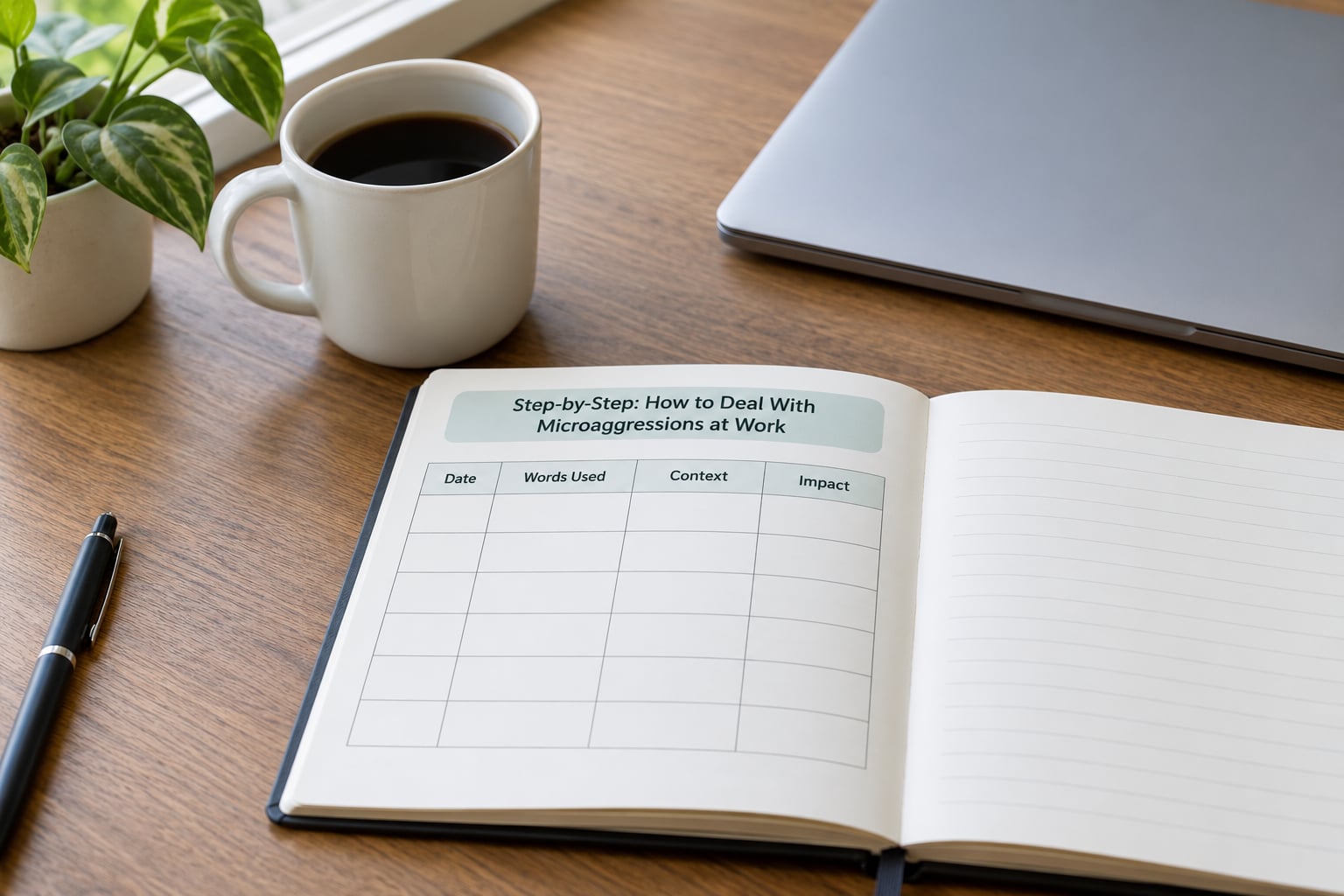
1. Recognize the Pattern Before You React
One odd comment is usually a comment. Twenty of them over four months is a pattern, and a pattern is something you can act on. Before you decide anything, look at four things: the exact words, the context, who else was present, and whether it has happened before.
Ask yourself the version of the question that actually helps: how many times, and who else has heard it? A name mispronounced once by someone who has never met you is a mistake. The same name mispronounced for two years after you have corrected it politely is a choice.
Context does real work here, and this is where honest self-assessment beats self-blame. A long-term colleague who is simply blunt, whose comments land the same way on everyone, may not be targeting you at all. Someone who targets you in front of your manager, or only when your manager is out, is building a different record.
On the r/blackladies forum, workers describe exactly this pattern: a task they completed used against them in front of a boss who then sided with the other person. That is not a misunderstanding, and it is worth naming as a pattern early.
2. Pause Before You Respond
Your first reaction is adrenaline, and adrenaline is a poor editor. The pause is not a weakness. It is the difference between a boundary and a blow-up.
Practically, that pause is one breath plus a decision about whether you have the bandwidth to address this right now. Sometimes you do not. A comment you can answer later in a hallway can ruin a whole afternoon if you answer it hot in a meeting. There is no prize for responding in the moment, especially when the moment is a room full of people watching.
If you do not respond immediately, write down what you remember before it blurs. Memory smooths things out and adds tone you wish you had heard.
3. Ask a Calm, Specific Question
Questions are the lowest-drama way to interrupt a microaggression because they ask nothing about character. They only ask for meaning, and there is rarely a clean answer.
- “What did you mean by that?”
- “Can you say more about that?”
- “I want to understand that better. Which part are you referring to?”
- “I’m not sure what that’s referring to. Can you clarify?”
- “Has that been your experience, or have you heard that from someone else?”
A flat, curious tone does most of the work. People hear accusation in tone long before they parse words, so keep the volume level and slow down slightly. The goal is a pause in the room, not a confrontation in it.
4. Set a Clear Boundary
After the question, if the answer is nothing, state the boundary in three parts: what the behavior is, how it lands at work, and what you need instead. Keep it to a sentence or two.
“That lands as a comment about my speech, not my work. I’d rather you comment on the work.” Or: “I’ve corrected my name three times, so I’m going to ask you to use it as written.” Or the one that costs the most and works best: “I’m going to stop responding to that.”
Criticize the behavior, never the person. You are not accusing anyone of being racist, sexist, or homophobic in a meeting. Those words turn a comment into a fight about who is a good person, and you lose the room. Name what was said, what it did, and what you want.
Do not explain your whole history or cross-examine their motives. One boundary, delivered plainly, then stop. People who were curious change behavior. People who were looking for an opening move on to the next target.
5. Document What Happened
A record is not drama. It is what turns your memory from a feeling into a fact, and it is what makes a pattern visible to anyone else who has to weigh it.
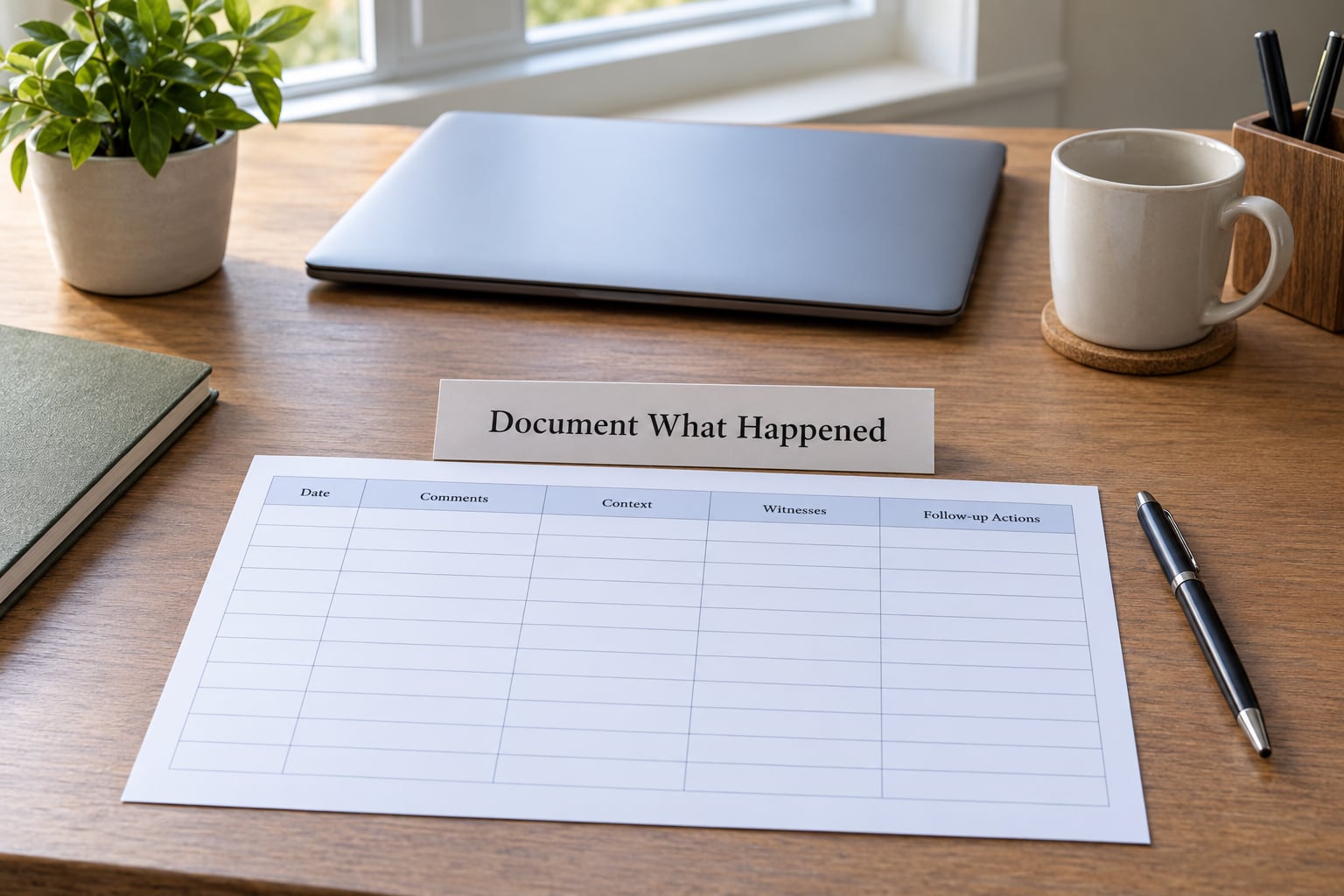
Record these fields the same day:
- Date, time, and location, including whether it was a meeting, a review, or hallway
- The exact words, quoted, as close to verbatim as you can manage
- Who said it and who was present
- Who else was targeted, if anyone
- What you did in response and what happened next
- Anything connected to work outcomes: assignments, credit, reviews, promotion conversations
- Prior instances on the same topic, with dates
Keep it in a personal document with backups, not on a shared drive, and write it in neutral language. Describe what was said and what happened, not what the person meant. If you use the word “racist” in every entry, someone can argue motive for an hour. If you quote the words and list the dates, there is nothing to argue about.
Mental Health America and researchers who study this describe the cumulative effect as the real injury. One incident is rarely reportable on its own. Six documented ones in a quarter are a pattern that any manager has to address.
6. Escalate When Necessary
Escalation is a sequence, not a leap. Most situations resolve at step one or two, and going in early with nothing often makes things worse rather than better.
- A direct conversation. Use the scripts above, privately. Follow up in writing the same day with a short note: what was said, what you asked for, how you want it handled going forward.
- Your manager or skip-level leader. Bring the log, not the feelings. Say: “These are the four instances since March. Here is what I have already said. I would like this to stop.”
- HR or an employee resource group. Ask for the outcome you want in writing: a conversation on record, a change in team norms, a note in a file.
- Formal route. In the US, the EEOC explains how to file a discrimination charge. Deadlines apply, and they are short, so check them rather than assuming you have time.
On r/AskHR, the recurring question is whether small repeated interactions are even worth reporting. They are, and more people file them than people expect. Ask a Manager covered a version of this in 2026: a coworker reported small interactions to HR, and the practical answer was that documentation is what gives a report weight.
Also plan for the case where the source of the microaggression is HR itself, or the person who owns the company. When that is true, the written log and the external routes matter far more, and you may want confidential advice from an employment lawyer before you file anything. A single consultation is usually worth the cost.
Where People Go Wrong at Each Step
- Responding hot. A sharp reply gives the person a story about you, not about the comment. Pause and use a script instead.
- Waiting for the perfect moment. There isn’t one. If you wait for a pattern, it grows.
- Confronting without a record. A conversation with no notes becomes “that never happened.” Write first.
- Expecting one conversation to fix it. Most change in behavior, and some people never will. Judge the outcome by what happens next, not by what they promise.
- Letting “you’re too sensitive” stand. That dismissal is part of the pattern, and it is the part most worth writing down. People who work in HR call it the gaslighting component of the pattern.
Tips for Handling Microaggressions at Work
Choose private over public whenever you have a real choice. A hallway conversation protects the other person’s dignity and yours, and a public correction often turns the room against the person who spoke.
Use a written follow-up after every verbal exchange. Two sentences is enough. It changes the tone of the whole record, because now there is a trail and everyone knows you keep one.
Find one person who has the full picture. A coworker, a mentor outside your reporting line, an ERG contact. Handling these alone is the part that wears people down fastest.
Watch for whether behavior actually changes over the next four to six weeks. One apology is not a trend. If nothing changes, you have your answer about whether to escalate.
Pay attention to the cost of self-shielding. A report on workplace microaggressions found 78 percent of women who faced them altered their appearance or conduct at work, and women in engineering forums describe being told to ignore remarks like “weird behavior” or to stop being so sensitive. Speaking less, dressing differently, softening your tone so you do not get called aggressive in a review. That is not resolving the issue. That is paying for it out of your own comfort every day.
Talking to a therapist or using an employee assistance program is not an admission of weakness. Some workplaces have one; most do not advertise it, and asking a manager costs nothing.
Common Mistakes: What Backfires and the Fix
Most workplace scripts fail for a handful of predictable reasons. Here is what usually goes wrong, with something that works better.
“Are you playing the race card?” This asks the other person to prove a negative about themselves, and it hands the room a debate about accusation instead of behavior. Try: “I asked what you meant. I’d like to hear the answer.”
A long explanation of every incident you have ever experienced. It turns a two-minute exchange into a seminar no one asked for. Say the one thing that happened, the impact, and the ask. Save the rest for your log.
Explaining why you are not sensitive. You should not have to prove your own reaction. Replace it with the impact sentence: “That lands as a comment about my speech.”
Quitting the conversation with “you’re being ridiculous.” It is satisfying for about an hour. The next instance gets logged and the pattern continues. Use “I’m going to stop responding to that,” which is final without being inflammatory.
Going straight to HR on the first incident. A single report with no pattern reads as a personality conflict, and it can cost you more goodwill than the comment did. Document, respond, and escalate on the second and third.
Confusing a bad joke with a pattern. If you raise it once, calmly, and it stops, you fixed it. If it returns, that is no longer a joke, and you escalate on the record, not on the memory.
Two habits carry most of this work: staying factual, and staying calm. Write down the words, not your conclusions about the person. Pause before you answer, then say the boundary once and stop.
Frequently Asked Questions
What should I do if I experience a microaggression at work?
Pause before you react, then respond in one or two neutral sentences: name the behavior, say how it lands, and ask for a change. Write down the date, the exact words, and who was present the same day. Treat a single incident as a conversation and several incidents as a pattern, because patterns are what you can escalate.
How do I respond to a microaggression without sounding confrontational?
Ask a question first, because questions carry no accusation. Try u0022What did you mean by that?u0022 or u0022I want to understand that better.u0022 If the answer is nothing, follow with the impact and the ask: u0022That lands as a comment about my speech, and I would rather you comment on the work.u0022 Criticize the behavior, not the person, and stop after one boundary.
Should I document a microaggression if it happens only once?
Yes. One entry costs two minutes and becomes the baseline for everything that follows, including a pattern you may not recognize yet. Record the date, the quote, the setting, and who was present. A single note is rarely actionable on its own, but it is how you build a case you can actually use later without relying on memory.
When should I report workplace microaggressions to HR?
Report when the behavior continues after you have addressed it directly, when it is tied to your assignments, credit, reviews, or promotion, when it happens in front of others repeatedly, or when anyone else is being targeted the same way. Bring your written log and ask for a specific outcome. Small repeated interactions are reported more often than most people expect.
What if my manager dismisses or minimizes the behavior?
Thank them for hearing you, then restate the pattern and your ask without arguing about intent: u0022These are five instances since February. I would like you to address it directly.u0022 If nothing changes after that, move up a level or take it to HR with your log. In the US, the EEOC explains how to file a discrimination charge, and the deadlines are short.
How can I deal with microaggressions if I am not ready to speak up publicly?
Use private channels. A hallway conversation, a written message, or a one-to-one with your manager works far better than a public correction, and it protects the other person’s dignity while protecting yours. You can also document without confronting anything yet, and tell one trusted colleague so you are not holding the whole thing alone.
Conclusion
Start by naming the behavior, not the person. Stay calm, ask one neutral question, state the impact in a single sentence, and set a clear boundary. Write down the date and the exact words the same day. If it happens again, you are no longer dealing with a comment, and the log becomes the thing that moves it.