
To wake up early when you are a night owl, move your clock in small steps: pick one fixed wake time, bring it earlier by 15 to 30 minutes every few days, and get bright outdoor light within half an hour of opening your eyes. Light is the strongest signal your body clock responds to, so timing does more work than willpower.
Here is the honest version of how that works. Your internal clock is a roughly 24-hour rhythm controlled by light and darkness, and late chronotypes release melatonin later at night and hit peak alertness later in the afternoon. When your alarm asks for a 6am start and your clock is still set for a 9am one, you get sleep inertia, that groggy lag where the alarm is ringing but your thinking is not online yet.
Most people land on a workable schedule in three to four weeks, not three days. Forum threads on the topic keep coming back to the same numbers: shift by no more than 10 to 15 minutes every one to two weeks, and use a 10,000 lux light therapy lamp for 30 minutes at wake-up time when the weather will not cooperate.
Table of Contents
- What You Need for How to Wake Up Early When You Are a Night Owl
- Step-by-Step
- 1. Set a Fixed Wake-Up Time You Can Keep
- 2. Shift Your Sleep Time Gradually
- 3. Use Morning Light to Reset Your Body Clock
- 4. Replace Evening Screens With a Wind-Down Routine
- 5. Build a Helpful Morning Routine
- 6. Stay Consistent Even After a Late Night
- 7. Fine-Tune the Plan for Four Weeks
- Common Mistakes
- What to Do When You Wake at 3 or 4 AM
- Frequently Asked Questions
- Can night owls really learn to wake up earlier?
- How early should I go to bed if I need to wake up early?
- Is it bad to use an alarm clock every day?
- What if I am still tired after waking up early?
- Should I take a nap when changing to an earlier schedule?
- Conclusion: Start With One Small Change
What You Need for How to Wake Up Early When You Are a Night Owl
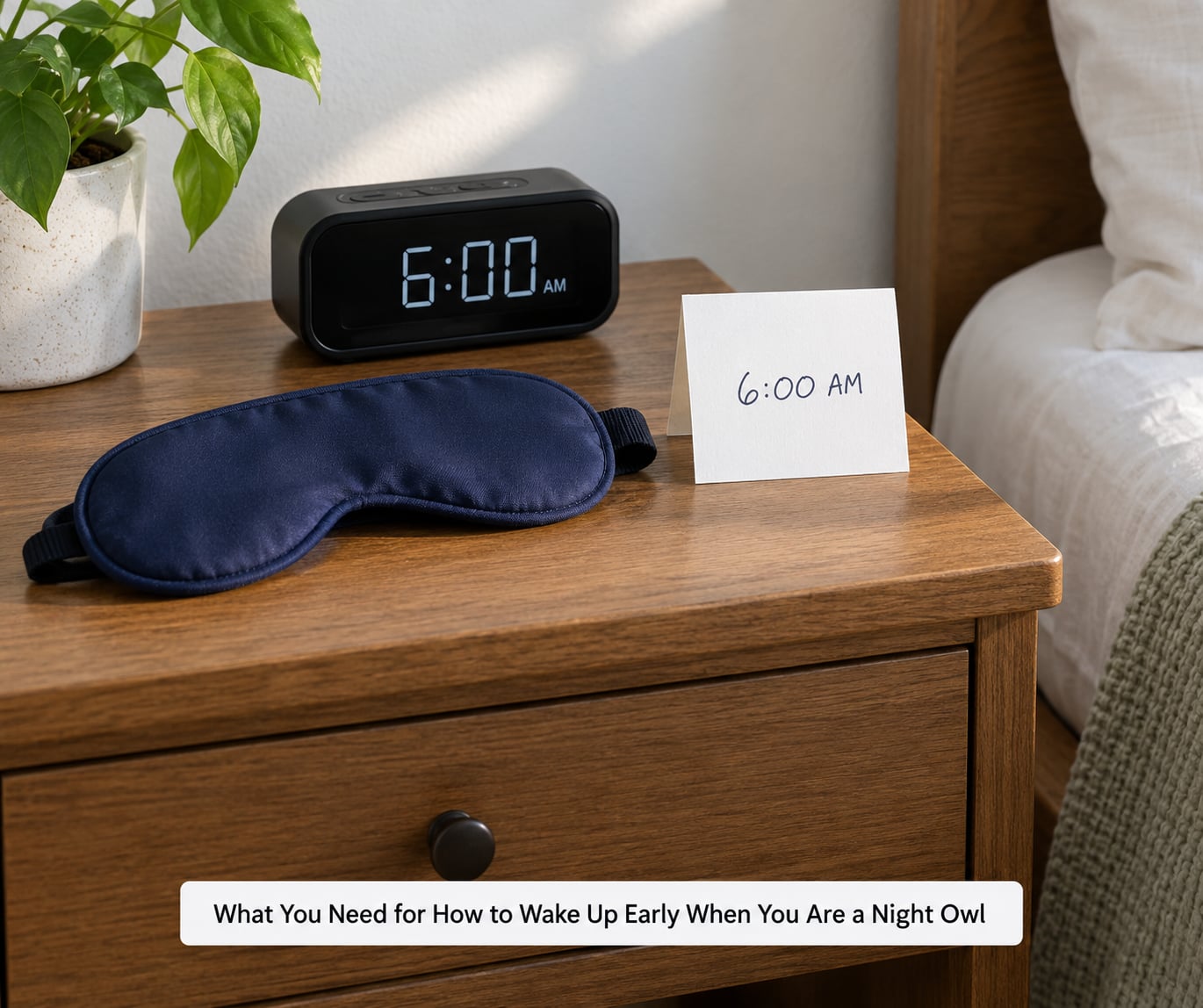
You need five things, and none of them cost anything. A realistic target wake time, a fixed sleep window, a clock, curtains or an eye mask, and a backup alarm.
Start with the sleep window. Adults generally need seven to nine hours, so pick the eight-hour version and protect it. That means if you want to be up at 6am, your target bedtime is around 10pm.
Aim for a wake time you can hold seven days a week, including Saturday and Sunday. Social jetlag is the daily mismatch between when your body wants to sleep and when the world expects you to be awake, and a schedule that swings four hours on weekends keeps that jetlag in place permanently.
The clock and the curtains do the environmental work. Put the alarm somewhere that forces you to stand up, keep the phone out of the bedroom, and get blackout curtains or a good eye mask so streetlight and early sunrise do not push your clock back later.
A backup alarm matters more than people expect. Place a second alarm across the room or in another room, ten minutes past the first. The only reason a night owl fails at waking early is that they never actually got up the first time.
Step-by-Step
1. Set a Fixed Wake-Up Time You Can Keep
Write down the wake time you need on your worst day, not your best one. If childcare drop-off is at 7:15am and you need to be functional by then, your alarm goes at 6am every day, including the days you have nothing scheduled.
Work backwards to find your latest reasonable bedtime, then hold that window steady for seven days before changing anything. Changing the wake time and the bedtime together is what makes the plan work, and changing only the wake time is what creates a sleep deficit.
How do you know this step is working? You wake within a few minutes of the alarm most days and you do not need a snooze to get moving. If you are hitting snooze repeatedly, your target is too aggressive right now, not your discipline.
2. Shift Your Sleep Time Gradually
Move bedtime and wake time earlier together, starting at 15 to 30 minutes per change and repeating every three to seven days. Reddit sleephackers threads recommend an even gentler 10 to 15 minutes every one to two weeks for people who have been night owls for years.
A worked example: if you currently fall asleep at 1:30am and wake at 9am, set both 30 minutes earlier for week one, so 1am to 8:30am. Week two moves to 12:30am and 8am. Three or four weeks like that usually gets a person to a 7am wake time without a single badly broken night.
Sudden jumps feel like failure because they create sleep debt rather than a rhythm shift. You are not building willpower, you are giving your body a new signal to lock onto, and the signal has to be believable.
3. Use Morning Light to Reset Your Body Clock

Get outside within 30 minutes of waking, even for 10 minutes. Morning light exposure tells your circadian rhythm that the day has started, and it pulls your whole rhythm forward so you start feeling sleepy at a sensible hour tonight.
When going outside is not practical, sit by the brightest window you have with your face toward it and leave it open. Overcast daylight is dim, so a lamp matters more on grey days than sunny ones.
The gear option is a 10,000 lux light therapy lamp used for 30 minutes at wake-up time, sitting about a foot away with light aimed at your face but not straight into your eyes. Buy one only if your mornings are indoors for months of the year, otherwise the window and a walk do the same job free.
4. Replace Evening Screens With a Wind-Down Routine
You cannot go to bed at 9:30pm and still be scrolling at 9:15, because the light and the content keep the alerting signal switched on. Build a 30 to 60 minute transition instead of trying to force sleep.
Dim the lights as the sun goes down, turn on night mode or blue-light filtering on every screen you own, and stop entertainment at a set point rather than whenever you get bored. Reading, stretching, folding laundry or a shower all work because they are repetitive and low-stimulation.
Alcohol and heavy meals close to bedtime fragment sleep even when they help you drop off. Keep the last few hours lighter, get your hardest thinking done earlier in the evening, and put the phone on charge outside the bedroom. You will feel the difference in how easily you wake up, not just how fast you fall asleep.
Melatonin gets described online as a shortcut, and timing matters more than anything else about it. Take it relative to your target bedtime rather than whenever you remember, and check with a pharmacist or doctor about dose and interactions before you start, especially if you take other medication.
5. Build a Helpful Morning Routine
Keep the first hour simple: water, curtains open, wash up, eat something. The routine does not need to be a productivity ritual, it just needs to be short enough that you will still do it on a bad morning.
Hold off on a heavy caffeine load right out of bed if you can. Waiting 60 to 90 minutes lets your cortisol do the lifting first, which usually takes the edge off the grogginess without the crash later. Keep a firm caffeine cutoff around 8 to 10 hours before bed.
How do you know it is working? Within 20 minutes of waking you can think clearly enough to make a decision, and your energy dip lands in the early afternoon instead of driving you to the sofa at 3pm.
6. Stay Consistent Even After a Late Night
After a late night, keep a reasonable wake time rather than sleeping in three hours and calling it recovery. Moving bedtime earlier by two hours to compensate usually backfires, because an early bed with no sleepiness produces an hour of staring at the ceiling.
A short nap of 20 minutes before 3pm is the safer recovery tool while your schedule is still moving. Anything longer tends to cut your night sleep and slow the very progress you are trying to make.
Treat a bad week as one bad week rather than a reset. People in night-owl communities describe the shift as an identity change with a long consistency streak, and the streaks survive the occasional late night better than the ones that demand perfection.
7. Fine-Tune the Plan for Four Weeks
Track four things in a note on your phone: how sleepy you were at bedtime, your mood, your energy through the afternoon, and whether you woke before the alarm. Daily takes under 30 seconds and it turns a vague feeling into something you can adjust.
Change one variable at a time. Still nodding off at 9:45pm needs a longer wind-down or dimmer evenings, while waking fine but dragging by noon points to light exposure and caffeine timing instead.
If you regularly cannot fall asleep or stay asleep, or if the early schedule is wrecking your days, talk to a doctor. Delayed sleep-wake phase disorder and other sleep conditions are real, common in late chronotypes, and treatable.
Common Mistakes
Shifting the schedule too fast. Moving everything back two hours on a Sunday costs you a week of recovery. Fix: 15 to 30 minutes every three to seven days, and hold each step for a week before moving again.
Going to bed without being sleepy. Early nights with a wired brain waste time and teach you to dread the alarm. Fix: start the wind-down earlier instead, and let sleep arrive when it arrives.
Using the weekend to sleep heavily. Sleeping until noon Saturday and then trying to wake at 6am Sunday keeps social jetlag fully alive. Fix: keep the wake time within an hour of your target on both days.
Leaning on caffeine to fight the fog. A double espresso at 7am pushes your body clock the wrong direction and guarantees a 3pm crash. Fix: delay caffeine by an hour or two and set a cutoff time.
Expecting the change overnight. Anyone can move one morning; the people who succeed are the ones still going at week four. Fix: judge the plan at 21 days, not day three.
What to Do When You Wake at 3 or 4 AM
This is the 4am rule, and for a night owl trying to shift earlier it is the hardest part of the week. If you wake in the small hours and cannot drift back off within about 20 minutes, get up, keep the lights dim, do something boring, and return to bed when sleepiness returns. Do not start the day at 4am, because that trains your clock to treat 4am as morning.
The reason people wake then is cortisol. The awakening response is a natural early-morning rise in cortisol that ramps up alertness and often comes with a lighter sleep phase, and it is the hormone most commonly named in answer to what wakes you up at 4am. Coffee and scrolling at 3am then add a caffeine load and bright light at exactly the wrong time.
Frequently Asked Questions
Can night owls really learn to wake up earlier?
Yes, though the shift usually takes several weeks rather than days. Your clock responds to light and timing, so holding a fixed wake time, moving it earlier in small steps and getting outdoor light within 30 minutes of waking will move your rhythm forward. Many late chronotypes reach an earlier schedule comfortably in three to four weeks. You are changing a signal your body already understands, not overriding personality.
How early should I go to bed if I need to wake up early?
Count back eight hours from your target wake time and treat that as your latest reasonable bedtime. If you need to be up at 6am, aim for lights out around 10pm. Start with a shorter window and extend it as your rhythm adjusts, since adults generally need seven to nine hours. Persistent trouble falling asleep is worth raising with a doctor.
Is it bad to use an alarm clock every day?
An alarm is a training tool, not a crutch, and using one daily while your schedule is still shifting is normal. The goal is to wake at the same time with less internal resistance, at which point many people set one for weekends only. Where alarms cause problems is when you snooze repeatedly, since that teaches you to keep sleeping through the signal you are trying to build.
What if I am still tired after waking up early?
Expect grogginess to fade as the light exposure and consistent timing add up. In the meantime, get bright light within 30 minutes of waking, move your body for a few minutes, delay caffeine by 60 to 90 minutes and keep caffeine out of the afternoon. If fatigue continues after three or four weeks despite seven to nine hours in bed, speak with a healthcare professional.
Should I take a nap when changing to an earlier schedule?
Keep naps short, about 20 minutes, and take them before 3pm while your schedule is moving. That covers the sleep debt from a late night without cutting into night sleep. Long afternoon naps or sleeping in on weekends will slow the shift, since both teach your clock the later timing you are trying to leave behind.
Conclusion: Start With One Small Change
The plan that works for a night owl is a gradual one: a fixed wake time, 15 to 30 minute shifts every few days, morning light inside 30 minutes, dimmer evenings and a steady wind-down. Nothing on that list needs willpower, only repetition.
Start tomorrow by choosing a wake time you could hold every day, then move it earlier by no more than 15 to 30 minutes. Give the plan three weeks before you judge it, and revisit this guide on how to wake up early when you are a night owl once your energy dip has moved out of the morning.