
Blending two families without resentment means merging two households slowly, on purpose, with the hard conversations finished before anyone moves in. Most of it is not about love. It is about schedules, authority, chores and the ex-partner, handled in the open. Reviewed for 2026.
There is a version of this story that ends badly, and it almost never turns on one dramatic fight. It turns on a hundred small things nobody agreed to: who sets the bedtime rule, who drives the kid to practice, why the other parent’s rules are different, why the stepparent is the one who enforces everything and gets no say in anything. Resentment in a blended family is cumulative, and a common phrase from people living it is that it is the banana peel plus the laundry plus the chores, not any single moment.
That matters because it means the fix is mostly structural. Couples who set rules before the move, keep one-on-one time with each child, talk to the ex without involving the kids, and review the arrangement on a schedule tend to get through the first two years in better shape than couples who hope love will sort itself out.
So: how do you actually blend two families without resentment? Below is a seven-step plan, roughly in order, plus the specific mistakes that undo it and the questions people ask most often. Budget six to twelve months for the early adjustment, and expect the relationship between you and your partner to be tested harder than anything else in the first six months.
Table of Contents
- What You Need
- Step-by-Step: How to Blend Two Families Without Resentment
- Pause Before Combining Daily Routines
- Have a Blending Conversation With Everyone
- Create a Co-Parenting Agreement Everyone Can Follow
- Agree on Rules, Boundaries, and Flexible Family Traditions
- Build a Predictable Weekly Rhythm
- Create Neutral Family Rituals Instead of Forcing Intimacy
- Review, Adjust, and Reward Progress
- Common Mistakes
- Quick Resentment-Busting Tips
- Frequently Asked Questions
- How long does it take to blend two families?
- Can a stepparent set rules without overstepping?
- What should we do if the children do not get along?
- How do we handle different parenting styles between households?
- How do we keep children from feeling caught in the middle?
- When is family therapy needed during a blended-family transition?
- Start With One Conversation
What You Need
You need agreements, not goodwill. Goodwill fades at about 6pm on a Thursday when three people are hungry and the youngest has homework undone. Before combining households, get these seven things down in writing.
- A shared calendar that both homes can see. Custody schedule, holidays, school events, sports, birthdays, medical appointments, work shifts. Every conflict about logistics is usually a conflict about what each person assumed the other knew.
- School and health access. Add the stepparent to pickup lists, the nurse’s office, the pediatrician’s records, the after-school programme contacts. If you have to ask for the appointment reminder, you are one missed meeting into a bad week.
- A transport plan for school, practice and handovers. Write down who covers which days and what happens when a shift changes at 5pm.
- An expense split for food, activities, clothing and the shared household. Which costs are shared 50/50, which belong to one parent, which get a receipt texted over. This is where quiet resentment does most of its damage.
- A list of house rules, kept short enough to read out loud.
- Each child’s actual input, age-appropriate, before the change rather than after it.
- Your own life still intact — friends, work, exercise, one thing you do that has nothing to do with anybody else’s schedule.
On that last one: people in the r/stepparents community are unusually clear that the isolation is as painful as the conflict. The stepparent often has the least entitlement to an opinion about how the family functions and the least access to anyone to complain to about it. Keep a few relationships that have nothing to do with this family.
Step-by-Step: How to Blend Two Families Without Resentment
Pause Before Combining Daily Routines
Stabilise each household before you try to stabilise the new one. This sounds obvious and gets skipped constantly, because the adults in a new relationship have every reason to want to close the distance fast.
The challenge is that moving in together changes bedtime, breakfast, screen time and who helps with homework, all at once, in a home where the kids already feel unsettled. The move is nice for the couple and disruptive for the children, and those two facts sit side by side for a year.
Advice on the mumsnet blended family forum repeats one point more than any other: spend more time together before moving together. Cohabiting for six to twelve months first lets you find out how each of you handles a bad evening without a house change on top of it. You are looking for steadiness, not a good week.
How you can tell it is working: by week three, the routines are boring and predictable rather than new and interesting. Children are not asking what happens to their bedtime. They are mildly annoyed about the noise.
Have a Blending Conversation With Everyone
Tell the children what is coming, roughly when, and what will not change. Keep it short, keep it honest, and do not oversell it.
Say the plain version: “We’re going to be living together. That means two homes become one. What you’re doing stays the same — your room, your school, your stuff. Some things will be different, and we’ll talk about them when we know what they are.” Then stop talking. Over-explaining is a common mistake and it hands a child six months of things to worry about.
The challenge is that children process this on their own clock, and a teenager who says “fine” has told you nothing. Ask one age-appropriate question — will I still have my own room, when do we move, can my friends still come — and let the rest arrive later.
On introducing stepchildren who have never met, keep it short and low-stakes. A walk, a meal, an activity they both already like, an adult nearby and not hovering. One parent present from each side, no long speeches, no photos posted the same hour. You want the child to get a sense of the person, not a performance about how well everyone gets along.
How you can tell it is working: they ask ordinary logistical questions instead of emotional ones. “Is my room still mine?” is a good sign. “Am I supposed to like her?” is a sign to slow down and let time do more work.
Create a Co-Parenting Agreement Everyone Can Follow
Write one page that answers: regular schedule, holidays, handovers, school and health decisions, expenses, discipline, and how disagreements get handled.
Schedule and holidays first, because they cause the most noise. Then transportation, then expenses, then decisions about school, medical care and therapy. Discipline is the hard one, and it belongs in this document rather than in a tense conversation at 9pm.
The single most important line in the whole agreement is about who communicates with whom. Children should never be the channel between the two homes. Not for messages, not for permission slips, not for “tell your mom I said so.” If the other parent needs to reach you, they reach you directly. One useful line: “Neither of us will ask a child to carry a message to the other.”
How you can tell it is working: you can answer any question about the schedule without checking with your partner first. If you cannot, the agreement is not finished.
Agree on Rules, Boundaries, and Flexible Family Traditions
Fewer rules, written down, posted where everyone can see, and actually applied. Most households need six to eight, not twenty.
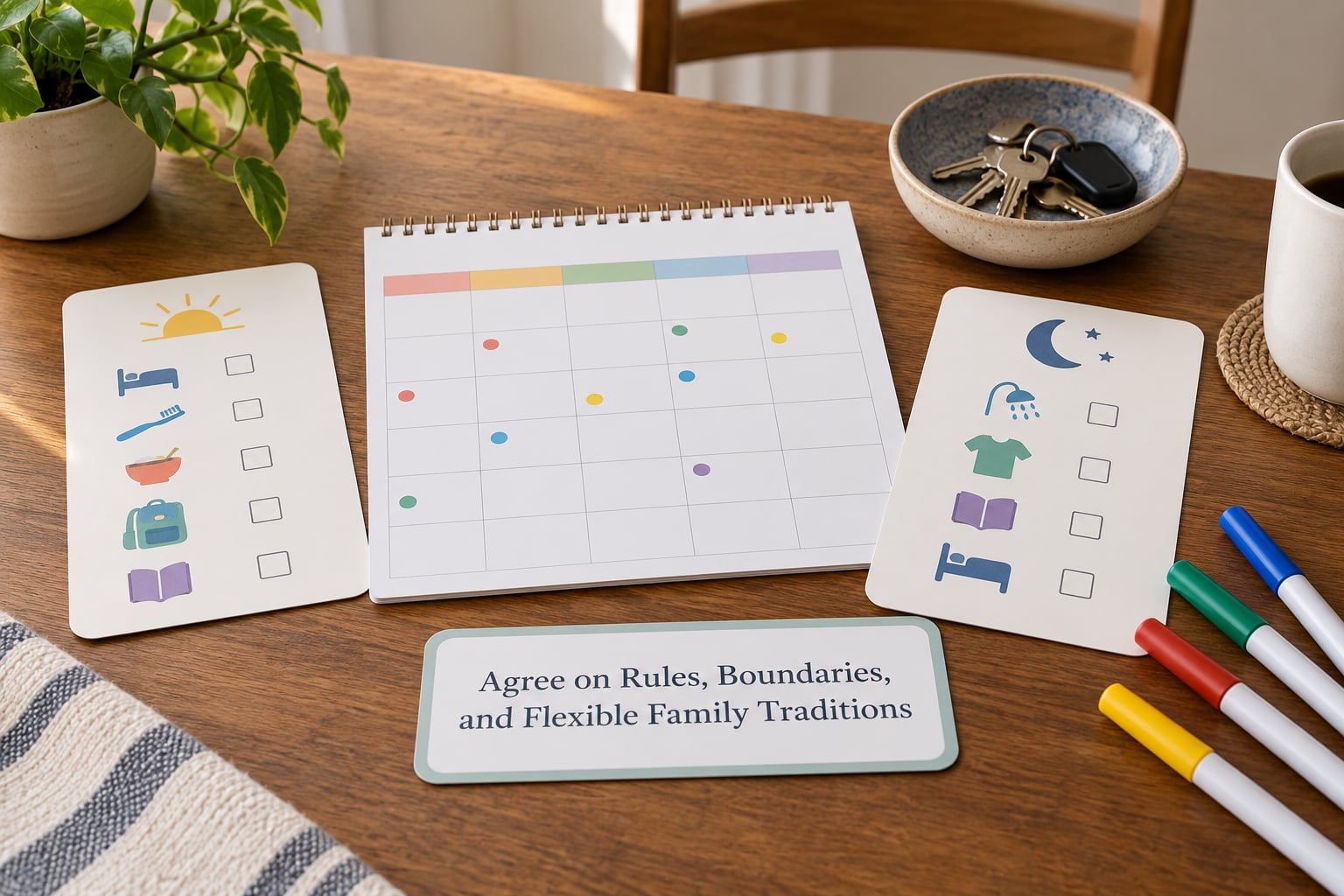
Compare what each household actually does rather than what each household claims to do. Bedtime, screen time, food, guests, homework, chores, what happens when someone is rude. Where the two homes conflict, decide which rule applies in which home and accept that the difference exists.
Traditions are worth protecting on both sides. You do not have to merge Friday night fish and Sunday morning church into one compromise ritual. Keep what matters to each family where it matters to them, and add one or two new things that belong only to the combined household.
If faith or culture is part of the picture, deal with it out loud before move-in, not in month eight. What happens on holidays, what the children are taught, who attends what. The 7-7-7 rule sometimes comes up in blended family discussions — roughly that each parent gets about 7 percent of a child’s childhood, so a week is the small change and a year is the big one. It is a useful reminder that the years matter far more than the weeks, and that the kids’ relationship with both parents keeps growing after the blend is settled.
How you can tell it is working: a child can state the house rules without checking with a parent, and both homes can state their own without embarrassment.
Build a Predictable Weekly Rhythm
Give the week a shape: what days the family eats together, when homework happens, what time the house quiets down, when each child gets one-on-one time with each adult.
The challenge is the gap days, when the schedule is decided by whoever shouts loudest. Predictability lowers the temperature more than any single rule. Children who know what Thursday evening looks like stop bracing for it.
Protect one-on-one time deliberately. A stepparent with twenty minutes on the sofa and a specific kid, once or twice a week, builds more trust than a month of shared dinners. Let the child pick the activity and follow their lead, which is often not the activity you would have chosen.
How you can tell it is working: children start initiating plans rather than waiting to be organised. Also keep some one-on-one time with your own children from before the relationship. It matters for them, and it is one of the fastest ways resentment builds between a couple.
Create Neutral Family Rituals Instead of Forcing Intimacy
Shared routines work. Forced closeness does not. You are building a household, not manufacturing affection between people who have not earned it yet.
Low-pressure options: a weekly board game night, a film the stepchildren picked, a Saturday morning walk, a chore the kids do together because it takes forty minutes alone. Ordinary things that happen repeatedly, with nobody making a speech about how well everyone is getting along.
On the question of who should come first: in the practical sense, the children do, because they are the only ones who cannot go home somewhere else. In the relational sense, your partnership comes first, and it has to, because a stepparent who is outranked by a ten-year-old ends up resentful inside a year. The workable version is that adult decisions are made by the adults, and the children are consulted about the parts that affect them.
How you can tell it is working: children start bringing the stepparent into things voluntarily, mentioning a school story or asking whether they can bring a friend over. That takes six months to a year for most families.
Review, Adjust, and Reward Progress
Book a fifteen-minute check-in every two weeks for the first six months, then monthly. Same time, same place, children not invited.
The challenge is that resentment usually grows quietly, and a scheduled conversation catches it while it is still small. In r/blendedfamilies, the recurring advice from long-term members is consistency, slow pacing, and couples counselling — not because anything dramatic is happening, but because the accumulated small stuff needs somewhere to go.
Run the conversation on observable behaviour. Not “you never back me up” but “twice this month you changed the rule after I already enforced it.” Behaviour can be discussed and adjusted. Motives turn into character arguments, and character arguments have no end.
How you can tell it is working: the list of complaints gets shorter and more boring over time. Track three specific items you wanted to change and check them monthly. Say the improvements out loud, including to the children.
Common Mistakes
Knowing how to blend two families without resentment means knowing which habits to skip. Most families do not fail at the merge itself. They fail at the small stuff around it: speed, loyalty tests, criticism of the other parent, and treating every difference as a fault.
Rushing the transition. Moving in to make the relationship feel solid quickly is the most common and most expensive error. Slow costs less than moving out.
Asking children to choose sides. Any version of “you like living here better, don’t you” puts a child in a position no child should hold. Loyalty competition is a real and harmful pattern, not a child’s choice.
Criticising the other parent in front of the kids. It always reaches them, and it forces them to manage your feelings. If a rule from the other home is genuinely unworkable, raise it with your partner as a practical problem, not as a character flaw.
Over-informing the children. A move-in is not a referendum on their parents’ relationship, and the details of custody or finances are not their business. Tell them what changes for their day. Nothing more.
Treating every difference as a problem. Two houses with different bedtimes is not a crisis. Decide whether the difference matters, and if it does not, stop rehearsing it. The resentment inventory is where this usually shows up.
Letting one partner concede to the ex and expecting the stepparent to enforce it. This is a specific, named failure mode: the partner agrees it is easier to go along with the ex, then the stepparent is the one left holding the resulting rule. Decide together first, out loud, which of you will carry which conversation.
Quick Resentment-Busting Tips
- Say the thing within 24 hours or let it go. Resentment is stored, not resolved.
- Name behaviour, not motives. “The homework check didn’t happen” beats “you never care.”
- Use shared language at home and neutral language about the other household. No nicknames for the ex.
- Keep one-on-one time with your own kids protected, not squeezed into whatever is left.
- Do not cancel your own life to prove commitment. Over-giving is its own form of resentment.
- Let a child say “I don’t want to do that right now” without turning it into a negotiation.
Frequently Asked Questions
How long does it take to blend two families?
Most households describe six to twelve months as the difficult adjustment period, and a year is a fair expectation rather than a deadline. Children usually widen their circle first and warm up in the second six months. Adults often settle sooner than children do. Judge progress by small changes in routine and willingness to be in the same room, not by whether anyone has become close. If nothing has shifted after a year, that is the point to bring in a family therapist, not a reason to keep waiting.
Can a stepparent set rules without overstepping?
Yes, within agreed limits. The stepparent can enforce the household rules that both adults agreed on in advance, and can add their own rules about shared spaces, meals and guests in their own home. What does not work is a stepparent setting rules about school, health or major decisions without consulting the birth parent first. The clean version is: propose it to your partner, agree it, and write it where the children can see it.
What should we do if the children do not get along?
Treat it as a normal adjustment, not a verdict on the family. Do not introduce the stepchildren to each other with an expectation they become friends, or tell them they should get along. Run shared activities that are low-stakes and short, let each child keep their own interests, and let one-on-one relationships form separately from the group. Sibling rivalry between steps usually eases once nobody is measuring the affection. Persistent open conflict is worth taking to a family therapist rather than solving with a rule.
How do we handle different parenting styles between households?
Pick your battles deliberately. Most differences matter less than they feel like at 9pm, so rank them: does this one affect the child’s safety, school or health, or is it a preference? Agree which rules are shared and which stay specific to each home, then stop revisiting the preferences. Write the shared ones down so enforcement is consistent. Where the two homes genuinely conflict on something important, ask the other parent for a specific, current reason before assuming it is arbitrary.
How do we keep children from feeling caught in the middle?
Never use a child as a messenger, and never ask them to take sides or comment on what the other household is like. Keep all logistics between the adults, including schedule changes, permission slips and messages. Give each child dedicated one-on-one time with each adult so neither relationship feels like the leftover option. Children are also allowed to love both households without guilt, and adults who say that out loud, calmly and without pressure, do more than any number of conversations.
When is family therapy needed during a blended-family transition?
Seek help earlier than most people do. Family therapy helps when conflict is weekly rather than occasional, when a child is withdrawing, angry or failing at school, when the couple cannot hold a 15-minute check-in without it turning into an argument, or when the stepparent’s resentment is affecting their relationship with the children. Couples counselling is useful earlier, for the adults only. Support groups for stepparents and blended families add something therapy cannot: other people living the same problem who have made it past month eight.
Start With One Conversation
Do one thing this week: put fifteen minutes on the calendar with your partner and write the household rules on a single page, together. Not the ideal version — the version you would both actually follow on a bad evening. Everything else in this plan, the co-parenting agreement, the weekly rhythm, the check-ins, gets easier once that page exists.
And if you are the one holding the resentment, say this to yourself first: loving someone’s children and being frustrated by the family system are not opposites. Both are usually true at the same time. 2026