The way to declutter a house room by room without burning out is to finish one space at a time using the same four moves every time: collect, categorize, cut out, contain. Pick a single room, pull everything out of one drawer or shelf at a time, sort it into five labeled containers, and give what remains a defined home before you move on. Most people finish a room in one to three sessions of 20 minutes each, and the whole house in two to three weeks.
What trips people up is rarely the mess itself. It is trying to see the entire house at once. A kitchen, a garage, and a closet with fifteen years of accumulation all blur into one enormous problem, and a problem that size produces nothing but paralysis.
Room-by-room works because each finished room gives you something visible to point at. That is the whole trick. This guide gives you the supplies, the room order, the per-room tasks, and the reset that keeps the result from sliding apart. Updated for 2026.
Table of Contents
- What You Need
- Step-by-Step
- How to Declutter a House Room by Room: Set Up Your Sorting System
- Start With the Entryway and Hallways
- Declutter the Living Room
- Declutter the Kitchen Room by Room
- Declutter Bedrooms and Dressers
- Declutter the Bathroom
- Tame the Home Office or Study
- Organize Storage Spaces and Utility Areas
- Finish With a Whole-House Reset
- Common Mistakes
- Frequently Asked Questions
- How long does it take to declutter a house room by room?
- What is the fastest way to declutter a room?
- How do I deal with clutter when I have nowhere to put things?
- Should I hire a professional organizer to declutter my house?
- How do I keep my house from getting cluttered again?
- Conclusion
What You Need
You need less than most people buy before they start, and that matters, because supplies bought too early become supplies with nothing to put in them.
- Five sorting categories, named out loud and written down: Keep, Toss or Recycle, Donate or Sell, Relocate, and Give Away. Writing the labels before you begin makes the decisions faster, because you are matching items to a category instead of inventing a category for every item.
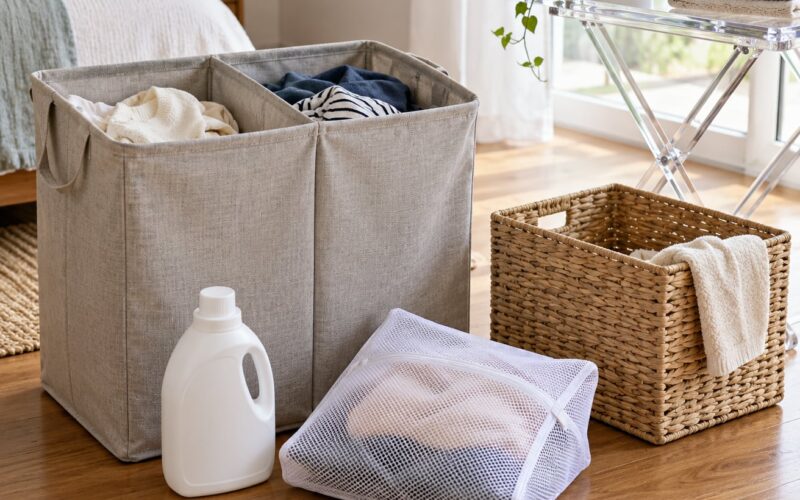
- Containers: a sturdy laundry basket or two, a couple of trash bags or a small bin for toss, a box or two for donations, and a box for items leaving the room but staying in the house.
- Sharpie or label maker and masking tape for the containers. Unlabeled containers are how donation piles turn into mystery piles.
- Cleaning basics: wipes, a dust cloth, all-purpose cleaner, a broom or vacuum, and a few old towels.
- A donation bag or box with a hard exit date written on it in your own handwriting. This one detail prevents more backsliding than any other.
- A small notebook or your phone to log what each room needs. You will notice the same three needs repeating and stop buying the wrong thing.
- A timer. A fifteen-minute timer on your phone is enough.
Skip storage bins and drawer dividers entirely until a room is empty. Organizing furniture is the last step, not the first.
Step-by-Step
How to Declutter a House Room by Room: Set Up Your Sorting System
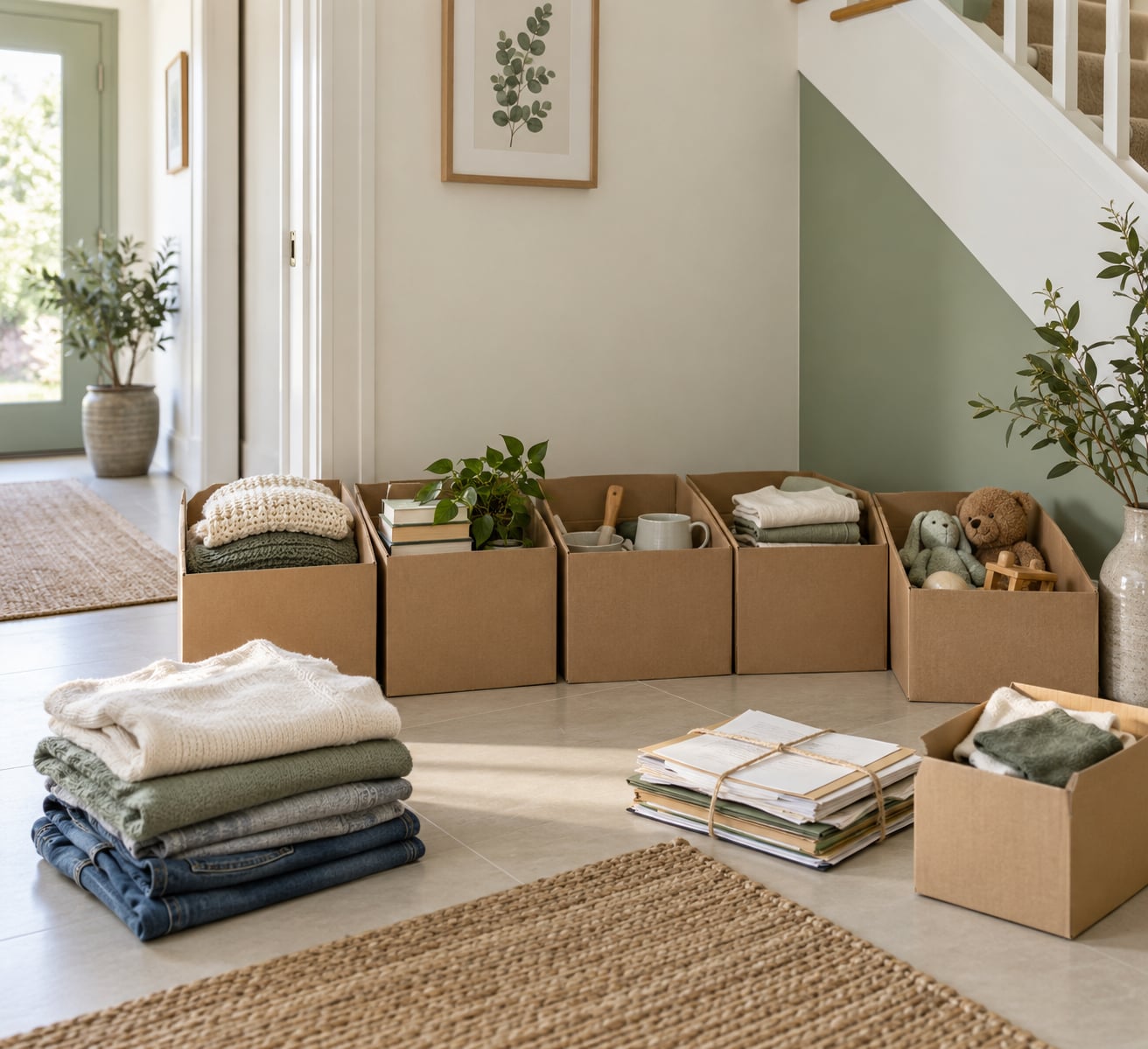
Set up five containers in one spot and label them before you touch a single item. Everything you lift gets a destination in under five seconds, and that is what keeps a two-hour job from turning into a full weekend.
Here is the system:
- Keep goes in a bag or basket you carry around with you, so decisions about a second look never interrupt the flow.
- Toss or Recycle gets its own immediate container. When it fills, walk it straight out to the bin rather than letting it sit.
- Donate or Sell gets a box with an exit date. Items go in, the box goes out, and nothing comes back in.
- Relocate catches things that belong in another room. This container needs a written list of destinations, or items scatter.
- Give Away covers specific people: the neighbor with a new baby, your cousin who just moved, the school drive.
Work on paperwork separately from objects. Anything with a name, account number, or legal document on it goes straight into a manila folder or a plastic sleeve and gets a decision on its own. Do not sort tax records into a donation box by accident, and do not shred documents you were told to keep.
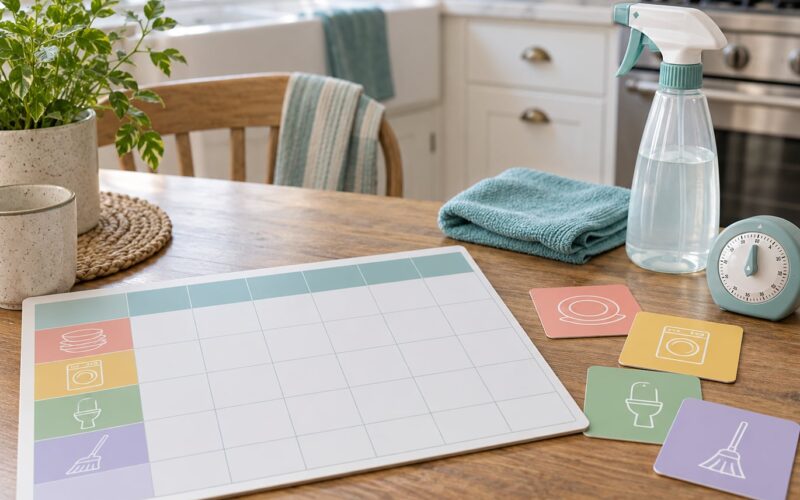
Set a schedule you can keep: two or three sessions a week, twenty minutes each, one room or one micro-area per session. Most people who abandon a whole weekend of decluttering succeed with fifteen minutes on a Tuesday. Set the timer, do the session, stop when the timer stops, and write down the next micro-area on the same page.
Start With the Entryway and Hallways
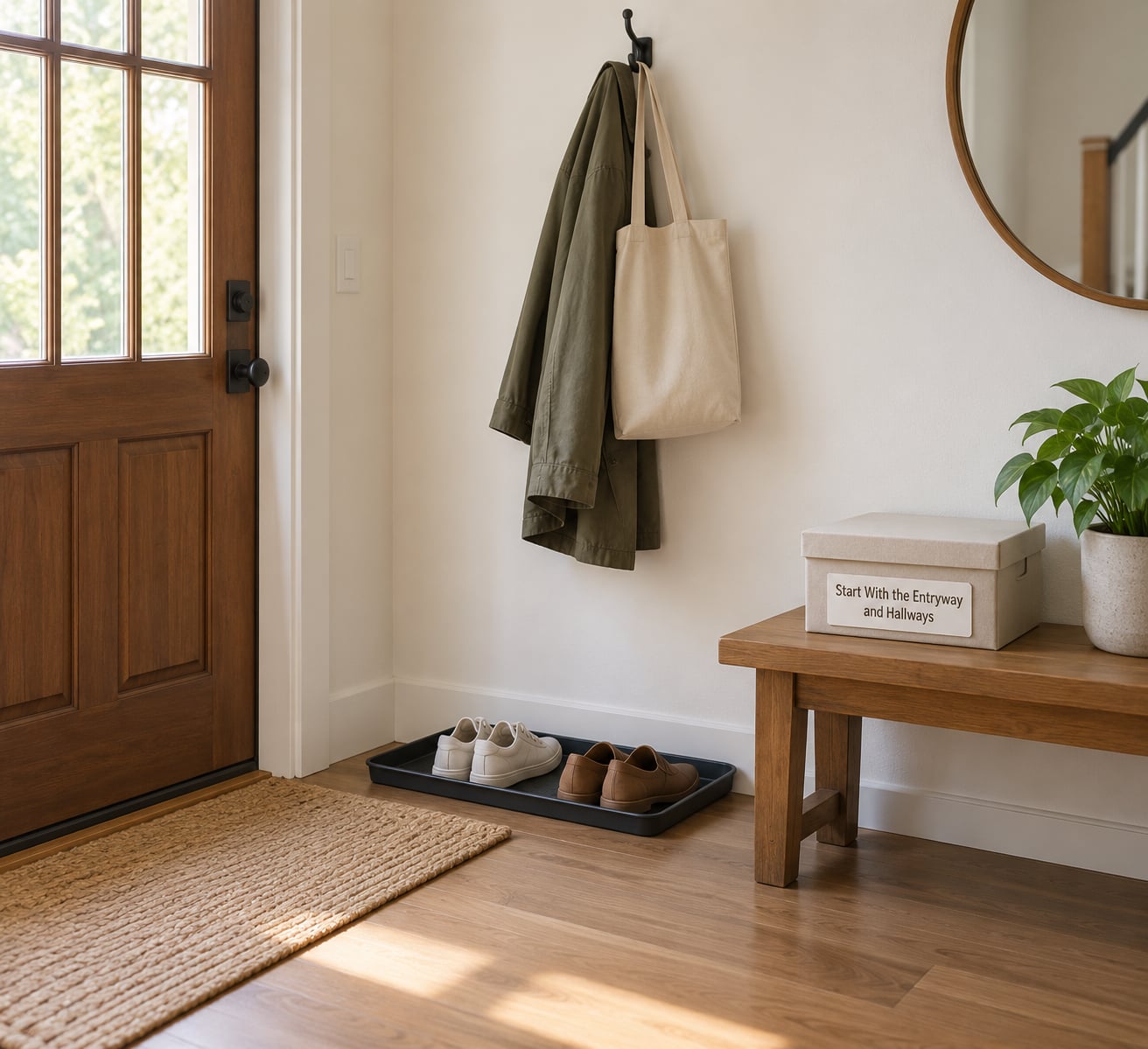
Start with the entryway because it is small, it is visible, and it is where shoes, coats, bags, and mail pile up every single day. A finished entryway also does something for the rest of the house: it gives arriving family a place to put things, which stops the coat from landing on a dining chair.
Clear the floor first. Pull out every shoe, bag, and stray object, then sort them. Keep the pairs you wear. Donate or give away the shoes that no longer fit anyone or have gone unworn for more than a year. Toss anything damaged beyond repair.
Then work up the wall. Count your hooks and be honest: most households own twice as many hooks as they actually use. Hooks rarely do the work of a small shelf or a narrow drop-zone basket, so measure the wall and choose one system. A slim rack near the door beats a coat pile, and a tray by the door for keys and mail beats a countertop.
Mail is the hidden clutter here. Anyone who has ever paid a bill twice because a piece of mail sat under a magazine knows the drill. Give bills, personal mail, and junk mail each a slot, with junk mail going into the recycling on the way past.
Finish by walking the hallway and asking what is not being used. Dead space above doorframes, the back of a closed door, the strip of floor beside the coat closet. Those corners are exactly where relocate items are supposed to end up, so find them now rather than creating new piles later.
Quick action: fifteen minutes, one tray, one hook rail, one recycling basket. Move on.
Declutter the Living Room
The living room is usually where duplicate categories hide, so sort by category rather than by surface. Pull everything off every horizontal surface into one area and work through it in piles: books, magazines and newspapers, remotes and chargers, decorative objects, and miscellaneous odds and ends.
Books are the classic duplicate zone. Most living rooms have a coffee table stack, a shelf row, and a bedroom shelf holding the same titles. Keep the copies you actually read and donate the rest in multiples.
Magazines and newspapers get a hard rule: no current issue stays out past the weekend, and anything you did not read within a month goes out. For electronics, work through cables with a simple test. Anything you cannot name the device for goes to the donate or e-waste box.
Edit decorative objects harder than feels comfortable. A shelf with thirty small objects rarely looks better than a shelf with eight spaced out, and the surplus is dead weight you will dust forever. Sentimental pieces deserve a slower decision, so move them into a single box you review after the room is finished rather than deciding in the moment.
End by defining storage zones. One basket for throws, one drawer for items that leave the room, one tray for things that need to go to another part of the house. Surfaces stay clear when every object has a named home, and a room cannot stay clear if the homes are vague.
Quick action: twenty minutes on one surface, one category at a time. Then a second session for the media and cables.
Declutter the Kitchen Room by Room
Kitchen decluttering is mostly duplication and expiration dates. Start with the food, because it produces the fastest visible change: pull everything from the pantry, refrigerator, and freezer onto the counter, then sort into keep, eat this week, and out.
Expired and opened-but-old food goes straight into the compost or the bin, unopened sealed items that you will genuinely use can go to a food bank, and anything unopened that nobody wants belongs in the toss pile. Check dates on the spice rack too, since ground spices lose flavor long before the printed date, and many kitchens are holding far more condiment types than any household actually cooks with.
Next, the cabinets. Group everything by use: daily cooking tools, occasional equipment, and kids’ items if they apply. Keep the daily pot and the daily pan within arm’s reach of the stove. Small appliances earn their space by being used at least once a month, so a waffle maker used twice a year usually has a cheaper home than your cabinet.
Dishware and cookware follow the same test. Keep two dinner sets if that is realistic for your household rather than twelve mismatched plates. Glass storage containers stack; mismatched lids do not, and a lid you cannot match is often a donation item on its own.
Finish with a drop zone for mail, keys, and bags near the door so the counter stops collecting them. A kitchen that stays clear usually has one tray designated for the incoming pile and nothing else on the counters that is not used daily.
Quick action: one cabinet, one shelf, twenty minutes. Pantry and refrigerator deserve their own full session.
Declutter Bedrooms and Dressers
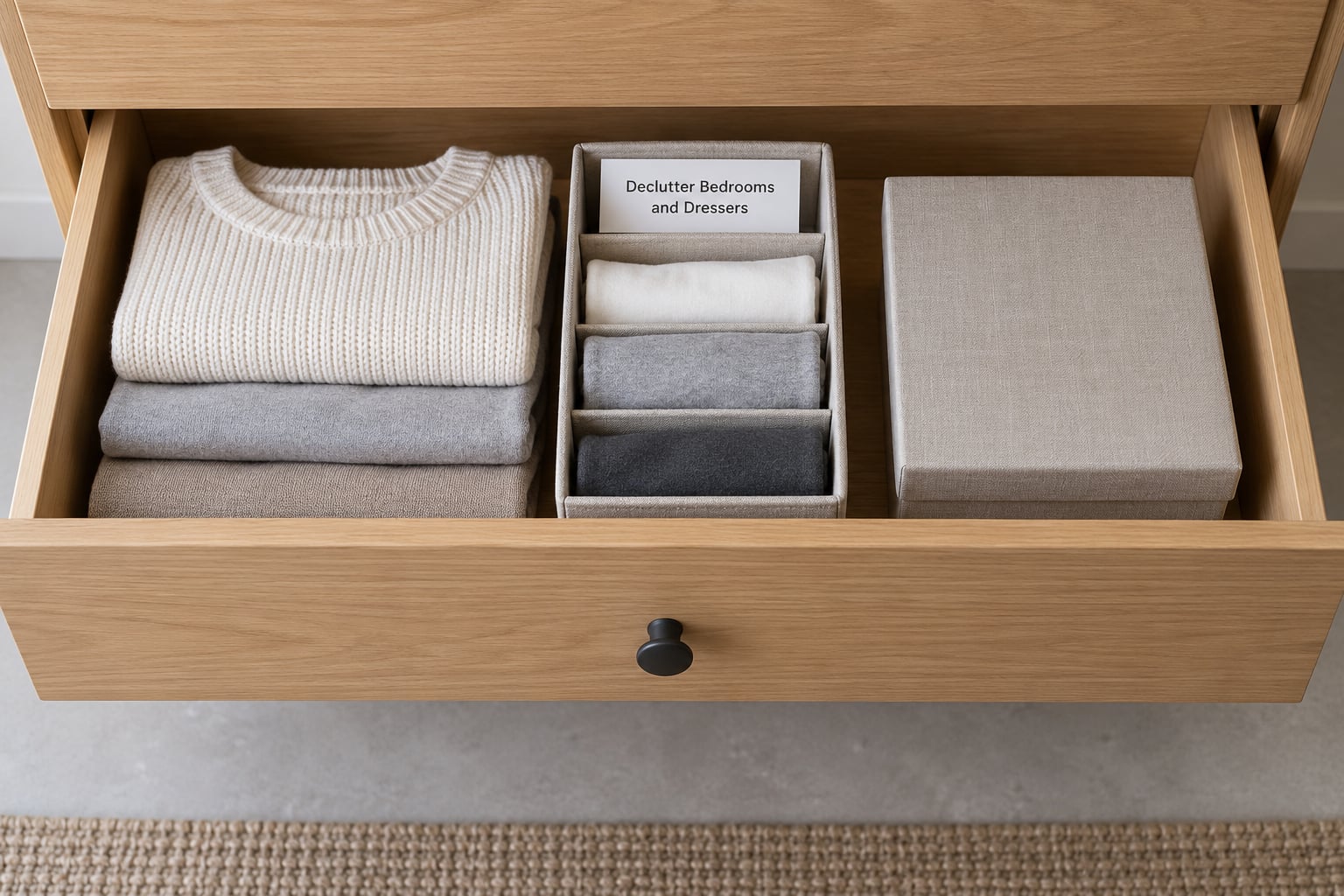
Bedrooms carry the most sentimental weight, so slow down there and make decisions on a separate pass. Dressers are the easiest place to start because every drawer has a defined size, and a drawer you have emptied is hard to refill with junk.
For clothing, the hanger flip method is the fastest honest filter. Move every hanger forward and to the side on a hanger rod. Anything you reach past goes to donate, anything you cannot rehang in the front row gets one last look, and the rest you reverse back.
That same pass usually reveals what does not fit: shoes that ended the year, tops that stopped fitting after a change, jeans you keep meaning to alter. If you have not worn something in a year and it is not seasonal, it goes. For kids’ clothing, size down aggressively. Clothes that fit next season are worth more to another family than they are to you in a bin.
Dressers get sorted by use: everyday on top, seasonal or overflow lower, keepsakes in one dedicated box rather than scattered across three drawers. Linens are grouped by person or by size, and towels that no longer match get donated rather than kept as rag stock. Under-bed storage works well for flat, seasonal, or rarely used items and badly for anything heavy, so heavy things go higher.
Nightstands get ruthless honesty. If it is not read, charged, or used within arm’s reach, it belongs in a drawer. Sentimental objects go into one keepsake box with a lid, and that box gets its own decision later, on a calm day, not at nine at night mid-sort.
Quick action: twenty minutes on one dresser, one drawer at a time. Closets and under-bed spaces need a full session each.
Declutter the Bathroom
The bathroom is often the easiest first room because nothing in it is sentimental and a lot of it is expired. It is a good confidence builder, though the entryway gives you a better finish line.
Pull out everything from the vanity and the shower area and group it: daily use, occasional use, expired, and unidentifiable. Unidentifiable is its own category for a reason. Half-full unlabeled bottles are a genuine safety issue, not just clutter.
Medications and anything that might be a medication go to their own decision. Check expiration dates, and take anything expired or unlabeled to a pharmacy take-back program rather than the trash, since most communities run those for free. Never combine pills from different bottles, and keep medications out of reach of children.
Towels and linens are a volume problem. Keep two sets per person plus a spare, and donate the rest. Many households have eight towels per person for no better reason than that towels are cheap, which is not a reason to store nine.
Cleaning supplies live together in one caddy rather than scattered under the sink in three half-bottles. Group by job: bathroom, floor, glass, and restock. Products long past their useful life get the toss pile, and mixing old chemicals together is worth avoiding entirely.
Quick action: twenty minutes on the vanity, one category at a time. Under-sink storage needs its own session.
Tame the Home Office or Study
Paper is the hardest material in any home, so give it a system rather than a pile. Most office clutter is not lost papers, it is action folders. Keep one small folder for anything you need to do within the month, one for records you must retain, and one for reference material you check more than once a year.
Retention rules matter more than any organizer here. Anything tied to taxes, property, insurance, warranties, medical records, or your vehicle gets scanned and stored digitally, with the paper kept only if you have a reason to keep it. Scan first, then discard the duplicate. Shred anything with a name, account number, or social security number rather than putting it in recycling.
Cables get tested, not guessed at. Wrap the ones you keep with a small tie and toss any without a device. Chargers live in one caddy by the desk so a new device never sends you hunting.
Stationery and supplies need zones: writing on the desk, paper in one drawer, reference books on one shelf. Devices and their accessories stay together in a single charging area, which prevents the drawer full of orphaned cords that forms in every office I’ve sorted.
Quick action: twenty minutes on the desk surface, then one filing session for the action folder.
Organize Storage Spaces and Utility Areas
Garages, basements, sheds, and deep closets are where relocate items go to hide, so give them a plan before you open a single bin. Pull one zone at a time onto the floor or driveway, sort, and decide where everything goes before anything gets covered up again.
Label every bin by category, not by vague sizes. Seasonal decoration, holiday, tools, camping, kids’ gear, and papers are categories that tell you what a bin holds without opening it. Consistent bin sizes help here too, since they stack without gaps.
The forgotten-donation sweep is the highest-value task in the whole garage. Most storage spaces hold boxes packed years ago that nobody has opened since. Anything in a sealed donation box should leave that day, because the longer it sits, the more likely it comes back through the door.
Do not relocate clutter into storage without a destination rule. If an item has no named zone and no date, it is not stored, it is delayed. Staying with the relocate container until everything has a home is the only way storage spaces stop becoming the room where the other rooms dump.
Hazardous materials need their own trip. Old paint, solvents, batteries, and propane never go into a donation box or a normal bin; check your local collection rules, since most areas run periodic drop-off events for them.
Quick action: twenty minutes on one zone, one wall of the garage or one row of basement shelving.
Finish With a Whole-House Reset
The reset is the step that separates a decluttered home from a house that got tidied for one weekend. It takes about two hours and it is what you will be repeating on a much smaller scale forever after.
Carry out every filled trash and recycling container. Take every donate or sell box out of the house, and put the sell items up for listing the same day. The hardest deadline in the whole system is the donation box exit date, and it is the one people quietly ignore until the pile is standing in the hallway again.
Return relocate items to their named rooms. This is tedious and it is the difference between a finished project and a distributed one. Anything that has been sitting in the relocate container for more than a week gets donated rather than placed, because if it had a real home you would have found it by now.
Wipe down every empty surface, sweep the floors, and clean the inside of drawers. Empty drawers smell like whatever was in them, and cleaning is the signal that tells you the work is over.
Photograph each finished storage area and each organized cabinet. A photo file on your phone is the memory aid that keeps you from re-buying organizers and re-deciding the same items six months later.
Then set the maintenance routine: one ten-minute reset a day in the room you touched, and one full reset each season. A cluttered home is not caused by a failure of willpower, it is caused by missing routines, and routines are easier to keep than grand decisions.
Quick action: two hours for the reset, then a calendar reminder for the daily ten minutes.
Common Mistakes
Almost every stalled declutter project fails the same way, and the fixes are mechanical rather than motivational.
- Over-organizing instead of decluttering. Buying drawer dividers for a drawer you have not emptied yet. Fix: no containers until the room is empty, and only buy what a pile has proved it needs.
- Moving clutter from room to room. Relocate items with no destination, which is just tidying in disguise. Fix: every item in the relocate container gets a written destination and a date, or it is donated.
- Sorting the entire house in one day. The marathon approach burns out before you reach the halfway point. Fix: twenty-minute time-boxed sessions, two or three times a week.
- Starting with the hardest room. The garage or a storage closet as room one is how projects die. Fix: start with the entryway or the bathroom and bank the win.
- Deciding on sentimental items too fast. Choosing under pressure means keeping everything or breaking down. Fix: one keepsake box, reviewed later on a calm day.
- Sorting another person’s belongings. Going through a partner’s wardrobe or a child’s room without consent is the fastest way to make decluttering a relationship problem. Fix: clear your own spaces first and let the other person set their own pace.
- Letting the donation pile come back in. The box sits in the hallway, nobody wants to deal with it, and items migrate home. Fix: a hard exit date written on the box, and a donation run the same day.
One more mistake deserves naming: buying organizers before decluttering when money is tight. If the budget is zero, use trash bags, laundry baskets, and cardboard boxes with masking tape. The containers do not change the decisions, they just hold them.
Frequently Asked Questions
How long does it take to declutter a house room by room?
Most rooms take one to three sessions of twenty minutes each. The bathroom and entryway finish fastest, often in a single session. Kitchens, pantries, closets, and garages usually need three or four because of duplicates, expiration dates, and deep storage. Working two or three sessions a week, a full house takes roughly two to three weeks.
What is the fastest way to declutter a room?
Start with trash, not with the hard decisions. Carry a bag through the room and pick up anything expired, broken, or unwanted, which takes ten minutes and immediately frees space. Then do one drawer or one shelf completely rather than one surface partially. Finishing a single contained space gives you momentum that scattered picking never does.
How do I deal with clutter when I have nowhere to put things?
You do not need storage first, so do not buy any. Work one container at a time and route it straight out: the trash and recycling go to the bin the same session, and the donate box leaves the house on the date you write on it. If relocate items have no destination, donate them instead. A house with fewer things needs less space than you think.
Should I hire a professional organizer to declutter my house?
It helps when you are dealing with an estate cleanout, a move or downsizing deadline, a large amount of paperwork, or a period when fatigue or illness has made the work impossible on your own. It is less useful for ordinary accumulation, where the mechanics here cost nothing. If you do hire help, use the service for the heavy rooms and handle the routine maintenance yourself.
How do I keep my house from getting cluttered again?
Run a ten-minute reset each evening in whichever room you used most, and a longer reset for one room each weekend. Give incoming items a designated home, like a mail tray or a basket by the door, so nothing lands on a counter. Keep donate and sell items in one container with a written exit date so nothing migrates back into a room.
Conclusion
Learning how to declutter a house room by room comes down to one repeatable routine: label five containers, finish one room before you start another, and carry the donation box out on the date you wrote on it.
Begin with the entryway, or with the easiest visible space in your home, and give it one twenty-minute session this week. Then book a follow-up session before you leave the room, because the second visit is what turns a tidied room into a decluttered one.