Budgeting as a newly single adult means rebuilding your monthly plan around one income and one household, then re-basing every cost that used to be split, including rent, utilities, the car, groceries, subscriptions and insurance, so the total fits a single take-home paycheck. If you want the short version of how to budget as a newly single adult, it takes one focused evening to build and about half an hour a month to keep honest.
The order matters. Work through these six steps: know your real net income, list every bill that has to be paid, audit the costs you used to share, give whatever remains a job, build a small cash buffer, then automate the plan and review it on a fixed date. That last habit is what separates a budget that works from a spreadsheet that quietly dies in month two.
- Work from take-home pay, never from the number on the pay stub before deductions.
- Treat one-person housing as the biggest line, then negotiate it or shrink it deliberately.
- Cancel or downgrade every shared subscription the same week you move.
- Save something small and automatic before chasing anything dramatic.
Table of Contents
- What You Need
- Step-by-Step: How to Budget as a Newly Single Adult
- 1. Set Your Real Take-Home Income
- 2. List Housing, Food, and Other Fixed Costs
- 3. Audit the Expenses You Shared
- 4. Build a Zero-Based or Flexible Budget
- 5. Build a Small Emergency Fund on One Income
- 6. Review, Automate, and Adjust
- Common Mistakes
- Frequently Asked Questions
- What percentage of my income should I budget when I become newly single?
- How much should I keep in my budget for unexpected expenses?
- Should I pay off debt before building a budget?
- How should we split housing and child-related expenses after separation?
- What is the simplest budget method for someone with one income?
- How long will it take to feel financially stable after becoming single?
- Conclusion
What You Need
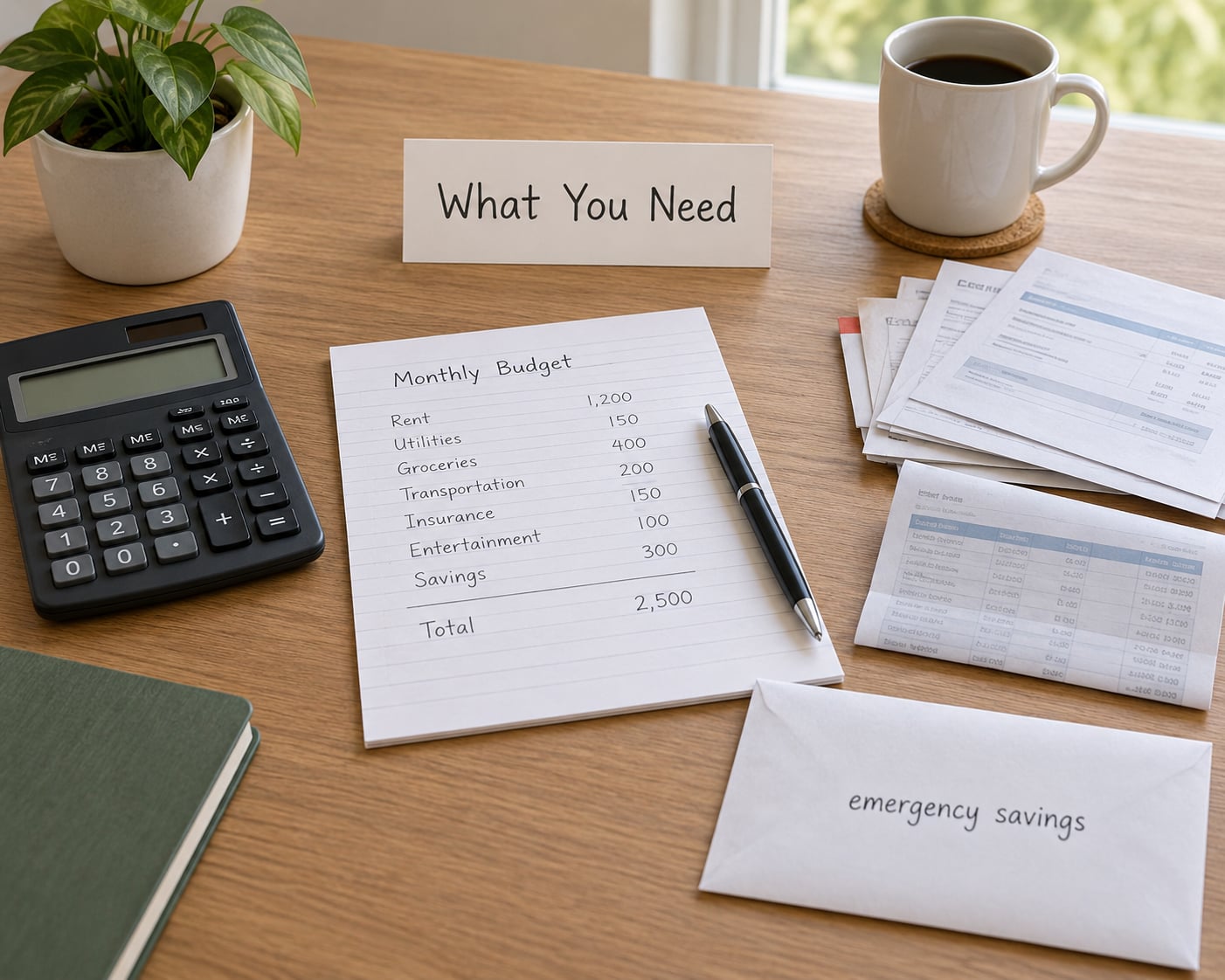
Gather these before you build anything. Most people try to budget from memory, and memory is where a bad estimate hides.
- Your real take-home pay. A recent pay stub plus three months of bank deposits, so you can see what actually lands.
- Every recurring bill. Rent or mortgage, utilities, internet, phone, insurance, minimum debt payments, subscriptions, transit pass, memberships.
- Your debts. Balance, minimum payment, interest rate and due date for each one, including anything a joint account covered.
- Account details. Log-in or account numbers for any joint checking, savings or credit card, plus your lease or mortgage paperwork.
- Your benefits details. What your employer covers for health insurance, whether there is a retirement match waiting, and your annual leave balance.
- A second account. A checking or savings account at a credit union, opened only to hold your buffer and sinking funds.
- A list of shared costs. Who is on each bill, who is on the lease, and which services you kept mainly for the other person.
One more thing worth having: a person who will not give you bad advice. A friend who has actually lived alone on one income is worth more than a dozen comment threads.
Step-by-Step: How to Budget as a Newly Single Adult
1. Set Your Real Take-Home Income
Open with the number that hits your account, not the larger number on your pay stub. Gross pay minus taxes, health insurance, retirement contributions and other deductions gives you your net income, and that is the only number you are allowed to spend.
If your pay varies, plan against the lowest month you have seen in the last six, then treat anything above that as buffer or debt payment. Hourly and contract work has its own trap: take your hourly rate, subtract roughly 15 to 30 percent for taxes and benefits nobody withholds for you, and budget from what survives.
Write the figure down. Rounding it up is the most common way a single-income budget fails in January.
2. List Housing, Food, and Other Fixed Costs
Now list what has to be paid every month before anything else. Most adults underestimate this list the first time they build it alone, which is exactly why doing this carefully in week one matters.
- Housing: rent or mortgage, plus renters or homeowners insurance and any HOA or building fee
- Utilities: electricity, gas or heating, water, trash, and internet or cable
- Food: groceries for one, plus a small eating-out allowance
- Transportation: car payment or lease, fuel, insurance, registration, parking, transit
- Health: the premium now coming out of your paycheck, plus prescriptions and uncovered care
- Minimum debt payments on everything you owe
- Phone plan, streaming services, cloud storage, gym or membership
Housing deserves its own rule. A common ceiling for a single income is keeping rent or mortgage near 30 to 35 percent of take-home pay, with a stretch up to 40 percent in a tight market. People posting in personal finance forums describe rent eating 50 to 70 percent and describe it as the single reason an emergency fund never grows.
If your housing number sits well above 35 percent, treat that as the first problem to solve, not a fact of life to complain about. Refinancing a lease, adding a roommate, moving at renewal or negotiating a month of free rent are all faster routes to breathing room than trimming coffee.
3. Audit the Expenses You Shared
This is where a shared budget becomes a single-person budget, and where most of the surprise lives. Costs that were halved overnight rarely stay halved.
| Cost | What a shared household looked like | What it costs one person |
|---|---|---|
| Housing | Half of a shared rent, often a room share | A full lease or mortgage, plus utilities that no longer split |
| Car | One payment funded by two incomes | The whole payment, fuel, insurance and repairs on one budget |
| Phone and internet | Family or shared plans | Individual plans, frequently priced higher per person |
| Groceries | Household shop for two or more | Less food but no second set of staples, condiments and household items |
| Subscriptions | One of each, shared logins | Every account in your name, plus anything bought only for company |
| Insurance and utilities | Deducted from two paychecks | One full payment each, billed to a single name |
Go through the list and mark each line keep, shrink or kill. Keep means you use it alone this month. Shrink means downgrade to a cheaper tier, a smaller unit or a basic plan. Kill means cancel today and do not resubscribe out of guilt.
Handle the joint accounts carefully too. Move your recurring payments to your own account first, then close the joint card once a balance of zero is showing, and check your credit reports afterward. People on Reddit and Quora describe the waiting period and the fear of a surprise statement far more often than the actual cost, and the fear is the part that keeps people paying for things they never use.
4. Build a Zero-Based or Flexible Budget
A zero-based budget means assigning every dollar of net income to a category, so the plan ends at zero with nothing unassigned. It suits people who like control. If that feels rigid after a hard split, use a flexible version: set the essential categories by target amount, leave one honest cushion line for the rest of the month.
Here is how the arithmetic works on a take-home income of 3,400 a month.
| Category | Monthly amount | Notes |
|---|---|---|
| Housing and utilities | 1,380 | Rent plus electric, water, trash, internet |
| Groceries and eating out | 320 | Cook most nights, eat out twice |
| Transportation | 380 | Payment, fuel, parking, registration |
| Insurance and health | 240 | Auto, renters, uncovered prescriptions |
| Minimum debt payments | 240 | Two accounts at minimum |
| Sinking funds | 200 | Car repair, gifts, annual fees, deductible |
| Emergency buffer | 150 | Automatic transfer, not spent by choice |
| Retirement contribution | 300 | Enough to capture any employer match |
| Everything else | 190 | Dining, phone, subscriptions, fun |
That leaves nothing for savings beyond the buffer, which is honest for a tight month. Most single-income households run the flexible version first, then raise savings once the essentials settle. The 50/30/20 split of needs, wants and savings is a reasonable target once your rent is under control, and it is worth revisiting when your income grows.
5. Build a Small Emergency Fund on One Income
Start smaller than you think. The community advice that shows up again and again in budgeting forums is to save a set amount per pay period, something like 25, into a separate account before you spend anything discretionary. Small enough that it survives a bad month, real enough to build on.
Your first target is one month of essential expenses, which for most single adults lands somewhere between 1,500 and 2,500. After that, aim for three to six months. The popular 4-3-2-1 framework goes further and treats insurance differently: four weeks of essential expenses in cash, three months in a savings account, one year of expenses in investments, and a good policy for anything you would hate to replace.
Keep irregular bills separate. Annual registration fees, holiday gifts, car repairs and the insurance deductible should each get their own small pot, fed a set amount monthly. That way the surprise arrives in a category you already funded instead of a hole you panic-fill with a credit card.
One rule protects all of it: this buffer is not spending money. If the fund becomes a second checking account, it never existed.
6. Review, Automate, and Adjust
Automation does the heavy lifting. Schedule rent, utilities, minimum payments and your buffer transfer for the day after payday, so money is assigned before you get a chance to spend it. Pay yourself first, then spend what is left.
Check in weekly for about ten minutes. Look at the buffer and sinking funds, and glance at what has actually been spent. Once a month, on the same date, sit down with the numbers for thirty minutes and note the gap between the plan and reality without blame.
Adjust on a schedule rather than in a crisis. At thirty days, fix the categories that were obviously wrong, usually groceries or subscriptions. At sixty days, renegotiate anything above 35 percent of take-home pay and check that sinking funds matched reality. At ninety days, raise the emergency transfer if the buffer has stopped moving, and put any surplus toward the highest interest rate you owe.
Two threads worth remembering. Monthly meetings on a fixed day, with no screens in the room, were built for two people and work just as well as a solo appointment with yourself. And Reddit users trying to move out on their own commonly suggest paying the expected rent into a separate account for three months first, as a private test of whether the budget survives contact with a real bill.
Common Mistakes
Budgeting from gross income. Gross pay ignores taxes and deductions, and the gap between the two is where the plan quietly breaks. Fix: net income only, written down, treated as fixed.
Keeping the old two-person budget. A shared spreadsheet assumes two incomes and halved costs. Fix: rebuild every line from zero as if you have never paid a bill alone.
Ignoring irregular costs until they land. Registration fees, deductibles, gifts and repairs do not fit neatly into a month. Fix: a sinking fund per item, funded monthly.
Covering basics on a credit card. A full card payment is still a budget failure, only slower and more expensive. Fix: treat the buffer as off limits, and trim the flexible categories instead.
Ignoring obligations that arrive with the split. Alimony, taxes, a legal deposit or a beneficiary change will hit whether or not they were budgeted. Fix: put one-time transition costs in the first month as their own line.
Skipping benefits and credit checks. Losing coverage or letting a joint card close badly can cost more than a year of coffee. Fix: confirm health coverage, check your credit reports, and update account beneficiaries.
Building a plan too tight to survive contact. A budget with zero slack fails on the first surprise and gets abandoned. Fix: keep a small cushion and a guilt-free line, even if modest.
Frequently Asked Questions
What percentage of my income should I budget when I become newly single?
Work from your net take-home pay, not your gross salary, and start by keeping housing near 30 to 35 percent of it. Once essentials are covered, a common first target is 50 percent for needs, 20 percent for wants and 30 percent for savings and debt. When income is tight, protect the essentials and the emergency buffer first. That is how to budget as a newly single adult without a plan that collapses in the first surprise month.
How much should I keep in my budget for unexpected expenses?
Aim for a starter buffer covering one full month of essential expenses, which for many single adults falls between 1,500 and 2,500. Build it with a fixed automatic transfer per pay period, such as 25, so it grows on bad weeks too. Keep it in a separate account you do not debit for everyday spending. Separate sinking funds for irregular bills, like car repairs and annual fees, so surprises arrive already funded.
Should I pay off debt before building a budget?
Build the budget first, because a budget tells you what you can actually put toward debt each month. Then attack the highest interest rate first once a small buffer exists, since that buffer prevents a single bad month from sending you back to the same card. If a debt carries a penalty or a collections flag, clearing that one can matter more than the rate. This is why how to budget as a newly single adult always starts with take-home pay, not with a payoff plan.
How should we split housing and child-related expenses after separation?
Put every shared cost in writing and split it by a rule you both accept, often 50/50 or by income for larger costs. Housing is usually handled separately, through a lease, an offset or a buyout rather than a monthly offset against savings. Child-related costs need a clear list: school, care, medical, activities and travel, plus how exchanges and unexpected costs are handled. Where you are unsure, a family law attorney can explain the rules that apply in your state.
What is the simplest budget method for someone with one income?
A flexible category budget is the simplest starting point: list net income, assign a target to each essential category, and give whatever is left a named job. Automate the essentials and the buffer transfer for the day after payday so the money is allocated before spending. Add a single guilt-free line so the plan survives an ordinary Friday. People who keep spreadsheets tend to do best with zero-based budgets, but the category method works for nearly everyone.
How long will it take to feel financially stable after becoming single?
Most people need three full months of accurate numbers before the budget stops feeling like guesswork, because the first two months are dominated by one-time costs such as deposits, transfers and cancellation fees. Real progress usually shows between six and twelve months, once rent is settled and the buffer has stopped shrinking. Stability is a feeling that arrives after a few months of bills clearing without surprises, which is the practical goal behind how to budget as a newly single adult.
Conclusion
The whole plan fits in four moves: write down your real take-home pay, list and cut every cost that used to be shared, protect a small automatic buffer, and put a monthly review on the calendar with a date and a time. That review is the part that decides whether any of the rest sticks.
Budgeting on one income is not about living with less. It is about knowing, on the first of the month, exactly what your money already decided. Marcus by Goldman Sachs puts the scale of the change plainly, noting that many people need a 30 percent or larger income increase after a separation to keep the same standard of living, so plan for a real adjustment rather than a moral failing.
Start tonight, with the bank statement and a pen. Learning how to budget as a newly single adult is less about a perfect spreadsheet than about a plan you can still follow in a bad month. Every rule here is a general guideline, and tax, benefit and legal rules vary by state and country, so check the specifics that apply to you before you make a big move.