
You can change your name after a divorce, and in most states you do not need a second court case. If your final decree says the court restores your former name, that decree is your authority: order certified copies, update your Social Security record first, then work outward through the DMV, your passport, employer, banks and the rest. Budget four to eight weeks and follow the order strictly, because agencies verify your identity against the Social Security record and will reject a mismatch.
This guide covers how to change your name after divorce in the United States, with the practical details people actually get stuck on: which route applies to you, what the decree has to say, what each agency asks for, and what it costs. Rules vary by state and change over time, so treat this as general information and confirm the current forms, fees and filing rules with your county clerk or the court’s self-help center before you file.
Table of Contents
- What You Need
- How to Change Your Name After Divorce Step by Step
- Step 1: Confirm That You Are Eligible to Make the Change
- Step 2: Read the Final Divorce Decree
- Step 3: Complete Your State’s Required Forms
- Step 4: File the Petition and Prepare for Any Hearing
- Step 5: Obtain a Final Court Order and Certified Copies
- Step 6: Update Your Records and Everyday Accounts
- Common Mistakes and Tips to Avoid Delays
- Frequently Asked Questions
- How soon can I change my name after divorce?
- Can I change my first name, last name, or both?
- Do I need a court hearing to change my name after divorce?
- How much does it cost to change your name after divorce?
- What should I do if the divorce decree does not mention a name change?
- Conclusion: Start With Your Final Divorce Decree
What You Need

Eligibility and procedure differ by state, so the first thing to confirm is which kind of change you are making. Restoring a name you used before the marriage is the easy path and is usually authorised by the divorce decree itself. Adopting a completely new surname, a first name, or a middle name almost always requires a separate petition, and in many states a notice published in a newspaper.
Before you fill anything out, gather what the court and the agencies will ask for:
- The final divorce decree or judgment, fully signed and entered by the court, with any name-restoration language visible.
- Any prior name-change order, if you have been through this before, so the clerk can see the chain of legal names.
- The exact new name you want, spelled out the way you want it on your licence, including hyphenation and any middle name.
- Current photo identification and proof of your present legal name, plus a current mailing address and phone number.
- The correct state forms for a name change or a name-restoration request, downloaded from the official court site rather than a template from another state.
- A filing fee, or a request to waive it if you cannot afford the fee. Most courts offer an application for poor person relief or a fee waiver.
- An ordered list of the agencies you need to notify, which you will build as you read Step 6.
Order more certified copies of the decree than you think you need. People routinely order three to five, because some agencies keep the original rather than returning it, and photocopy or notarised copies are rejected by the Social Security Administration, most DMVs and the State Department.
How to Change Your Name After Divorce Step by Step
Step 1: Confirm That You Are Eligible to Make the Change
Eligibility usually turns on three things: the divorce has to be final rather than pending, the name you want has to be one the court can lawfully restore or grant, and you have to be a competent adult asking for yourself. Most states also require that the change not be fraudulent or used to avoid a legal obligation.
Restoring a name you used before the marriage is close to automatic in many states, either because the decree names it or because the decree is silent and state law fills the gap. A genuinely new surname is different. Courts treat that as a new legal identity, which is why it usually means a full petition, notice, and in some states a hearing.
Verify the specifics for your situation before filing, because a neighbouring state can require documents the next state over does not.
Step 2: Read the Final Divorce Decree
Open the decree and find the operative paragraphs at the end, where the court grants the relief it was asked to grant. Look for wording along the lines of the petitioner is restored to the use of her former name, or the petitioner is granted a name change to a specified name. That sentence is your legal authority for everything that follows.
If the decree lists the name incorrectly, with a maiden name you never used, or with a typo, do not work around it. A correction is usually handled by the clerk issuing an amended or corrected judgment, and in some states that has to happen within a short window after entry of judgment rather than years later.
If the decree is silent, you have three options: ask whether the court will issue a corrected or supplemental order, file a standalone adult name change petition, or begin using your former name socially while you decide. Plenty of people describe that last route on Reddit as starting to go by their maiden name everywhere and completing the legal paperwork when they get round to it. Bureaucracy is usually the obstacle, not the law.
Step 3: Complete Your State’s Required Forms
Most petitions ask for less than people expect: your current legal name, the proposed new name, your date of birth, the court case number and county, the date the divorce was entered, and your signature under penalty of perjury. Some states also ask whether you have ever been convicted of a felony, whether a bankruptcy is pending, or whether the change is for a reason tied to a criminal proceeding, and some require a background disclosure attachment.
Check the venue and filing location on the court’s own site rather than assuming the family court handled it, because adult name change petitions are often filed in probate, district, or general jurisdiction court depending on the state. Include your contact details and a current address, and keep every supporting document together in one folder.
Never use a form from another state. The fee schedules, notarisation rules and signature blocks are not interchangeable, and a rejected filing costs you the delay rather than the form.
Step 4: File the Petition and Prepare for Any Hearing
File through the court’s self-help centre or clerk’s office, either in person or by mail or e-filing where your court allows it. Ask for a file-stamped copy of whatever you submit, and note the case or docket number. Uncontested petitions are frequently decided on the paperwork without anyone appearing in court, so a hearing is not always part of the timeline.
Where a hearing is set, prepare as if you will be asked three questions: why you want the change, what you will be called, and whether anyone could be harmed by it. Answer plainly and stay respectful, including about the other parent. If you have a safety concern, ask the clerk about a waiver of publication or sealed notice requirements, which several states offer for victims of abuse.
Bring your certified decree, your photo identification and a written list of the name exactly as you want it. Spelling matters more than people expect; the court will use the name you write on the petition, not the one you say out loud.
Step 5: Obtain a Final Court Order and Certified Copies
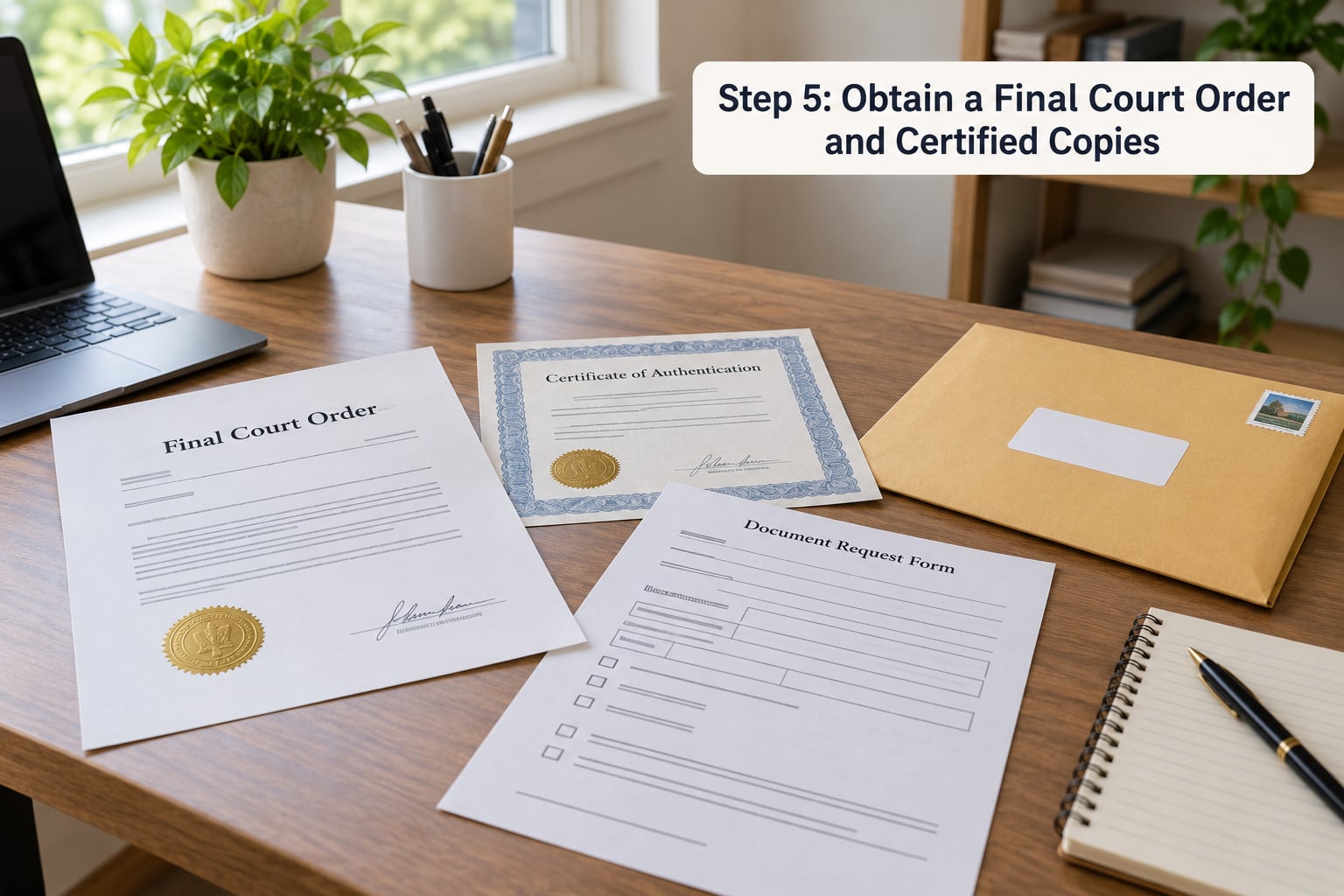
Once the judge signs, collect the order and read it against your petition character by character. Confirm the surname, the spelling, whether it is hyphenated, and whether your middle name or first name changed. A single wrong letter here gets repeated by every agency for years, because each one copies from the last.
Then request certified copies. The clerk’s office is usually the only source, the fee is typically a modest per-page charge that varies by county, and many offices need a few business days to prepare them. Order three to five copies at once, ask for the largest available format, and keep them in a folder rather than in a handbag where they will be lost.
These certified copies are the document every agency asks for. Once you have them in hand, how to change your name after divorce stops being a court question and becomes an administrative one, which is the easier half.
Step 6: Update Your Records and Everyday Accounts
Work in this order, because each step depends on the one before it:
- Social Security Administration. File Form SS-5 with the certified decree and evidence of lawful change. It is free, and processing commonly runs about 10 to 14 business days.
- Driver’s licence or state ID at the DMV. In person in most states, with the certified decree, your current licence and proof of residence. Reissue fees vary by state.
- Passport. Use Form DS-11 if you have never held a passport or cannot submit it, Form DS-82 for a renewal by mail, and Form DS-5504 for a change on an existing passport within fifteen years of issue.
- Employer and payroll. Give HR the certified decree early, before a new job or a background check runs against your old name.
- IRS records. Update the name on your tax return for the next filing, and remember the name on your W-4 must match your SSA record.
- Banks, credit unions and credit bureaus. Notify Equifax, Experian and TransUnion, and ask each institution what documentation it requires.
- Insurers. Health, auto, life and homeowners policies, including beneficiary designations.
- Retirement and beneficiaries. Update 401(k) and IRA beneficiary forms and your will, which most people never touch.
- Voter registration. Update through your county board of elections or voting assistance office.
- Professional licences. Teachers, nurses, attorneys and others must update their licensing board separately; some require the new Social Security number on file first.
- Everyday accounts. Utilities, landlords, streaming services, credit cards, subscriptions, your email address, and your social media profiles.
Some institutions will ask for the certified decree separately, and some will quietly update nothing. Keep a checklist with dates and confirmation numbers so you are not discovering a mismatch years later.
Common Mistakes and Tips to Avoid Delays
Filing before the divorce is final. Courts generally cannot act on a name change while the divorce itself is pending, because there is no decree yet. Fix: wait for the signed judgment, and ask your attorney or the clerk to confirm the entry date.
Using an outdated name on the petition. The name you write has to be your current legal name, which for most people is still the married name. Fix: check your driver’s licence before completing the form.
Misspelling the name you want. Courts do not correct this for you later, and every downstream record inherits the error. Fix: read the name back aloud and compare it to your birth certificate.
Skipping certified copies. Photocopies and notarised copies get turned away by the SSA, most DMVs and the State Department. Fix: order three to five certified copies and keep them in one place.
Missing a deadline. Correcting a decree or filing a later petition can carry short cutoffs in some states, and a new name change also runs into notice requirements. Fix: check the deadlines on the official court site before you assume you have unlimited time.
Paying without confirming the fee. Filing fees vary widely by county and change over time. Fix: call the clerk before you go, and ask about a waiver application if the fee is a real problem. Many courts will not waive fees informally.
Updating accounts before the order is final. Changing your email, bank login or social media first can lock you out of two-factor authentication, because those systems check the name against your ID. Fix: update Social Security first, then ID, then the digital accounts, and change your recovery email and phone before anything else.
One more tip worth stating plainly: nothing requires you to change anything legally. You may use your former name socially with no paperwork at all, and no court will reopen your case over it. That gives you time to decide without a deadline pressing on you.
Frequently Asked Questions
How soon can I change my name after divorce?
You can start as soon as the divorce is final and the signed judgment or decree has been entered by the court. Order certified copies first, because the Social Security Administration, the DMV and the State Department all require them. If the decree is silent on names, you can use your former name right away and file a name-restoration petition whenever you are ready.
Can I change my first name, last name, or both?
A last name is the easy case, especially a maiden name, because courts routinely restore it through the divorce decree. A first name or middle name change, or an entirely new surname, is treated as a fresh name change petition in most states. That route usually needs a separate filing, sometimes published notice, and occasionally a hearing before a judge.
Do I need a court hearing to change my name after divorce?
Often no. If your decree already restores your former name, there may be no hearing at all because no new petition is required. For a separate name-change petition, many states decide on the paperwork alone when nobody objects, while others schedule a short hearing. The clerk for your county can tell you which applies to your state and county.
How much does it cost to change your name after divorce?
The Social Security Administration update is free, and the DMV charges a reissue fee that varies by state. You will pay for certified copies of the decree at the clerk’s office, and for a passport if you hold one. A separate adult name change petition adds a filing fee that ranges widely by county, so the total is usually modest unless you need a publication waiver or an attorney.
What should I do if the divorce decree does not mention a name change?
Check your state law first, because many states let you resume a former name without any court language at all. If you need the paperwork, ask the clerk whether the court will issue a corrected or supplemental judgment, or file a standalone adult name change petition. Courts cannot always amend a decree years later, so a fresh petition is often the practical route.
Conclusion: Start With Your Final Divorce Decree
Three actions cover most of the work. First, confirm your eligibility under your state’s rules, including whether you are restoring a former name or adopting a new one, since those are different legal pathways. Second, read the final decree end to end and note exactly what name language it contains, and what it lacks. Third, get the current forms, filing location and fee from your court’s self-help centre or clerk rather than from a generic template.
Once the signed order is in hand, how to change your name after divorce becomes a disciplined administrative task. Update Social Security first, then your licence, then everything else in the order given above, and keep a written checklist so nothing falls through six months later.