Yes, you can have a home office in an apartment. You need about 3 square meters (32 square feet) of clear floor space, a desk surface at least 60cm deep, an adjustable chair, and one good light source. Most people set theirs up in a weekend. If you are wondering how to make a home office in a small apartment, the order matters far more than the shopping list: pick the zone first, measure it, then choose furniture that fits the measurement instead of the other way around.
I have rearranged the same corner of my own apartment four times now, and the version that finally stopped feeling cramped had nothing to do with expensive furniture. It had to do with where the chair could pull back and whether the lamp reached the page. Here is the whole process, step by step.
Table of Contents
- What You Need
- Step-by-Step: How to Make a Home Office in a Small Apartment
- Choose the Best Location
- Measure and Plan the Workspace
- Choose Compact Furniture and Storage
- Set Up Lighting, Power, and Internet
- Create a Work-Life Boundary
- Common Mistakes
- Frequently Asked Questions
- Can you have a home office in an apartment?
- How can I set up a home office in a small space?
- What is the minimum room size needed for a home office?
- What are some creative ideas for an office in a small apartment?
- Can I set up an office in a rental apartment without drilling?
- Where should I put my desk in a small apartment?
What You Need
Most of this list is short, and several items you almost certainly already own.
- Measuring tools: a tape measure, a piece of painter’s tape to mark floor footprints, and a phone flashlight to find outlets in dark corners.
- A desk surface with at least 60cm (about 24 inches) of depth. Below that, a keyboard and a notebook stop fitting side by side.
- A chair that adjusts to you, not one borrowed from the dining table. Seat height adjustment and some form of back support matter more than anything else you will buy.
- A task lamp, ideally with adjustable color temperature.
- A power strip with surge protection, plus an under-desk cable tray or a roll of hook-and-loop cable ties.
- One closed storage container for the things you do not want visible when the room flips back to living space.
The zero-cost version of this list: keep the dining table as the desk, put the laptop on a stack of hardcover books, clip a reading light to a shelf, roll the cables with a reusable velcro strap, and move the paper into a lidded basket. Renters do this constantly, and it works well enough to test a layout before spending anything.
Step-by-Step: How to Make a Home Office in a Small Apartment
Six steps, in this order. Skipping ahead to the furniture is the single most common mistake, because the wall you picked may only give you 120cm of usable run.
Choose the Best Location
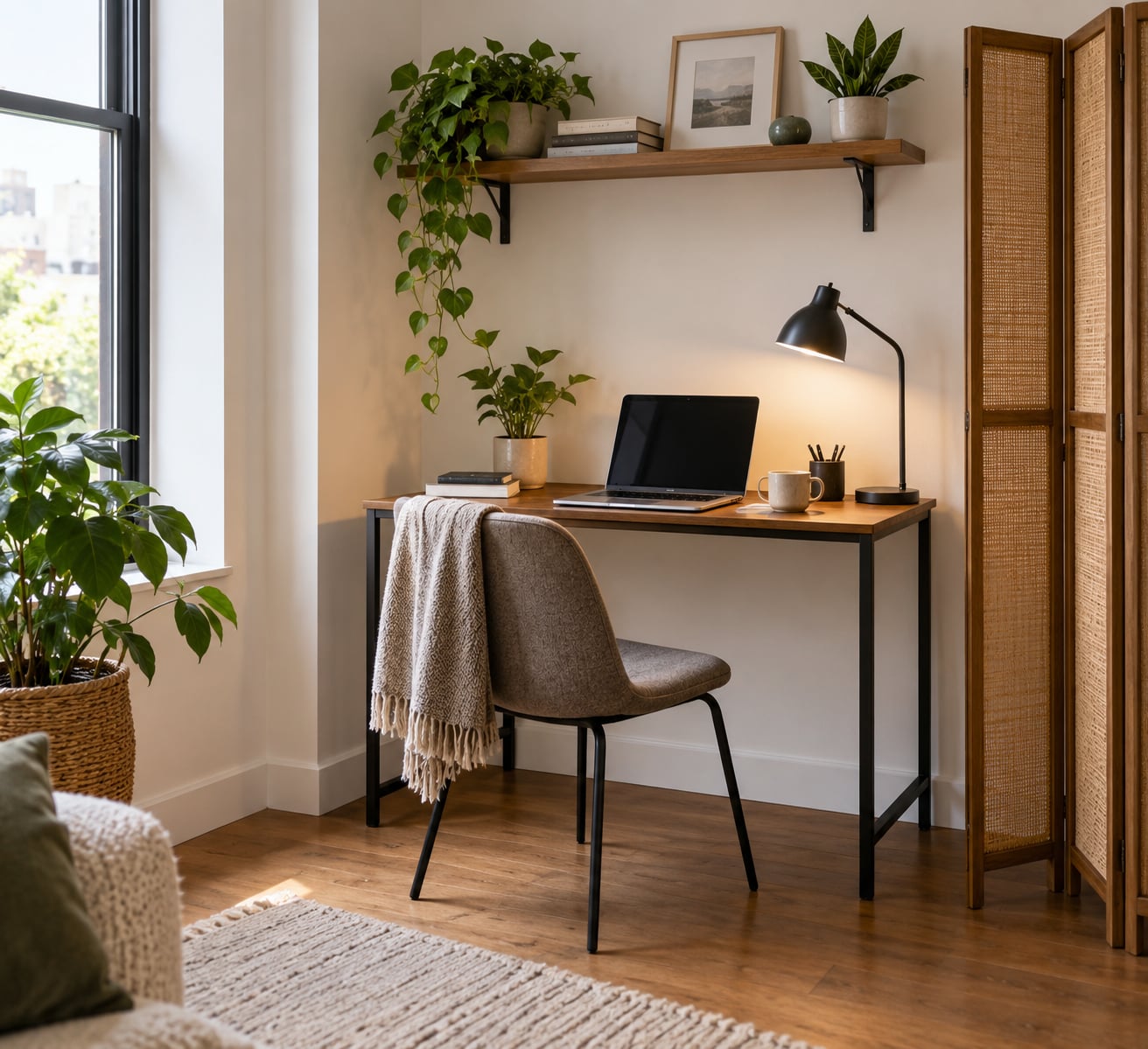
The best location in a small apartment is a corner that gets natural light but sits to the side of the window, not directly in front of it or with its back to it. That side-on position gives you daylight without the screen glare that ruins an afternoon, and it keeps the window usable for opening air.
Forum threads on r/homeoffice and r/WFH keep circling the same question, whether near the window or away from it, which tells you placement is the hard part. A corner with one solid wall, a reachable outlet, and a path to the door that does not cut through your chair wins over a prettier spot by the window every time.
| Zone | Space you need | Best desk style | What to watch |
|---|---|---|---|
| Living room corner | About 3 sq m | Corner desk or wall-mounted | Family traffic; needs a boundary at night |
| Dining table | None, it is already there | None, use the table | Clearing it every evening |
| Bedroom corner | About 2.5 sq m | Compact writing desk | Work invading rest space; closet doors |
| Closet conversion | About 1.5 sq m | Wall-mounted or lap desk | Heat, no window, limited depth |
| Kitchen counter | One counter section | None, counter height | Distraction, food traffic, standing only |
| Window nook | About 2 sq m | Perpendicular narrow desk | Glare and heat gain, radiator clearance |
On the desk facing the window or away from it question: side-on is the answer people settle on. Facing the window gives you a bright screen fighting daylight behind you, and backing onto it gives you a wall of glare plus a blocked source of light for everyone else in the room.
Measure and Plan the Workspace
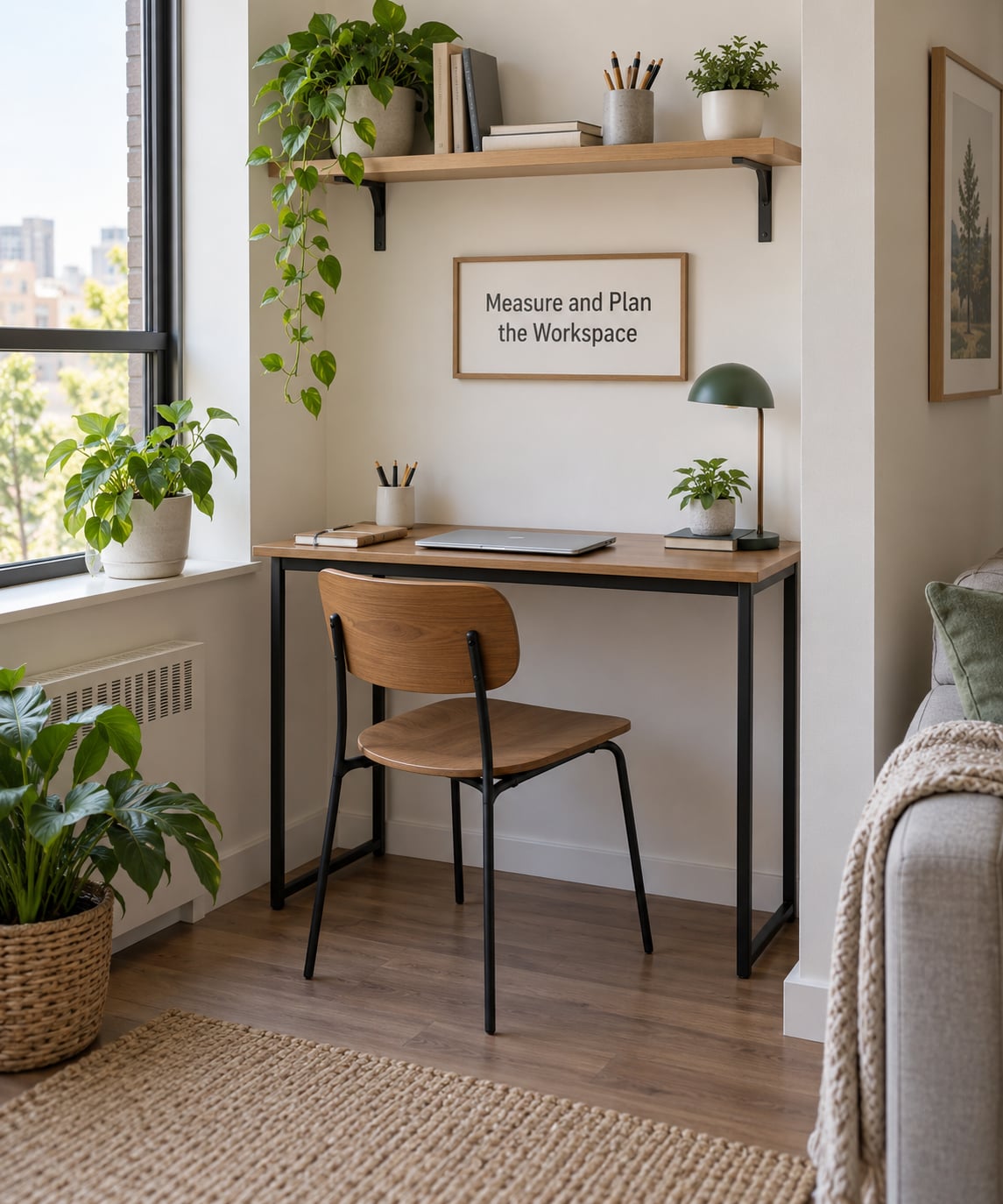
Measure before you buy, and measure five things: the wall run you intend to use, the position of every window, the door swing, the distance to the nearest outlet, and the space your chair needs to pull back.
Chairs need about 75cm (30 inches) of clearance behind them to slide out and lean. If that pull-back zone crosses a walkway, you will resent the setup within a week.
A cheap trick beats a floor plan app: tape the footprint of your desk and chair onto the floor with painter’s tape, then live with it for two days. Walk around it, make coffee in it, open the door with it. It shows you instantly whether you have blocked a path or a baseboard radiator. That is the honest way to plan how to make a home office in a small apartment before any money changes hands.
As a rough square-footage guide: a studio around 160 square feet gives you one workable corner; a one-bedroom gives you a corner plus a place to put the printer and the paperwork; anything larger lets you keep a small dedicated room. The limit is rarely square footage, it is door swings and outlets.
Choose Compact Furniture and Storage
Compact furniture earns its footprint by doing at least two jobs. A fold-down desk is a desk until 6pm and a shelf after that. Storage stairs hide a printer, a record player and a stack of paper in the footprint of a single step. Ladder shelves and wall-mounted shelves take storage off the floor entirely, which is the only genuinely free real estate in a small apartment.
Corner desks fit into the dead triangle where two walls meet, and L-shaped desks are worth it only if you use both arms daily. A lap desk plus a pillow on the sofa works for reading and email, not for six hours of typing, so treat it as a secondary station rather than the main one.
Whatever you choose, set the numbers before you adjust anything. These are the measurements people who work from home actually check:
| Setting | Target | Quick check |
|---|---|---|
| Desk depth | 60cm minimum (about 24 inches) | Keyboard and notebook must sit side by side |
| Monitor viewing distance | 50-60cm (20-24 inches) from your eyes | Arm’s length plus a hand’s width |
| Top of screen | 7-9 inches below eye level | Gaze falls slightly downward, no chin tuck |
| Elbow angle | 90 to 110 degrees | Shoulders stay dropped when you type |
| Task lamp reach | Light lands on the page, not the screen | No shadow from your hand at night |
| Sit-stand rhythm | 20 minutes sitting, 8 standing, 2 moving | Set a timer for the first week |
If your shoulders rise when you type, the desk is too high. If your chin drops to read the screen, the screen is too low. Those two checks catch most of what goes wrong.
On the size question, one desk around 3 square meters with a laptop and a single external monitor is a proven configuration among people working from tight rooms. One good surface beats two mediocre ones, because every extra surface in a small apartment becomes a place clutter collects.
Set Up Lighting, Power, and Internet
Layer your lighting instead of relying on the ceiling fixture. Overhead light alone is what makes small rooms feel like waiting rooms. Add a task lamp that throws light onto the work surface, and keep the ceiling light for the room around you.
For color temperature, aim for 4000-5000K during the working day, which reads as neutral white, and drop to 2700-3000K in the evening so your eyes are not pushed by blue light right before bed.
Handle glare before you move the furniture. Side-on to the window usually solves it. If it persists, a matte anti-glare screen on the monitor is cheaper than reorienting the whole desk.
Power and internet are where small apartments surprise people. Find your outlets before you place the desk, not after; if the nearest one is more than a meter away, plan for a power strip rather than an extension cord stretched across a walkway. Clip an under-desk cable tray to the desk frame and route everything through it, so the floor stays clear and vacuuming takes ten seconds.
For Wi-Fi, test signal strength where the desk will actually sit rather than where the router lives. If it is weak, a wired connection, a mesh unit, or a phone hotspot as backup is more reliable than moving the desk to a worse working position for the sake of the connection.
Create a Work-Life Boundary
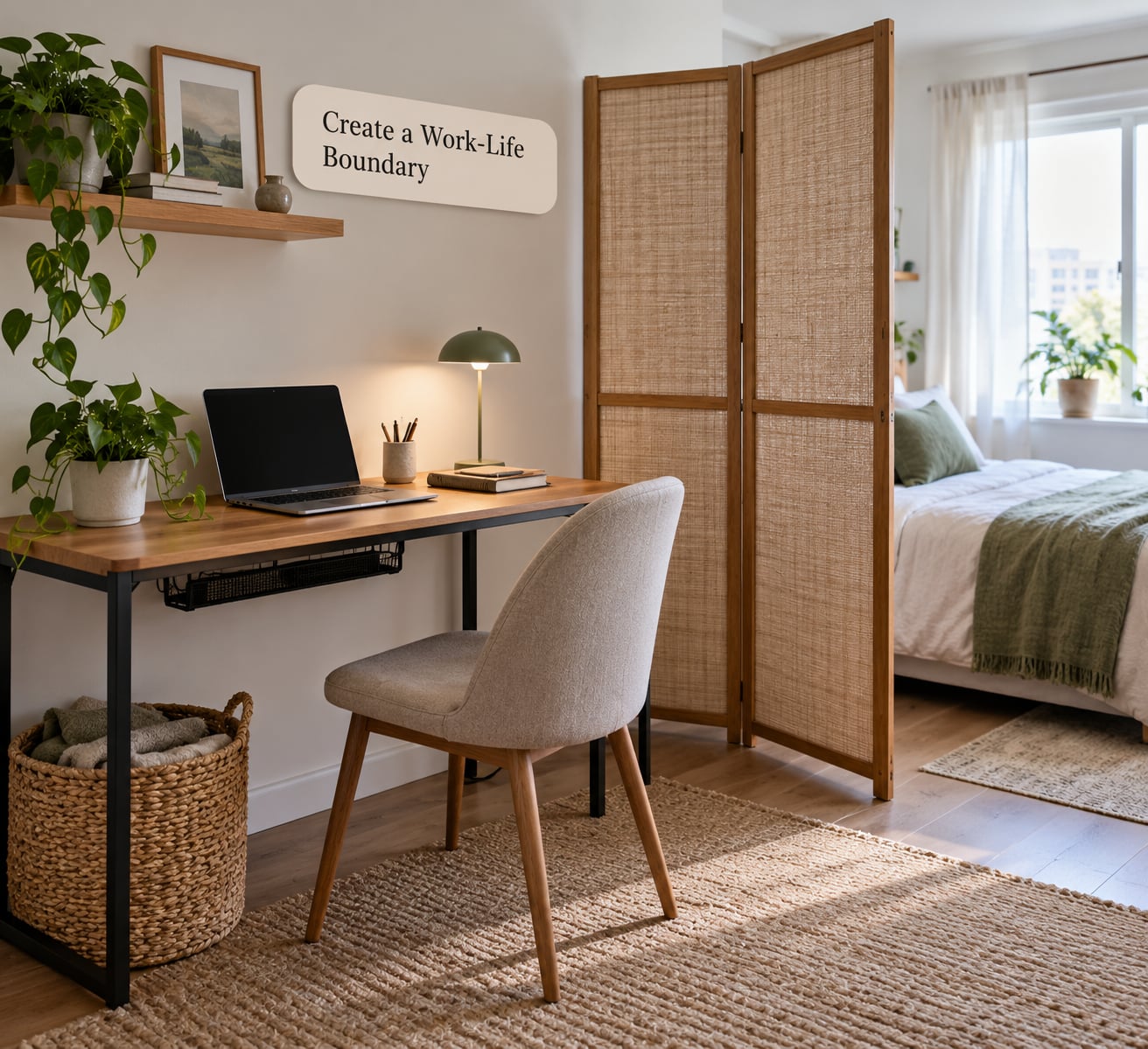
A boundary matters more in an apartment than in a house, because there is no closing door between the office and the sofa. The most common complaint from people working in open-plan studios is that half the apartment starts to feel like work and evenings stop feeling like evenings.
Three things help. First, a shutdown routine: two minutes at the end of the day where the desk is cleared, the laptop is shut, and the work bag goes into its drawer. Second, a physical marker: a folding screen, a curtain on a track, a rug edge, or a shelf that visually ends the workspace. Third, dedicated work-only storage, so nothing work-related is sitting on the coffee table at 7pm.
For thin walls and roommates, set expectations out loud before the first call. A headset with decent noise cancellation handles steady background noise, and it does nothing about a barking dog. If you take calls daily, a heavy curtain or a rug on the hard floor absorbs more than most people expect.
Common Mistakes
Buying furniture before measuring. The desk looked right in the showroom and does not fit between the radiator and the door. Measure, tape the footprint, then buy.
Putting the desk flush against the window. You lose half your daylight, gain glare, and block a draft source. Set the desk perpendicular to the window instead.
Relying on the ceiling light alone. One overhead fixture means shadows across your hands and eye strain by mid-afternoon. Add one task lamp and angle it at the work surface.
Reusing the dining chair all day. A hard dining chair has no lumbar support and no height adjustment, and both matter more over hours than most people expect. Borrow a better chair or adjust the desk height to suit you, not the seat.
Letting cables and paperwork accumulate. A rolling cart or a single basket, emptied weekly, keeps the surface honest. Cables get clipped; loose paper gets a home.
Never switching the zone off. If the desk looks identical at 8am and 10pm, your brain treats the whole room as work. The shutdown routine is what turns a corner into an office.
If you want a fast start instead: an hour gets you a taped footprint, a desk cleared and wiped down, a lamp positioned, cables clipped, a basket for the paperwork, and one chair checked against the elbow angle in the table above. That is enough to tell you whether the zone works before you commit a weekend to it.
Frequently Asked Questions
Can you have a home office in an apartment?
Yes. Most apartments can hold a workable home office in about 3 square meters of clear floor space. You need a desk at least 60cm deep, a chair you can adjust, one good light source and a reachable outlet. Renting is not a blocker, as long as your setup stays reversible and you check what your lease says about drilling and paint.
How can I set up a home office in a small space?
Pick the zone before anything else, then tape the footprint on the floor and live with it for two days. Measure the wall run, the door swing, the outlet distance and the chair pull-back zone. Only then choose furniture that fits, adding vertical storage, one task lamp and an under-desk cable tray to keep the floor clear.
What is the minimum room size needed for a home office?
About 3 square meters of clear floor space is the practical minimum for a desk, a chair and a walking path around it. Closet conversions can work in roughly 1.5 square meters with a wall-mounted or lap desk, though they get hot and lack daylight. One-bedroom apartments usually have room for a corner plus space to keep the printer and paperwork.
What are some creative ideas for an office in a small apartment?
Fold-down wall desks that become shelves after hours, corner desks that use the dead space where two walls meet, storage stairs that hide a printer, and ladder shelves that take storage off the floor entirely. A rolling cart gives you a mobile station, and a folding screen or track curtain marks the end of the work zone so the room can flip back to living space.
Can I set up an office in a rental apartment without drilling?
Usually, yes. Tension-mounted and over-the-door shelving, removable adhesive hooks rated for the weight you load them with, and freestanding desks need no holes in the wall. Read your lease first, since some buildings restrict drilling in certain rooms, and avoid anything you would have to patch out of the deposit. Weight the adhesive products before you trust them.
Where should I put my desk in a small apartment?
In a corner that sits side-on to a window rather than facing it or backing onto it. Side-on placement gives you natural light without screen glare and keeps the window clear for airflow. Prioritise a solid wall, a reachable outlet and a chair pull-back zone that does not cross a walkway. Check noise levels too, since a corner near a shared wall works badly for daily calls.
Start with the tape. Mark the footprint, give it two days, and the rest of how to make a home office in a small apartment gets a lot easier, because you will be choosing furniture for a space you already understand rather than hoping it works when it arrives.