To cut grocery costs without coupons, you change four things: what you buy, how much of it you buy, what you already own at home, and how quickly food gets thrown away. Work the pantry before the cart, build meals around what is already in the fridge, compare unit prices instead of package prices, and switch most staples to store brands. Households that adopt the full set report cutting their bill by roughly 15 to 25 percent, mostly because every habit attacks a different leak. It takes about an hour a week, most of it on a Sunday evening.
The biggest single change is usually not a discount at all. It is finding out what you already spend, then matching it to what your household actually eats. Everything after that is smaller, steadier work.
Table of Contents
- What You Need
- How to Cut Grocery Costs Without Coupons: Step-by-Step
- 1. Set a weekly grocery spending limit
- 2. Plan meals around food you already have
- 3. Make and use a flexible shopping list
- 4. Compare unit prices instead of package prices
- 5. Choose store brands for most staples
- 6. Shop strategically and resist impulse purchases
- 7. Reduce food waste at home
- 8. Spend less on meals eaten away from home
- 9. Review prices and adjust the plan each month
- Common Mistakes
- Buying a large package without checking how much you actually use
- Planning meals nobody will eat
- Treating a sale as a saving
- Letting food expire in the crisper
- Shopping before updating the list
- Setting a limit without looking at what is already in the kitchen
- Frequently Asked Questions
- Are store-brand groceries really cheaper?
- How can I compare grocery prices without using coupons?
- Should I buy in bulk to save money on groceries?
- What is the best way to reduce food waste at home?
- Can grocery stores price match or offer digital deals?
- What is the fastest way to start saving on groceries?
- Conclusion
What You Need
None of this needs an app, a membership card, or a spreadsheet. It needs five ordinary things, and four of them you already have.
- Your real spending number. Pull the last two or three months of grocery charges from your banking app. Checking accounts and card statements both work, and two months is better than one because it smooths out a holiday or a birthday party.
- A payment method. A debit card or a reloadable card keeps the impulse buy from turning into a balance carried for a month.
- A planning method. A paper notebook works. A notes app works. A printed weekly plan works. Pick one that you will actually open, because a system you skip is worth nothing.
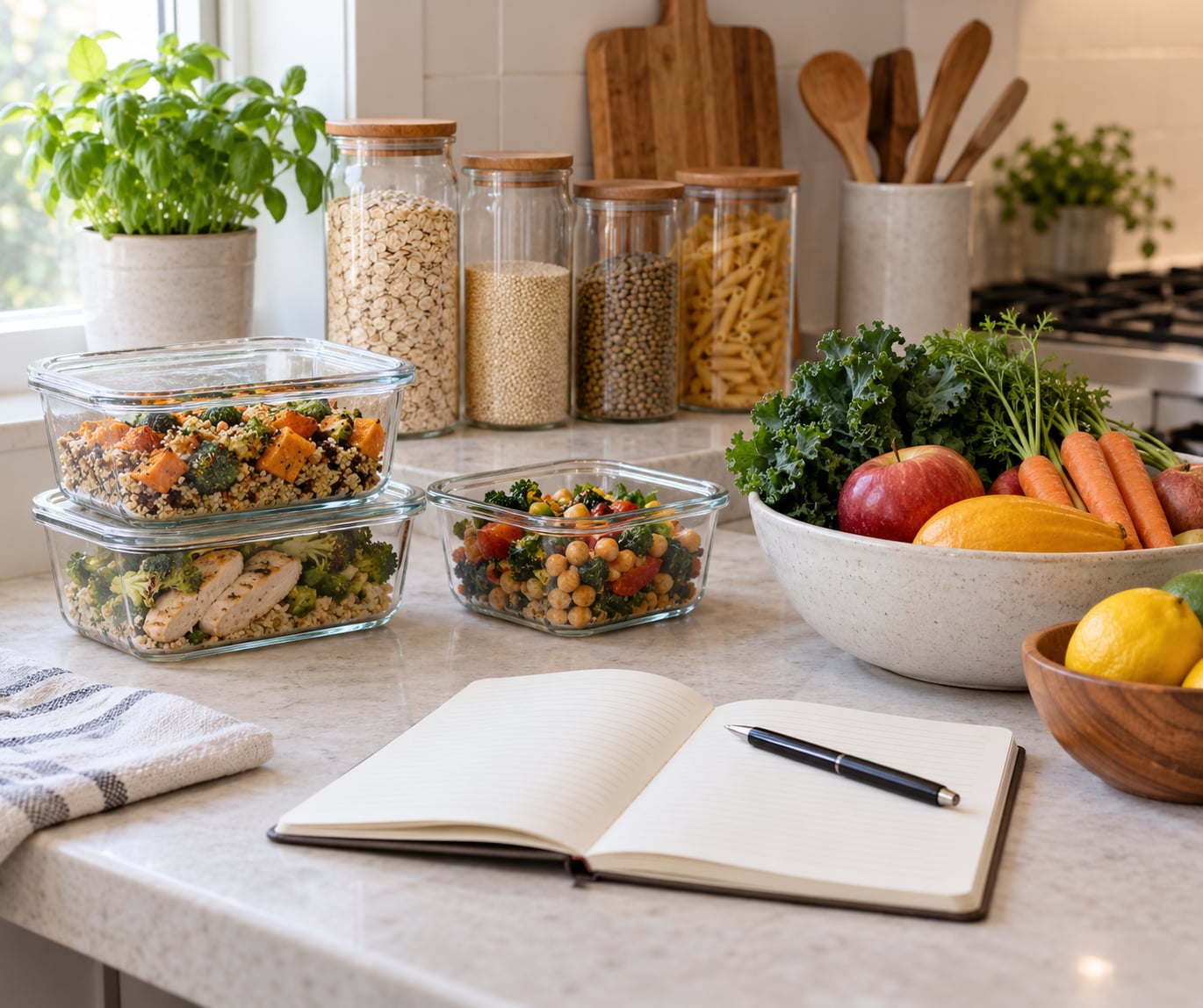
- Containers for cooked food. A shelf of matching glass or plastic containers in the freezer is the cheapest meal-planning tool you can buy, and it turns a batch of soup into four separate dinners.
- A notebook or grocery list in your pocket. If it lives on your phone, that is fine. If it lives in your head, it does not exist.
Add one honest look at your kitchen before you go shopping. Pull out the pantry, check the freezer, and look at the crisper drawer. That inventory is the raw material for every step that follows.
How to Cut Grocery Costs Without Coupons: Step-by-Step
The nine steps below work as a system, but they do not have to be done in order, and they do not have to be applied rigidly. Your food needs, your tastes and your budget decide the shape of it. What you are building is a repeatable routine, not a diet. Follow it for a month, adjust what does not fit your household, and keep the parts that do.
1. Set a weekly grocery spending limit
A spending limit is the step that makes the other eight work, because it converts a vague hope into a decision. Start from the number you actually spend, not the number you wish you spent.
Divide your last quarter’s grocery total by the number of weeks in that quarter. That weekly figure becomes your ceiling. Then split it so each part of the store has a number attached: roughly 25 to 30 percent for meat, fish and eggs, 20 to 25 percent for produce, 20 percent for pantry and dry goods, 10 to 15 percent for dairy and frozen, and about 10 percent for household and personal items if you shop for those in the same basket.
How much should you budget for groceries per week? That depends almost entirely on household size and how much you cook, so treat these figures as orientation rather than a target to hit. They move with food prices in your region.
| Household | Weekly | Monthly |
|---|---|---|
| One person cooking most meals | 50 to 70 | 215 to 300 |
| Couple | 90 to 140 | 390 to 600 |
| Family of three | 140 to 190 | 600 to 820 |
| Family of four | 175 to 230 | 760 to 1000 |
| Family of five or six | 230 to 320 | 1000 to 1400 |
A worked example: a family of four was averaging 320 dollars a week, part of it from takeout runs added at the register. Setting a ceiling of 210 forced two changes, which were cooking four nights a week instead of three and moving the drinks out of the basket. At the end of the month the grocery line sat at 205, and the money that came off takeout was the part the household felt most.
How you know it worked: at the end of four weeks your actual spend is under the ceiling without meals being skipped.
2. Plan meals around food you already have
Shopping before inventorying is the most expensive habit in this article, because it guarantees you buy a second jar of something you already own. Inventory first is the fix.
Open the fridge, the freezer and the pantry, and write down what needs to be eaten soonest. Perishables go to the top of that list. Half a bunch of herbs, two carrots, a half bag of frozen peas and some soft cheese become the spine of two or three meals, and the rest of the shop supports those meals rather than replacing them.
A simple fridge-clearing week looks like this: chopped vegetables and eggs become a frittata or a stir-fry on the first night. A roast or a batch of chili covers two nights, with part of it frozen for a fourth. A bag of greens becomes a salad alongside whatever protein is already cooked. Sourdough or rice made in a big batch feeds lunches. Nothing in that week is exotic, and nothing requires a special ingredient bought on impulse.
One habit from a popular frugal forum thread is worth repeating: freeze vegetable ends, herb stems and cheese rinds in a bag in the freezer, then boil them for stock. Scraps you would have thrown out become a cooking base for free.
3. Make and use a flexible shopping list
Your list is a tool for deciding, not a record of decisions you already made. Build it after the meal plan and after the pantry check, then organize it by store section: produce, meat, dairy, pantry, freezer, household. A list sorted by aisle moves at the pace of a person who is shopping with a purpose.
Assign quantities to your household instead of to your optimism. One adult does not finish a nine-pound bag of potatoes, and a family of four does not eat two packages of tortillas in a week. This is the failure mode that quietly wastes money in one and two person households, where nearly all packaging is designed for a family.
Build in a small buffer, maybe one extra item per category for the week you know will be busy. Ten percent headroom keeps the list honest. Twenty percent turns it into an overspending plan, because the extra items are usually snacks and drinks you would not otherwise have bought.
How you know it worked: every item in the cart is on the list, and you can say what each item is for.
4. Compare unit prices instead of package prices
A bigger package looks like a bargain and sometimes is one. The only reliable test is the price per unit, and most stores print it on the shelf tag. Bring a small calculator or do the division in your head; it is just a division.
Consider rice: a 2-pound bag priced at 5 dollars works out to 2.50 dollars a pound, while an 11-pound bag at 14 dollars works out to about 1.27 dollars a pound. The same difference shows up in toilet paper and laundry detergent, where the cheaper option is usually the larger one because those are stable, non-perishable items with predictable use. Canned beans are the same story, since a case of eight is usually cheaper per can than two cans of four.
Two terms worth knowing. A stock-up price is the genuine low point an item hits, usually once every six to twelve weeks, and it is worth buying extra for the items you use constantly. A loss leader is an item priced to pull you into the store, often milk, eggs, bananas or bread, and it is worth buying because you needed it anyway.
What not to buy in bulk is just as important. Bulk perishables you cannot finish cost more than the low price saved, because you paid twice, once at the register and once in the bin. Frozen vegetables, dry beans, toiletries and shelf-stable items are safe. Fresh meat, bakery bread and soft produce are not.
5. Choose store brands for most staples
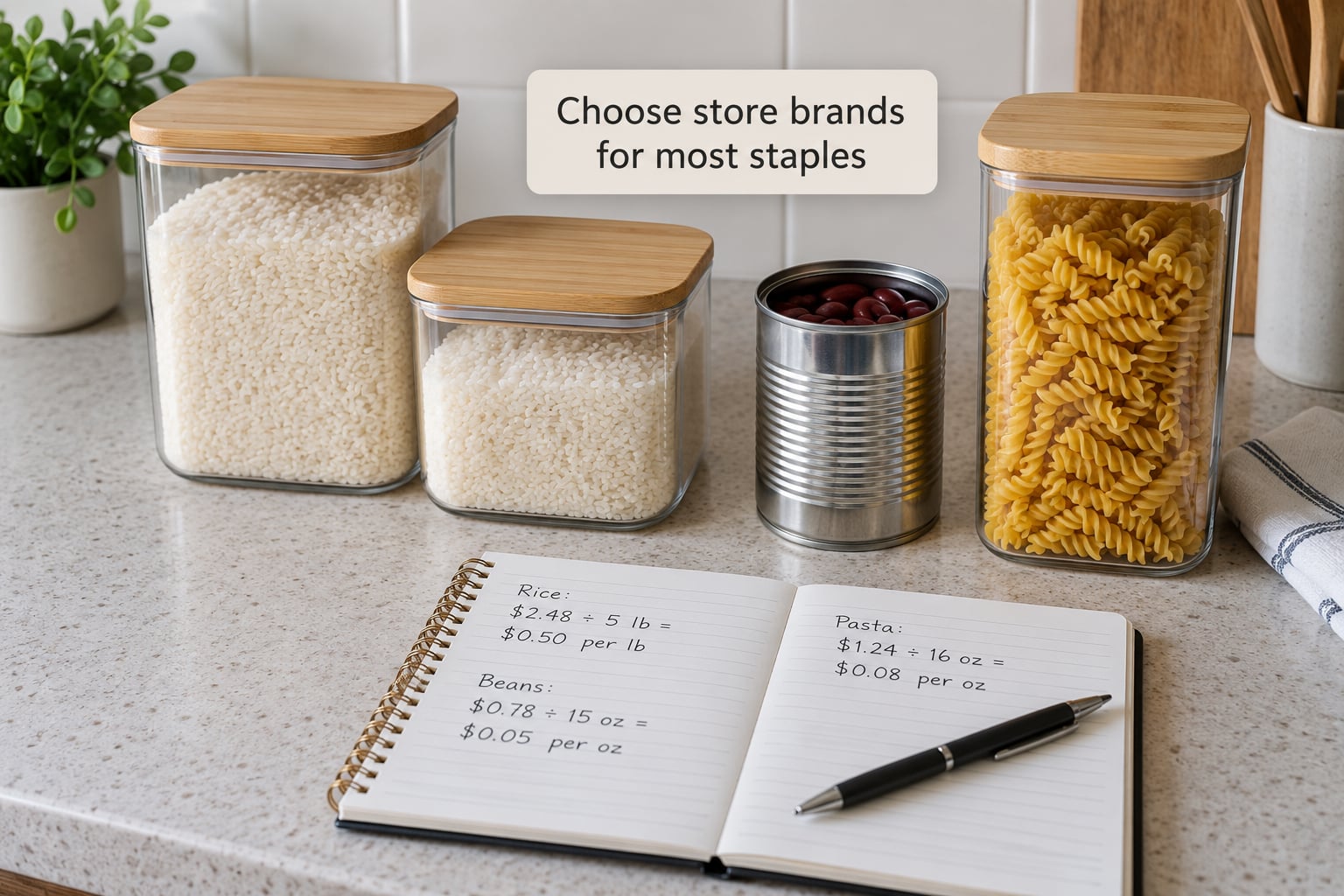
Store brands are the easiest recurring saving on the shelf, because the product is often close to identical and the price gap is not. For dry goods, canned items, frozen vegetables, tortillas, broth, cleaning products and paper goods, a private-label version is usually the better buy with no change in how you cook.
Compare labels rather than front-of-package claims. Match serving sizes, then compare protein, fiber, sodium and added sugar per serving. If the numbers line up, the store brand wins on price. If your household genuinely prefers a specific brand in one category, keep that one and switch the other eleven.
Some categories are worth keeping by brand: coffee where taste really matters, anything with a specialty diet requirement, and products your family is loyal to. Switching those is where the habit turns into a fight, and a fight ends the habit.
A practical rule: switch one category a week for a month. Nobody notices the change, which is the proof that it worked.
6. Shop strategically and resist impulse purchases
Most of the money you do not plan to spend gets spent in the middle of the store, on a tired day, in a bad mood, with a hungry child. Change the conditions rather than relying on willpower.
- Shop once a week, on purpose. More trips means more unplanned additions every single trip.
- Eat first, then go. A full stomach is the cheapest impulse control available.
- Fill the cart with what is on the list, not with extras. Add unplanned items to the cart, not to the basket you are already holding.
- Set a checkout rule. Nothing goes through the register that is not on the list or not in the kitchen already.
- Check the running total at checkout, not at the register. Many stores show your cart total on a screen while you shop, which turns the budget into a live number instead of a surprise.
Another forum favorite: if a store is having a sale on something you would not otherwise buy, it is still money out the door. Saving two dollars on a product you did not need is not a saving.
7. Reduce food waste at home
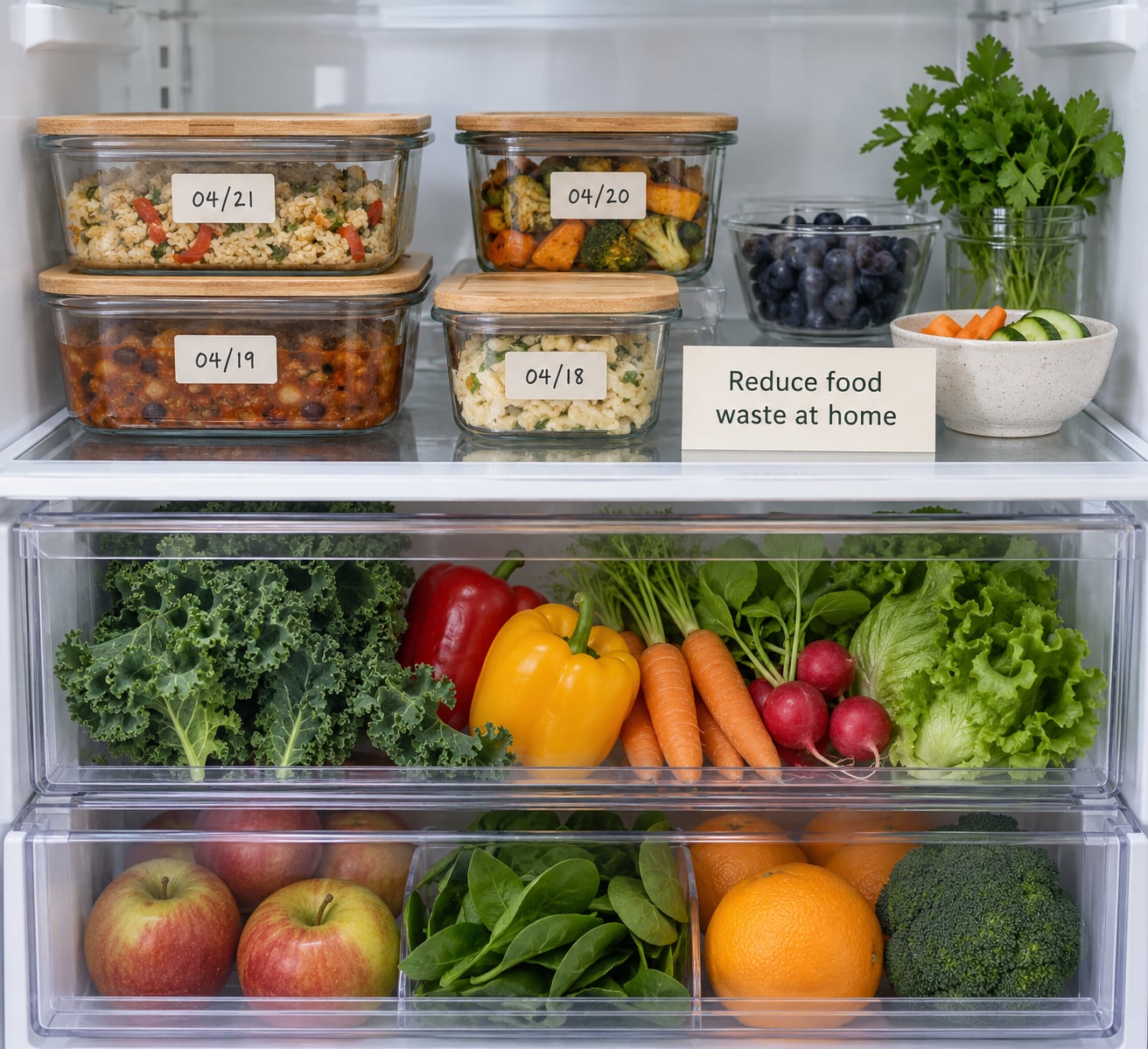
Food waste is money already spent and then thrown away, which makes it the only leak in your budget that you can recover. Read labels the way they are written. Best-by dates are about quality, not safety. Use-by dates are a safety judgment call. A date label is not a license to keep food until it turns, and a date that has passed is not a reason to throw food out early.
Storage does most of the work. Keep greens dry in a cloth-lined bag or a container with a paper towel, refrigerate berries unwashed and wash only what you will eat that week, and store bread in the freezer rather than letting it go stale on the counter. Freeze produce at peak freshness, right after you cut it or the day you bring it home, and flatten bags so they stack instead of tumbling into a single block.
Portion before you cook, not after. Cook rice for four servings and freeze two immediately, in a container that holds exactly two. Cooked food from the night before becomes a packed lunch instead of a decision nobody makes. When you do have more than you can eat, freeze it flat in labeled bags and write the date on the outside with a marker.
On safety, follow what the USDA actually requires. Refrigerate perishable food within two hours, or one hour if it is above 90 degrees outside. Refrigerate or discard perishable leftovers within three to four days, or freeze them. Keep raw poultry at 165 degrees Fahrenheit, ground meat at 160, and whole cuts and fish at 145, measured at the thickest part. Breaded or raw pre-seasoned poultry is the exception that catches most people: treat it as ground meat and cook to 165. Do not rely on smell or appearance as a safety test.
Freezer space is the usual objection. A flat bag freezes more efficiently than a bulky container, and a single sheet pan of food that is already the right portion sizes is easier to use than six jars. No freezer at all is workable if you shrink your list, shop more often, and buy the frozen bags rather than the fresh equivalents.
8. Spend less on meals eaten away from home
Takeout is where grocery budgets quietly disappear, because it never appears on a grocery receipt. Cooked food from dinner the night before is the cheapest replacement, and it takes about a minute to assemble.
A packed lunch needs no special container and no special food. Portion the same meals you already cook, keep one reusable container in your work bag so it cannot be forgotten, and treat the second portion as already cooked rather than as a second meal to make. Ice packs keep cold foods cold, and reheat leftovers to 165 degrees before eating them.
Water instead of single-serving drinks is the other quiet win in the same category, and it is visible in the cart every single time.
9. Review prices and adjust the plan each month
Once a month, spend fifteen minutes reviewing what actually happened, and write down the categories where you overshot.
Compare a handful of items you buy every week across two stores, and time the trip before you commit to it. A discount grocer every other week can produce real savings, but readers on low-income budgets describe it as the single biggest win they have found, and also as the one that has to be judged by hours spent. If a trip across town takes forty minutes each way, the comparison price has to be meaningfully lower to pay for itself.
Look for the recurring leak rather than the dramatic purchase. Buying the same lunch every day at the same counter, throwing away produce twice a week, or restocking a shelf that already has three open boxes of the same thing are all bigger than any single mistake.
Rebuild next month’s list from what you learned, and keep your numbers somewhere you will see them. A note on the fridge or a note in your phone works better than a system you never open.
Common Mistakes
Most households trying this make the same handful of mistakes, and each one has a simple correction.
Buying a large package without checking how much you actually use
A twenty-pound bag of rice is a good deal only if your household finishes it before it turns. Buy the size that matches one month of real use, and calculate the price per unit before you decide.
Planning meals nobody will eat
A plan built around food the family dislikes fails by week two, and a failed plan is worse than no plan. Start with the six meals you already cook without complaint, then add one new meal a week.
Treating a sale as a saving
A sale is only useful for items you were already going to buy. Buying a second bottle because it was reduced is the same spending, moved.
Letting food expire in the crisper
Produce bought with good intentions rots in the bottom drawer. Use what is softest first, and put the drawer at eye level so you open it.
Shopping before updating the list
A trip without a list is a trip where the plan sets the budget instead of you. Ten minutes of planning is cheaper than any coupon.
Setting a limit without looking at what is already in the kitchen
The budget will not hold if the pantry is still full. Inventory first, every time.
A few final habits that hold up over time: shop with the same list format each week so planning gets faster, keep one meal that requires no cooking for the night the plan slips, and review the budget monthly rather than daily. Progress that you can see is what keeps a system running longer than a good first month.
Frequently Asked Questions
Are store-brand groceries really cheaper?
Usually, yes, on the categories where the recipe is identical: dry grains, canned goods, frozen vegetables, tortillas, broth, paper goods and cleaning supplies. The gap on these items is often fifteen to thirty percent. Where you pay full price for the brand is coffee, specialty diet items and anything your family strongly prefers, so switch those last.
How can I compare grocery prices without using coupons?
Use the shelf price and the unit price on the tag. Divide the shelf price by weight, count, or volume to get a price per ounce or per unit, then compare items in the same category against each other. Also compare your regular price to the lowest price you saw for that item in the previous six to twelve weeks. That regular versus low comparison tells you whether a sale is real.
Should I buy in bulk to save money on groceries?
For stable, non-perishable items you use constantly, yes: toilet paper, detergent, canned goods, dry beans, pasta and frozen vegetables. The unit price drops and the risk is low. For perishables you might not finish, no. You pay the low price and then pay again when the food is wasted, which is why bulk fresh meat and bakery bread routinely cost more than the small package.
What is the best way to reduce food waste at home?
Inventory before you shop, then plan meals around the oldest items first. Freeze perishables at peak freshness, cook in double batches and freeze the second portion the same night, and label every container with a marker and a date. Best-by dates are about quality rather than safety, while use-by dates are the safety guidance. Follow USDA time and temperature rules for poultry, ground meat and leftovers.
Can grocery stores price match or offer digital deals?
Most supermarket chains price match a handful of competitors on identical items, usually the same size and brand, and policies differ by store, so check the service desk or the app before you buy. Store loyalty programs also offer member prices and points on items you already purchase, which are automatic savings rather than coupon work. Check the policy on your receipt, because matching happens after the sale, not before.
What is the fastest way to start saving on groceries?
Pull your last three months of grocery spending from your banking app, divide by thirteen, and treat that as your weekly number. Then shop the pantry, fridge and freezer before you build a list, and write the list around what is actually there. Those two steps usually produce more in the first month than switching brands, because they stop the duplicate purchases entirely.
Conclusion
Start where you are standing. Check what is already in the kitchen, pull your real weekly number from your bank, and write a list with a number attached to each section of the store. That is the whole first move, and it takes an evening.
What follows from there is repetition rather than restriction. Shop the pantry first, plan around the oldest food, compare unit prices, switch most staples to store brands, and treat waste as money you already spent. Households that keep this up tend to land 15 to 25 percent lower than where they started, without a coupon app and without cutting meals.