The fastest way to handle a client who does not pay is to work through a fixed escalation ladder instead of reacting to every silence: check the contract, send a short factual reminder, set a real deadline, offer a written payment arrangement, and escalate one step at a time. Most unpaid invoices get resolved in the first two stages, and the ones that do not need you to have a paper trail that would hold up in small claims court.
This guide is written for freelancers, coaches, consultants, and small service firms. It takes roughly two weeks of steady follow-up before you reach the stage where legal options start to matter.
Table of Contents
- What You Need Before You Chase the Invoice
- Step-by-Step: A Professional Escalation Process
- Step 1: Respond Without Escalating Too Quickly
- Step 2: Review the Contract and Payment Terms
- Step 3: Send a Professional Overdue Invoice Notice
- Step 4: Offer a Written Payment Arrangement
- Step 5: Escalate in a Controlled Way
- Common Mistakes That Make the Situation Worse
- Frequently Asked Questions
- What should I do when a client refuses to pay?
- How many reminders should I send before escalating?
- Can I stop working if a client has not paid my invoice?
- Should I charge late fees to a client who missed the due date?
- How do I collect a small unpaid invoice?
- Can I send an unpaid invoice to a collection agency?
- Conclusion
What You Need Before You Chase the Invoice
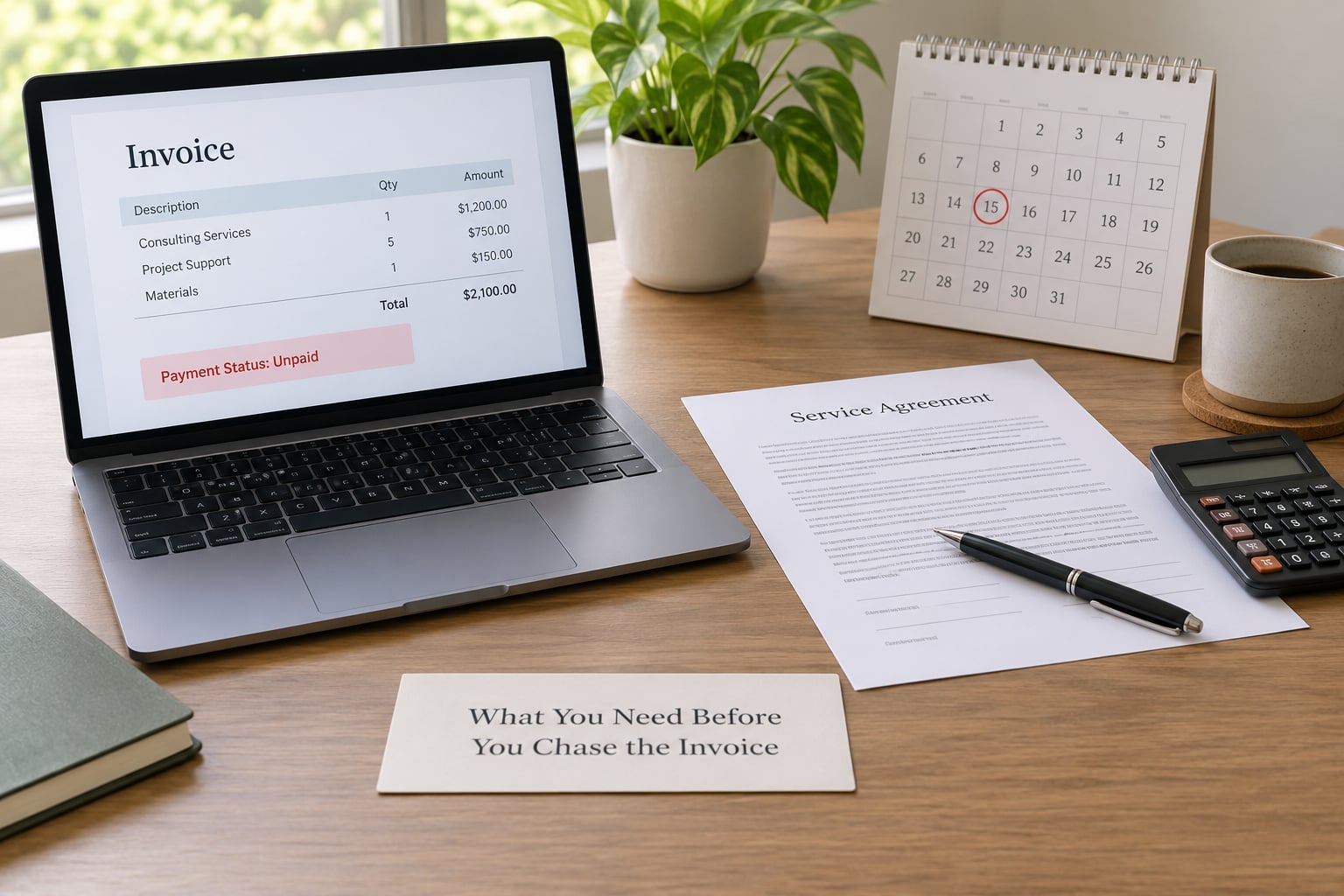
Gather everything before you send the first message. Ten quiet minutes of paperwork saves you from sending a reminder that contradicts your own contract.
- The signed contract or written agreement. The version both sides signed, including any addenda about scope or payment.
- Every invoice you sent, with the invoice number, date issued, due date, and amount.
- Proof of delivery. Files transferred, work published, milestones signed off, or a written acceptance message.
- Payment records. Screenshots of the payment portal, bank or card statements, and any partial payment already received.
- The full email thread showing scope approval, change requests, and any promise to pay.
- Written payment terms you actually agreed to, including deposits, milestones, and net terms.
- A dated timeline. When the due date passed, when you noticed, and who you have contacted since.
- Your escalation options. Collections agency, small claims court in the right county, and a lawyer you could call.
Save the whole packet in one folder. If it ever reaches a court or a collections agency, that folder is the case.
Step-by-Step: A Professional Escalation Process
Step 1: Respond Without Escalating Too Quickly
Most non-payment in the first two weeks is an oversight, a failed card, or a person waiting to see if you will chase. A calm first response usually settles it.
Before writing anything, rule out three mundane explanations. Did the payment actually fail, or did it post to a different account? Did the client dispute the work in writing, and if so, is the dispute about something you can fix? Is the invoice for a deliverable you never sent?
Then send one short message. Keep it to a few sentences: invoice number, amount, original due date, where to pay, and a specific date by which you need a reply. Attach the invoice again rather than making them hunt for it.
A good first reminder sounds like this:
Hi Dana — invoice 1042 for the brand workshop is still open, due on the 12th. The payment link is attached. If it is scheduled for a particular date, let me know by Friday so I can update my records. If something about the invoice looks wrong, tell me and I will sort it out.
Notice what that message does not do. It does not argue, accuse, threaten, describe how much the work cost you, or remind them how many other clients are waiting. It gives them an easy path to either pay or explain themselves.
Step 2: Review the Contract and Payment Terms
This is the step most people skip, and it is where your leverage actually lives. Pull the agreement and find five things.
- The due date and payment terms. Net 30, net 15, or due upon receipt. If the contract is silent, that is itself useful information, because a court will look at what was reasonable rather than what you hoped for.
- Late fee or interest terms. A flat monthly fee or a percentage. What is enforceable varies by state and country, so check before you invoice it.
- Notice requirements. Some contracts require a written notice period before you can treat the account as in default. Skip it and your escalation can be challenged later.
- The dispute process. Many agreements require a written objection within a set window after delivery.
- Intellectual property and deliverable terms. Whether ownership, editable files, and site access transfer on full payment. This is the lever you use later.
Also note the statute of limitations for contracts in your jurisdiction. It is typically several years, but it varies, and some states now allow shorter periods for written contracts. Do not let a debt you are avoiding age out while you are still hoping.
Two things to keep in mind. Most non-payment cases are disputes about scope or quality, not deliberate theft, so check whether your client has raised a complaint you can actually resolve. And keep every exchange in email rather than text or direct messages, because a clean written trail is what makes the later stages quick.
Step 3: Send a Professional Overdue Invoice Notice
When silence continues, escalate the format while keeping the tone flat. Three stages cover most cases.
Around 15 days past due, a friendly reminder that assumes good faith and asks for a payment date. Around 30 days, a firmer written notice that states the balance, the late fee your contract allows, and a deadline with a real date. Around 60 days, a final notice that names what happens next, such as suspending work or referring the account to collections, and gives a last date.
Every notice should contain the same core elements:
- Invoice number, issue date, original due date, and the exact amount still outstanding
- A description of the work the invoice covers and the date it was delivered
- Contract payment terms and any late fee being applied
- Every accepted payment method with a direct link
- A specific reply deadline
- The consequence of no response, stated plainly but without threats
A final notice reads like this:
Hi Marcus — invoice 1187, issued 4 August, due 18 August, remains unpaid at the full amount. Under our agreement, payment is due within 15 days of the invoice date, and a late fee applies after that.
I am holding further work on the current scope until this is resolved. Please reply by 12 September with either payment or a proposed payment schedule. If I do not hear from you by that date, I will refer the balance to a collections agency and take the steps available to recover it.
Keep notices to one page, plain language, no emotion. Sent from your business address. Never include insults, guesses about the client’s finances, public threats, or claims you cannot support, because anything overstated can be used against you later.
Step 4: Offer a Written Payment Arrangement
A client who tells you they cannot pay the full amount today is often more honest than one who goes quiet. Turning that into a written arrangement recovers more money than pushing for everything today.
A payment arrangement should state the total amount owed, any credits or partial payments already made, the number and amount of installments with dates, the final date, what happens if an installment is missed, and a confirmation that the rest of the agreement stays in force. Have both sides sign it.
Protect yourself while you negotiate. Do not start new work on the unpaid balance. Charge only the agreed rate, not an emergency surcharge. If the arrangement covers work in progress, describe exactly what each installment buys. And keep the original due date recorded, because an arrangement does not erase the original debt unless it says so.
Decide in advance which requests you will decline. A discount that sets a precedent for every future invoice is a real cost, and a plan with no final date is not a plan.
Step 5: Escalate in a Controlled Way
If the final notice passes without a reply, move up one level at a time rather than all at once.
- Pause new work on that account. This is your strongest and cheapest lever, and it is usually enough on its own.
- Hold back final deliverables where your contract ties transfer of ownership, editable source files, or site access to full payment. Check the contract first. Handing over the finished work free removes your only real leverage.
- Send a formal demand letter, either from you or, for larger balances, drafted by a lawyer on letterhead. A letter from an attorney is one of the strongest signals you can send without filing anything.
- Hire a collections agency. They will chase for a percentage of what they recover, so the economics work best on decent-sized balances. You will also need proof the debt exists.
- File in small claims court when the balance justifies the effort. Filing is usually straightforward and you can often appear without a lawyer, but getting the money after a judgment is a separate problem. Check the ceiling where you will file, since it varies a great deal by state and country.
Two practical warnings. Statute of limitations clocks are running, so do not delay a filing for years hoping for a better offer. And if the client may be insolvent, get advice early; chasing money from a business that no longer exists wastes months.
At some point you have to accept a write-off. Know your numbers: if the outstanding balance is smaller than the time it would take to collect, and the relationship is not worth more future work, closing the file and moving on is a business decision, not a failure.
Common Mistakes That Make the Situation Worse
- Arguing on the phone. Emotional calls produce nothing you can use later. Fix: put every substantive point in writing after the call and read the client your summary before you send it.
- Accepting an unclear promise. “Payment is coming next week” is not a commitment. Fix: ask for a date and an amount, and put it in writing, even by email.
- Continuing unpaid work. Scope creep on an unpaid invoice turns a payment problem into a bigger one. Fix: no new work until the current balance clears, and say so kindly but plainly.
- Threatening action you have not checked. Promising a lawsuit, a lien, or a report to a credit bureau before confirming what your contract and local law allow can expose you. Fix: verify first, then escalate.
- Handing over everything early. Delivering final files while waiting destroys your leverage. Fix: tie transfer of ownership and editable files to payment in writing from the start.
- Losing the paper trail. Scattered texts, calls with no notes, and missing emails make a valid claim hard to prove. Fix: one folder, chronological, backed up somewhere off your laptop.
- Waiting too long to act. Assuming the balance will resolve itself is the most expensive habit on this list. Fix: set a date in your calendar the day an invoice goes past due, and work the ladder.
Frequently Asked Questions
What should I do when a client refuses to pay?
Start with facts, not feelings. Confirm the contract terms, confirm the work was delivered and accepted, and rule out payment processing errors. Then send a short written reminder with the invoice, the amount, and a specific reply date. If there is no response, escalate in stages: firmer notice, then a payment arrangement offer, then a formal demand, then collections or small claims court. Document every step.
How many reminders should I send before escalating?
Three written contacts over roughly six weeks is a reasonable standard: a friendly reminder near 15 days past due, a firm notice near 30 days, and a final notice near 60 days. Each one should name the balance, the deadline, and the next step. If all three pass without a reply, escalate rather than repeating yourself. The goal is a clear record of your attempts, not an endless chain of messages.
Can I stop working if a client has not paid my invoice?
Usually yes. You are not obliged to keep delivering services for free, and pausing new work is the fastest way to get paid. Two cautions. First, check your contract for any clause requiring notice before you suspend work. Second, do not withhold work you were contractually required to hand over, such as ownership that transferred on delivery. Withholding final files or site access is only sound where your agreement ties them to full payment.
Should I charge late fees to a client who missed the due date?
Only if your contract allows it. A late fee or interest charge is a contract term, and whether it is enforceable depends on the state or country involved, with some limits on how high a fee can be. Add the clause before work begins rather than after an invoice is missed. When you do apply a fee, state the contract basis and the calculation in the notice so the client can see it is not arbitrary.
How do I collect a small unpaid invoice?
Start with the cheapest steps: a clear written demand, a phone call, and a formal notice naming the balance and a deadline. Small claims court is often the next step, and filing is designed for people representing themselves, though the cost in time and filing fees varies by location. If the balance is very small, weigh that against your time. A collection agency typically takes a percentage, so it is rarely worth it on a trivial amount, and writing off a tiny balance is sometimes the rational choice.
Can I send an unpaid invoice to a collection agency?
Yes, and you will need documentation. Agencies typically require proof of the debt, such as a signed contract, the invoice, delivery records, and a full statement of any payments already received, plus evidence of your own collection attempts. They usually charge a percentage of what they recover, so agencies make most sense on balances large enough to justify it. Check whether the client is a business, because consumer debt rules are different from commercial ones.
Conclusion
Start today by pulling the contract and the invoice for the oldest unpaid balance and writing down the real due date. Send one factual written reminder today with a specific reply deadline, then work the ladder one step at a time and keep every message in one file. Most balances clear at stage one, and the ones that do not are far easier to deal with when your documentation was clean from the start.