To date your spouse on a budget, agree on one fixed monthly amount, move it into a separate account the day it lands, and plan around it. Most couples overspend on dates because they budget nothing and improvise. Pick a number, protect a recurring slot on the calendar, and choose ideas from a cost tier that fits. The habit matters far more than the spend.
That is the honest answer, and it is less complicated than most budgeting advice. There is no magic card that makes dinner cheaper. There is a small system, a few habits, and a list of ideas that cost close to nothing.
The part people get wrong is treating a date as something you buy. Most of what makes an evening feel like a date costs nothing: a decision made in advance, phones in another room, and an activity you both finish at the same time. The spending is almost a side effect.
Couples who do this well tend to describe the same three numbers, and none of them is the restaurant. It is the amount they set aside, how far ahead they plan, and how often they do it. Below is how to build that, plus where to look when the money in the account runs out.
Table of Contents
- What You Need
- Step-by-Step
- Step 1: Agree the monthly date fund
- Step 2: Move the money the day you are paid
- Step 3: Decide the three cost drivers before you go
- Step 4: Take turns choosing
- Step 5: Spend nothing when nothing is available
- How to Date Your Spouse on a Budget by Choosing Free Experiences
- How to Date Your Spouse on a Budget with Low-Cost Activities
- How to Date Your Spouse on a Budget Without Skipping Planning
- How to Make Budget Dates Feel Special
- Common Mistakes
- Frequently Asked Questions
- How can we date our spouse when money is tight?
- What is a realistic budget for dating your spouse?
- What if one partner wants to spend more than the other?
- How can we use coupons and rewards without making dates stressful?
- What are some free date ideas that do not feel boring?
What You Need
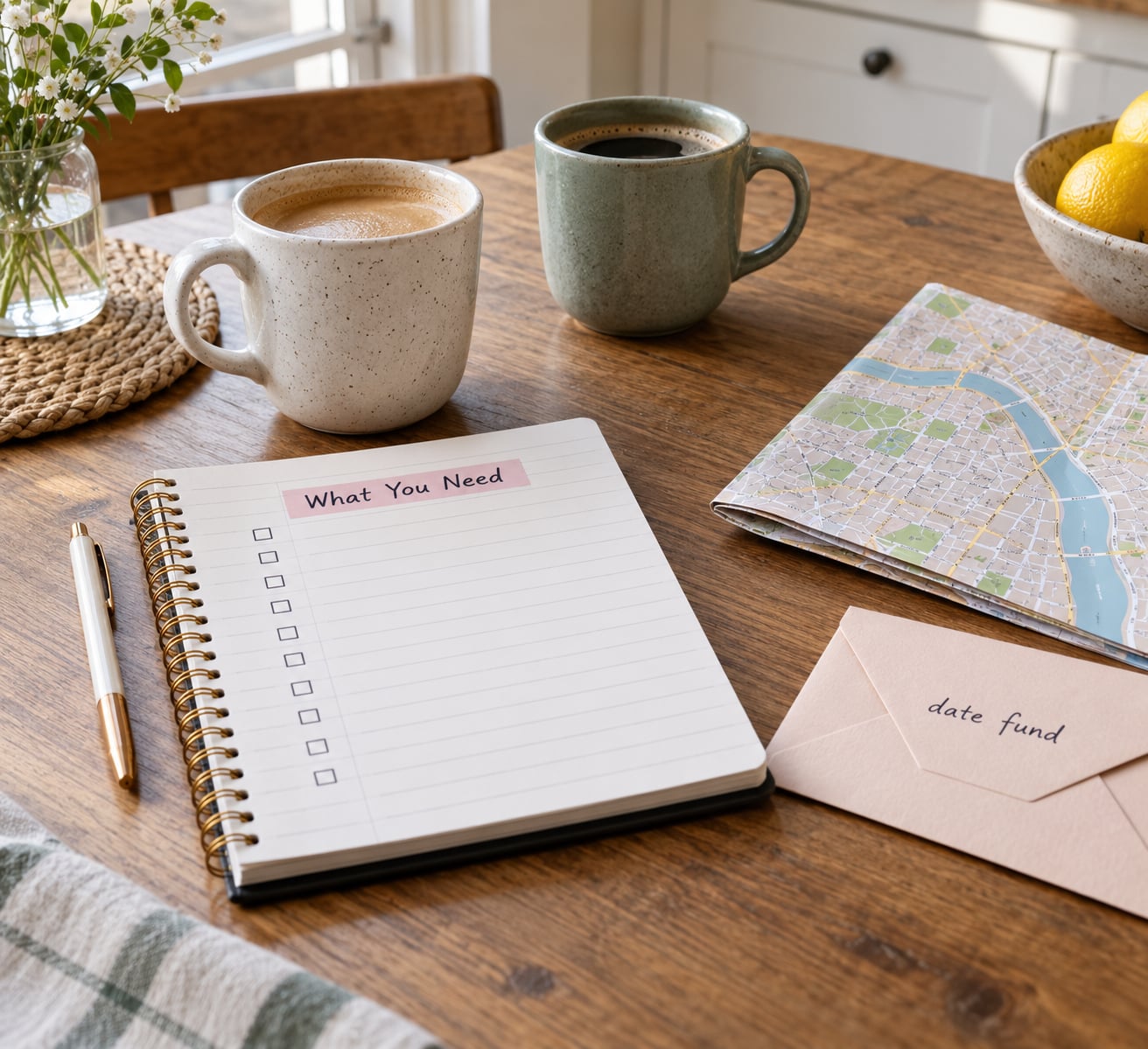
You need less than most couples assume. Five things, and three of them are conversations.
A number, agreed by both of you. Pick a monthly figure that would not sting if it were spent in one weekend. For many couples that lands somewhere between 20 and 60 dollars a month. The number that works is the one you can repeat without dread, not the one that sounds generous.
A separate place for it. Open a second checking account, a savings account, or a labelled envelope, and transfer the amount the day you get paid. Couples who report the habit working say the same thing: money in a shared pot gets absorbed by shared spending. Money in a pot with a name on it survives.
Both partners’ input, even when you are not going out. Ask what each person actually enjoys doing. One of you may want a walk and a long conversation, the other may want to be somewhere with other people in it. A date that satisfies one person is an outing, not a date. Both answers in, or it does not happen.
A time slot you can protect. This is the piece most couples skip and the piece that ends most budgets. A standing Wednesday evening, a Sunday morning, or the first Saturday of the month. Recurring slots are easier to defend against a work deadline or a sick kid than anything you arrange fresh each time.
A short list of nearby free options. Spend ten minutes on your city’s parks page, your library’s events page, and a local Facebook group or Meetup. Note three things running this month. Couples who hunt for events find them; couples who wait for inspiration end up defaulting to a restaurant.
Once those five exist, the date stops being a negotiation and starts being a plan.
Step-by-Step
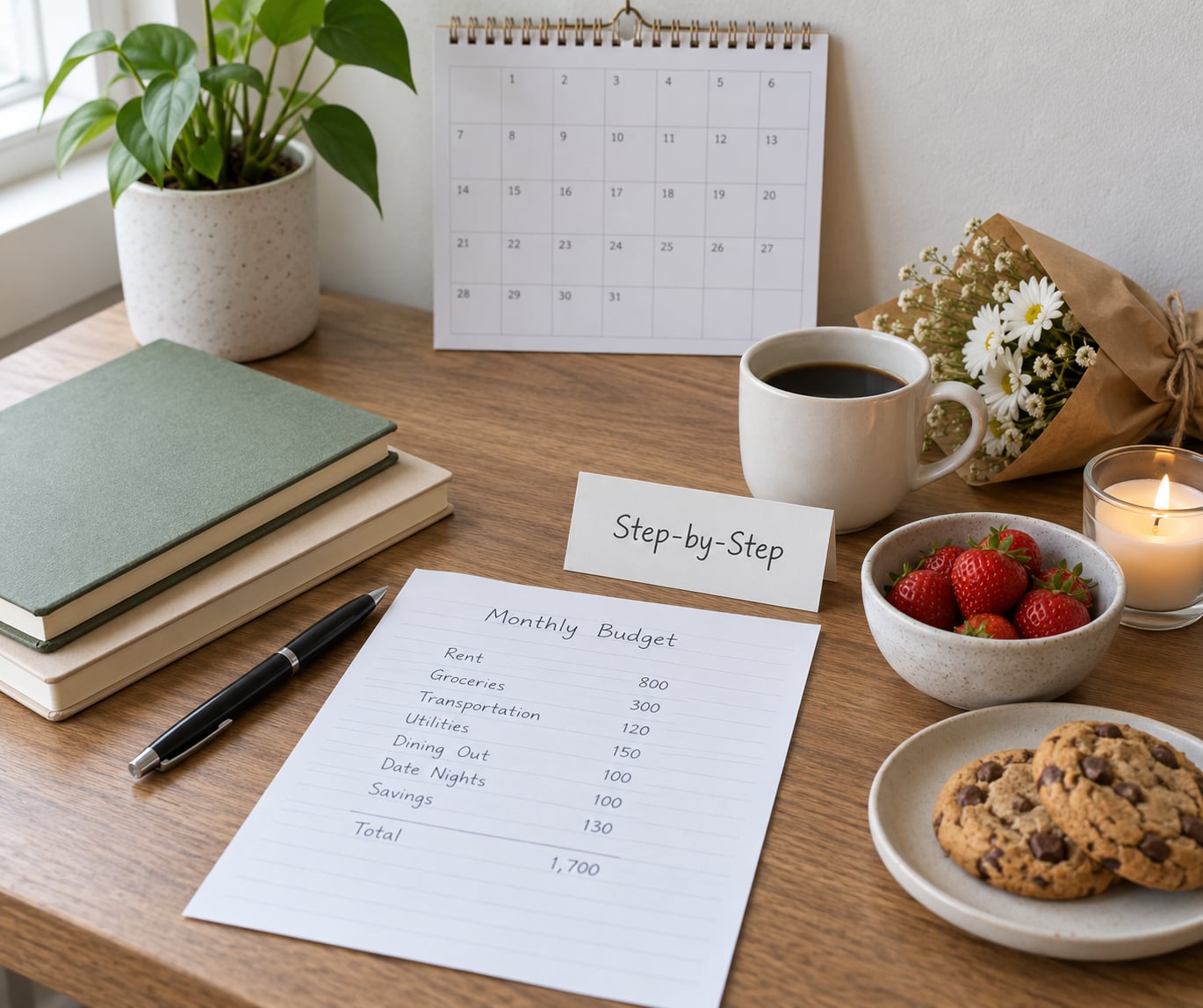
Five steps, in order. The first two are money, the third is logistics, the fourth is execution, and the fifth is what keeps it alive.
Step 1: Agree the monthly date fund
Sit down for fifteen minutes and pick the number together. Write it down. Then decide what it covers: food and drinks, transport, and childcare. Most budget surprises come from one of those three not being counted, particularly childcare, which couples consistently report is the real obstacle far more often than the price of dinner.
You know it worked when you can name the figure without checking, and neither person winces. If one of you is calculating whether the date is worth it during the date, the number is too high.
Step 2: Move the money the day you are paid
Set an automatic transfer for the date fund on payday. The amount does not matter at this point; the timing does. Couples who move it manually tend to move it late, then skip. Automation also removes the feeling of spending, which is what kills most budgets before they start.
You know it worked when you can plan a month of dates without asking the bank anything. If you are checking the balance mid-month and hoping, tighten the number rather than hoping harder.
Step 3: Decide the three cost drivers before you go
Every date night costs food and drinks, transport, and childcare. Know which ones you can cut before you leave the house. Matinee tickets cost less than evening ones. A drink brought from home costs a fraction of the restaurant pour. A friend who will take your kids for two hours removes the largest line item entirely.
You know it worked when the evening cost is close to what you planned before you got home, and any gap comes from a choice rather than a surprise.
Step 4: Take turns choosing
Alternate who plans the date, and let the chooser own it completely, including choosing something they actually want. This is the step that stops the budget from becoming resentment. One partner doing all the planning every time turns a shared habit into a chore they quietly avoid.
You know it worked when both of you are genuinely excited about the next one, including the one the other person picks.
Step 5: Spend nothing when nothing is available
Decide in advance that a no-spend date is a date, not a failure. There will be months when the fund is short or gone. That is a scheduling problem, not a relationship problem, and couples who have agreed this in advance handle it far better than couples who discover it in the moment.
You know it worked when you still do something together, even a ten-minute walk, on the weeks when the money is not there.
How to Date Your Spouse on a Budget by Choosing Free Experiences
Free experiences work because they take longer, which is exactly what couples say they lack. A walk, a picnic, or an hour in a park gives you two hours of conversation for the price of a coffee.
A walk somewhere with a destination beats a walk around the block. Public gardens, waterfronts, and trails with a view at the end of them give you something to point at. Pack coffee and a snack from the kitchen and you have a date for under five dollars including the ingredients.
Neighbourhood exploration is the one people repeat most. Pick a part of town you have never walked through, agree on a landmark, and walk toward it. You will end up at a bakery, a used bookshop, a mural you would have driven past. It costs whatever you choose to buy, which can be nothing.
Free events are the strongest free option and the most overlooked. Museums commonly run pay-what-you-wish hours in the evening, many libraries run their own free programming, and parks departments schedule summer concerts, outdoor films, and free yoga in summer. Many community stages run music with no cover charge.
The mechanic that makes this reliable is finding them once and writing them down. Check the city parks page, the library events calendar, Eventbrite, Meetup, and a local Facebook group. Build a small list of recurring events for your season and you will never again post the desperate same-evening question asking what to do nearby.
At home, free means using what you have. A themed dinner where you both cook something neither of you has made before. A playlist you built for each other. Rummaging through a box of old photos or answering questions from a list you wrote years ago. Board games you own. A bath, dim lights, no phones.
How to Date Your Spouse on a Budget with Low-Cost Activities
Low-cost means spending real money, just less of it. These are the options for the month when the date fund needs to stretch.
Coffee and a walk costs roughly four to eight dollars and takes two hours, because the walking is free. The trick is choosing somewhere with music or a table outside so it does not feel like a waiting room.
Museums are cheaper than people assume. Many are free outright, many have pay-what-you-wish late nights, and some counties hand out library museum passes that give members discounted entry to partner institutions. Free first Thursdays have become common enough that they show up in most cities’ calendars. Pair one with a walk and you have a full evening.
Cheap cultural nights are everywhere and almost nobody uses them. Open mics, community theatre, poetry readings, gallery walks, amateur music at a coffee shop. First Tuesday art walks often include something complimentary, which turns an stroll into an event with a bit of ceremony.
Outdoors beats most indoor alternatives on price. Disc golf in a public park, a community tennis court, a bike ride on a flat trail, a fishing licence, geocaching, or a long walk with an ice cream stop on the way back. Many towns also run cheap or free high school sports and plays, which is a genuinely good evening out.
Saving money on a restaurant date is mechanics, not restraint. Go at happy hour rather than at dinner peak. Choose the early bird or weeknight special. Order one starter and share a dessert instead of two mains. Many restaurants charge a cover charge that disappears entirely at the bar. If alcohol is part of the evening, know that a bottle bought at a shop is commonly around thirty percent cheaper than the same bottle on a restaurant list, and some places let you bring your own for a small corkage fee.
And if one of you would rather not cook on your night off, say so out loud. Cooking is not a budget win if it becomes a second job you resent. Buying dinner and sitting down is a legitimate use of the fund.
How to Date Your Spouse on a Budget Without Skipping Planning
Five minutes of planning is the difference between a memorable evening and a drive to a restaurant and back.
Take turns choosing, decide the cap before you leave, and put the plan on a shared calendar where both of you can see it. A date that exists only in one person’s head does not happen. A date on the calendar survives a hard week.
Decide in advance what kind of date this is: an experience, a meal, or a conversation. Couples who mix all three in one evening end up paying for all three and enjoying none. One evening for a long walk and talking, one for a meal out, one for something you both do with your hands. Each one costs less because it is trying to do one job.
Log what the date actually cost while it is still fresh. A running total is more useful than memory, and most couples find their real average is different from what they assume. Some weeks you will be under. That is what the fund is for.
For parents, the logistics are the whole game. A date-night exchange with another couple solves two problems at once: you get two hours without arranging a sitter, and they get the same. Swap the same evening each month and neither side pays much. Many parents say this single arrangement rescued their date nights; the money was rarely the real problem, the sitting was.
If you genuinely have nothing to spend, say so plainly and plan the no-spend version in advance rather than as a consolation prize. A picnic built from what is in the cupboard, a long walk, and an hour of talking is a real date. Couples in debt payoff seasons and unemployment stretches who keep a minimum version going describe the same result: the habit survives the hard stretch and the date night never felt like it disappeared.
How to Make Budget Dates Feel Special
The difference between a date and an ordinary evening is intent, and intent is free.
Put the phone in another room, not face down on the table. That single change does more for a conversation than any amount of spending. Announce the plan beforehand so it is not just a quiet evening that happens to have no plans.
Small gestures carry a long way. A handwritten note left somewhere unexpected. A playlist started before you leave the house so the drive counts as part of it. Flowers from the grocery store on the way home, which is five dollars and reads as a gesture rather than a purchase.
Add one small ritual that is only yours. It could be dessert at the kitchen counter, or a walk to the end of the street and back before you go in. Rituals are what couples miss when they stop dating; they cost nothing and they signal that this evening is not the same as every other evening.
Finish together. Starting a film one of you will not watch, or a project that takes three weeks, ends the date without ending it. Pick things with an ending.
If one of you is not a date person, stop treating that as a problem to solve. Many people would enjoy the walk and the company and would rather not be handed a planned evening with an agenda. Let the chooser plan every third date, and let the other person choose an ordinary evening where you are both just home. Consistency is what protects you, not format.
Common Mistakes
Mistake: equating spending with effort. The expensive evening feels like the real one, so the cheap one feels like settling. The fix is a rule: one small prepared detail per date, whatever it costs. A note, a dessert, a playlist. Preparation is what people feel, and it is free.
Mistake: letting one person plan every date. It turns into unpaid work, and the planner starts cancelling to get a break. The fix is strict alternation, and letting the chooser choose something they want without editorial comments.
Mistake: never agreeing on a number. Without a shared limit, each date gets judged after the fact by whoever feels it most. The fix is fifteen minutes and a written figure. Agree it once and stop revisiting it.
Mistake: ignoring free time and calling it a money problem. Parents on every forum describe the same pattern: there is money, and there is no sitter. Fix the logistics first, with a standing swap, and the money problem often gets smaller on its own.
Mistake: comparing a budget date to an anniversary dinner. Different categories, and the comparison never helps. Hold your cheap dates to their own standard, and save the big meal for something that genuinely deserves marking.
Mistake: waiting for the right mood. Waiting for enthusiasm means never going. Put the slot in the calendar, and treat showing up as the decision.
Keep them boringly predictable: same slot, same fund, same alternation. The couples who describe a habit that stuck all say the same thing in different words. They stopped making it an occasion to plan and made it a standing appointment to keep.
Frequently Asked Questions
How can we date our spouse when money is tight?
Set a small amount aside automatically each month, protect one recurring time slot, and plan around free events and near-free activities. Couples who do this say the money is rarely the real blocker; childcare and time are. Solve a standing swap with another couple first, and the budget stretches further than you would expect.
What is a realistic budget for dating your spouse?
For most couples, somewhere between 20 and 60 dollars a month is realistic and repeatable, and lower still works if you plan around free events. The right figure is the one you can fund without anxiety and spend twice in a row. Set it aside automatically on payday so date money is never competing with bills.
What if one partner wants to spend more than the other?
Do not agree on a spending level, agree on an amount and an experience. One partner can spend the full fund on a meal out once a month if the other partner genuinely wants that, then choose cheaper options the rest of the month. Alternating who plans tends to settle this faster than a single standing rule.
How can we use coupons and rewards without making dates stressful?
Keep it to one habit: a rewards account you already use, and coupons for things you were buying anyway. Anything involving searching, clipping, and tracking turns a date into admin, which is the opposite of the point. One partner can own the discount habit completely, or drop it entirely, as long as nobody treats the date as a shopping trip.
What are some free date ideas that do not feel boring?
Free ideas fail when they lack a destination or an ending. A walk to a specific landmark, a pay-what-you-wish museum late night, a free concert in the park, an open mic night, or a themed dinner you cook together with a playlist already running all work better than a vague evening at home. Add one small ritual and it stops feeling like a default.
Start with the conversation, not the ideas. Pick a monthly figure this week, open the account or the envelope, and put the first date on the calendar before you go shopping for anything. Everything else on this list is easier to do once those two things exist.