
Knowing how to document workplace discrimination comes down to one habit: write down what happened while it is still fresh, in plain neutral language, with the date, the people present, and the exact words used. Most incidents are never proven from memory alone, because the people involved remember them differently. A dated record is the piece you control, and it is what an employer, an agency, or a court actually looks at.
It takes about 20 minutes a day once you have a template, and the first entry is the hardest because it sets the tone. What follows is the format I wish every employee had before their first HR meeting: what to gather, how to write each entry, how to preserve messages safely, and how to report it without handing someone a reason to target you.
This is general information, not legal advice. Rules and deadlines vary by state and change often, so treat this as a starting point and check your own situation with a qualified employment attorney or a legal aid organization when the stakes get high.
Table of Contents
- What You Need
- The identifying details
- A dated record format
- The evidence that already exists
- The employer’s written policies
- A storage plan you have thought through
- How to Document Workplace Discrimination Step by Step
- Identify the relevant policy and the protected basis involved
- Write a dated, neutral account of each incident
- Create a timeline that connects related events
- How to document workplace discrimination without missing details
- Preserve messages, files, and other evidence lawfully
- Report the conduct through the proper channels
- Track follow-up, retaliation, and requested accommodations separately
- Prepare a concise factual summary for escalation
- Common Mistakes
- Frequently Asked Questions
- What should I include when I document discrimination at work?
- Can I record my manager or coworker in a workplace conversation?
- Should I keep a personal written record of discriminatory incidents?
- How do I organize emails and messages as evidence of discrimination?
- What should I do if I report discrimination and nothing changes?
- When should I contact an employment lawyer about workplace discrimination?
- Conclusion: Start With a Clear Timeline
What You Need
You need four things before you start, and none of them require permission from your employer.
The identifying details
Full names and job titles of everyone involved, including witnesses and comparators. Write down the reporting structure too: who your manager is, who HR is, and whether your workplace is covered by a union agreement or an arbitration agreement. If you signed an arbitration clause on day one, read it again now, because it changes how and where a claim can be filed.
A dated record format
A notebook, a word processor file, or a notes app works. What matters is that every entry carries a full date and sits in chronological order. A photo of a paper page is fine as long as it is legible and you can produce the original later. People ask on career forums whether a personal journal is admissible, and the honest answer is that a dated, factual, consistent log is treated as evidence, while an emotional diary is treated as noise.
The evidence that already exists
Emails, chat messages, calendar invites, performance reviews, meeting notes, job postings, org charts, photos of notice boards, and the company’s own handbook. Most claims are proven with records somebody else created before you ever got involved.
The employer’s written policies
Most companies have an equal employment opportunity or anti-discrimination policy, a code of conduct, a harassment policy, an accommodation request process, and a reporting channel. Pull these before you report anything, because the document you cite by name tends to get a faster, more specific response than a general accusation.
A storage plan you have thought through
Decide where your records live before you collect them. Records kept only on company systems can disappear the week your access is revoked. Keep a personal copy outside work systems, and read the next section on privacy before you copy anything from a work device.
How to Document Workplace Discrimination Step by Step
Work through this in order the first time. After that it becomes a maintenance habit, not a project.
Identify the relevant policy and the protected basis involved
Find the written policy that covers the conduct, then note what it says and where you found it. Quote the key line in your log with the policy name and section.
Then name the characteristic at issue without deciding what it means legally. Federal law covers race, color, religion, sex including pregnancy, sexual orientation and gender identity, national origin, disability, age 40 and over, and veteran status. State laws add more, including some that cover hairstyle, which matters a great deal for Black employees and is worth documenting specifically.
Write it as an observation, not a verdict: “Three comments this quarter about my hair texture in team meetings, all from the same two people.” You are recording what happened so someone else can assess it later.
Write a dated, neutral account of each incident
Use seven fields for every entry and the same seven fields every time. Consistency is what makes a log readable, and a log with gaps in it gets discounted.
- Date and time. Full date, start time, end time, and time zone if you work remotely across states.
- Location. Physical room, video call name, or the channel the message appeared in.
- Who was present. Full names and titles, including people who joined partway through.
- Exact words used. Quotes for the sentences that mattered, marked as quotes. Do not paraphrase when you can remember the phrasing.
- Observable conduct. What was done rather than what you concluded from it: reassigned accounts, removed from a thread, a shift changed without notice.
- Your response. What you said or did at the time, including staying quiet.
- Witnesses. Who saw or heard it, and whether they have confirmed it to you.
Add an eighth optional field for the business impact: a project that slipped, a client you lost, a metric that moved. That connects the conduct to something your employer cares about.
Create a timeline that connects related events
Individual incidents rarely prove anything on their own. Power comes from the sequence: the comment before the review, the review before the reassignment, the reassignment before the schedule change.
Build one continuous chronology rather than separate notes. Put each entry on a single line with its date and a five-word summary, then look down the column for gaps, clusters, and cause and effect. A gap in the record usually means an incident you never wrote down, and that is the most common and most fixable problem I see in logs people bring in.
Also list the comparators. If you were passed over for a role, record who got it, their title and tenure, and where they sat relative to you in the relevant protected group. Note whether the same thing happened to others in your group, and over what period.
How to document workplace discrimination without missing details
Use this field checklist each time, then separate what you observed from what you inferred. Write the observation in the log, and keep interpretation out of it entirely.
- Who was involved and who was nearby.
- What was said or done, in the order it happened.
- When it started, when it stopped, and what happened immediately after.
- Who witnessed it, including people who disagreed or said nothing.
- What record exists: an email, a ticket, a calendar entry, a photo, a screenshot.
- What it changed for your work, your schedule, your pay, or your access to information.
- Which written policy covers it, if any.
- What you did next, and who you told.
Write the entry the same day, even if it is three sentences. A log rebuilt a year later is worth a fraction of one written that evening.
Preserve messages, files, and other evidence lawfully
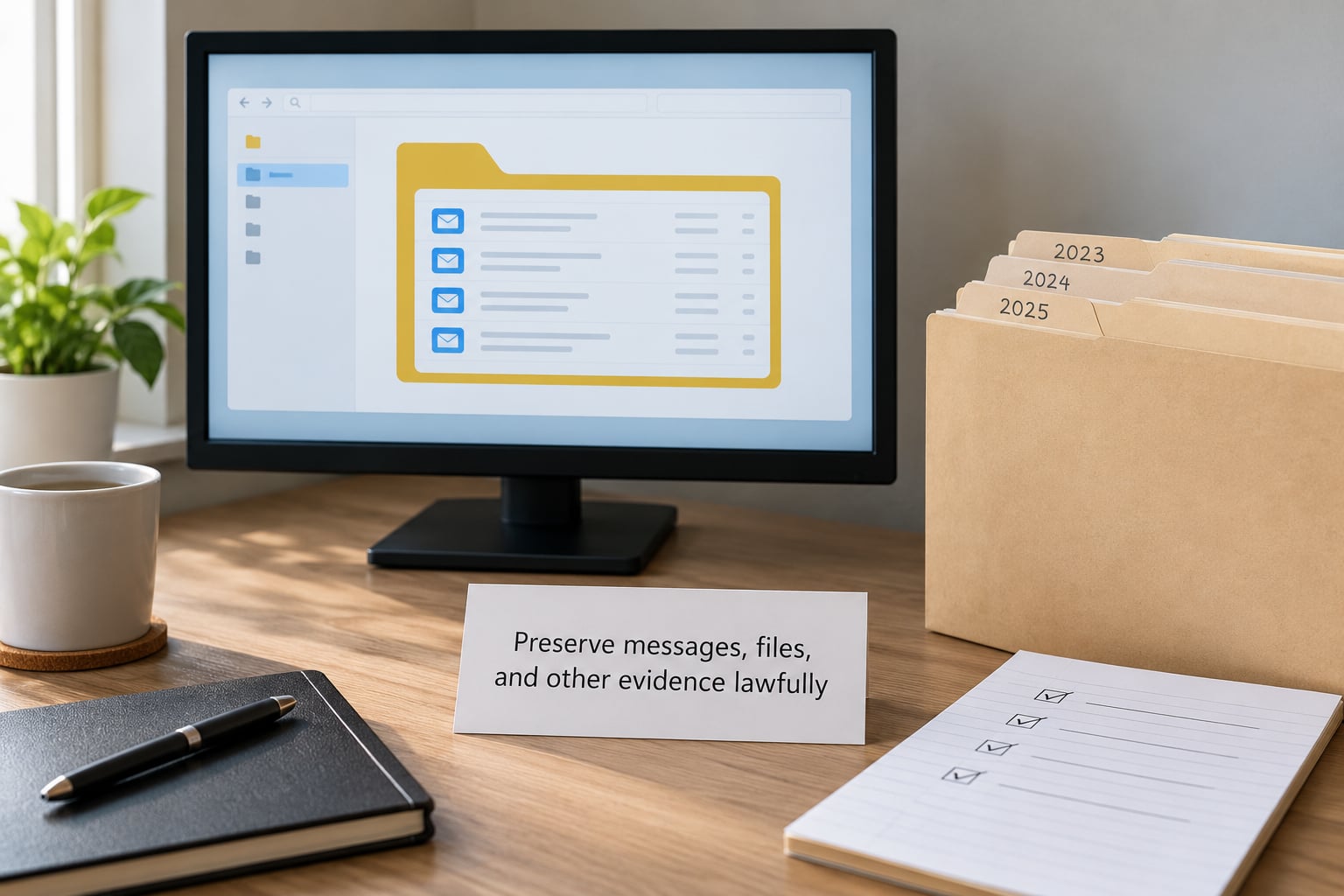
Preservation means keeping the original intact with its dates and sender information, not just the text you find useful.
For messages, save the full thread rather than a screenshot of one line, and keep the date line and participant names visible. Export rather than forward when your tool allows it, and keep both the export and the original location noted. Do not edit, trim, or annotate an original file, and do not forward company material to a personal account as a habit, because internal forwarding rules vary and some workplaces monitor personal mail tied to work addresses.
Be careful with a personal phone. Photographing a screen or saving an email on a device you use for work can raise questions about your own device policies, and in several states an employer cannot inspect your personal phone without a warrant. The cleanest approach is a personal paper notebook and a personal storage location you control, plus copies of only the documents you have a legitimate reason to hold.
Two limits worth knowing. Copying trade secrets, customer lists, or other people’s personal information can create a separate problem, so leave those alone. And if your employer has sent you a litigation hold notice or told you to preserve records, keep everything and change nothing until a lawyer tells you otherwise.
Public records are free and often useful: a court docket search can show whether your employer or a related company has faced prior complaints. Organizational charts and job postings for a role you were passed over help show whether a protected characteristic lines up with access to visible work.
Report the conduct through the proper channels
Reporting in writing creates a record and starts the clock on the employer’s response obligations. Use the channel your employer provides, which may be a manager, HR, a compliance office, an anonymous reporting system, a union representative, or a designated independent channel.
Send a short written complaint with the date, the conduct, the people involved, the policy you are citing, and what you are asking for. Keep a copy and note how you sent it. If you report verbally, follow up the same day by email summarizing exactly what you said and what was decided.
Give a date. Something like “I would like to discuss the concerns in this email by the close of business on Friday, March 14” creates a checkpoint without being hostile.
Track follow-up, retaliation, and requested accommodations separately
Open a second file. Retaliation is a distinct claim from the discrimination itself, and it is easier to prove when its own record stays separate from the original events.
In that file, log every contact after your report: the date, who you spoke with, what you asked for, what you were told, and when the promised action was due. Save copies of every accommodation request and every reply. If a schedule, title, assignment, review, or pay decision changes after you reported, record the date of the decision, what changed, and how the new arrangement compares with what you had before.
Ask for agreed actions in writing and send a short confirmation email, for example: “Confirming our conversation today: the meeting is moved to Thursdays and the reporting line change starts on the 1st. Thank you.” That email is often the only clean proof of what was agreed.
Prepare a concise factual summary for escalation
When you need to escalate, the whole log will not travel. Build a one or two page summary that anyone could follow.
Order it this way: a short background paragraph, a dated chronology, the pattern you observed, the harm described in concrete terms, the evidence index with dates, the questions still unresolved, and a clear statement of the remedy or follow-up you want. Cut any sentence that expresses anger, and cut anything you cannot support with a record or a witness.
Attach an evidence index with one line per item: date, description, file name, and where the original lives. Keep the original file in place and provide a copy, because an index that points to something nobody can find wastes everyone’s time.
Common Mistakes
Almost every weak log I have seen fails the same way, and the fixes are simple once you know them.
Writing how you felt instead of what happened. “This was humiliating and unacceptable” tells a reader nothing they can use. “He said in front of six people that the team needed someone who could write a real proposal, then asked if I was sure my English was fine” gives them everything.
Recording hearsay. “Everyone knows the team thinks that” cannot be verified. Write that you were told something, by whom, and when. Do not repeat it as fact.
Leaving dates vague. “A few weeks ago” fragments your chronology. If you truly do not know the date, write your best estimate and mark it as an estimate rather than dropping the entry.
Editing original files. Annotated screenshots and trimmed threads look altered, and that can cost you credibility on the very evidence that was strongest.
Recording conversations without checking local law. Recording is legal in some states and restricted in others, including on company equipment. Check your state rules before your next one on one meeting.
Confronting the person directly. A private confrontation can escalate, produce nothing you can use, and hand the employer a performance story. Document, report, and let the process run.
Quitting before you report. Leaving ends your access, your file, and often your strongest argument. People ask this constantly on forums, and the consistent answer is that reporting first preserves options. If you are leaving anyway, save your records and file before your final day.
Keeping everything on work systems. Access can be revoked the same week as a termination. Keep personal copies somewhere outside work.
Three habits keep a record safe. Separate your fact log from your feelings journal, back your personal copy up somewhere encrypted that your employer does not administer, and give copies only to a lawyer, an agency, or your union rep.
Frequently Asked Questions
What should I include when I document discrimination at work?
Write seven fields for every incident: full date and time, location, names of everyone present, the exact words used, the observable conduct, your response at the time, and any witnesses. Add an optional eighth field on business impact, such as a project that slipped or a client you lost. Keep each entry neutral and factual, and add your interpretation nowhere in the log.
Can I record my manager or coworker in a workplace conversation?
It depends on the state. Some states allow recording a conversation you are a party to, others require the consent of everyone involved, and company policy on recording devices can add separate restrictions or termination grounds. Federal law also limits how recorded conversations may later be used in court. Check your state rules and your employee handbook before you record anything, and consider a written follow-up email instead.
Should I keep a personal written record of discriminatory incidents?
Yes, and it is usually the only evidence you control. A contemporaneous log that is dated, specific, and consistent with other records is regularly relied on by investigators and treated as evidence, while an emotional diary with no dates is not. Write each entry the same day, keep entries in chronological order, and store a copy outside company systems so nothing is lost if your access is revoked after you leave.
How do I organize emails and messages as evidence of discrimination?
Save the full thread, not a cropped screenshot, and keep dates, sender names, and participant lists visible. Export the original where your tools allow, never edit or annotate the source file, and give your evidence index one line per item with the date, a description, and the file name. Note who else was copied, since a thread that shows who was deliberately left out can be as useful as the message itself.
What should I do if I report discrimination and nothing changes?
Follow up in writing with a specific date and ask what has happened since your report, referencing the policy you cited. Open a separate retaliation file and log every change after your report, including schedule, title, assignments, and pay. Many states require a charge with the EEOC or a state agency within 180 days, or 300 days in some circumstances, so track that deadline rather than assuming the problem resolved itself.
When should I contact an employment lawyer about workplace discrimination?
Contact a lawyer early, ideally before you escalate outside the company, if you are considering quitting, if you have already been disciplined or terminated, if you signed an arbitration agreement, or if the conduct involves physical threats, sexual harassment, or wage theft. Many employment attorneys take consultations at no cost, and legal aid organizations and union representatives often handle cases for free or at low cost.
Conclusion: Start With a Clear Timeline
If you do one thing today, open a document and write the first entry: the date, the people, what was said, where it happened, and who was there. Then write the second one tomorrow, in the same format.
After that, pull the relevant policy, preserve the messages that already exist, copy your records somewhere outside work systems, and report in writing so the company has a dated response obligation. Keep retaliation in its own file, track the filing deadlines, and talk to an employment attorney or a legal aid organization early if you are weighing your next move.