
Most new coaches do not have a coaching problem. They have a positioning problem. Knowing how to get your first client as a coach comes down to four things: a specific person you help, one clear offer, a short list of people who already trust you, and a short structured call that ends with a clear next step.
Here is the honest version: most coaches land their first paying client somewhere between two and four weeks of consistent outreach, not overnight. The plan below walks through the seven steps in the order that produces results fastest, with the exact wording you can copy.
Table of Contents
- What You Need
- How to Get Your First Client as a Coach: Step-by-Step
- Step 1: Choose a Coaching Niche and Ideal Client
- Step 2: Create a Simple Proof-Based Offer
- Step 3: Build a Credible Coaching Profile
- Step 4: Create Useful Content Before You Sell
- Step 5: Reach People Who Already Need Help
- Step 6: Hold a Discovery Call and Identify the Real Goal
- Step 7: Follow Up and Close the First Booking
- Common Mistakes
- Frequently Asked Questions
- How long does it take to get your first coaching client?
- Should new coaches offer free coaching sessions to get clients?
- How much should a new coach charge for a first package?
- Do I need an LLC to start a coaching business?
- How do I get coaching clients with no network and no social media?
- Conclusion
What You Need
You do not need a website, a certification nobody has heard of, or an audience. You need five things before you send a single message.
- A clearly defined coaching niche and offer. One sentence naming who you help and what changes for them.
- A credible profile. One page, or even one long post, that explains your background in plain language.
- A scheduling link. A free calendar slot with a short intake form attached.
- An intake form and a coaching agreement. Both short. The agreement sets scope, session length, cancellation terms and what is out of scope.
- A written record of your method. The steps you take a client through, written down, even if no client has paid you yet.
On the legal side, register your business and carry appropriate liability insurance before the first paid session. Rules on business structure, insurance and record keeping differ by country and state, so check what applies where you live and treat this as general information, not legal advice.
How to Get Your First Client as a Coach: Step-by-Step
Step 1: Choose a Coaching Niche and Ideal Client
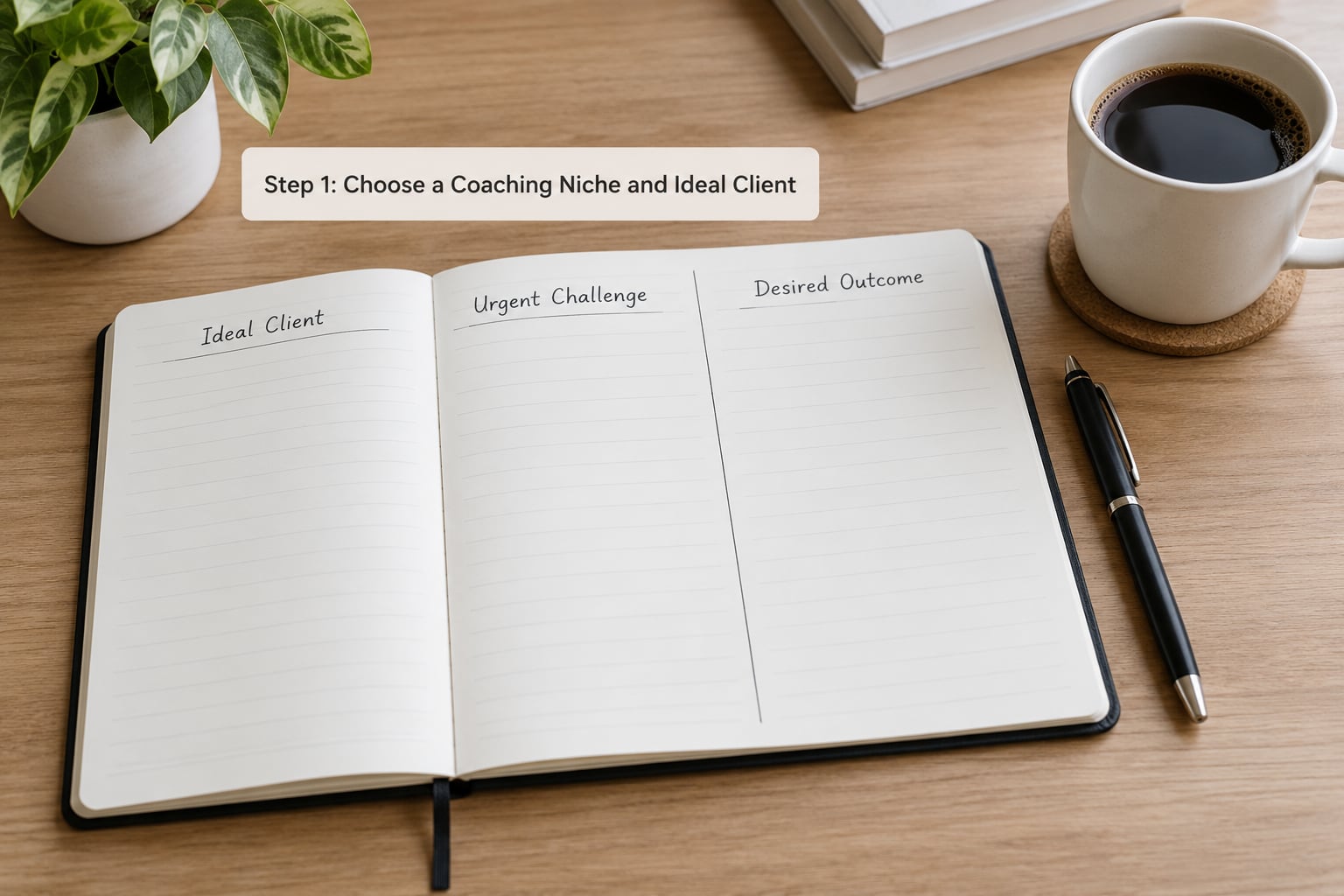
Narrow from a topic to a person. Career coaching for nurses is a different offer from career coaching for first-generation graduates, and both are easier to buy than career coaching for anyone.
Write your ideal client statement in one sentence using three parts: who they are, the challenge that costs them the most right now, and the outcome they want. Something like: I help newly promoted managers who dread difficult conversations to lead their first real team conversation without rehearsing it for two hours.
Then write an anti-client list. These are the people you will not take on right now, such as clients wanting crisis care, clients who need clinical support rather than coaching, or anyone who cannot commit to sessions. Coaches on r/lifecoaching keep repeating the same lesson: the clarity of your no is what makes your yes believable.
How do you know the niche is narrow enough? If you can post it in one social media bio without it sounding like a fortune cookie line, it is probably still too broad.
Step 2: Create a Simple Proof-Based Offer
Turn the niche into one thing a person can buy this week. New coaches usually pick one of three shapes.
- A paid discovery call. Thirty minutes to clarify the problem, followed by a written recommendation. It filters people out early and it pays for your time.
- A short introductory package. Four to six weeks with a stated number of sessions and one measurable outcome.
- A beta client spot. Two to five reduced or free places in exchange for a written case study and testimonial.
Practitioners on r/lifecoaching commonly advise starting at roughly 70 to 80 percent of the established rate in your niche and raising it later, rather than racing to the bottom. Low starting fees tend to attract price-sensitive clients and put a ceiling on what you can charge in year two.
Say the price out loud once, in a mirror, without apologising. Most new coaches add three unnecessary qualifying words before the number. Write the number, pause, then continue.
Step 3: Build a Credible Coaching Profile
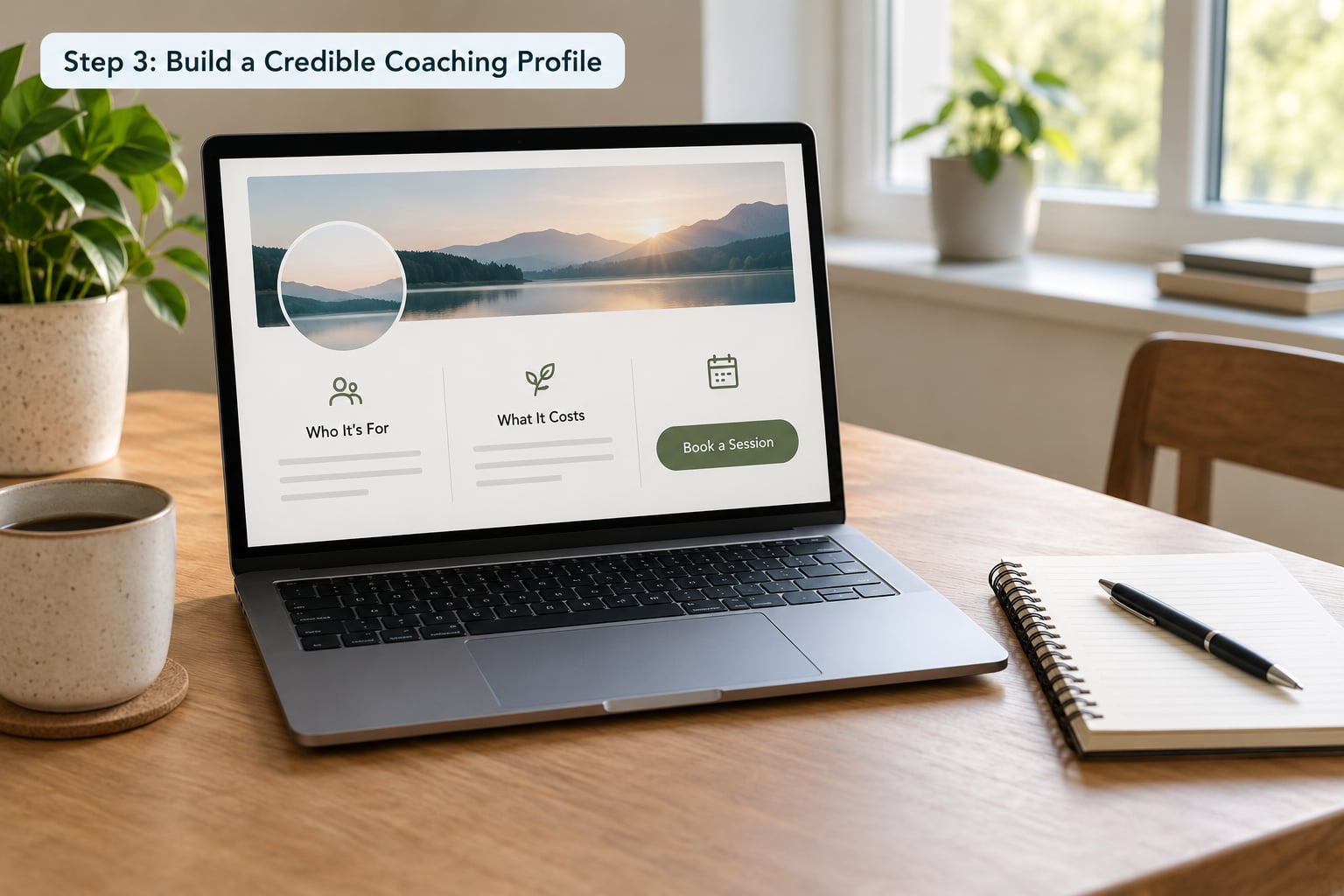
One page is enough. It needs five parts: who you help, what you do, how you work, what a client can expect in the first month, and a booking link. That is the whole profile.
Lead with the outcome, not the credential. Your certification belongs near the bottom in one line. The top of the page answers a stranger’s question: is this person for me?
Avoid claims you cannot back up. No guaranteed results, no invented statistics, no testimonials from people who never worked with you. Reviewers and readers spot inflated promises quickly, and one bad promise ends the conversation.
If you have no client results yet, use your own history as the proof. Describe the problem you had, the approach you used and what changed, in that order. It reads as real because it is real.
Step 4: Create Useful Content Before You Sell
Publish one or two genuinely useful pieces. Not daily posts. One thing that solves a problem for your ideal client in under ten minutes.
A checklist, a short recorded lesson, or a short written example using the challenge, approach and result structure all work. The goal is not reach. The goal is that a prospect who reads it thinks: this person clearly understands my situation.
Send that piece to the same warm contacts you reach out to. A useful article attached to a personal message gets read far more often than a pitch, because the pitch is about you and the article is about them.
Step 5: Reach People Who Already Need Help
Start with the 30-contact sprint. Write down 30 names of people who know you, used to work with you, or share your problem space. Contact ten per week. Ten is enough that the numbers become meaningful; thirty is small enough to finish.
A short message that works, written for a former colleague:
Hey Maria, I have started coaching and I am taking on my first few clients. I work with support leads who are exhausted and considering leaving a job they used to like. No pitch here, I just wanted you to know. If it is useful, I am running a short call to talk it through.
A direct message for a stranger in a community:
I read your post about the deadline you keep missing. I coach first-time managers on planning that survives a busy week. I am offering a few free 20-minute planning calls this month. Happy to send a couple of times if useful.
Notice what neither message does. Neither leads with the coach, and neither asks for money in the first line.
If your warm list is thin or already exhausted, go where your ideal client already gathers. Post regularly in a niche community, offer a short talk at a coworking space, join a professional association, or approach a complementary professional such as a trainer, therapist or recruiter and set up a two-way referral.
Community presence beats cold outreach, which is the recurring advice in coaching forums. Be useful there for three weeks before you ever mention your offer.
Step 6: Hold a Discovery Call and Identify the Real Goal
A discovery call is structured intake, not free coaching. New coaches regularly give away the whole first session and end up with a warm, grateful, unpaid friend.
Run it this way: fifteen minutes to understand the situation, twenty minutes to explore what has already been tried and what is really blocking progress, then five minutes to lay out one recommended next step and one alternative.
Five questions cover most of it:
- What made you look for a coach this month rather than last year?
- What have you already tried, and what happened?
- What does the problem cost you, in time, money or wellbeing?
- What would be different in your work six months from now if this worked?
- What is the real obstacle to starting this week?
Question five is where commitment surfaces. When the answer is scheduling or money, you have a solvable objection. When the answer is avoidance, the person needs a smaller first step, not a bigger package.
Step 7: Follow Up and Close the First Booking
End the call with a written summary: what they said, what you heard, what you recommend and what it costs. People decide much later than they feel like they will, so the summary is what actually sells.
Recommend one option. Two recommendations turn a decision into a negotiation. If your first package does not fit their situation, say so and say why.
Handle the money hesitation honestly. If they cannot afford the full package now, offer the paid discovery call as the smaller first step rather than discounting everything. Coaches on r/lifecoaching are consistent on this: discounting to avoid a hard conversation costs more than the conversation.
Then follow up. Once, two days later, with something useful rather than a nudge, such as a resource you promised or a short note on something they mentioned. After that, one message a week for three weeks, then stop. Silence is not failure; chasing after a clear no is.
When the first booking lands, ask two things at the end of the engagement rather than the start. A written case study with their permission, and one specific introduction to another person in the same problem space. That is how one client becomes two.
Common Mistakes
Trying to coach everyone. The fix is your ideal client sentence, written today, and a list of people who are not a fit right now.
Leading with credentials instead of outcomes. Your certification gets read once. The sentence about what changes for the client gets read every time.
Offering too many services. A brand-new coach listing life coaching, career coaching, business coaching and workshops signals that nothing is proven. Offer one thing until it has a few results behind it.
Making claims you cannot verify. Guaranteed outcomes and borrowed testimonials destroy trust in the first reply. Describe the process and the pace instead.
Sending generic messages. A message that could go to anyone gets ignored by everyone. Mention the specific thing they said, wrote or did.
Selling on the first call. Most people buying coaching have been burned by a bad experience. Give the free session structure and earn the sale over two or three conversations.
Failing to follow up. Around half of coaching deals close after the second or third conversation. One polite message after a week does more than a new campaign.
Over-building before you sell. Logo, colour palette, five-page site. Clients do not buy those. They buy a clear promise and a person they trust. Build that first, the rest later, once you have money coming in.
Frequently Asked Questions
How long does it take to get your first coaching client?
Most coaches who follow a consistent outreach plan land a first paying client somewhere between two and four weeks. The variable is not coaching skill, it is how many relevant conversations you have each week. Coaches who contact ten people a week and follow up properly get there far faster than coaches waiting for the right person to appear. Start with a paid discovery call so the first booking itself already pays you.
Should new coaches offer free coaching sessions to get clients?
Offer a free conversation, not free coaching. A free discovery call of 20 to 30 minutes gets you the information you need to decide whether you can help. Free coaching sessions tend to create warm, unpaid friendships who rarely convert, and they cost you the energy that a paid package would have earned. If you want to give away real coaching time, limit it to two or three beta places in exchange for a written testimonial.
How much should a new coach charge for a first package?
Practitioners commonly suggest starting at roughly 70 to 80 percent of the established rate in your niche and raising prices as you build results. Price the outcome and the length of the engagement rather than hourly blocks. Underpricing tends to attract clients who negotiate and leaves you stuck at a low ceiling for years. Say your price plainly, once, without padding it with qualifying words, and let the call do the persuading.
Do I need an LLC to start a coaching business?
It depends on where you live and what you are charging. Many coaches begin with a simple written agreement and payment process, then register a business structure once they sign their first paid client. Rules around business registration, taxation and liability insurance vary by country and state, so check the requirements that apply to you before you invoice anyone. This is general guidance, not legal or tax advice.
How do I get coaching clients with no network and no social media?
Pick one place where your ideal client already gathers and become useful there for three weeks before you mention your offer. Niche community groups, professional associations, coworking spaces and local meetups all work. Offer a short practical talk, answer questions properly, and let people approach you. Alongside that, contact five people a week who used to work with you. One narrow community done consistently beats five channels done occasionally.
Conclusion
Here is the whole plan in four lines. Choose one audience and write your ideal client sentence. Build one offer with one outcome and one price. Publish one useful piece that solves their problem in ten minutes. Then contact five to ten relevant people every week, follow up twice, and learn from every conversation.
Most coaches who struggle to get their first client are not under-skilled. They are waiting to be found instead of being found. Pick the ten names today, before the day ends, and start there.