
Quitting a job gracefully means three things done in this order: tell your manager first, in a private conversation; follow up the same day with a short written resignation letter that names your last working day; then work your full notice period and hand over properly. That is the whole formula. Everything else on this page is detail for the situations that make people nervous — the notice clause nobody read, the manager who reacts badly, the offer that has not been signed yet.
If you are wondering whether this is the right moment, use the checklist in What You Need first, then work through the seven steps below in order.
One thing to say up front: most of the dread comes from the unknown. A bad reaction at work is a signal about the manager, not about your professionalism. Advice threads on r/careerguidance and r/jobs describe the same handful of scenarios over and over, and almost all of them have a prepared answer.
Table of Contents
- What You Need
- Step-by-Step: How to Quit a Job Gracefully
- 1. Decide What You Are Leaving For
- 2. Check Your Contract, Benefits, and Notice Rules
- 3. Build a Resignation Letter and Transition Plan
- 4. Tell Your Manager in a Private Conversation
- 5. Protect Your Reputation During the Notice Period
- 6. Create a Handoff That Makes the Team Stronger
- 7. Finish Well and Request the Right References
- Common Mistakes
- Frequently Asked Questions
- How much notice should I give when resigning?
- Can I resign by email instead of talking to my manager?
- Can I quit my job without giving two weeks notice?
- What do I say when my boss asks why I am leaving?
- Will I still get a good reference after I resign?
- When do I get paid, and can I cash out unused vacation?
- Conclusion
What You Need
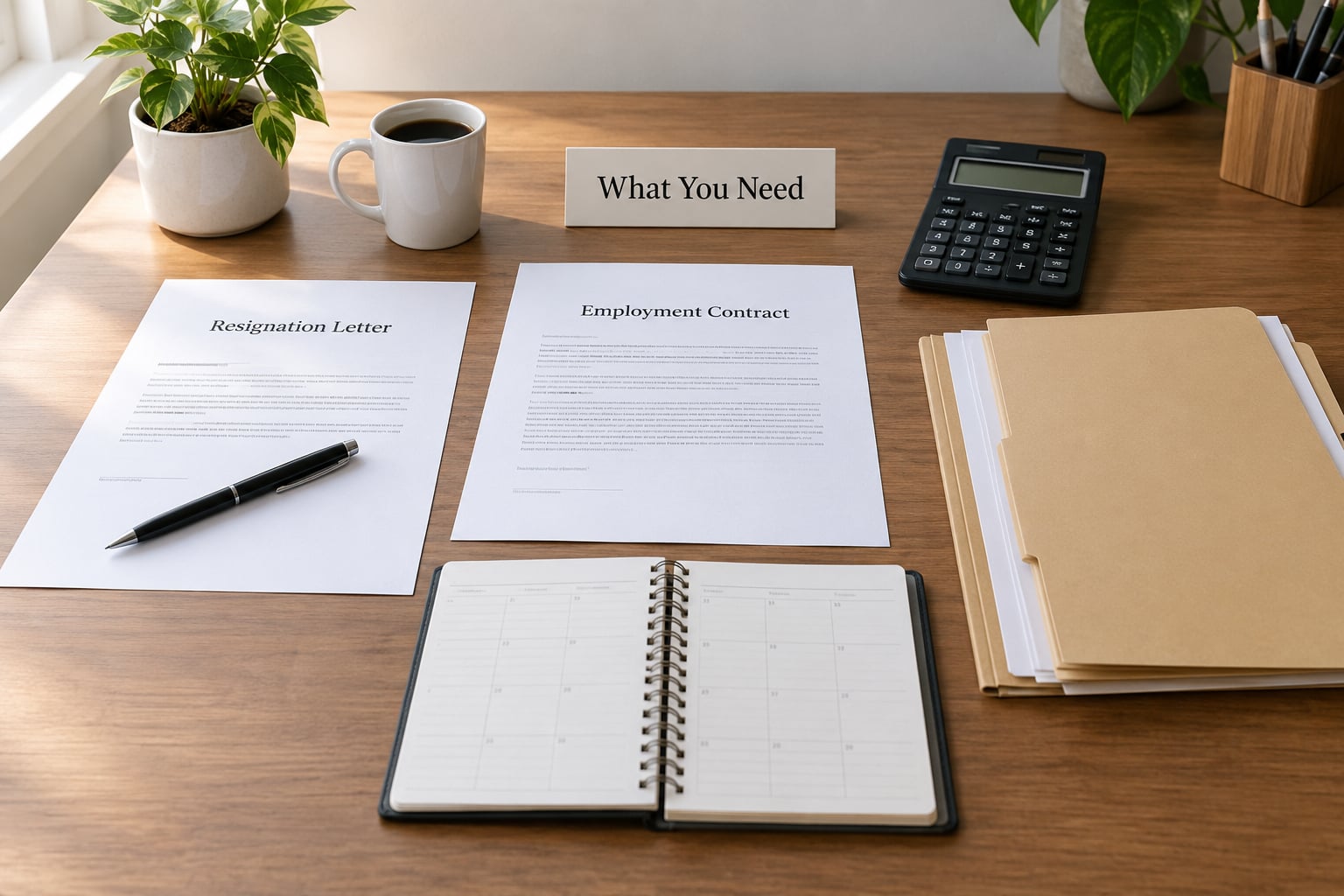
Resigning badly usually starts with missing information, not with saying the wrong thing. Gather these six items before you tell anyone you are leaving.
- A written record of your notice period. Your employment contract, offer letter, or the employee handbook section on notice. If the contract says four weeks, two weeks is a broken commitment even where the law would not require it.
- Your financial runway. Know how many weeks of expenses you can cover without a paycheck. This decides whether you can wait for a signed offer or a later start date.
- Accrued leave and benefit dates. How many vacation days you have banked, when health coverage ends, and whether your retirement plan has a vesting date inside your notice window.
- A personal copy of your own work. Contracts you managed, proposals you wrote, performance notes, your contact list for clients you handled. Company property stays with the company, so take copies of your own files and nothing confidential.
- A list of open work. Every project, recurring task, deadline, and commitment currently in your name. You will need this in step six.
- A confirmed next step, if you have one. A signed offer with a start date, or a clear plan if you are leaving without one.
Two things to confirm with HR in writing before you resign: the exact date your benefits and access end, and whether your final pay includes unused paid leave. State-specific rules vary and change, so ask rather than assume. In most US roles you are at-will, meaning either side can end the relationship without notice, but your contract or a signed offer can add obligations on top of that.
Step-by-Step: How to Quit a Job Gracefully
The process below runs from the decision to the last day. It takes two to four weeks in a typical US role, longer where a contractual notice period or garden leave applies. If you only take one thing from it, take the order: prepare, then tell your manager, then write it down, then hand over.
1. Decide What You Are Leaving For
Some exits are a move and some are an escape, and they deserve different pacing. A move toward a specific role, a credential, or a change of industry is easier to explain and easier to recover from. An escape from burnout or a bad manager is legitimate, but if you quit first and start looking second, you will take the first decent thing that comes along.
Write down your nonnegotiables for the next role before you resign, not after. If the thing you need is creative control and the new role has none, the timing is wrong. You will know the step worked if you can finish that sentence out loud without flinching: I am leaving because I want a role where I own the client relationship end to end.
There is also the money question. If you have three months of runway, you can wait for a signed offer and a confirmed start date. If you have two weeks, the same move becomes a gamble — and offers fall through more often than people expect, especially ones with long approval chains.
2. Check Your Contract, Benefits, and Notice Rules
Your notice obligation lives in one of five places, and most people only look at one. Search your contract and handbook for “notice,” “resignation,” and “termination.” Check the offer letter for a start-date clause that can push a notice period out. Look at any employment agreement, and if you are a senior hire, a separate agreement often sits on top of the standard one.
Then check whether you are at-will. At-will is the US default: either side can end things at any time, with no notice required by law. It cuts both ways, and it is why people are sometimes able to leave immediately. It does not mean leaving is free, because references, rehire eligibility, and a small professional community are not governed by statute.
Six things to confirm, and where each one hides:
- Notice period. Employment contract, offer letter, employee handbook. It sets your last working day and tells you whether you are meeting a commitment.
- At-will status. Contract language plus state law where you live. It decides whether leaving immediately is legally available to you.
- Accrued paid leave. HR or payroll. Whether it is paid out is often state- or company-specific.
- Health coverage end date. Benefits portal or HR. It drives when you need new coverage lined up.
- Retirement vesting. Plan documents. A vesting date inside your notice window changes the timing.
- Final pay timing. State law and company policy. In many states payroll timing is set by law, not by preference.
Send HR two or three plain questions in email so the answers exist in writing. Ask what notice they have on file, when benefits and system access end, and whether unused leave is paid out. You are not being difficult; you are closing the loop on facts that are otherwise vague at the worst possible moment.
3. Build a Resignation Letter and Transition Plan
A resignation letter is a record, not a speech. It needs four things: the date you are writing it, the fact that you are resigning, your intended last working day, and a short thank-you. Everything else is optional and most of what people add is a mistake.
Here is a version that works in almost any situation:
Dear [Manager’s first name],
Please accept this as formal notice of my resignation from my position as [Job Title] at [Company]. My last working day will be [date], which gives [number] weeks notice in line with my employment agreement.
Thank you for the opportunity to work here. I am happy to support the transition in whatever way is useful over the next few weeks.
Kind regards,
[Your full name]
Keep it under 150 words. Do not include complaints about your manager, comparisons to your next salary, sarcasm, or a detailed account of why you are leaving. Do not promise to stay indefinitely, and do not name your new employer — you are not obliged to, and it invites questions you would rather not field.
Draft the handoff plan alongside the letter. A simple one-page document listing your open work, who should own each item, and when it is due does more for your reputation than any paragraph of thanks.
4. Tell Your Manager in a Private Conversation
Ask for a private one-on-one early in the week, and give a real reason. “Do you have thirty minutes to talk tomorrow morning?” rather than an email that asks whether they are free. Do not send the resignation by email first — that gives your manager no chance to respond like a person, and it is the single most-cited complaint in advice threads about resignations.
Then say the thing plainly, early, and once:
“I have made the decision to leave. My contracted notice is [number] weeks, so my last day would be [date]. I want to do everything I can to make the transition smooth, and I am happy to talk through what the team needs from me.”
Then stop talking. Most managers are not waiting for a speech, and a long explanation invites negotiation you did not ask for. You will know it landed if the conversation moves to dates, handover, and what happens next rather than to why.
If the reaction is anger, disappointment, or silence, keep your tone flat and do not defend yourself. Try: “I understand this isn’t what you wanted to hear. I’ve thought it through and the decision is final, but I do want the handover to be clean.” Guilt-tripping about how much you have been given, or a threat to make your life difficult, tells you something useful about the manager and less about you. Do not respond in the moment — take a day, and keep everything afterwards in writing.
Send the letter within an hour of the meeting. Same day, same thread, addressed to your manager with HR copied. That closes the loop before anyone has time to speculate.
5. Protect Your Reputation During the Notice Period
The notice period is where most reputations are actually decided. People assume it is a formality; it is the last thing a future reference will ask about.
Keep meeting your commitments first, even the ones that have stopped mattering. Stay reachable, turn things around on the same timeline you did before, and keep your calendar visible. A few people find their workload quietly reduced or their projects reassigned the week after they hand in notice — that is normal, and it is not a comment on you. Ask directly what would be most useful and put your energy where the answer points.
Document as you go. Keep a running list of decisions, deadlines, and context that a successor would otherwise have to reconstruct. If you are interviewing, keep it to a couple of calls a week and schedule them outside working hours where you can. Pulling out mid-call because you are interviewing reads very differently from taking a call at lunch.
Set one boundary and hold it: you are willing to do a reasonable handover and train a successor, not to take on an unbounded stream of new work because it feels easier than saying no. “I can take this on if we drop X” is a complete sentence.
6. Create a Handoff That Makes the Team Stronger
Leave systems and context, not just tasks. Anyone can list what is due. What they cannot reconstruct is why it is due, who the client is, and what breaks if it slips.
Build the handover in four parts: a status list of every open item with a named owner and a date; a folder of current files organised the way the next person will look for them; a short written procedure for anything you do regularly, such as a monthly reconciliation or a client check-in; and a one-page summary of the relationships you own, including who to contact and what they care about.
Then actually walk your successor through it. Book the sessions early rather than in your final week, and record any walkthrough you can so it survives you. This is the part that gets remembered well after you, and it is also the part that makes the reference call easy for your manager to write.
7. Finish Well and Request the Right References
In your last week, close the administrative loop. Return the laptop, badge, keys, and any equipment, and get written confirmation of what you returned. Ask for the dates you need in writing: your final pay date, when unused leave is paid out, when health coverage ends, and your last day of system access.
Ask for a reference while you are still there and the work is fresh. Make it easy, and make it neutral:
“As I finish my time here, would you be comfortable acting as a reference for [target role]? Happy to send you a short summary of the work I am most proud of, so it is easy to talk about.”
Send a short thank-you note to your manager and one to the team, and to anyone who helped you. Keep both warm and specific — a line about what you learned from someone beats a generic paragraph. If the relationship is good enough, stay in touch after you leave. A message every few months costs you nothing and keeps you in their memory when a role opens.
If a counteroffer comes up, slow it down. Take it only if the reason you wanted to leave has genuinely changed — a fixed manager, real flexibility, the scope you asked for — and not because someone said they were sorry to lose you. If the underlying problem is still there, you will be job-hunting again in four months, from a weaker position. Declining politely: “I’ve decided to move on, and I want to be straightforward with you that this isn’t a negotiation. I appreciate the offer, and I’ll help make the transition as smooth as I can.”
Common Mistakes

Almost every resignation that turns into a career problem starts with one of these. Each has a straightforward fix.
Resigning by email or chat with no warning. Your manager hears it the same way a customer hears a cancellation. Fix: private conversation first, letter within the hour.
Explaining your reasons in detail. A long account of bad management, unfair pay, or a difficult colleague becomes a record that follows you. Fix: one neutral sentence — “I’m pursuing a new opportunity” or “I’m taking time for something personal” — and stop.
Going quiet during the notice period. This is read as indifference, and it is the reason some good leavers get lukewarm references. Fix: keep your normal response times until your last day.
Overexplaining the new role. Naming your employer invites salary comparison and awkward questions. Fix: you are not required to share where you are going, and “I’d rather not say” is a complete answer.
Making demands. Last-minute demands for a raise, a title change, or a rushed reference turn a clean exit into a negotiation. Fix: make requests you would happily have granted someone else.
Sweeping, delaying, or sabotaging. Fix: this is not only unfair, it is the fastest route to a legal problem and a burned reference. Leave clean, always.
Quitting a job you just started. Short tenure is awkward but manageable, especially in your first job. Fix: give proper notice, keep the reason neutral, and ask for a reference anyway — many people will still write one.
Telling the team before your manager. It puts your manager in the position of announcing your own resignation, which most of them resent. Fix: manager first, team after, in whatever way your company normally shares news.
A few shorter transition tips worth keeping. Take your vacation days before you leave if you can, since leave is often harder to get once notice is filed. Save your own work, and nothing belonging to the company. Write down the names of three people you want to stay in touch with while you still have their work email.
Frequently Asked Questions
How much notice should I give when resigning?
Two weeks is the common US norm for hourly and professional staff, and it is what most managers expect. Your employment contract, offer letter, or employee handbook may specify more, and senior, executive, and public-sector roles often carry 30 to 90 days. Check your contract before you commit to a date, then give the notice it asks for. Where you are at-will, two weeks is still the professional expectation even though the law does not require it.
Can I resign by email instead of talking to my manager?
You can, but you should not unless your manager works remotely and even then only in a live call or video meeting. An email that opens with a resignation gives your manager no chance to respond like a person, and that is the detail coworkers and future employers hear about later. The usual approach is a short private conversation, followed by the formal resignation letter the same day, so there is a written record of the notice and the last working day.
Can I quit my job without giving two weeks notice?
In most US states at-will employment means either side can end the relationship at any time, so leaving without notice is generally legal. It can still be costly. Many employers will not rehire, references often go unanswered, and in a tight industry the reputation travels. Leaving immediately becomes reasonable when the workplace is unsafe or in breach of contract, where the personal cost of staying outweighs the cost of the fallout. Ask HR for your final pay and benefit dates in writing either way.
What do I say when my boss asks why I am leaving?
Give one short, neutral, non-negotiable reason and do not elaborate. Something like pursuing a new opportunity, taking time for something personal, or a career change works and stays true even if your real reason is burnout or a difficult manager. If pressed for specifics, repeat the same sentence and change the subject to the handover. A detailed explanation rarely changes your manager’s mind and tends to end up in the reference conversation.
Will I still get a good reference after I resign?
Most people do, and it comes down to how your notice period went. Managers write the reference around your reliability, your handover, and how you handled the final weeks, not around whether you were happy there. Stay responsive, document your work, train whoever takes it over, and ask for the reference while you are still employed. If you left in a way that was genuinely unsafe or unlawful, that is a different conversation, and worth seeking advice on before you decide how to frame it.
When do I get paid, and can I cash out unused vacation?
Final pay timing is set by state law in many places rather than by company preference, and your last paycheck may need to include unused paid leave. Do not assume either way. Ask HR in writing, before your last day, for the final pay date, the amount of accrued leave, and the date health coverage ends. Unused leave is often forfeited or paid out depending on your state and your contract, which makes it worth using before you go rather than after.
Conclusion
Leaving well is a short process done in the right order: find your notice rules, settle your finances so you are not forced into a bad decision, prepare the letter, have the private conversation, then hand over something that works without you. Start this week by reading your contract’s notice clause, asking HR the three questions about final pay and benefits, and writing the letter — then the conversation is a ten-minute appointment instead of an event you have been dreading for a month.