
You know couples counseling is working when the arguments get shorter, you reach for the tools you practiced in session, and saying something honest no longer costs you the evening. Judging by how the session itself feels is the most common mistake people make — many couples walk out of a useful session discouraged because fifty minutes wasn’t enough to untangle a decade of resentment. This guide is about looking at life outside the therapy office, where the actual evidence lives.
A note before we start: this is general information about how progress in couples counseling is typically evaluated, not clinical advice about your relationship. Your therapist knows your specific situation. If there’s any safety concern in your home, that changes the conversation entirely, and individual support is worth seeking right away.
Most couples don’t need a quiz. They need a baseline, a few honest observations, and a way to bring those observations into the next session. That’s what the steps below give you.
Table of Contents
- What You Need Before You Judge Progress
- Step-by-Step: How to Tell If Couples Counseling Is Working
- 1. Compare the Situation With Where You Started
- 2. Look for Better Communication
- 3. Check Whether Conflict Is Changing
- 4. Assess Trust and Emotional Safety
- 5. See Whether Each Partner Is Taking Responsibility
- 6. Review Progress Toward Shared Goals
- Common Mistakes When Judging Progress
- Frequently Asked Questions
- How long does couples counseling take to show results?
- Does progress in couples therapy have to be linear?
- How do you know couples therapy has stalled?
- What if one partner feels like nothing has changed?
- How do you tell your counselor that therapy is not helping?
- Conclusion
What You Need Before You Judge Progress
Most couples evaluate counseling with no baseline at all, which is why the same three arguments can feel like proof it’s failing one month and progress the next. Four things make assessment possible.
A shared definition of what you’re working on. “Better communication” isn’t measurable. “We want to get through a disagreement about money without either of us leaving the room” is. If you never wrote goals down, ask your therapist at the start of the next session to help you phrase two or three of them in plain behavioral language. That sentence is the yardstick for everything that follows.
Something to measure against. Before counseling started, you almost certainly argued about who does the dishes, felt dismissed on Tuesday nights, and went to bed angry most weeks. Write down three specific patterns from that period — the time of day, the trigger, the usual ending. Vague memory flatters itself in both directions, and it will convince you nothing has changed when something has.
Notes from sessions. A few lines after each session is enough: what came up, what tool you were given, what homework you agreed to. Couples who write things down tend to remember that progress was cumulative rather than dramatic, which matters because most real change is not dramatic.
A realistic timeframe. Early sessions are often heavier, not lighter. Talking about patterns you’ve avoided for years tends to surface uncomfortable material before it settles. If you decided in week one that you would quit by week three, you built in a false negative from the start.
Step-by-Step: How to Tell If Couples Counseling Is Working
1. Compare the Situation With Where You Started
Pull your baseline notes out next to your current ones and compare them line by line. Not feelings — behaviors. Did the argument that used to end in a slammed door and three days of silence end in a pause and a return this time? That’s a change, even if the subject was the same bill.
Look for the gap between “things are better” and “this specific thing is different.” The first is a mood; the second is data. A useful prompt: what did the last disagreement look like, step by step, and what did the same disagreement look like six months ago?
Watch for change that shows up in the small stuff first. Calling your partner by name instead of a nickname they’ve hated for years, laughing together during something that used to be tense, going to bed on the same night more often. These are the micro-moments researchers talk about, and they’re real data, not sentimentality.
2. Look for Better Communication
The clearest signal is whether you can discuss something difficult without the conversation spiraling. Not that it stays calm the whole time — that it doesn’t escalate beyond repair.
Several concrete markers show communication is improving:
- You use “I” statements about your own feelings instead of “you always” and “you never.”
- You can finish a sentence. Fewer interruptions, less talking over each other to win.
- You ask a clarifying question when you’re lost instead of assuming the worst.
- You can say “that’s not how I see it” without it landing as an insult.
- You bring up a hard topic with a plan for how you’ll handle it, not as an ambush.
- You apologize, or attempt to, without a “but.”
One of the most telling signs is that the tools stop feeling like homework. If you practiced a time-out on a Thursday and actually used it on Saturday without anyone reminding you, that’s the skill moving from the therapy office into your marriage.
The shift from “you” language to “we” language gets talked about a lot in session and it’s worth watching for at home. We versus you reframes a disagreement from a verdict on your partner’s character into a problem the two of you are standing on the same side of.
3. Check Whether Conflict Is Changing
This is where most couples draw the wrong conclusion. A good month of marriage still contains disagreements. If the goal were zero conflict, you’d be done by session two and the relationship would be about as interesting as a parking lot.
The realistic goal is conflict that goes differently. Look at the shape of the argument, not whether it happened.
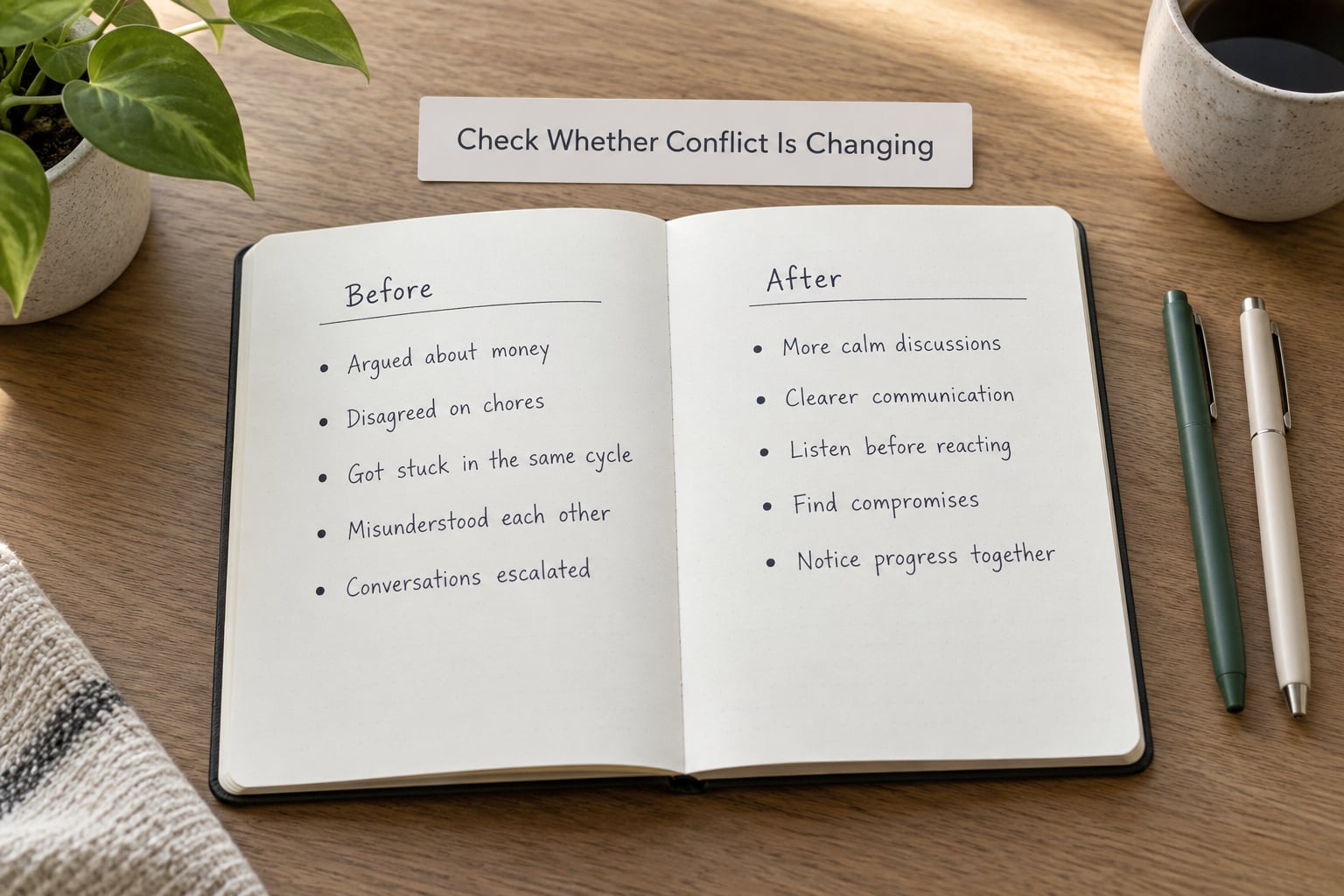
Ask these four questions about your last fight:
- How long between the trigger and the raised voice? A shorter fuse is worse; a longer one is progress.
- Does it end with a repair, or does it end with a withdrawal that lasts days?
- Can you name the request underneath the complaint? “You never help” is usually carrying “I’m drowning and I need help.”
- Does the same subject come back the same way every time? A repeated fight on an unchanged pattern is stalled progress.
Repair attempts matter more than perfect arguments. A hand on an arm, a joke that isn’t sarcastic, saying “can we start over” mid-sentence — those small bids toward reconnection count. A couple who fights loudly and reaches for each other in the same evening is doing better than a couple who never raises their voice and hasn’t spoken honestly in four months.
Contempt is the one thing to name out loud. Sarcasm aimed at someone’s core character, eye rolls, the impression of a partner’s voice — a therapist will usually flag that as a priority rather than a side issue, because it’s harder to build anything on top of it.
4. Assess Trust and Emotional Safety
Emotional safety is the ability to say something true without fear of punishment, shutdown, or ridicule. It’s the base everything else sits on, and it’s the slowest thing to build and the easiest to damage.
Observable signs that safety is rising:
- Promises get kept, or you hear an honest reason when they don’t.
- One of you raises something embarrassing without bracing for impact.
- You disagree without fear of being walked out on, ignored, or mocked.
- You can hear a hard truth about your own behavior and stay in the room.
- Silence stops being a weapon. A quiet evening is rest, not punishment.
Rebuilding after a trust breach is slower. Couples recovering from infidelity often describe six months to a year of work before the relationship feels steady again, and they’d tell you the timeline wasn’t the hard part — the repeated small acts of follow-through were. Anyone who promises that trust snaps back in a set number of weeks is selling something.
Watch the ratio of risk each of you takes. If one person raises hard truths and the other only agrees, the relationship isn’t in a repair cycle; it’s in an appeasement cycle, and it won’t hold.
5. See Whether Each Partner Is Taking Responsibility
Couples counseling rarely works when one partner treats it as a compliance project. Progress on this dimension shows up in ways that are easy to observe from the outside.
Look for each of you saying “my part in that was” without being asked twice. Defensiveness drops — fewer counterattacks, less scorekeeping about who started the last fight. A request your partner makes on Tuesday actually shows up on Wednesday, not as a favor but as a response. And you find yourself able to articulate why their reaction makes sense, even while disagreeing with it.
That last one is the shift. Understanding isn’t agreement. A partner who can say “I can see why that landed badly for you” has moved from defending a position to seeing a person, and that capacity is what makes the other changes possible.
There’s a version of this section that needs saying directly, because it’s the most common source of frustration in couples forums: the feeling of doing all the emotional heavy lifting while your partner coasts. On r/TalkTherapy, people describe attending sessions prepared, doing the reading, raising the topics, and leaving with the same dynamic intact. It’s a fair complaint, and it usually isn’t a reason to quit. It’s a reason to name it in session, out loud, where the therapist can work with both of you on it.
Couples counseling is not a solo project with an audience. If one partner won’t engage, a good therapist will address that directly rather than spend fifty minutes on the other person’s issues every week. If that isn’t happening, the problem is worth naming — and it’s covered further down.
6. Review Progress Toward Shared Goals
Six steps of observation still leave you needing a decision. Here’s how I would make it.
Take your two or three goals from the start of therapy and score each one honestly: not moving, some movement, clearly moving. Then check that the movement is consistent rather than a single good week. One great Saturday after a rough month isn’t a trend, and a bad Tuesday after two good months isn’t a verdict either.
Then look at where you are against what a reasonable course of counseling looks like. Emotionally Focused Therapy commonly shows improvement across eight to twenty sessions, with many couples reporting meaningful change in the eight-to-twenty range (Johnson, 2004). Cognitive behavioral approaches for couples often move faster on specific behaviors, in roughly ten to fifteen sessions (Baucom, Epstein, and LaTaillade, 2002). Those aren’t promises, and different approaches run on different clocks — but they give you something more useful than instinct.
Bring three specific things to the next session: one thing that measurably improved, one pattern that hasn’t budged, and one question about the approach. Therapists generally respond better to that than to “I don’t know if this is working.” It’s a far more useful sentence, and it takes about fifteen seconds to say.
If you’ve been through this and nothing has shifted after a dozen or so sessions, you’re allowed to ask for a change. See below.
Common Mistakes When Judging Progress
Judging after one session. A single fifty-minute hour is too small a sample. The first few sessions are often disorienting because old material is being pulled up by the roots, not because the work is failing.
Reading one bad week as a verdict. A rough stretch can come from work stress, sick kids, a bad month of sleep. Judge in trends across two or three months, not in snapshots.
Scoring your marriage on a feeling scale. “We’re doing better, 7 out of 10” drifts with the day and can’t be checked later. Convert it to behavior: did we get through the money conversation without one of us leaving?
Blaming one partner for the whole result. Even when the effort really is lopsided, framing the assessment as “you ruined it” ends the conversation. Frame observations as patterns, not verdicts — that’s the same discipline the therapy is teaching.
Treating a bad fight as failure. A couple that fights and repairs is learning something. A couple that avoids conflict entirely often hasn’t improved; they’ve just gone quiet.
Waiting for a feeling to show up before trusting the evidence. Connection often returns last, after communication and safety have improved. Absence of warmth in month two is not a verdict on the whole effort.
A few habits make the tracking easier. Set a ten-minute check-in on the same day each week, and ask three fixed questions: what went better this week, what got worse, and what do we want to try next week. Rotate who leads. Write the answers down. Keep it light enough that it doesn’t become its own source of conflict — the point is noticing, not adding a scoreboard to an already tense marriage.
And when something is not working, raise it with your therapist before raising it with your partner. Partners who feel abandoned by therapy tend to get defensive, which then gets read as proof the therapy is failing. Therapists, by contrast, treat a stalled session as information they can act on. Say it in the first few minutes, not the car ride home.
Frequently Asked Questions
How long does couples counseling take to show results?
Most couples notice something within four to six sessions, often small things like shorter arguments or easier conversations. Structural changes usually take longer: Emotionally Focused Therapy often shows improvement across eight to twenty sessions, and behavioral approaches to specific issues can move within about ten to fifteen. Trust repair after a betrayal typically takes six months to a year. Judge over months, not sessions.
Does progress in couples therapy have to be linear?
No. Progress is rarely a straight line, and setbacks are common even in treatment that is working. A rough week or an argument that feels like old ground can follow a genuinely good month. The pattern that matters is a slower baseline over two or three months: shorter recovery time, more repair, less escalation. If nothing at all has shifted after several months, that is worth discussing directly with your therapist.
How do you know couples therapy has stalled?
Stalling usually looks like the same recurring argument with no change in shape, homework that never happens, session after session spent on one partner’s issues only, or the same unresolved question returning every week with no new ground covered. Another sign is dread rather than neutrality before each session. If you notice two or three of these, say so in session and ask whether a different approach, a new goal, or a different therapist would make sense.
What if one partner feels like nothing has changed?
Name it in the room, specifically, with one or two observable examples. Say what you expected, what you noticed instead, and what you want to try next. A good therapist will work with the gap directly rather than treating the hesitant partner as the problem. Individual sessions alongside couples work are common for exactly this situation and don’t have to mean anything is wrong with the marriage.
How do you tell your counselor that therapy is not helping?
Lead with specifics rather than a verdict. One example of a pattern that changed, one that didn’t, and one question about the approach gives the counselor something to work with. Ask what they would expect to see by now and compare that to what you’re seeing. Switching therapists is also a normal step, not a failure, and you can change direction without ending couples counseling altogether.
Conclusion
Do one thing before your next session: find the three patterns you wrote down before counseling started, and mark each one as changed, partly changed, or the same. Then pick the one or two changes worth mentioning and say them out loud in the room. That single conversation will tell you more than a month of wondering, and it’s the fastest way to find out whether the approach needs adjusting.
Reviewed for accuracy in 2026. This article is educational and does not replace individualized therapy. If you are in an unsafe situation, contact a domestic violence hotline or a local emergency service.