
School anxiety is the intense, lasting worry a teen feels about the school day itself, and helping a teen manage anxiety about school starts with listening instead of fixing. You lower the pressure to attend, build a predictable routine, practise a couple of calming tools together, and put a simple plan in place with the school. Most families see real change over weeks to a few months, not overnight.
This guide is general education, not a diagnosis or a substitute for care. If your teen talks about harming themselves or has a plan to end their life, call or text 988 in the US (Suicide and Crisis Lifeline), text Crisis Text Line on 741741, or go to the nearest emergency department.
Table of Contents
- What You Need
- Step-by-Step: How to Help a Teen Manage Anxiety About School
- 1. Listen Without Jumping to Fixes
- 2. Identify What Makes School Feel Overwhelming
- 3. Build a Predictable Morning and School Routine
- 4. Practice Small Coping Tools Together
- 5. Create a School Support Plan
- 6. Protect Sleep, Rest, and Recovery
- 7. Know When Professional Support Is Needed
- Common Mistakes
- Frequently Asked Questions
- What should I do if my teen refuses to go to school because of anxiety?
- How can I help my teen manage anxiety during the school day?
- What are simple calming techniques a teenager can use at school?
- Should I talk to my teen’s teacher about school-related anxiety?
- When should I seek professional help for my teen’s anxiety?
- Can medication help a teenager with school anxiety?
- Where can parents get free or low-cost help for a school-anxious teen?
- Conclusion
What You Need
You do not need a toolkit of products. You need a few things that make the next two weeks easier to handle.
- A calm place to talk. A kitchen table, a car before anyone else is awake, a walk around the block. Somewhere the teen is not being watched.
- A simple daily plan on paper. One page: wake time, breakfast, out-the-door time, where the cop-out spot is, when you check in. Written down, not held in your head.
- A notebook. Dates, what happened, how the morning went, when sleep broke, what you noticed. Patterns are easier to see in a notebook than in a bad week.
- Contact names. The school counselor’s direct line, the attendance office, one teacher your teen tolerates, the pediatrician or therapist, and one backup person who can step in on a hard morning.
- Ten quiet minutes a day. Not a therapy session. Just time with your teen that has no agenda.
Step-by-Step: How to Help a Teen Manage Anxiety About School
Seven steps, in order. Do the first one before you do anything else, because every other step depends on it.
1. Listen Without Jumping to Fixes
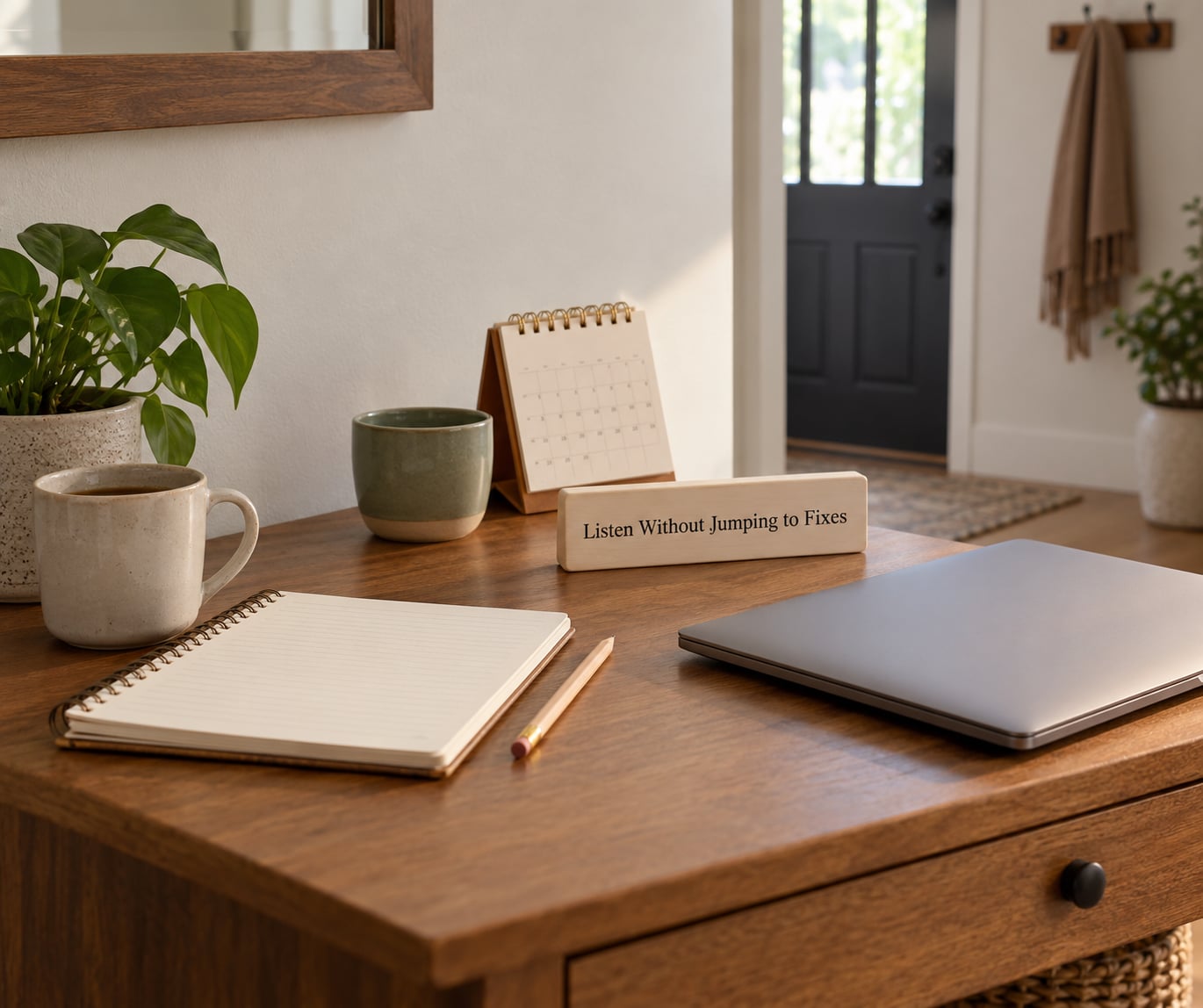
Start by listening. The single biggest improvement parents report comes from the moment a teen realises you are not going to argue, correct, or solve it immediately.
Pick a low-pressure moment, not the morning of a bad day. Ask open questions and give the answers room: “What’s the hardest part of the school day for you?” “What would help most this week?” Then stop talking. Silence feels wrong to you and useful to them.
Validate before you suggest anything. Naming the feeling does not make it bigger; dismissing it does. Try “That sounds exhausting,” or “I never got this easy either at your age,” instead of “It will be fine.”
A useful repeatable question, borrowed from the Fathering Project’s parent guidance: “What’s one thing today that made you anxious, and what helped?” Ask it most evenings. It builds a pattern you can both see.
What you say in the first ten seconds decides whether the rest of the conversation happens. Here are the phrases that tend to land and the ones that tend to shut it down.
| Instead of this | Try this |
|---|---|
| “Why are you being like this?” | “I want to understand what school feels like for you.” |
| “You will be fine.” | “That sounds genuinely hard, and I believe you.” |
| “Just get over it.” | “You do not have to get over it today. What would make today a bit easier?” |
| “Everyone else is managing fine.” | “Your school day is different from what you see from the outside.” |
| “You need to go. Those are the rules.” | “I am not going to force you. I want to understand what happens in your body when you think about going.” |
| “Do not tell me what you think.” | “Tell me the worst day you had. I will not react.” |
If nothing else lands, parents on forums like r/parentsofteens keep repeating the same lesson: being present and practical works better than arguing the case.
2. Identify What Makes School Feel Overwhelming
Anxiety that is not specific is hard to work with. Get specific by noticing patterns, not by labelling your child. Watch what your teen says, when the tension spikes, and what they avoid.
School anxiety rarely sits in one place. It usually clusters somewhere: the ride in, a particular class, lunch in the hall, the walk between periods, a group project, the fear of being called on. Write each one down with the day and time it happened.
Also track the physical stuff. Stomach aches and headaches that show up on school days but vanish on a Saturday, a racing heart, shaky hands, tight chest, feeling sick right before the doors. Track sleep, because a teen who is awake until 1am is carrying yesterday’s school day into today.
Ask about the things that sit underneath the anxiety. Bullying, a friendship that fell apart, a teacher relationship that turned cold, a diagnosis or a neurodivergent profile that school has not adjusted for, a family change, a grief. Anxiety about school is often a symptom of something specific, and it is often not simply “stress.”
You will hear “I don’t know” more than you want to. That is normal. Keep asking which part of the day is worst and work backward from there.
3. Build a Predictable Morning and School Routine
Uncertainty is what feeds this anxiety. The morning does not need to be exciting or perfect. It needs to be boring in a way the teen can predict.
Move the decisions to the night before. Clothes out, bag packed, lunch made, schedule printed, alarm set, phone charging across the room. Every decision a teenager has to make at 7am is a small argument with a tired nervous system.
Then give the morning realistic time. Most anxious teens underestimate how long getting out the door takes, and a rushed start turns a normal morning into a failure. Add fifteen minutes to what actually happens rather than what you wish happened.
Keep breakfast small and predictable. Some teens manage a full meal, some manage a banana and a drink, and some cannot eat before school at all. Do not turn breakfast into a test of willpower.
Give the morning an ending ritual. The same song on the way out, the same two minutes of quiet before you open the car door, a hug that is asked for rather than assumed. Repetition is the point.
For the school day itself, lower the cost of being there. A different drop-off spot, a later start time if the school allows it, a quiet lunch room instead of the main hall, one specific teacher or counselor the teen actually trusts. Many parents say progress started the day the school had one adult the kid could go to.
4. Practice Small Coping Tools Together
Coping tools work best when practised at a calm moment, then used again when anxiety is lower. Learning a breathing exercise at 7:40am in a panic does not work.
| Tool | What it is | When to use it |
|---|---|---|
| Paced breathing | Breathe in for 4 counts, hold for 2, out for 6 | In the car, before class, at a school event |
| Grounding 5-4-3-2-1 | Name 5 things you see, 4 you hear, 3 you touch, 2 you smell, 1 you taste | When thoughts are racing or the room feels unreal |
| Feet on the floor | Press both feet down and notice the contact for 60 seconds | Discreet, works in class, no one notices |
| Worry time | Fifteen minutes at a set time each day to write or talk about worries | Late afternoon, so worries do not sit all over bedtime |
| Writing it down | One page: what is worrying me, what is in my control today | Before bed, or right after a bad period |
| Moving | A five-minute walk, stairs, a sport, shaking it out | Before school and straight after, when the body is wound up |
Let the teen pick two, not six. Teenagers reject a full toolkit because it feels like another assignment. One they chose and use becomes theirs; five you assigned become homework they resist.
For social anxiety, practice rather than lecture. Role-play a two-minute hallway conversation. Rehearse one lunch question. Build small talk reps the way an athlete builds a drill, then celebrate the first time it feels slightly less awful.
Keep a short list of wins. Driving to school without a fight, asking one question in class, going to the counselor’s office. Parents commonly track these as a victory journal, and it stops the recovery looking like nothing is happening.
5. Create a School Support Plan
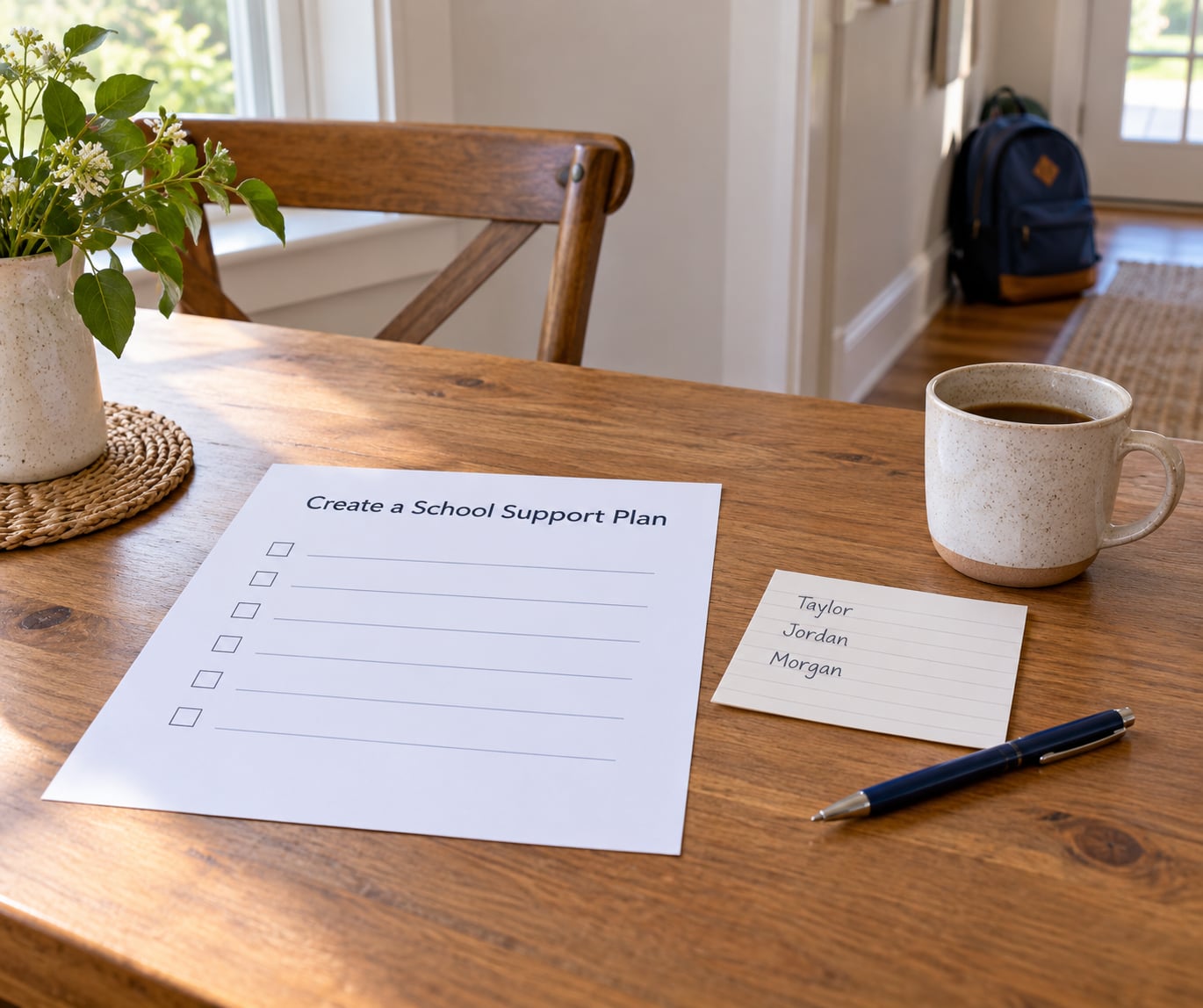
You cannot carry this alone, and neither should your teen. A written plan with the school turns a private struggle into a managed support, and it protects your teen when things get bad on a Tuesday you are not there.
Start with the school counselor. They coordinate across teachers, they know what is already in place, and they are usually free. Many families skip them because they assume the counselor is not interested; ask anyway.
Write down the specific asks. Warning signs you have noticed, accommodations that would lower the load, a check-in contact, how you want to be contacted, and one trusted adult on campus. Requests that name a person, a time and a place get answered; vague requests get filed.
Ask what formal options exist. An IEP is for eligible students with qualifying conditions and an IEP covers academic services; a 504 plan can cover accommodations for a qualifying disability. School staff can tell you whether either route applies and how the paperwork works. Many families use a written informal plan with a counselor first and add formal paperwork later.
Bring one page: your teen’s name, the pattern you have observed, two or three accommodations you are requesting, and the best way to reach you. People report the difference between a rambling voice call and a one-pager is roughly the difference between a plan and a referral.
Handle attendance letters early and factually. Reply before the deadline with a short written update saying your teen is struggling with anxiety-related attendance and is working with the counselor on a plan. Ask what the school requires on paper. Silence is what turns a health issue into a discipline problem.
If bullying is part of the picture, raise it separately from the anxiety conversation. A named, documented safeguarding concern travels differently than a general worry, and it should not be bundled into a mental health request.
6. Protect Sleep, Rest, and Recovery
Sleep is where a lot of this is won or lost. A teen who sleeps six hours has less capacity to handle a hard period by morning, which makes next day heavier, which makes sleep worse again.
Keep the wake time steady, including weekends, and move screens out of the bedroom a good hour before bed. Get moving during the day, keep meals predictable, and build in downtime that is not a reward for finishing homework.
Trim the late-night work. An hour of work after 10pm is worth less than an hour before 9pm. Talk with the school about workload before it becomes a midnight habit.
7. Know When Professional Support Is Needed
Contact a pediatrician, a licensed therapist or a school mental health professional when distress is most days a week, when it is getting worse over weeks, or when it is costing your teen school, sleep, eating or friendships.
Ask for a professional evaluation if you see panic attacks, physical symptoms that keep showing up, major sleep or appetite changes, dropping grades, withdrawal from activities they used to enjoy, or school refusal that lasts more than a couple of weeks. School avoidance can also sit alongside ADHD, autism or OCD, which is a good reason to raise it with a clinician rather than treat it as pure nerves.
If your teen is already out of school, contact the school the same week and ask for a return plan with dates. The first goal is often not a full day. It might be sitting in the car, then a quiet room for one class, then a half day, then a full day. Small rungs beat a single leap.
Therapy helps most when it involves the parent, not only the teen. For many families, therapy with parent coaching or a family-based approach does more than teen-only sessions, because the morning routine and the school relationship are where the anxiety lives.
And while you are on a waitlist, do the listening, the routine, the two coping tools and the school meeting. Those are not placeholders for real care. They are the parts you can start today.
Common Mistakes
Most mornings go wrong because of one of these. Each has a straightforward correction.
Forcing attendance by force. Dragging, arguing at the door and public pressure tend to deepen the refusal rather than shorten it. Parents who pulled back on the daily battle usually saw the conflict drop first and the attendance move later. Make the deal explicit out loud so the teen hears it from you, not from the school.
Repeated reassurance. Telling a worried teen everything will be fine over and over teaches them their fear is unreasonable. One calm validation, then move on: “I hear how hard this is, and I am not going anywhere.”
Comparing them to other kids. You are comparing your teen’s inside to somebody else’s outside. Even a cousin who seems fine is managing a day you cannot see.
Minimising or arguing. “Get over it,” “everyone feels that way,” and explaining that they are making it worse all close the conversation. Parents on parenting forums and on schoolavoidance.org name this as the thing that made things harder.
Avoiding school entirely without a plan. A day off that becomes a week is easy, and easy is hard to unlearn. Keep it short, keep it dated, and keep one school connection alive.
Becoming the school’s crisis manager. You are the messenger between a child who cannot attend and a school issuing attendance letters. Do not carry both sides alone; get the counselor involved so it is not you versus the attendance office.
Making the anxious teen the family project. Watch for siblings. Do they get talked about as the one with the problem? Do they get asked to report on the morning? Siblings under that kind of pressure start to resent, and the household gets tense. Give them your attention deliberately, and do not put them on messenger duty.
What helps most is boring consistency. The same routine, the same short conversation, the same two tools, for weeks. Expect setbacks around exams, transitions, sports seasons and social events. Progress here is measured in months, and a bad week is not a failed plan.
Look after yourself too. The anxious parent, angry child cycle is well known: a parent’s fear drives hovering, the teen pushes back, the pushing back confirms the parent’s fear. Naming the loop out loud breaks it faster than trying to be perfectly calm.
Frequently Asked Questions
What should I do if my teen refuses to go to school because of anxiety?
Do not force the door and do not lecture, even though the attendance letters start arriving. Sit down, say that you are not going to make them go today, and ask what the school day looks like from inside their head. Then contact the school counselor within the same week and ask for a written return plan with dates. Recovery runs in months, not days.
How can I help my teen manage anxiety during the school day?
You are not there to manage it for them; you are there to remove friction. Agree on two small tools they can use without anyone noticing, like pressing both feet into the floor or breathing out longer than you breathe in. Give them one named adult at school, a predictable place to eat lunch, and a short check-in message at midday.
What are simple calming techniques a teenager can use at school?
Feet on the floor for 60 seconds works anywhere, including in a test. Paced breathing in for 4 counts, hold 2, out for 6 calms a racing body. Grounding works too: name 5 things you can see, 4 you hear, 3 you touch. Practise all three on a calm day first, because none of them is learnable in the middle of a panic.
Should I talk to my teen’s teacher about school-related anxiety?
Yes, with specific asks rather than a general worry. Name what you have observed, the days and lessons it happens on, the accommodations you are requesting, and one action the teacher can take, such as a quiet check-in at the start of class. The counselor is usually the better first contact because they can coordinate across teachers.
When should I seek professional help for my teen’s anxiety?
Seek help when distress shows up most days, is worsening over weeks, or is affecting school, sleep, eating or friendships. Panic attacks, physical symptoms that keep recurring, withdrawal from things they enjoyed, and lasting school avoidance all deserve a professional evaluation. A school counselor can point you to a clinician, and a pediatrician can start the referral.
Can medication help a teenager with school anxiety?
Sometimes, but only as part of a full evaluation by a qualified prescriber who works with your teen, and usually alongside therapy and school support rather than instead of them. If your teen is already on medication for anxiety or ADHD, tell the prescriber about school avoidance, because the pattern may be a side effect or a missed dose rather than the whole picture.
Where can parents get free or low-cost help for a school-anxious teen?
Start with the school counselor, school-based mental health services, the school district’s family support office, and your pediatrician or health centre. In the US, the SAMHSA National Helpline is 1-800-662-4357, and 988 covers urgent mental health support by call or text. Online directories for licensed therapists also allow you to filter by insurance, telehealth and evening hours.
Conclusion
To help a teen manage anxiety about school, do four things first: listen without fixing, remove one source of daily pressure, practise one coping tool together, and pick up the phone to the school counselor. Keep it boring and keep it up week after week. If the anxiety is persistent, worsening, or touching your teen’s safety, contact a pediatrician or a licensed therapist rather than waiting it out.