
Learning how to become a manager for the first time means shifting from producing the work yourself to setting direction, coaching people and clearing blockers so the team produces it. Most new managers were promoted for doing the job well, not for managing people, so the first few months are less about grand strategy and more about building habits you will use for years.
Realistically, expect three things in your first ninety days: a lot of listening, more conversations than you expected, and a slower sense of progress than when you were doing the work yourself. If you get clarity from your boss, a real conversation with each direct report, and one honest look at how the work currently runs, you will be ahead of most first-time managers.
This guide walks through what to prepare before you start, then seven steps in order, from accepting the role to reviewing how it is going. Framework names like the SBI feedback model and the GROW coaching model appear where they help; everything else is plain advice you can use on Monday.
Table of Contents
- What You Need
- Step-by-Step: How to Become a Manager for the First Time
- 1. Accept the Promotion and Reset Your Role
- 2. Learn Your Team’s Work and Strengths
- 3. Set Clear Expectations and Ways of Working
- 4. Build Trust Through Regular One-on-Ones
- 5. Delegate Instead of Taking Every Task Back
- 6. Give Feedback and Handle Difficult Conversations
- 7. Review Results and Improve Your Management Plan
- Common Mistakes
- Frequently Asked Questions
- How long does it take to get good at managing people?
- How do I manage former peers who now report to me?
- What should I delegate first as a new manager?
- How do I give negative feedback for the first time?
- How do I stay in charge without becoming a bottleneck?
- Should I get management training before accepting the role?
- Conclusion: Start With Your First 30 Days
What You Need
You need very little to start. What you cannot do without is clarity about the job, a picture of what your team already does, and one person outside the team you can be honest with.
- Written expectations from your boss. Ask what success looks like at 90 days in writing, even if it is only an email. When you are evaluating yourself in month three, you need something other than memory.
- A roster and a picture of work in flight. Names, roles, start dates, who is on leave, and what is currently overdue. Ask your predecessor for their task list if one exists.
- Protected time on the calendar. Block two or three hours a week for one-on-ones before the week fills itself. This is the habit new managers skip first, and skipping it is expensive.
- One support contact. A manager you respect two floors up, or a peer outside your team. Someone you can say “did I handle that badly” to without a formal process.
- Communication channels with clear norms. Decide which channel means what: chat for quick coordination, email for anything with a decision attached, meetings for anything with disagreement in it.
- A private place for notes. A notebook or a locked document. One-on-ones produce the most useful information you will get, and you do not want it visible on a screen behind you.
Step-by-Step: How to Become a Manager for the First Time
1. Accept the Promotion and Reset Your Role

Say yes, then separate what you were promoted for from what you are now being paid to do. Those are different jobs, and the gap between them is where new managers get stuck.
The most useful first conversation is with your boss, and it is short. Try something like: “I want to get this right. What are the three things that would tell you, ninety days from now, that this promotion worked?” You will usually get a much clearer answer than you expected, and it gives you a document to check yourself against later.
In the same conversation, ask what authority you actually have. Can you approve expenses, change a deadline, reassign work, or talk to a stakeholder directly? Getting this wrong in either direction causes real problems. Guessing too small and you will spend months asking permission. Guessing too large and you will discover the boundary in front of your team.
Then name the first three outcomes that matter. Not a vision statement. Concrete things like “the weekly report goes out on time for the next two months” or “we finish the migration before the quarter closes.” If your team already has goals, adopt them rather than replacing them in month one.
You know the step worked when you can answer one question without hesitating: what does your job look like this week? If you still cannot, the conversation with your boss is not finished.
2. Learn Your Team’s Work and Strengths
Meet every direct report one-on-one in your first few days. This is the single most repeated piece of advice across manager forums, and the thing experienced managers say they most wish they had done first. You are not gathering information to use later; you are starting relationships, and listening is the fastest way to do that.
For each person, find out five things: what they own, what they are currently working on, what they need from you, what they want to be doing in a year, and what they wish the last manager had understood.
That last question does a lot of work. It tells you what people missed, and it lets you fix it without blaming anyone.
A simple first one-on-one runs about thirty minutes: ten minutes on them and their work, ten on what support they need now, five on what success looks like in their role, five on anything you should know. Leave the last five for what they want to talk about, which is where the useful surprises come from.
Write down what you learn and read it back the next day. Most new managers discover that at least one person has been doing critical work nobody formally owns.
3. Set Clear Expectations and Ways of Working
Ambiguity is what makes teams anxious under a new manager, more than strictness does. Say how things work here.
Cover five areas: which work takes priority this quarter, who decides what when, how and when you will communicate, what deadlines mean, and what quality bar you are holding. Then ask the team where you are wrong.
That last part matters. Inviting correction in week two buys you a team that tells you when a deadline is impossible, instead of quietly missing it and pretending everything is fine. Involving people in the rules makes them feel owned, which is different from imposed.
Be consistent rather than popular. Treating two people with identical situations differently is the fastest way to lose trust in a small team.
4. Build Trust Through Regular One-on-Ones
Keep one-on-ones weekly, thirty minutes, same time, same place if you are in the same building. Predictability is the feature, not the length. A cancelled 1:1 that gets rescheduled three times reads as a low priority.
A structure that works for most teams: what went well since we last met, what is in your way, what your priorities are this week, what you want to learn or get better at, and what you need from me.
The last two are the ones people skip and the ones that build your team fastest. Asking about someone’s growth when you are still learning yourself is disarming, and it says you see them as more than output.
Trust here is not warmth. It is whether someone tells you bad news early. You get that by not punishing the messenger, and by being honest yourself, including about your own mistakes and about when you do not know something.
5. Delegate Instead of Taking Every Task Back
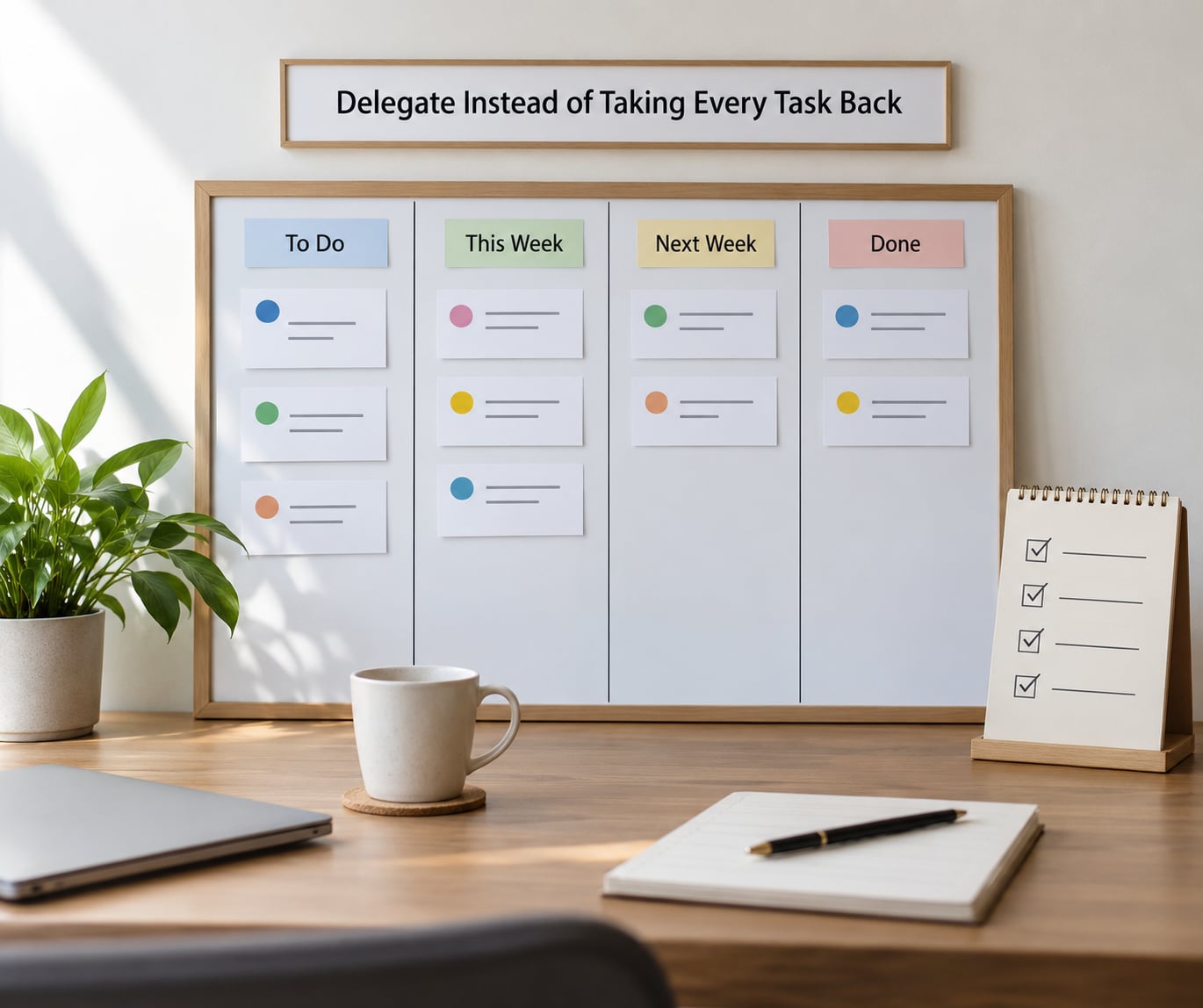
Delegation is the hardest habit for people who were promoted for being excellent at the work. Taking a task back feels like raising quality. What it actually does is teach the team that they cannot be trusted with it, and the team learns exactly that.
Match tasks to what people are good at and what they want to grow into. Then define three things in writing: the outcome, the boundaries, and the deadline. “Own the client renewal calls” is not a delegation. “Own the renewal calls for our top 20 accounts, draft the renewal terms by the 15th, and tell me before you promise anything outside our pricing policy” is.
Then step back far enough to let the work be theirs. Coaching over hovering means being available for questions, not checking the draft before it exists. If the result is off, name the gap and let them fix it. That is slower once and faster forever after.
Watch for progress and say it out loud. People keep doing what gets noticed, so “that deck was much clearer this week” lands harder than a generic compliment.
6. Give Feedback and Handle Difficult Conversations
Feedback is not a yearly event. The most effective managers give small notes within a day or two of the thing, while the person still remembers the moment.
The SBI model keeps it clean: Situation, Behaviour, Impact. “In yesterday’s client call, you answered the pricing question yourself before checking with me, and the client came back unhappy about the figure. Next time, check with me first and we will go in together.” Specific, recent, about behaviour rather than character, and finished. That is the shape most hard conversations need.
When someone misses a standard you set, follow the same order every time: name the standard, name what happened, ask for their view, agree the next step and a date. People rarely fight the standard. They fight when they feel ambushed.
If performance is genuinely off, the conversation is longer, not shorter. Expect to hear about workload, unclear priorities or a missing skill. Those are fixable, and finding one usually changes the outcome. What is not fixable is a pattern, and a pattern you cannot change should end with HR involved before it ends with an argument.
Prepare for the emotional reaction without bending on the substance. Someone who is upset has listened to the message; they just do not like it. Acknowledge that, stay on the facts, and end on what happens next.
7. Review Results and Improve Your Management Plan
Weekly, keep it short. A fifteen-minute Friday check on your own list: did the one-on-ones happen, did I give any feedback, what am I personally doing that someone else could own, and what is blocked and needs my boss involved.
Then review properly at 30, 60 and 90 days. At 30 days, you should know everyone’s work and have written expectations in place. At 60, you should see steady one-on-ones and at least one real delegation. At 90, you should be able to tell your boss which parts of your team’s output changed because of decisions you made.
Review the people, not just the deliverables. Look at workload balance, whether anyone is isolated, whether the person you were worried about has improved, and where you are still the bottleneck. That last one is the honest metric most managers avoid.
Being honest about your own leadership growth is part of the job. Ask your boss what you should do differently, and ask one of your reports what they wish you would start or stop doing. The second one stings and is the more useful of the two.
Common Mistakes
Almost every new manager makes at least three of these. The pattern is predictable because the skills that got you promoted are the ones you keep leaning on.
- Doing the work instead of enabling it. Fix: list everything on your plate this week and hand three items over. If your calendar is full of work someone else could do, that is the finding.
- Holding every decision yourself. Fix: write down the decision, the deadline and who should own it. Move it, and resist the urge to take it back.
- Announcing changes on day two. Fix: listen for a month before you redesign anything. Understand why the current process exists, then change one piece.
- Treating former peers differently out of guilt. Fix: be consistent with everyone from the first 1:1. Separate the friendship from the feedback.
- Micromanaging. Fix: agree the outcome and the check-in points in advance, then stay out of the middle. If you are correcting work you could have set a standard for, that is the cause.
- Falling back on the same skills that got you promoted. Fix: doing the job well and managing people are different jobs. Get training, read, or ask a mentor to review your approach.
- Skipping one-on-ones when the week gets busy. Fix: put them in the calendar as recurring events. They are the first thing to protect, not the first thing to sacrifice.
- Staying silent when work is not good enough. Fix: give the note within two days. Silence reads as approval, and the standard drifts quietly.
- Confusing fairness with identical treatment. Fix: apply the same standard to everyone, then support each person’s situation differently.
- Measuring success by your own output. Fix: track whether your team is delivering, learning and staying. That is the new job description.
- Trying to be the popular boss. Fix: warmth is fine, standards are separate. People respect a manager who is pleasant and still holds a line.
- Naming the previous manager’s mistakes to bond with the team. Fix: thank them for the foundation and move on. You will get a reputation either way, so pick the one you want.
If you take one habit from this list, make it the first: schedule every recurring one-on-one in your calendar before the week fills up. It is the mechanism behind almost everything else on the list.
Frequently Asked Questions
How long does it take to get good at managing people?
Most first-time managers say six months before the job feels manageable and closer to a year before they trust their judgement. That is normal, not a sign you were promoted too early. The early months are slow because you are building relationships and learning what you do not know yet. Managers who feel competent fastest are usually the ones who run short one-on-ones early and delegate sooner.
How do I manage former peers who now report to me?
Be consistent from your first one-on-one with everyone, including friends, and do it the week you start rather than after you have been friendly for a month. Say plainly that the reporting line has changed and that work conversations will be handled as work. Most friendships survive the promotion. The ones that do not are usually the ones where you avoided a hard conversation or treated people differently to spare them.
What should I delegate first as a new manager?
Start with work that is a real part of the role, well defined, and reversible if it goes wrong. A weekly report or a recurring customer check-in suits most new managers. Explain the outcome, the boundaries and the deadline rather than listing steps, then stay available without hovering. Keep work that depends on relationships you have not built yet, and anything genuinely urgent while you learn the landscape.
How do I give negative feedback for the first time?
Use the SBI model: Situation, Behaviour, Impact. Pick something recent and specific, describe what the person did rather than what they are, and explain the effect it had on the work or the customer. Then agree the next step and a date. Give it within a day or two, in private, and end on something you want more of. Do not soften it into vagueness, because unclear feedback gets repeated.
How do I stay in charge without becoming a bottleneck?
Audit your calendar every Friday and mark anything you could hand over. Define outcomes and boundaries rather than steps, set a check-in point, and then let the work be theirs, including the rough first draft. Expect the first attempt to be worse than what you would have made, and treat that as the cost of building capability. If you are rescuing the same task every month, the brief was too tight.
Should I get management training before accepting the role?
Ask your company what is on offer first, since many employers fund a course or coaching in the first six months. Training helps with frameworks for feedback and delegation, but it does not replace practice. The fastest gains usually come from a mentor who reviews your actual conversations, plus one good book. If you can negotiate a start date, a week of preparation beats starting on a Monday with nothing.
Conclusion: Start With Your First 30 Days
For the first 30 days, the work is simple enough to say in one breath. Get clear expectations in writing from your boss, meet every person on your team one-on-one and mostly listen, set the ways of working, start the weekly one-on-ones before the calendar fills, and delegate the first real piece of work that is not urgent.
Ignore the people who tell you to have a five-year vision in week one. Clear beats grand, and it holds up through 2026 and every year after it.
Book the recurring one-on-ones today. Everything else in this guide becomes easier once that is in the diary.