Yes, you can start investing with 100 dollars, and 100 dollars is a real starting point rather than a rounding error. The practical way to begin is simple: clear high-interest debt, keep a small emergency cushion, open the account that gives you the best deal, and buy one broad, low-cost, diversified fund. The whole process takes an evening and about an hour of reading.
Here is the part nobody tells you at the start. That first 100 dollars will not change your life financially. What it does is start a habit and buy you time, and time is the ingredient that actually does the work. Someone who begins at 22 with small amounts has four more decades of compounding than someone who begins at 42, with the same monthly habit.
Below is the plan in plain language, including the parts that trip people up. Nothing here is personalized financial advice, and tax and account rules vary by country and state, so check the details for where you live.
Table of Contents
- What You Need
- Money that is genuinely spare
- High-interest debt under control
- A starter emergency cushion
- Identification and a broker
- One fund, not a research project
- How to Start Investing with 100 Dollars, Step by Step
- 1. Confirm how to start investing with 100 dollars responsibly
- 2. Choose a beginner-friendly investment account
- 3. Decide where to put the money
- 4. Open and verify the account
- 5. Fund and make the investment
- 6. Check the investment and decide what comes next
- What 100 dollars actually becomes
- Common Mistakes That Cost Beginners Money
- Investing the emergency money
- Buying one company’s stock with the whole amount
- Chasing whatever just went up
- Paying fees you do not notice
- Selling after a bad week
- Trying to double it fast through trading
- Frequently Asked Questions
- What is the best investment for a 100 dollar beginner?
- Can I invest in stocks with only 100 dollars?
- Should I invest my 100 dollars or keep it in an emergency fund?
- What is the difference between a Roth IRA, traditional IRA, and brokerage account?
- Do I have to pay taxes on a 100 dollar investment?
- Is it safe to start investing with 100 dollars?
- Conclusion
What You Need
You need four things before any money moves. Most beginners who stall do not lack the fourth one, they are missing the first.
Money that is genuinely spare
The 100 dollars has to survive contact with your next bill. If it is the buffer between your checking account and overdraft fees, it is not investment money. Community discussions on r/investingforbeginners and r/personalfinance keep circling the same test: if losing it would mean a missed payment, it belongs in savings.
High-interest debt under control
Credit card balances running into the high teens or twenties are a guaranteed negative return. Paying one down beats any market investment you could buy with the same dollars, and you can treat the debt payoff as your first investment return.
A starter emergency cushion
One small month of expenses in a high-yield savings account is enough to start. It is not the full three-to-six-month fund most guides recommend, but it stops a surprise repair bill from forcing you to sell your investments at the worst possible moment.
Identification and a broker
A brokerage account needs your name, date of birth, address, and a photo ID or SSN verification in the United States. You will also pick a commission-free broker that supports fractional shares, so 100 dollars can buy a slice of a fund that costs several hundred dollars per share.
One fund, not a research project
Know what you are buying before you buy it: a broad index fund or ETF with a low expense ratio and no load. You do not need a stock-picking strategy. You need one diversified thing you will still own in ten years.
How to Start Investing with 100 Dollars, Step by Step
Six steps, in order. Skipping ahead to step three when step one says wait is how beginners end up selling in a bad month.
1. Confirm how to start investing with 100 dollars responsibly
Run the readiness test: no high-interest credit card balance, one small month of expenses saved, and no upcoming bills that depend on the money. Pass all three and the 100 dollars is ready. Fail one and the correct first move is paying the balance or leaving it in savings. You are still investing either way, just in a lower-volatility asset that happens to be guaranteed by the bank.
2. Choose a beginner-friendly investment account
The account type matters more than the fund you pick inside it. The usual order goes: your employer’s 401(k) with a match first, because a match is an instant return nobody negotiates; then a Roth IRA, if your income qualifies, because growth inside it is tax-free; then a taxable brokerage account, which has no contribution limit and no tax advantage. A traditional IRA gives you a deduction now and taxed withdrawals later. If you have access to a match, that outranks everything else on this list.
3. Decide where to put the money
Four routes cover almost everyone. Broad index funds or ETFs buy a slice of hundreds or thousands of companies in one purchase. Fractional shares let you own a piece of a single fund priced above your budget. Target-date funds and robo-advisors pick and rebalance for you. Round-up apps sweep spare change from everyday card spending into a managed portfolio. Two filters narrow it: a low expense ratio, ideally under 0.10 percent, and enough diversification that one company’s bad quarter cannot sink you. With 100 dollars, per-transaction fees and high expense ratios bite proportionally harder, so a cheap fund matters more here than for someone with ten thousand.
4. Open and verify the account
Choose the account type from step two, enter your information exactly as it appears on your ID, and expect an identity check that can take a few days. Create a password you have never used anywhere else and turn on two-factor authentication before you deposit a cent. You will know it worked when you can see an account dashboard showing a zero balance, your account type, and a funding option.
5. Fund and make the investment
Link your bank and transfer the 100 dollars. Use a limit order rather than a market order if the fund trades intraday, so you cap the price you pay instead of accepting whatever the market asks. Check for any account minimum that would block a small transfer, and confirm whether fractional purchases are enabled. Place one deliberate buy, then wait a moment and refresh the positions screen. Seeing the fund listed with its unit count, average cost, and current value means the order settled.
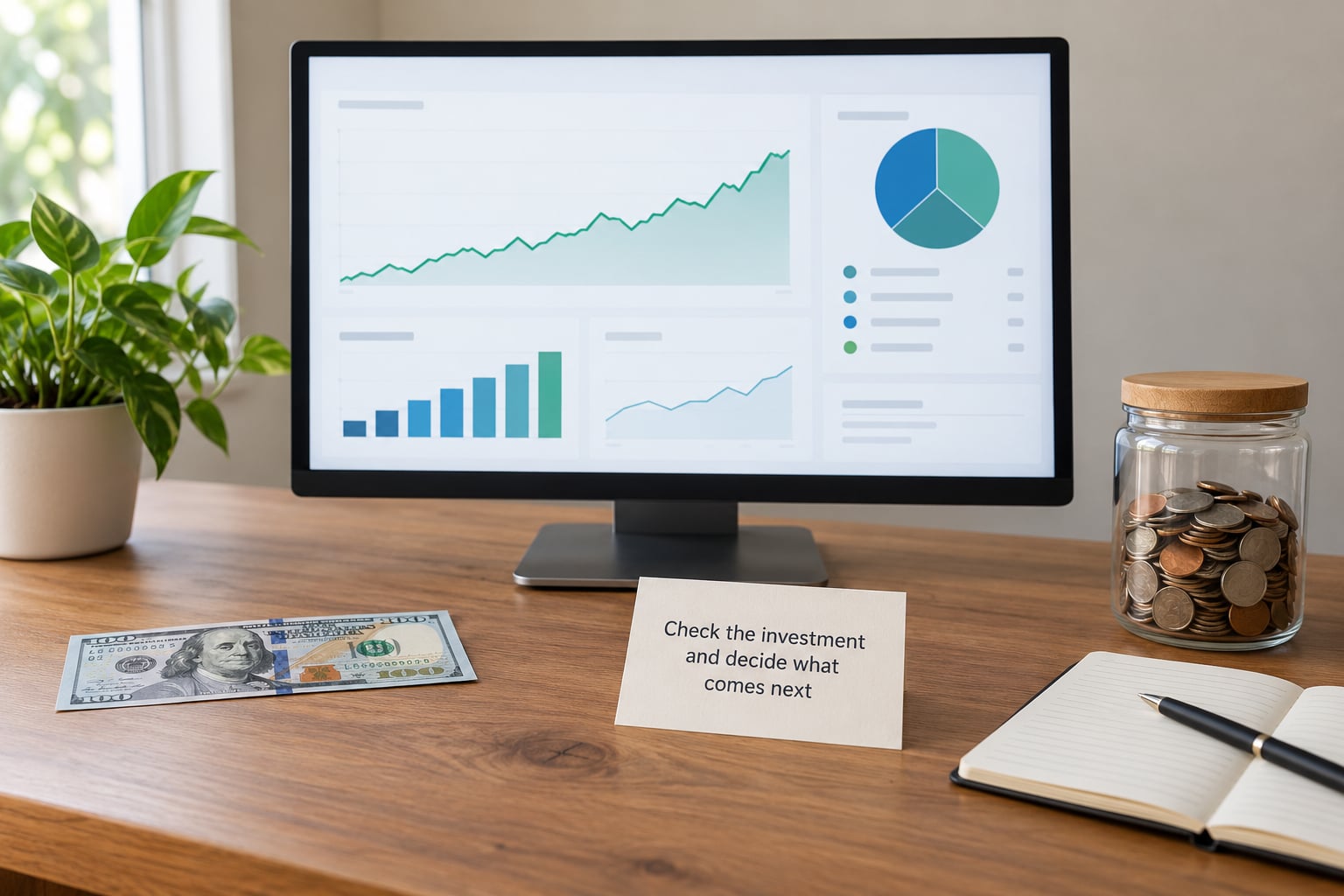
6. Check the investment and decide what comes next
Now the real work starts, and it is mostly boring. Look at your holding once a month, not once an hour. Set an automatic recurring contribution, even 20 dollars a month, because that habit outlasts any single purchase. Turn on dividend reinvestment so payouts buy more shares automatically. Then decide what to do the next time a red day makes you regret the whole thing.
What 100 dollars actually becomes
Here is the honest math, using a 7 percent average annual return. That is a reasonable long-run placeholder for a diversified stock portfolio, not a promise, and real years are often worse and sometimes much better.
| Time horizon | 100 dollars alone | Starting at 100, plus 20 dollars a month | Starting at 100, plus 50 dollars a month |
|---|---|---|---|
| 5 years | 140 dollars | 1521 dollars | 3591 dollars |
| 10 years | 197 dollars | 3513 dollars | 8487 dollars |
| 20 years | 387 dollars | 10226 dollars | 24984 dollars |
| 30 years | 761 dollars | 23432 dollars | 57438 dollars |
Read that last row again. Left column, the money you never add to, grows to less than eight times your original deposit. Third column, small consistent additions, turns into a sum that changes what retirement looks like. That gap is the whole argument for how to start investing with 100 dollars: the habit compounds more reliably than the amount does.
Common Mistakes That Cost Beginners Money
Almost every expensive investing mistake traces back to one of six, and all six are more tempting with a small balance because the stakes feel small either way.
Investing the emergency money
The fix is boring: keep one month of expenses in a high-yield savings account, invest the rest. A savings account pays interest and keeps the money available. An investment account can be down 20 percent on the day you need it for a car repair.
Buying one company’s stock with the whole amount
A single stock is a coin flip with your savings on one side. With 100 dollars, put it into something holding hundreds of companies instead. Forum posters ask whether to spread 100 dollars across a few ETFs or buy one expensive stock, and the consensus answer stays consistent: one broad fund beats several guesses.
Chasing whatever just went up
By the time a trend reaches your feed, larger accounts have usually moved on. Set a rule that you only buy something you would still want to own if it dropped 30 percent, then stick to it.
Paying fees you do not notice
A 1 percent expense ratio on a small balance is a meaningful slice of the account. Use a commission-free broker with no load, and check the expense ratio before you buy.
Selling after a bad week
A 12 dollar drop on a 100 dollar balance is 12 percent, and it is noise. Beginners on r/investingforbeginners describe the anxiety of watching a small balance swing and coping with it by not checking the app for a week. That single habit does more for long-term results than any fund pick.
Trying to double it fast through trading
Turning 100 dollars into 1000 dollars in a day is not a strategy, it is a coin flip with extra steps. Day trading with a small balance is how beginners lose the money they just found. There is no reliable shortcut, and anyone promising one is selling something.
Frequently Asked Questions
What is the best investment for a 100 dollar beginner?
For most beginners, one broad, low-cost index fund or ETF is the right first purchase. It holds hundreds or thousands of companies, so a single bad quarter cannot sink you. Buy it inside the account that gives you the best deal, usually a 401(k) match first, then a Roth IRA, then a taxable brokerage account. Look for an expense ratio under 0.10 percent and no load.
Can I invest in stocks with only 100 dollars?
Yes. Most commission-free brokers let you buy fractional shares, meaning you can own a slice of a stock or fund that costs several hundred dollars per share. Individual single stocks are still risky with such a small balance, because one company’s bad news can halve it. Most beginners use fractional shares inside a broad index fund rather than picking one company.
Should I invest my 100 dollars or keep it in an emergency fund?
Keep it in a high-yield savings account until you have one small month of expenses saved and no high-interest credit card balance. Then invest the rest. Savings give you stability and immediate access, investments give you growth over years. The order that works best is debt first, emergency cushion second, investing third, and both the savings and the investing continue from there.
What is the difference between a Roth IRA, traditional IRA, and brokerage account?
A Roth IRA is funded with after-tax money and grows tax-free, with qualified withdrawals untaxed. A traditional IRA may give you a deduction now, but you pay tax when you withdraw in retirement. A taxable brokerage account has no contribution limit and no tax advantage, but you can withdraw at any time without an early-withdrawal penalty. Employer plan rules vary, so check your own.
Do I have to pay taxes on a 100 dollar investment?
On a taxable brokerage account, dividends and realized gains are generally taxable, and a small sale can create a small tax bill you must report. Inside a Roth IRA, growth and qualified withdrawals are tax-free, so the tax impact at this size is usually nil. Contribution limits and income rules are set by the IRS and change, so confirm the current numbers before you open anything.
Is it safe to start investing with 100 dollars?
Small does not mean unsafe. The real risk is volatility over short periods, and 100 dollars is not enough to lose in a way that changes your life. It is not insured, so keep your emergency fund separate and never invest money you need within three years. Nobody can promise returns, and anyone guaranteeing a specific outcome is not being straight with you.
Conclusion
Your first move tonight takes about twenty minutes: check your credit card balance and your savings cushion. If both are fine, that is how to start investing with 100 dollars without turning it into a second job. Open the account that gives you the best match or tax treatment, transfer the 100 dollars, and buy one broad low-cost index fund. Then set a small recurring contribution and let it run.
That is the whole play. Keep saving, keep the costs low, keep the money diversified, and give it years. Nobody can promise what 100 dollars will become, and anyone who does is guessing. What you control is the habit, and that part is fully in your hands.