
To market a small business without paid ads, you build channels you own or earn: a complete Google Business Profile, local search visibility, reviews, referrals, an email list, helpful content and partnerships with nearby businesses. The honest part is time. Expect two to four focused hours a week, and expect referrals and profile visibility to move in weeks while search traffic takes months.
Most guides for this topic are a flat list of twenty tactics with no order. Owners follow half of them, see nothing for eight weeks, and quit. The fix is sequencing: earn money from the fast channels first, then invest the slow ones while they compound.
Below is a seven-stage system built in that order, plus the weekly time each stage costs. If you only have two or three hours a week, stages 1 through 4 are your whole plan for the first month.
Table of Contents
- What You Need
- Step-by-Step: How to Market a Small Business Without Paid Ads
- 1. Identify Your Ideal Customer and Buying Problem
- 2. Build a Clear Offer Customers Understand
- 3. Optimize Your Local Search Presence
- 4. Turn Customers Into Referrals: Marketing Without Paid Ads
- 5. Earn Visibility Through Helpful Content
- 6. Build Relationships With Local Partners
- 7. Follow Up, Ask for Feedback, and Measure Results
- Common Mistakes
- Zero-Cost Marketing Tips That Build Trust
- Frequently Asked Questions
- How long does it take to market a small business without paid ads?
- What is the best free marketing channel for a local small business?
- Can a small business grow without paid advertising?
- How often should I post when marketing my business organically?
- How do I know which organic marketing channels generate customers?
- Start This Week, Not This Quarter
What You Need
You need very little, and almost none of it costs money. Here is the honest list, with a free or near-free option next to each item.
- One defined ideal customer. Not a demographic grid. A person, in a place, with a problem. This is step one of the plan.
- One clear offer. A specific thing a person can buy or book, with a reason to trust it and a next step.
- Accurate business information. The same name, address and phone number everywhere you appear. This consistency is called NAP consistency, and mismatched listings are the single most common local search mistake I see.
- A Google Business Profile. Free, and for most local businesses the highest-return thing on this list. Owners in local business forums almost always name it first.
- A simple website or one landing page. Mobile-friendly, loads fast, states what you do, where you work, and how to contact you. A single page beats no page; a ten-page site you cannot edit beats neither.
- A way to collect contacts. A simple newsletter signup or a form that sends to your inbox. One sheet of names beats a thousand followers.
- A way to ask for reviews. A link, a QR code, and a sentence you are not embarrassed to send.
- A basic tracking method. A notebook or spreadsheet. You do not need an ad dashboard for organic work.
Paid tools are optional. Free options cover most of it: Google Business Profile, Google Search Console, Google Analytics, Bing Webmaster Tools, Mailchimp’s free tier, Canva for design, and Buffer’s free tier for scheduling. Vendor guides will push their own product, so weigh that when you read them.
Step-by-Step: How to Market a Small Business Without Paid Ads
The seven stages below run in sequence, not in parallel. Each one makes the next one easier, and each one produces something you can measure. Start with one customer group and one goal, such as ten new inquiries in ninety days, rather than opening every platform you can find.
Here is what each tactic costs you in time, and how long before it gives anything back.
- Google Business Profile. Free. About an hour to set up, then 30 minutes a week. First result in 2 to 6 weeks. Best for local service businesses.
- Review generation. Free, 30 minutes a week. First result in 3 to 8 weeks. Best for any business with repeat customers.
- Referrals. Free, 45 minutes a week. First result in days, sometimes up to 3 weeks. Best for trades, clinics, salons and coaches.
- Local partnerships. Usually free, 1 hour a week. First result in 3 to 6 weeks. Best for retail, hospitality and services.
- Email list. Free tier, 1 hour a week. First result in 4 to 12 weeks. Best for everyone with repeat customers.
- Helpful content. Free, 2 to 3 hours a week. First result in 3 to 9 months. Best for businesses with a specific niche.
- Organic social. Free, 1 to 2 hours a week. First result in 2 to 4 months. Best for visual and local brands.
- Micro-creator collaborations. Product or a fee, sometimes free, about 1 hour a week. Timing varies widely. Best for food, fitness and retail.
Read that last list honestly. Two things on it usually cost money even when people call them free: creator collaborations may need product or a fee, and newsletter sponsorships are paid. Everything else can start at zero.
1. Identify Your Ideal Customer and Buying Problem
Most wasted marketing happens because a business tries to reach everybody. Narrow it until it feels uncomfortably specific, then write one paragraph about that person.
Fill in four boxes. Where are they physically located or shopping online? What problem is on their mind right now? What has already happened, or already failed, before they call you? And what makes them pick a provider this week instead of next month?
Here is a real example. A mobile car detailer in a mid-sized town was posting about “clean cars” and “we love cars” and getting nothing. Rewritten: “We come to your driveway in the Eastside between 8am and 4pm, on weekdays, so working owners don’t have to drop a car off. We book most days a week.” That version names the customer, the service area and the schedule, and it is what people search for.
Your version should answer three questions in plain words: who you help, what problem you solve, and why someone should contact you instead of scrolling. Put it on your landing page and use it as the intro on your profile and social bios.
2. Build a Clear Offer Customers Understand
An offer is easier to buy when it is concrete. Open-ended descriptions make people do work, and people who have to work usually walk away.
A workable offer has four parts: a tangible benefit, a reason to believe it, one clear next step, and an honest note about availability or timing.
Take a vague service, “consulting for growing businesses,” and rebuild it. Benefit: a two-hour session where we map your funnel and you leave with a written plan. Reason to trust it: named work you have done, or a specific number you can stand behind. Next step: a booking link that opens in one click. Availability: sessions currently open Tuesday through Thursday, and I take four a week.
Nothing here needs a discount you cannot afford. Specificity does most of the work a coupon would have done.
3. Optimize Your Local Search Presence
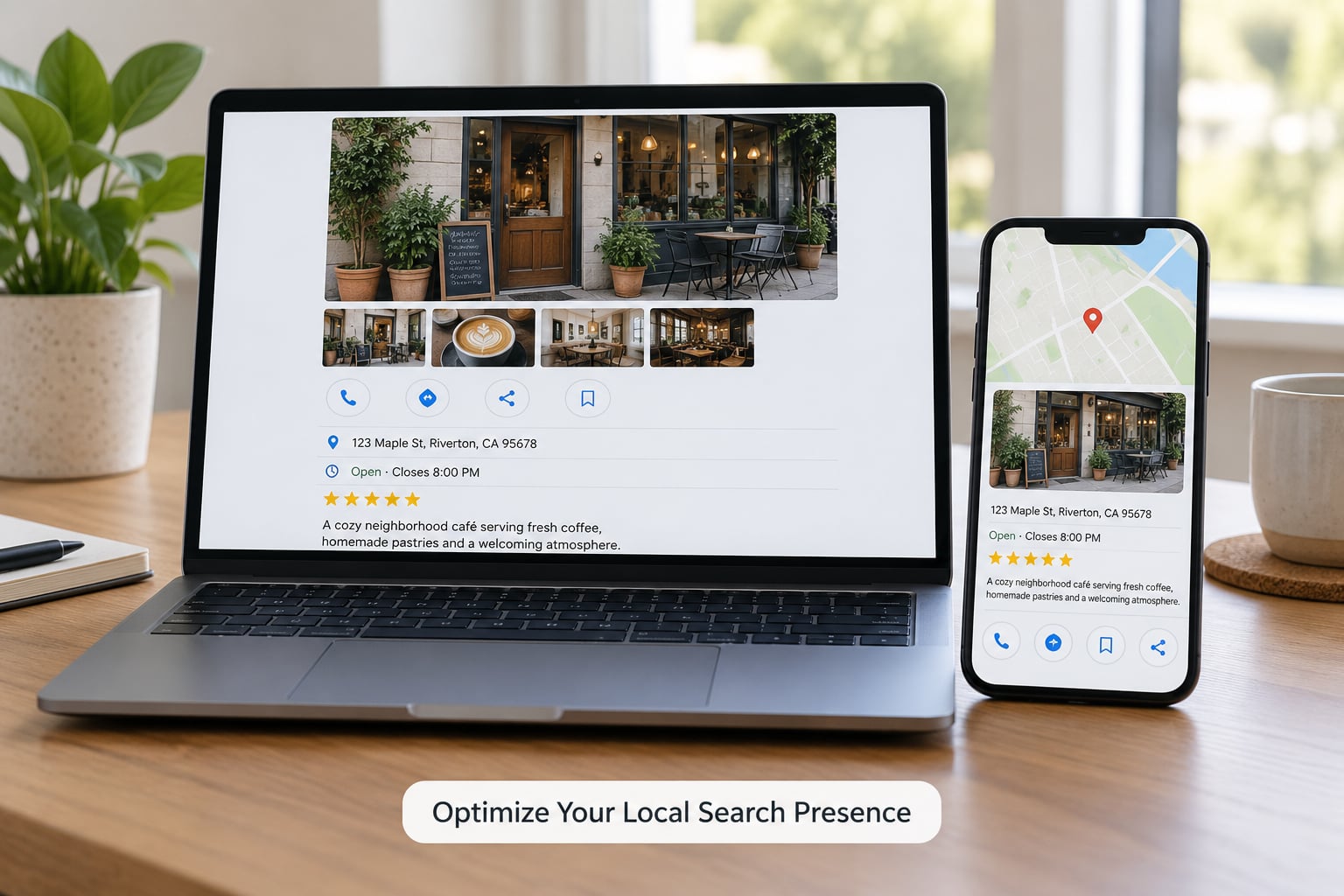
For a local business, this is the channel to fix first. Google Business Profile is free, it appears directly in map results, and owners on business forums consistently rank it as their best zero-cost action.
Claim the profile, then complete every field properly. Use the exact name customers would type, with no extra keywords stuffed in. Pick the most accurate primary category and add real secondary categories that match what you actually do. List every service, set accurate hours including holiday hours, and add a real local address if you have one eligible location.
Next, fix consistency. Search your business name plus your town across directories and make sure the name, address and phone number match your profile character for character. Old mismatched listings from previous owners and previous phone numbers quietly bury small businesses.
Add photos that show real work, recent ones, uploaded regularly. Write updates that carry a small piece of local keyword naturally, such as the service and the neighborhood you cover, without keyword stuffing. Then link the profile to a mobile-friendly page on your site.
Ask for honest reviews in a simple way: one short message after a completed job, a direct link or QR code, and a request to describe their experience in their own words. Never incentivise a review, and never buy one.
How do you check it worked? Open a private browser window and search the service plus the town, as if you were a customer standing nearby. If your business does not appear in the local pack, keep working on categories, reviews and photos. That check takes two minutes and it is the most useful five minutes in local marketing.
4. Turn Customers Into Referrals: Marketing Without Paid Ads
Referral and word-of-mouth marketing is still the highest-return free channel for service businesses. Owners describe it the same way: it produces the best customers, at zero cost, and only if you give people something easy to forward.
A referral system is a process, not a hope. Ask at the moment the customer is most pleased, usually right after you solve the problem, and make the ask small.
Here is a script that works. “Thanks for trusting us with that. If you know someone nearby with the same issue, would you introduce us? Here is a short message you can forward if it helps.” Then send three or four sentences they can paste: who you are, the problem you solve, the area you cover, and how to reach you. Keep it under a hundred words.
Give people a reason to send it. A referral rate that is slightly better for an existing customer, a free diagnostic visit, or a donation to a cause they care about all work better than nothing.
Track it simply. Ask new customers one question at intake, how they heard about you, and keep a weekly tally. Without that question, referral marketing feels untrackable, and owners routinely assume their best channel is not working because nothing is counting it.
On incentives: a small thank-you is normal practice. Anything that rewards a positive review crosses into review manipulation and can break platform rules and your customers’ trust. If you offer something, make it for the referral itself, not for the sentiment.
5. Earn Visibility Through Helpful Content
Content works when it answers a question a real customer actually asked. The owners who get nothing from blogging are publishing promotion dressed up as articles.
The formats that carry the most weight for a small business are short: a checklist, a frequently asked questions page, a short video answering one objection, a before and after photo with a caption, a plain explainer on social. Repurpose one answer across several of them instead of starting from scratch each time.
Every piece needs a next step that matches the offer in step 2. A checklist that explains what to look for when choosing a provider should end with a booking link, not a shrug.
Here is an example that works without sounding promotional. A plumbing company writes a post titled “Five things to check before your water heater goes out,” covering age, warranty, sediment, power, and where the shutoff is. It is genuinely useful, it names the problem at the right moment, and it closes with a line about same-day emergency callouts. Nobody reading it feels sold to, and it keeps bringing in people for months.
Be patient with this channel. Content and search traffic take three to nine months, and they compound once they land. Treat it as an asset you are building, not a lead source you are chasing.
One more note for 2026: a growing share of searches now return an AI summary above the links. Short, direct answers to real questions, clear factual sentences and simple tables are what get quoted there. Write the answer first, then explain it, and you will be readable both to people and to answer engines.
6. Build Relationships With Local Partners
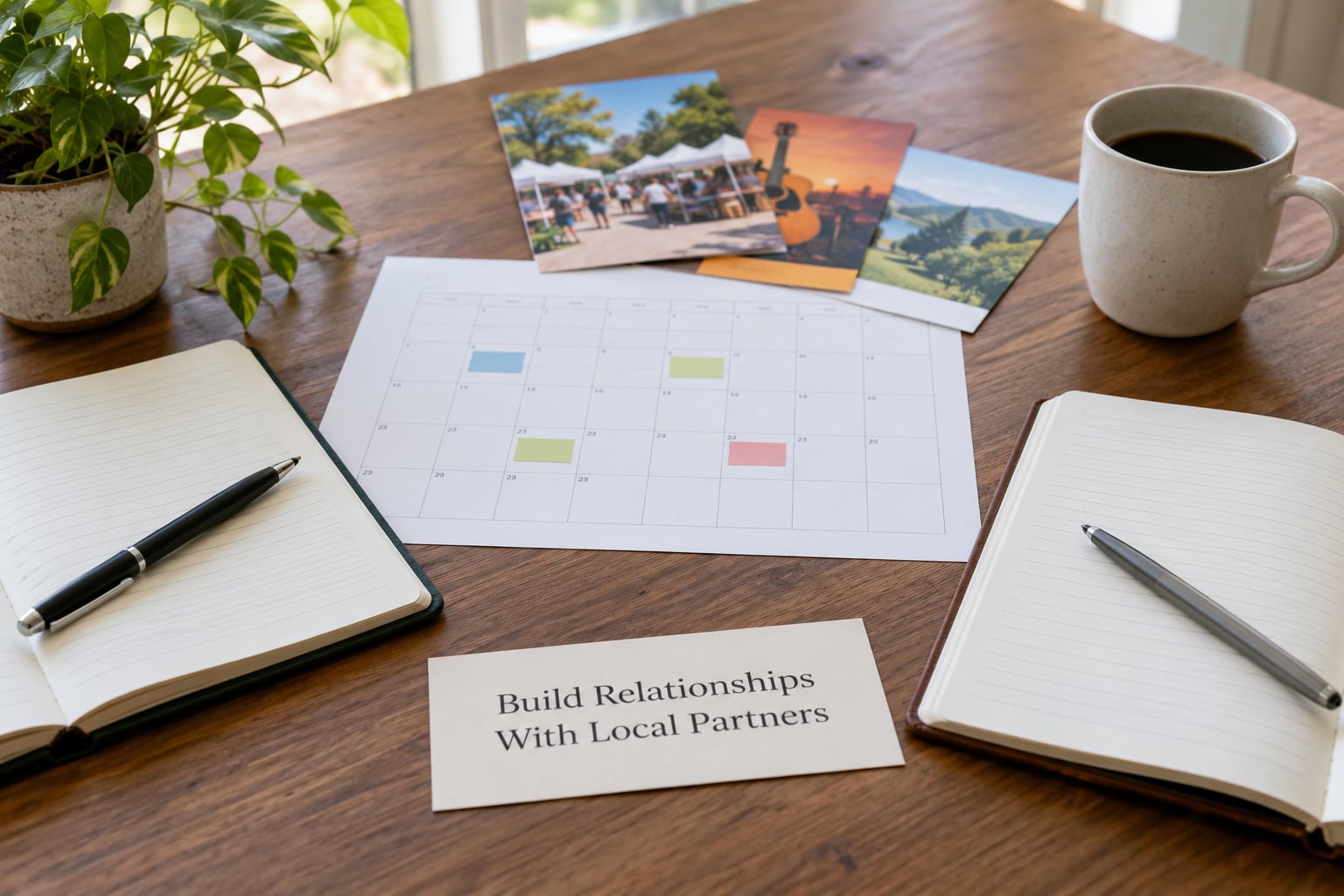
Partners let you borrow an audience you have not earned yet. Look for businesses that serve the same customer but do not compete with you: a gym and a physiotherapist, a wedding photographer and a florist, a cafe and a bookshop, a landlord and a cleaner.
Propose something specific, because vague offers get ignored. A shared workshop, a joint evening event, a standing cross-reference card, a discount code the other business can hand out, or a monthly newsletter swap all work.
Keep outreach short. Name their business, say what you do in one sentence, propose the specific idea, and say why their customers would want it. Ten sentences is plenty. Follow up twice, then move on.
Measure partner-generated leads the same way you measure referrals: one question at intake, a code or phrase if you want a cleaner count, and a weekly number. Partnerships that are never counted are the first thing owners drop when things get busy, sometimes months before they would have paid off.
7. Follow Up, Ask for Feedback, and Measure Results
This is the stage that separates businesses that grow from businesses that churn. It takes about two hours a week and it is where most owners give up first.
Run a simple weekly rhythm. Reply to every inquiry the same day. Send a short useful follow-up to anyone who asked a question but did not book. Ask every finished job for an honest review. Thank anyone who sent a referral, personally. Write down what came in.
Track the numbers you can actually see: website inquiries, calls, direction requests from your profile, email sign-ups, referral mentions, partner leads, and which piece of content a new customer mentioned. Weekly is enough. Monthly reviews are where you decide what to cut.
Then do the thing owners skip. Find the channel producing customers who stay, and put more time there. Pause the one producing views and no inquiries. That decision is the entire point of tracking, and it is the answer to the most common complaint on marketing forums, which is not that tactics fail but that nobody can tell which ones work.
Common Mistakes
- Trying to reach everyone. Fix: one customer group until the message lands, then widen.
- Changing platforms constantly. Fix: stay on one or two channels for ninety days before judging them.
- Offering no clear next step. Fix: one link, one action, on every post and page.
- Posting without a customer problem in mind. Fix: write the question a customer asked you this week, then answer it.
- Buying fake followers or reviews. Fix: delete the listing, ask real customers instead. Fake signals cost you trust and can hurt visibility.
- Ignoring profile details. Fix: categories, hours, services, photos, reviewed twice a year.
- Asking for referrals with no help. Fix: send a forwardable message they can paste.
- Measuring likes instead of customers. Fix: track inquiries, calls, sign-ups and the intake question.
- Treating slow channels as failures. Fix: judge search and content on a 90-day clock, not a 30-day one.
Zero-Cost Marketing Tips That Build Trust
- Answer every question a customer asks, on the channel they asked it on, even when it costs you fifteen minutes.
- Make the first five minutes of contact easy: reply fast, be specific, tell them what happens next.
- Ask satisfied customers to describe the result, not just rate it. Specific stories convert better than stars.
- Reply to negative reviews calmly, once, without arguing, and move the conversation to a direct channel. Owners who handle criticism well often gain more trust than those with only praise.
- Send a short email every few weeks with something useful and no pitch attached, then a soft next step.
- Keep your business information current everywhere, including old directories you forgot about.
- Repurpose one strong customer answer into a post, a short video, a checklist and a profile update.
- Show the work. Real before and after photos outperform written claims for almost every local trade.
- Ask, at the end of a good job, whether there is anyone else nearby with the same problem.
- Give away one genuinely useful thing each month, such as a free fifteen-minute consultation or a short checklist, and let the value do the talking.
Likes and follower counts belong at the bottom of your dashboard, if you track them at all. Conversations, inquiries and repeat bookings are the numbers that pay the bills.
Frequently Asked Questions
How long does it take to market a small business without paid ads?
Referral asks and profile improvements can produce inquiries within a couple of weeks. Review volume, partnerships and email usually show a measurable change in one to two months. Search and content take three to nine months to compound, which is normal rather than a sign something is wrong. Judge each channel on its own clock and review the numbers monthly.
What is the best free marketing channel for a local small business?
For most local businesses it is a complete, accurate Google Business Profile with real photos, correct categories and a steady flow of honest reviews. It is free, it appears directly in map results, and it keeps working long after you stop touching it. Pair it with a simple referral process and ask one question at intake so you know how customers found you.
Can a small business grow without paid advertising?
Yes, plenty do, though it takes longer and it depends on your market, your margins and how much of your target customer sits close enough to reach. Organic channels such as local search, reviews, referrals, email and partnerships carry real cost in time rather than cash. Businesses that treat those as assets they keep, rather than expenses they rent, do grow without ad spend.
How often should I post when marketing my business organically?
Enough to stay useful and consistent, not enough to exhaust you. For most small businesses that means two or three posts a week on one or two channels, plus a monthly email. Consistency matters more than volume because both customers and answer engines reward reliable sources. If posting three times a week is draining, drop to once a week rather than stopping completely.
How do I know which organic marketing channels generate customers?
Ask one question at intake: how did you hear about us? Record the answer in a simple spreadsheet with the date and the channel, then total it weekly. Cross-check it against profile direction requests, calls and email sign-ups. After a month or two the pattern is usually obvious, and it tells you which channel deserves more time and which one to pause.
Start This Week, Not This Quarter
Pick one customer group, finish your Google Business Profile, and send five warm messages asking for an introduction. That is the whole first week. Add a review request after every job and ask how customers found you, and the slow channels, content and search, can build quietly in the background while the fast ones pay for the month.