Teaching kids about money by age works when you match one idea to one stage: coins and “it runs out” around age three to five, jars and a first allowance at six to nine, written savings goals from ten, self-funded spending in the early teens, and banking, earning and borrowing at sixteen and up. Start at three, and keep the amounts small enough that getting it wrong does not hurt.
Money habits have a head start on us. Research from the University of Cambridge found that core financial habits are largely formed by about age seven, which is why the preschool years matter as groundwork rather than as something to wait out. A five-year-old who has watched money run out is learning something a fifteen-year-old given a lecture will not.
Table of Contents
- What You Need
- Step-by-Step
- Start With Money Awareness: Ages 3 to 5
- Introduce Earning, Saving, and Spending: Ages 6 to 9
- Build Basic Budgeting: Ages 10 to 12
- Introduce Saving Goals and Financial Trade-Offs: Ages 13 to 15
- Practice Real-World Independence: Ages 16 to 18
- Use Real Family Conversations and Review Points
- Common Mistakes
- Frequently Asked Questions
- At what age should I start teaching my kids about money?
- How much pocket money should I give my child?
- Should allowance be tied to chores?
- What is the 50/30/20 rule for kids?
- How do I stop my child spending all their money on the first outing?
- What is the 3-3-3 rule for kids?
What You Need
You need very little to start, and what you need changes as the child grows. The mistakes parents make are rarely about the wrong equipment. They come from skipping straight to tools built for teenagers.
- Real cash, or pretend money early on. Physical coins and notes for the first stage. Card payments hide the transaction, and a child who never sees money leave a hand has no reason to think anything is finite.
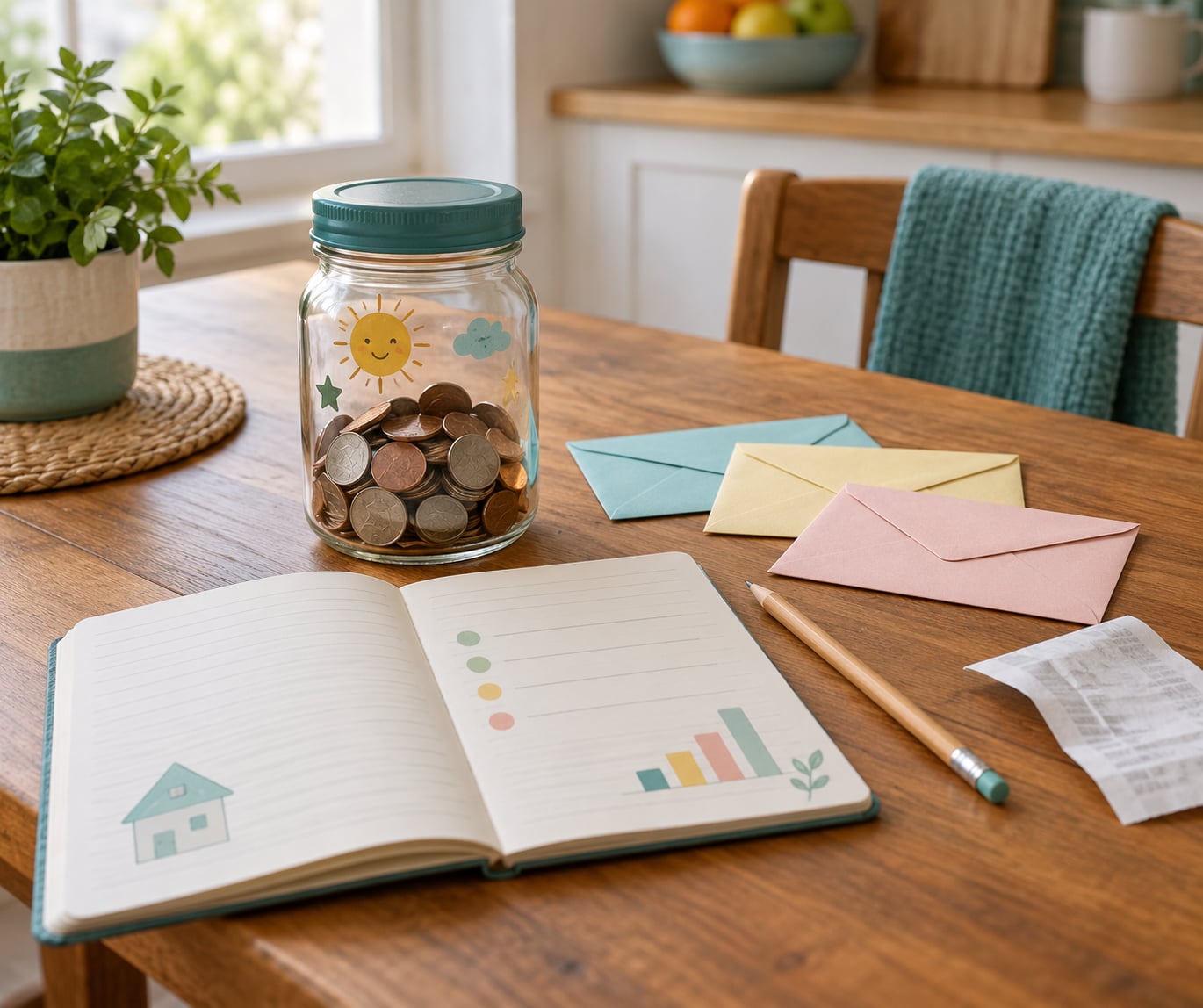
- Three visible containers. Glass jars, envelopes or a labelled box for spend, save and give. Visual containers are the most recommended tactic parents report, because a nearly empty jar teaches more than any conversation.
- A notebook and a pen. For a goal with a date on it, a list before a shop, and later a simple budget. Handwritten works better than an app at this age.
- A child savings account. Usually from around age six to eight, when a bank will open one in a child’s name. Later it becomes a joint account with a debit card.
- A fixed pay day and fixed rules. The amount and the day it arrives should never depend on your mood or how the week went. Consistency is the whole teaching device.
Write the family’s money rules on one sheet and stick it to the fridge: no top-ups mid-month, no buying candy at the checkout, allowance is not tied to good behaviour. Rules you can point at remove the need to negotiate every time.
Step-by-Step
The table below is the whole plan on one screen. Work down it in order, and let readiness, not a birthday, decide when a child moves up a level.
| Age band | The concept that lands | What to do in practice | What to avoid |
|---|---|---|---|
| Ages 3 to 5 | Money is real and it runs out | Count coins together, play shop at home, hand over a few coins to buy a real sweet | Lectures, coins they cannot yet hold, buying everything for them |
| Ages 6 to 9 | Money can be earned, saved and spent | Three jars, a written savings goal with a date, a small weekly payment | Paying for every chore, taking the jar back |
| Ages 10 to 12 | Choices have trade-offs | A limited amount for a set period, three spending categories, receipts reviewed weekly | Buying the thing for them after they overspend |
| Ages 13 to 15 | Needs versus wants, and marketing | Switch to monthly pay, fund their own phone and clothes, price-compare together | Rescuing them, arguing about the purchase at the till |
| Ages 16 to 18 | Credit, interest and choices with real stakes | Debit card with limits, a realistic monthly budget, part-time work with pay yourself first | Co-signing, letting them overdraft without discussion |
Start With Money Awareness: Ages 3 to 5
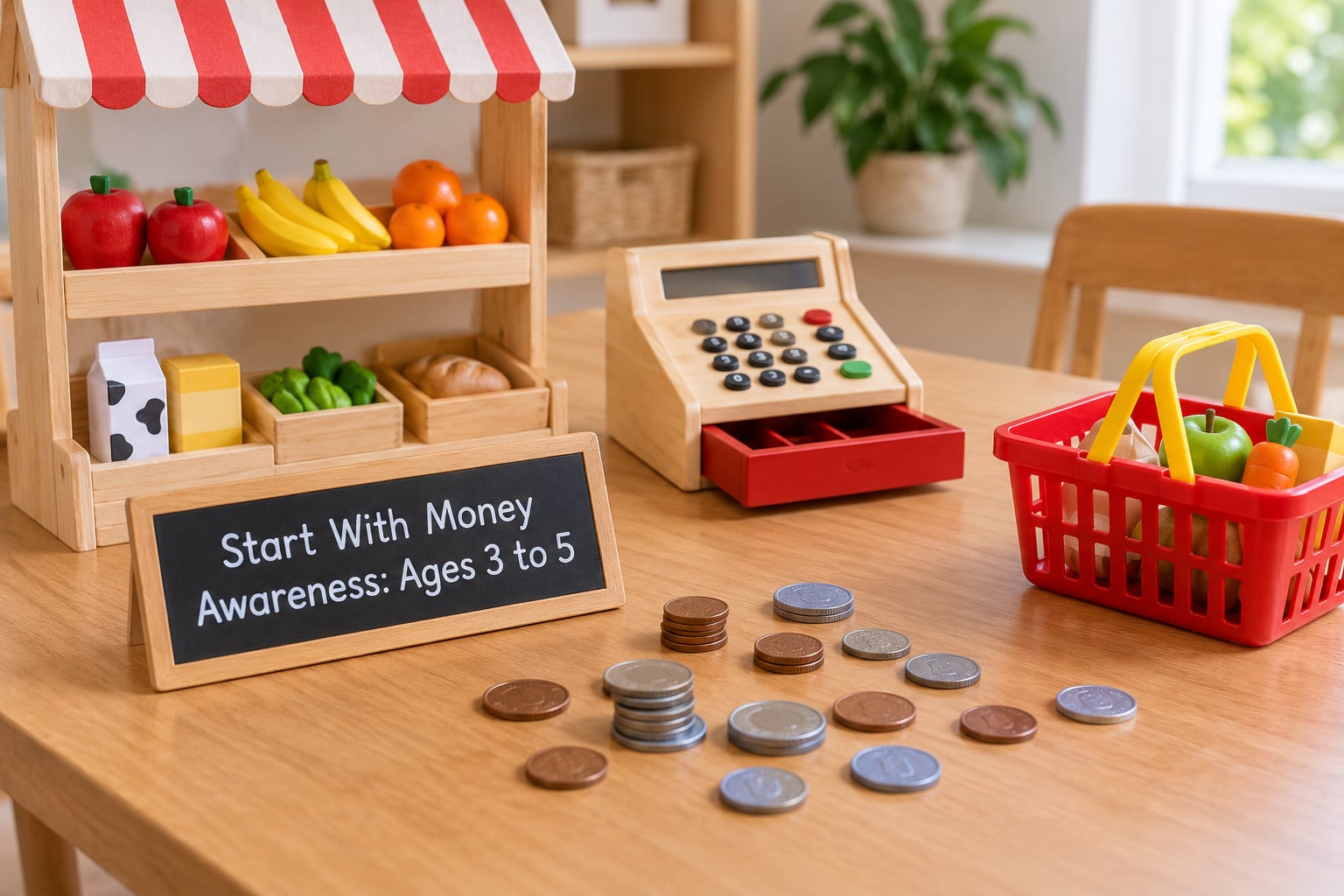
The goal at this age is recognition and waiting, not arithmetic. Teach the child to identify a few coins and a one and a five, and to say plainly that money is used up.
Play shop is the single most useful activity. Set prices on household objects, hand over pretend coins, and let your child make the wrong change. Then run it again with real coins on a real sweet at a real till, which is where the idea actually lands.
Delay the moment of purchase. Say the treat comes tomorrow, and see whether they can hold onto that for a day. This is the earliest, lowest-stakes version of delayed gratification, and it is the habit that pays out for years.
They are ready to move on when they can name two or three coins unprompted and can wait a day without a melt-down.
Introduce Earning, Saving, and Spending: Ages 6 to 9
This is the jar stage, and it works because it separates three ideas that adults blend into one. Explain income simply: people work and get paid, and that is where money comes from.
Set up three jars and write the split on the lid. A common starting point is half spend, a third save, and the rest give, adjusted to whatever your child actually manages well. When the save jar is filled, they pour it into a real account, and you let them press the buttons.
Give a small weekly amount on a fixed day. Under a year old in value is fine, because the lesson is the waiting and the choosing, not the purchasing power.
For earning, use a short list of extras beyond normal family duties. Nobody pays a child to make their bed, but a set of harder jobs on a laminated card can earn real money. Base the weekly payment on the full amount, so the payment never shrinks because they had a bad week.
They are ready to move on when they can say what the save jar is for without being asked.
Build Basic Budgeting: Ages 10 to 12
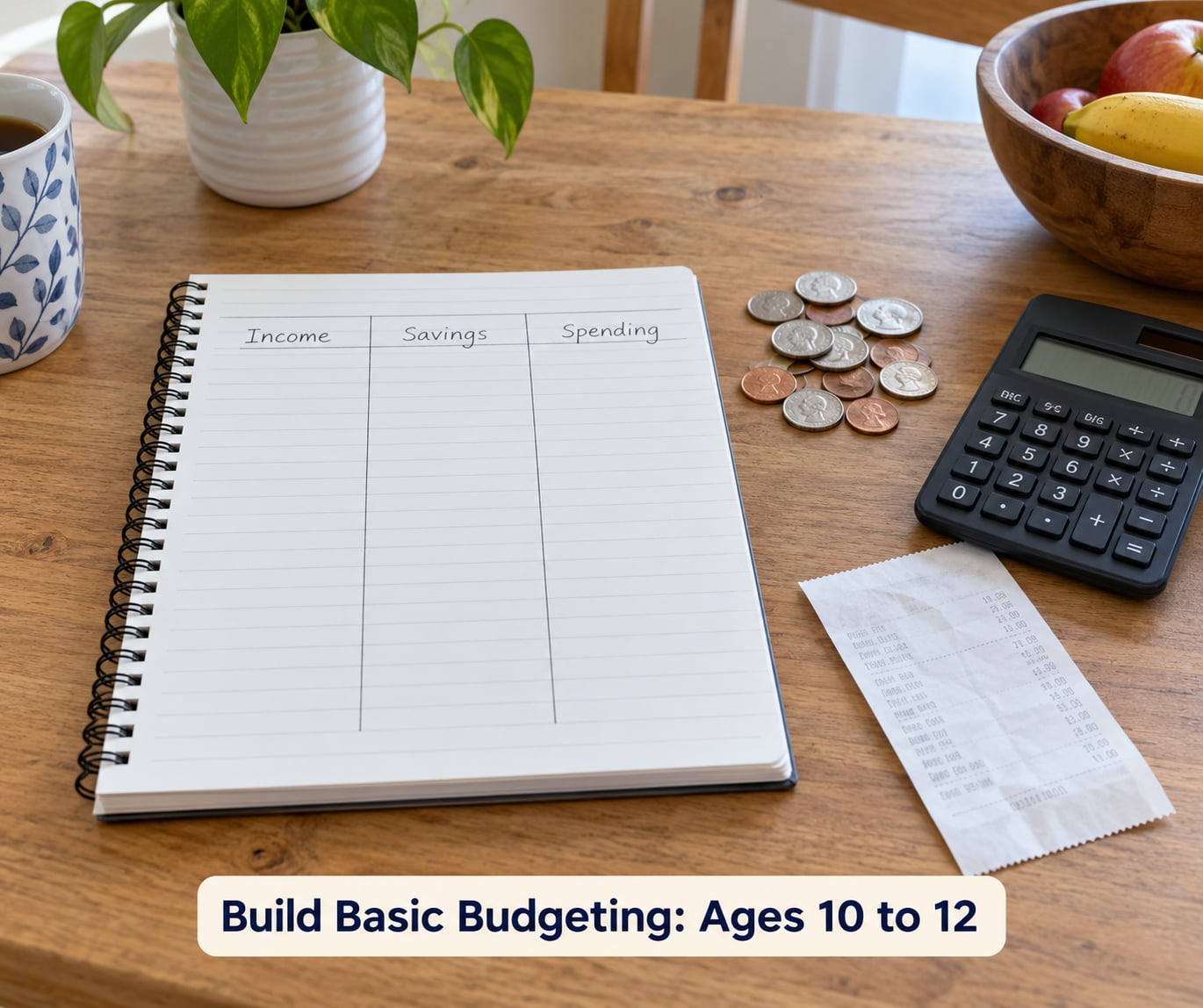
At ten, children can compare two prices and hold a grudge about a bad deal, which means they are ready for trade-offs. Move to a monthly amount covering three or four specific things: their own phone top-up, one clothing item, going out with friends, and a savings contribution.
Give them three columns in a notebook: needs, wants, savings. Before a shopping trip, they write down what they expect to spend and take that much. Afterwards they compare the guess with the receipt, and that gap is the lesson.
Review the numbers once a week, calmly. Ask questions about why something cost more than expected rather than correcting the total. Parents report that letting a child run out completely once, without a rescue, is the moment the concept finally clicked for them.
Now is also the point to open a savings account in their own name and let them see the balance grow. Some banks pay a small bonus for regular deposits, which turns saving into something with a reward attached.
They are ready to move on when they can tell you before a purchase how much of their budget it will eat.
Introduce Saving Goals and Financial Trade-Offs: Ages 13 to 15
Teenagers can handle a bigger goal and a monthly cycle. Switch the weekly payment to a monthly one on a fixed date. Many parents find this the single change that finally made budgeting make sense, because weekly money disappears before the month is over and never forces a plan.
Set a savings target with a deadline and a name attached, like a specific item or a trip. Write it on a card with the target amount and the date, and put it where they see it. Then let them defend the number to you.
Teach needs against wants out loud in real situations, mostly supermarket aisles. Ask which of the two things in their hand they need this week. Make them pay for their own phone, their own clothes and their own subscriptions before you consider helping.
Now name the machinery working on them. A teenager’s feed is selected by algorithms, influencers are paid to recommend things, and buy-now-pay-later splits a purchase into instalments that hide the total. Explaining the mechanics honestly beats demanding that they resist.
They are ready to move on when they can describe a trade-off they made on purpose and say what they gave up.
Practice Real-World Independence: Ages 16 to 18
By sixteen, a realistic monthly budget is the whole job. Include fixed costs, spending, saving and something fun, and let them adjust it when it fails. A budget that breaks is more instructive than one that never does.
Move to a bank account with a debit card that has spending limits set by you, so the limit is the teaching tool rather than the bank. Have them pay a recurring bill themselves, such as a phone or streaming subscription, and set up the automatic payment themselves.
Cover the basics of credit and debt before it happens to them. Good debt buys something that pays off later, such as education; bad debt buys consumption that disappears. Interest is a fee for borrowing money, and on a credit card it compounds against you. Warn them specifically about overdrafts and buy-now-pay-later, and tell them what happens when a payment is missed.
If they work, make pay yourself first the rule. A fixed percentage goes to savings before anything else touches the balance, and it happens automatically.
They are ready for adult money when they can produce a written budget, explain what interest costs, and say no to you without needing a reward.
Use Real Family Conversations and Review Points
Money teaching is not a curriculum you complete. It is a habit, and habits need a rhythm. Keep a short weekly check-in where they tell you what they spent, what surprised them and what they are saving for, and treat it as conversation rather than audit.
Add a check-in twice a year. Ask whether the amount they receive still stretches to the things they pay for, whether they have a goal that has stalled, and what they want more control over next. Raise the amount when they are consistently out of money, and hold it steady when they are not.
Say your own trade-offs out loud. When you skip a delivery or check a cheaper option, mention it. Modelling beats instruction, and children copy what they see you do far more reliably than what you tell them to do.
Set the money conversation up as something everyone has, including you. Children who hear their parents say they are not buying something this month learn that choosing between wants is normal, not a punishment.
Common Mistakes
Making money a reward for good behaviour. This is the first habit to break, because it teaches that money is something you deserve rather than a tool you use. Give an unconditional baseline amount, and let earning be separate and clearly labelled.
Skipping the needs and wants conversation. Children do not develop judgement from being handed decisions without context. Name it explicitly in the shop, out loud, every time, and it becomes a habit instead of a lecture.
Rescuing a bad purchase. Parents report topping up when the money runs out mid-month as the most common mistake of all, and it undoes everything. Let them carry the consequence. Say nothing about being right; the outcome is the teacher, and a lecture cancels it.
Paying only by card. A contactless tap hides the transaction completely, so the child never connects spending with money leaving. Cash for the early stages, and a debit card with visible limits later.
Starting late and waiting for a bigger income. You do not need money to teach money. Coins in a jar, a hand-me-down outgrown, handwashing the car, a matching contribution for the goal. The children of parents on tight incomes teach the same lessons with less, and the system still works.
Shaming mistakes. A child who is embarrassed about money will stop telling you about money. Keep the tone flat and curious, treat a bad purchase as data, and never use the words silly or wasteful about them.
Grandparents breaking the rules. A recurring source of chaos. Ask directly, agree a small cash figure for birthdays and holidays, and let it be consistent even if it is not the amount you would choose.
Frequently Asked Questions
At what age should I start teaching my kids about money?
Start as soon as your child can hold a coin, usually around three, and expect the foundations to land by about seven. Early work is recognition and waiting, not arithmetic: count coins, play shop at home, and let them make a real small purchase with real money. From age six or seven you can add jars, a written goal and a first weekly amount.
How much pocket money should I give my child?
Give an amount that stretches. Under a year old is plenty at six to nine because the lesson is waiting and choosing. From ten, work out what they pay for themselves, such as a phone top-up, one clothing item and going out, then set a monthly figure that covers those with a little left over. Raise it only when they consistently run out.
Should allowance be tied to chores?
Partly. Keep a fixed unconditional base amount so nobody is negotiating for their pocket money, then add a separate short list of paid extras beyond normal family duties for those who want more. The base teaches choice; the extras teach that money can be earned. Pay the base in full regardless of how the chores went that week.
What is the 50/30/20 rule for kids?
It is an adult budgeting split: fifty percent of take-home pay on needs, thirty percent on wants, twenty percent on savings and debt. For a child, the proportions should be flipped, with savings taking the largest share because they have the most time to benefit. A common starting point at seven is half spend, a third save, the rest give.
How do I stop my child spending all their money on the first outing?
Move from weekly to monthly around thirteen, and have them write a list with prices before the trip and take only that much. When the money runs out, do not top it up. Many parents find one deliberate shortfall is the lesson that finally sticks, as long as you stay calm and do not say you told them so.
What is the 3-3-3 rule for kids?
It is a saving guideline about giving money time to grow: roughly three years of regular contributions, a period long enough for interest to earn interest, and a modest monthly amount. It is worth showing a teenager with a savings account because it makes the case for starting small and starting early, which is the message you have been repeating for years.
Start this week with one jar, one amount and one fixed day, then let readiness move your child up rather than a birthday. Whatever their age, write down what they pay for themselves next, and take the conversation from there.