
A 100-point gain is realistic for most people, and the timeline depends almost entirely on what is dragging the score down. If card utilization sits above 30% or your reports contain errors, big movement can show up in 30 to 60 days. If your file is simply thin or old, budget six to twelve months.
That is the honest version of how to raise your credit score 100 points. Nobody can promise a specific number, because lenders build scores from data your three bureaus report, and that data updates on its own schedule. What you can do is attack the factors in order of how much weight they carry, then let time work on the rest.
Start with the two questions that drive everything: what percentage of your available credit are you using, and does your report contain anything that is not accurate?
Table of Contents
- What You Need
- How to Raise Your Credit Score 100 Points: Step-by-Step
- Check and Correct Your Credit Reports
- Bring Balances and Credit Utilization Down
- Make Every Payment On Time
- Use a Sensible Credit Card Strategy
- Build a Stronger Credit Profile Over Time
- Common Mistakes
- Frequently Asked Questions
- Is it realistic to raise a credit score by 100 points?
- What is the fastest way to improve a low credit score?
- Should I pay off collections or close old credit cards?
- How long does it take to raise a credit score by 100 points?
- Does paying off one credit card raise your score immediately?
- Can I raise my credit score without opening a new account?
- Where to Start This Week
What You Need
You can start tonight with an hour of work. The goal is to know your exact position before you change anything.
- Your three reports. Pull them free at AnnualCreditReport.com, the only site authorized to give you all three without a subscription. Equifax, Experian and TransUnion each maintain a separate file, and they rarely match.
- A list of every open account. Name, issuer, last four digits, credit limit, current balance, and the oldest open date. Write it on paper or in a plain spreadsheet.
- Every statement for the last two cycles. You need the statement closing date, not just the payment due date. They are different dates, and the gap between them explains a lot of confusion.
- Your last 12 months of statements. Bank, card, and loan. Look for fees, interest charges, and any account you no longer recognize.
- A budget that shows the real monthly surplus. Paying down balances only works if you know how much you can actually put toward it.
- A dispute template and a paper file. A folder or folder on your computer for letters, copies, and dates. Send disputes by certified mail so you have proof of the date.
- A note of your score from each bureau. Free scores from card apps and the bureaus are usually the same 300 to 850 scale but different models.
Money management rules vary by state and change over time, so treat everything here as a general framework rather than personal financial advice. If your situation involves collections, judgments, or identity theft, a nonprofit credit counselor or an attorney is worth a consultation.
How to Raise Your Credit Score 100 Points: Step-by-Step
The order matters. Fixing a reporting error costs nothing and can be worth 20 to 100 points on its own. Closing a card you do not need can cost you points. Work top to bottom and resist the urge to do everything at once.
Check and Correct Your Credit Reports
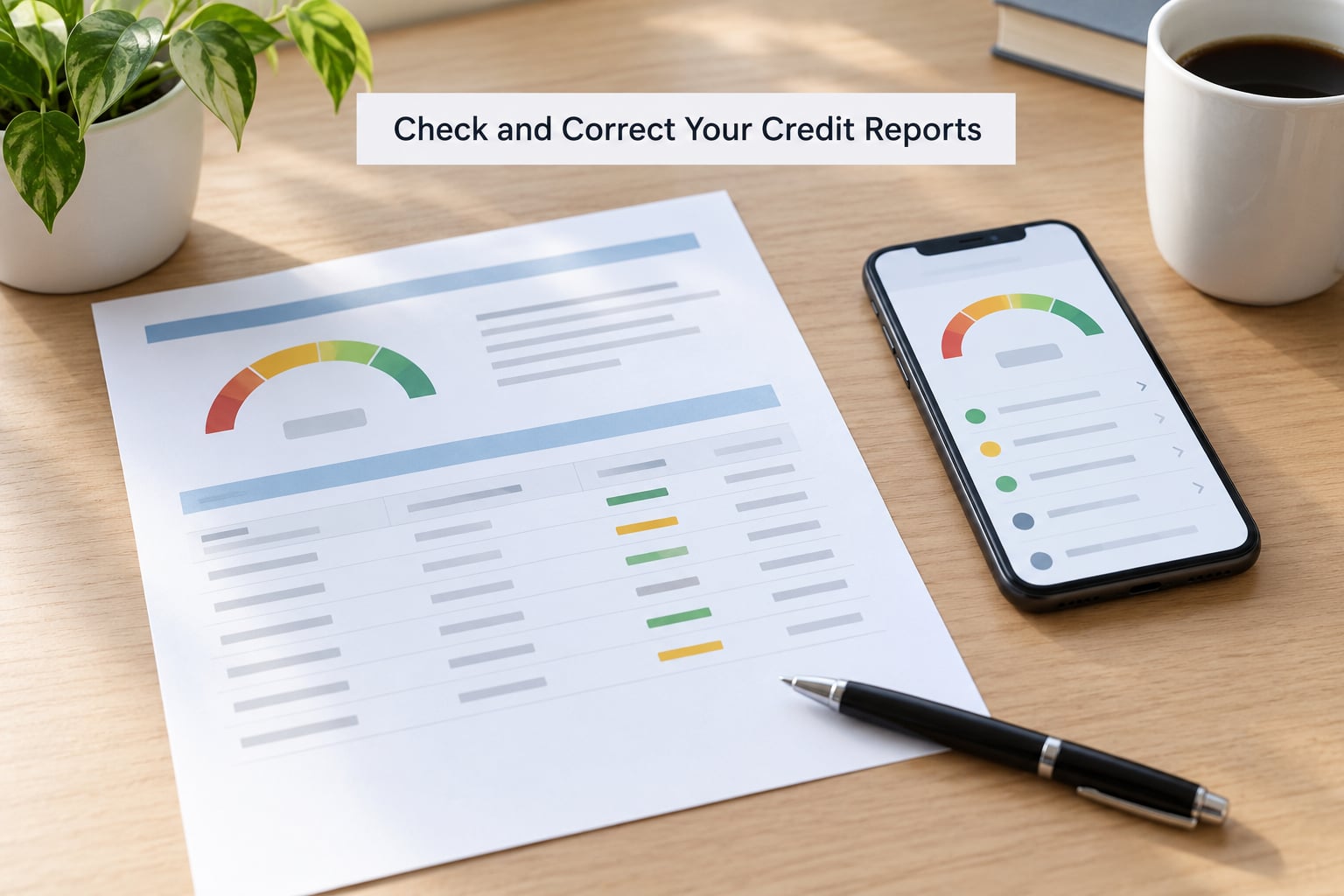
Most score damage that people blame on bad luck is actually a reporting error. Duplicate accounts, collections attached to the wrong person, obsolete balances that should have fallen off, accounts listed as delinquent after you paid them, and wrong addresses or employer names all happen more often than the bureaus admit.
Download all three reports and compare them line by line. Mark anything that is wrong, unknown, or belongs to someone else.
- Find the address on the report itself. Each bureau lists a dispute address for the specific credit report you pulled. Use the address on your copy, not a general customer service address.
- Write one letter per bureau per error. Keep it short. Name the account, state that it is inaccurate, explain why, and ask for a reinvestigation. Include your name, address, date of birth, and the last four digits of the account in question so the bureau can match you without asking questions.
- Attach proof. A copy of a paid receipt, a settlement letter, a court filing, or a police report strengthens the dispute. Send copies and keep the originals.
- Send it certified mail. The Federal Fair Credit Reporting Act gives the bureau 30 days from receipt to investigate and respond. Keep the certified receipt and the copy you mailed.
- Follow up. If the deadline passes without a proper written response, escalate to the bureau’s consumer dispute department, then to the Consumer Financial Protection Bureau or your state attorney general.
One warning about identity theft. If someone opened accounts in your name, file an identity theft report at IdentityTheft.gov first. A fraud affidavit creates documentation that makes the bureau disputes much easier.
For a collection you do not recognize, ask the collection agency for proof of validation. Under the Fair Debt Collection Practices Act, they must show you documentation. If they cannot, send a dispute and a cease-and-desist letter.
Bring Balances and Credit Utilization Down
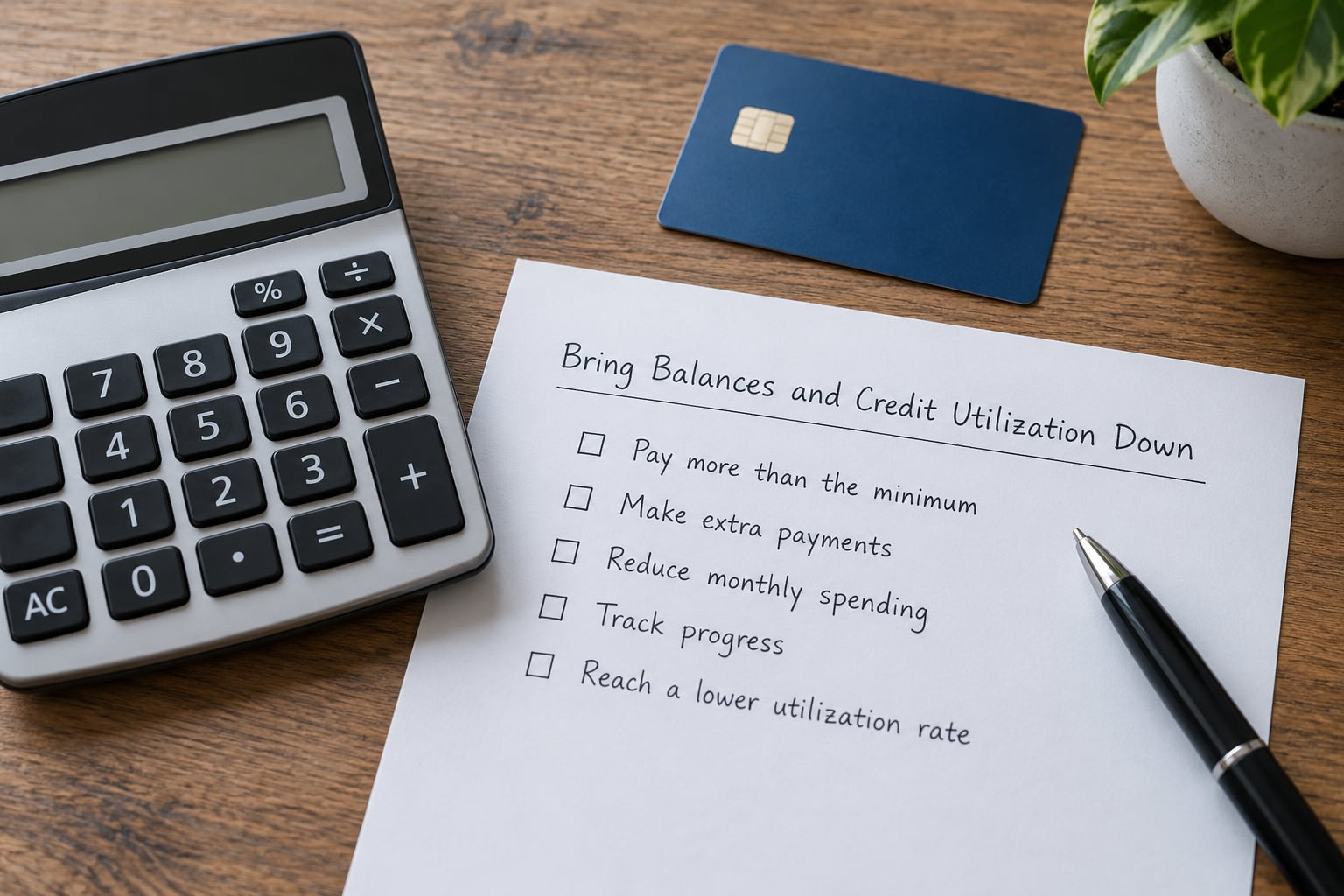
Credit utilization is the second heaviest factor and the one you can change fastest. It is the share of your available revolving credit that you are using. Scores generally react to the balance your card reports to the bureau, which is the balance on your statement closing date.
Here is the math. If you have one card with a 6,000 limit and a 5,000 balance, that card reports about 83% utilization. If you pay it down to 500 before the closing date, the same card reports about 8%. No credit history change, no new account, no payment made on time differently. Just the number the bureau sees.
Two rules matter more than the rest:
- Per-card utilization counts. A single maxed card hurts even when your overall ratio looks fine. Spread balances across cards so no single one goes much above 30%.
- Total utilization matters too. Add every revolving balance, add every revolving limit, and divide. Under 30% is the common guideline for lenders, and under 10% is where scores usually stop climbing.
For balances above that, order your payoff by rate, not by balance alone. Highest interest first costs the least money overall. If two rates are close, the highest balance first frees up credit lines sooner, which helps your ratio drop faster.
Paying early in the cycle helps. A balance paid in full before the closing date is often reported as zero or near zero. Experian has noted that for some profiles a small balance of about 1% scores slightly better than a true 0%, since a reported balance shows an active revolving account. It is a small effect and it varies by model.
If you cannot cut enough, ask your issuer for a credit limit increase. Many issuers process a request through a soft pull that does not appear on your report. Before you request one, compare the requested limit against your income and existing balances so the new ratio is defensible. Requesting an increase on a maxed card is a wasted move.
The community method called AZEO, all zero except one, means paying every card to zero except a single card that keeps a small balance. It works as a short-term bridge before a mortgage or rental application, not as a permanent strategy. Running AZEO across every card for months can leave you with no revolving accounts reporting activity.
Make Every Payment On Time
Payment history carries the largest weight in the standard FICO model, roughly 35%. The reason the number is so large is that lenders see it as a direct promise about future behavior.
One missed payment is not fatal. A 30-day late is a minor ding, a 60-day late is more serious, and a 90-day late or a charge-off can follow you for about seven years. What hurts most is the pattern, not the single event.
Set up autopay for the minimum on every account, then schedule an extra manual payment each month to whatever the payoff plan calls for. Minimum autopay protects the history. The extra payment moves the balance that the statement closing date reports.
Watch for the trap that catches people who always pay on time. If you pay every month but your card auto-posts on the 14th and you always pay on the 3rd, the statement shows whatever balance was sitting on the 14th. You were on time and still reported high utilization.
Late payments stay on your report for seven years. Collection accounts typically stay for seven years from the first delinquency on the original account. Pay-and-delete agreements, where a collector agrees to remove the account after payment, are common for older balances. Whether a collector can legally delete depends on the age of the debt and the state you live in, so ask in writing before you pay.
Use a Sensible Credit Card Strategy
Card habits move scores indirectly, mostly through utilization and account age.
- Keep your oldest card open. Length of credit history is roughly 15% of the FICO score. Closing the card you have had the longest removes the account that anchors it, and it usually lowers the score immediately. You can ask an issuer to close the account without affecting your credit, but the effect is the same.
- Do not close a card you just paid off. This is a common and costly reflex. The available credit disappears, your total ratio spikes, and people report the drop in surprise. Keep the card open, or request a limit increase on another card first.
- Avoid new applications in bulk. Multiple hard inquiries for cards in a short window read as a sign of trouble. New credit is about 10% of the score, and applying adds nothing while your utilization is high.
- Consider a secured card when approval is hard. You put down a deposit that becomes your credit limit, you get a real revolving account reporting to the bureaus, and you treat it as a training account. Six to twelve months of on-time payments on a secured card can build the history that a thin file lacks.
- Add installment credit only if you can afford it. Credit mix matters. Holding an auto loan or student loan alongside one credit card tends to help. Opening a second loan purely for the mix is not a good trade.
- Balance transfers can buy breathing room. Moving a high-rate card balance to a lower-rate card lowers interest and, if the transfer limit counts toward your limits, can improve your ratio. Watch the fee and the timeline. A balance transfer is not a payoff.
Build a Stronger Credit Profile Over Time
Some parts of a score cannot be rushed. Length of credit history, credit mix, and new credit respond to time and to a small number of careful decisions.
| FICO factor | Approximate weight | What moves it |
|---|---|---|
| Payment history | 35% | Autopay on every account |
| Amounts owed (utilization) | 30% | Lower reported balances |
| Length of credit history | 15% | Time. No shortcut |
| Credit mix | 10% | Revolving plus installment credit |
| New credit | 10% | Few recent hard inquiries |
Most free scores you see online are not the score a mortgage lender pulls. Mortgage lenders generally use older FICO models, while auto lenders increasingly use FICO 10 T or VantageScore 4.0, which weight your most recent behavior more heavily. That is why a score can climb on one and stall on another. Read the model, not just the number.
Realistic timelines, by where you start and what is wrong:
| Starting score | Typical situation | Realistic window to gain 100 points |
|---|---|---|
| Under 550 | Collections, charge-offs, high utilization | 12 to 24 months, partly dependent on error removals |
| 550 to 620 | Thin file, high utilization | 6 to 12 months |
| 620 to 680 | Utilization around 30%, one late mark | 4 to 9 months |
| 680 to 740 | Aged file, moderately high balances | 6 to 12 months |
| Over 740 | High balance on an old card | Often under 60 days once utilization drops |
Report the biggest percentage improvement and someone starting at 500 may never reach 700, while someone starting at 700 with a maxed card can pass it in a month. Ranges, not promises, are the only honest way to describe it.
What a 100-point gain is worth depends on where you land. Lenders price by band, so moving from the low 600s into the 700s can change the offers you see on a mortgage or auto loan far more than another 100 points on top of an already high score. Rates and thresholds shift with market conditions, so check current terms where you apply.
Common Mistakes
Most lost ground comes from well-intentioned moves. Here are the ones that come up again and again, with the fix.
- Closing several cards to remove balances. You cut total credit instead of total balance, and the ratio gets worse. Fix: keep the cards open and pay the balances down instead.
- Paying off collections and then not asking about removal. Money leaves your account and the negative mark stays. Fix: request a pay-and-delete agreement in writing before sending payment.
- Paying a credit repair company upfront for “guaranteed” results. Legitimate repair companies do not charge before the work and cannot remove accurate information. Fix: use the bureau dispute process yourself, which is free, and check whether a company is registered with the CFPB.
- Opening three cards in a month to chase a bonus. Multiple hard inquiries and new accounts land in the same quarter. Fix: one application at a time, spaced out, and only when your utilization is already under 20%.
- Checking the score daily. Checking your own report is a soft pull and does not hurt you, but anxiety makes people change strategy every week. Fix: check once a month on a fixed date, or set up free alerts and stop looking.
- Ignoring the statement closing date. You pay in full every month and the balance still shows high. Fix: pay before the closing date, not before the due date.
- Paying a collection that is past the statute of limitations without checking first. Paying can restart a clock in some states. Fix: confirm the law where you live before you send money.
Frequently Asked Questions
Is it realistic to raise a credit score by 100 points?
Yes for most people, but the timeline depends on the cause. Removing inaccurate accounts or cutting card utilization from 50% to under 10% can move a score 40 to 100 points within one or two reporting cycles. A thin file with no late payments is slower, usually six to twelve months. Nobody can promise a specific result, because each credit file is different.
What is the fastest way to improve a low credit score?
Pay down balances on the cards you are using hardest and ask the issuers for higher limits at the same time. Utilization carries about 30% of the weight in the FICO model and updates every month. Errors come close behind, because a removed collection or a corrected delinquency can shift a score far more than another month of good behavior.
Should I pay off collections or close old credit cards?
Do both the opposite way most people assume. Pay the collections, ask in writing about a pay-and-delete agreement, and keep the old cards open. Closing an old card removes part of your credit history and can raise your utilization at the same time, which usually lowers the score. If you must close one, close a recent card with a low limit instead.
How long does it take to raise a credit score by 100 points?
If utilization is high or your reports contain errors, 30 to 60 days is realistic because balances report monthly. Otherwise six to twelve months is a fair expectation. Starting near 500 with collections on file takes longer than starting near 700 with one maxed card, which can clear a 100-point gap after a single payment.
Does paying off one credit card raise your score immediately?
Not instantly. Card issuers report to the bureaus monthly, so a payment shows up at your next statement closing date, then again when the bureau updates your file. Paying in full before the closing date can lower reported utilization on that next refresh. Closing the same card right after paying usually cancels the benefit and pushes your ratio back up.
Can I raise my credit score without opening a new account?
Yes. Most of the work is paying down existing balances, disputing errors, requesting limit increases on cards you already hold, and setting up autopay. New accounts only help when your file is thin, which is why a secured card is a common choice for rebuilding credit from a low score with limited history.
Where to Start This Week
Pull your three reports from AnnualCreditReport.com and mark anything that looks wrong. Then look at one number: the share of your available credit you are using, and the balance that appears on your last statement closing date. Fix an error or cut that balance before you do anything else, because those two moves account for most of the ground between a mediocre score and how to raise your credit score 100 points with real results.