
Big projects rarely get delayed because you lack drive. They stall because the work has no visible beginning, the next step is unclear, and the whole thing feels too big to hold in your head for one sitting. If you learn how to stop procrastinating on big projects, the fix is a system, not a pep talk: define the finish line, cut the project into deliverables small enough to finish in a single work session, then protect time on your calendar to produce them. Most people see motion inside a week.
Below is the plan I would hand someone on day one. It takes about two hours to set up properly, and the setup is what makes the hard part easier.
Table of Contents
- What You Need
- Step-by-Step: How to Stop Procrastinating on Big Projects
- 1. Identify What the Finished Project Requires
- 2. Separate the Project Into Deliverables You Can Finish in One Sitting
- 3. Find the Emotional Reason You Are Avoiding the Work
- 4. Make the First Step Physically Easy: How to Stop Procrastinating on Big Projects
- 5. Block Time and Protect the First Session
- 6. Work in Focused Sprints With Short Breaks
- 7. Track Visible Progress and Reward Completion
- 8. Review the Project at the End of Each Week
- Common Mistakes
- Waiting for motivation to arrive first
- Planning the entire project before starting
- Working without a deadline
- Setting the scope too large
- Multitasking your “project time”
- Checking progress constantly
- Abandoning the plan after one missed session
- Frequently Asked Questions
- What is the 5 4 3 2 1 rule for procrastination?
- What is the 321 rule for procrastination?
- Is procrastination a form of ADHD?
- What is ADHD procrastination like?
- Why do I procrastinate on things I really want to do?
- Start With One Small, Visible Action
What You Need
You need five things before you start, and none of them cost money or require special software. A pen and a notebook work as well as any app, honestly.
- A defined final result. One sentence describing what exists at the end and what a stranger could check to confirm it.
- A real deadline. A date with a consequence attached, shared with at least one other person so it cannot drift quietly.
- A task list broken into single-session items. Anything requiring more than one sitting is split further.
- A work setting that resists distraction. A specific place, a specific start time, notifications silenced.
- A simple progress record. A checklist, a page of crossed-off lines, a spreadsheet. Paper is fine.
Here is what that looks like in practice. “Launch my business website” is not a project; it is a wish with a verb in it. Rewrite it as “the site is live at my domain by March 14, with a homepage, four service pages, a contact form that sends email, and two written case studies.” That version has a finish line you can point at. From there, the task list writes itself: gather logo files, write homepage headline and subhead, draft one service page, photograph and caption two case studies, build and test the contact form, publish, test every page on a phone, announce it.
Every item on that list is roughly one sitting. That is the entire trick. Your brain can hold twenty minutes of work in front of it. It cannot hold a website.
Step-by-Step: How to Stop Procrastinating on Big Projects
Eight steps, in order. Do them once and you have a running system for every large project that comes after this one.
1. Identify What the Finished Project Requires
Write one sentence starting with “Done means”. Done means the proposal is sent to all three directors. Done means the kitchen has new counters, a mounted sink and a working dishwasher. Done means the course has six published modules with video in each one. The test is whether a stranger could look at the result and agree it is finished, without asking you a single clarifying question.
Time: 15 minutes. How you know it worked: you could hand that sentence to someone else and they would know when to congratulate you.
If you cannot write the sentence, you do not have a project yet. You have a topic. Go find the deliverable first.
2. Separate the Project Into Deliverables You Can Finish in One Sitting
Divide the project into phases, then cut each phase until every piece fits inside a single focused session, roughly 30 to 90 minutes. Anything that does not fit gets cut again. “Write the introduction” becomes “write a 150-word intro in one sitting, badly, just to get words on the page.” “Build the app” becomes “make the sign-up screen work with fake data.”
Watch for the oversized item that hides inside your list. If a task needs three people, three tools and a decision nobody has made, it is not a task yet. It is a decision wearing a task’s clothes. Put the decision at the top of the list and handle it first, because everything after it depends on it.
Time: 30 to 45 minutes. How you know it worked: you can look at any single line and estimate how long it takes. If a line makes you shrug, cut it.
3. Find the Emotional Reason You Are Avoiding the Work
The cause matters, because each one needs a different response. Take the project you keep postponing and ask why. Be specific, not vague.
- It is too big to picture. Fix: do step 2 again, then work only on the smallest piece for one sitting.
- You dislike the work itself. The writing, the admin, the awkward call. Fix: shrink the rep, or pair it with something you enjoy using the same way temptation bundling suggests.
- You are afraid of how it will turn out. Perfectionism and fear of judgement. Fix: set an explicit quality floor for a first draft, write it badly on purpose, and stop rereading earlier sentences.
- You do not know enough yet. Fix: make “research this” a real deliverable with a time limit, so learning becomes a task rather than a precondition.
- Competing responsibilities. Fix: shrink the plan honestly. A smaller project finished this month beats the same project never scheduled.
Say the reason out loud once. Wording like “I want to procrastinate because if I start and it is not good enough, that proves something about me” takes the vague dread and pins it to a sentence, and a sentence is far easier to argue with than a fog. That step costs nothing and takes ten seconds, and for most people it is the one that loosens the whole knot.
Time: 15 minutes. How you know it worked: you can name the specific emotion, not just “I don’t feel like it.”
4. Make the First Step Physically Easy: How to Stop Procrastinating on Big Projects
Design a first action that takes 10 to 20 minutes and cannot really fail. Open the document and type a heading. Gather the five folders you need into one place. Draft a rough version of the opening 200 words, knowing you will rewrite it later. Buy the one supply you need so tomorrow has no excuse.
This works because starting has a fixed cost, and on a big project that cost feels enormous. Call it activation energy: the effort required to begin, not to finish. Ten minutes of low-stakes opening work costs far less than the imagined weight of the whole thing, and once you are in motion, continuing costs much less than starting did.
A pattern worth noticing: a lot of us clear every easy small task first, which feels productive all day while the hard project stays exactly where it was. Choosing the small physical action deliberately reverses that.
Time: 20 minutes to design it. How you know it worked: you can do it today without deciding anything.
5. Block Time and Protect the First Session
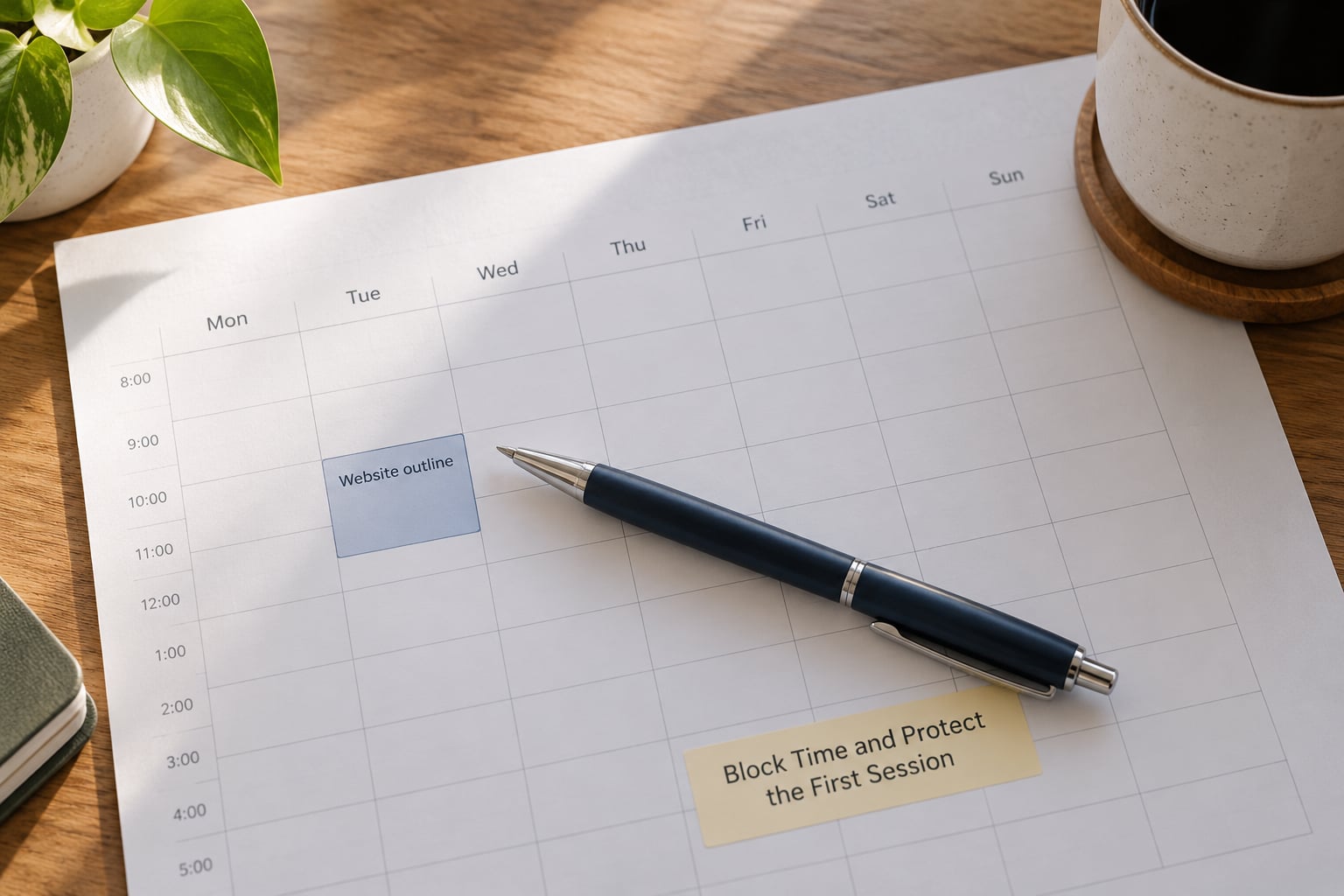
Put the first session on your calendar with a start time and an end time. Not “Tuesday afternoon”, a time. Unfussy example for someone with a full-time job and evening family duties: Tuesday 8:15 to 9:00 for the outline, Thursday 8:15 to 9:00 for the first draft section, Sunday 10:00 to 11:30 for the bulk writing. Nobody gets more time than that, so the plan is built on the hours you actually have.
Then decide what gets removed. One hard call and a personal number are two separate people in many homes, so before you sit down, put the phone in another room and use a paper timer you cannot check messages on. Interruption handling is the part most plans skip: decide in advance that if something interrupts you, you write the interruption on a sheet of paper and return to the current task rather than abandoning the session.
Time: 20 minutes. How you know it worked: the block exists in your calendar and you have told one other person you will use it.
6. Work in Focused Sprints With Short Breaks
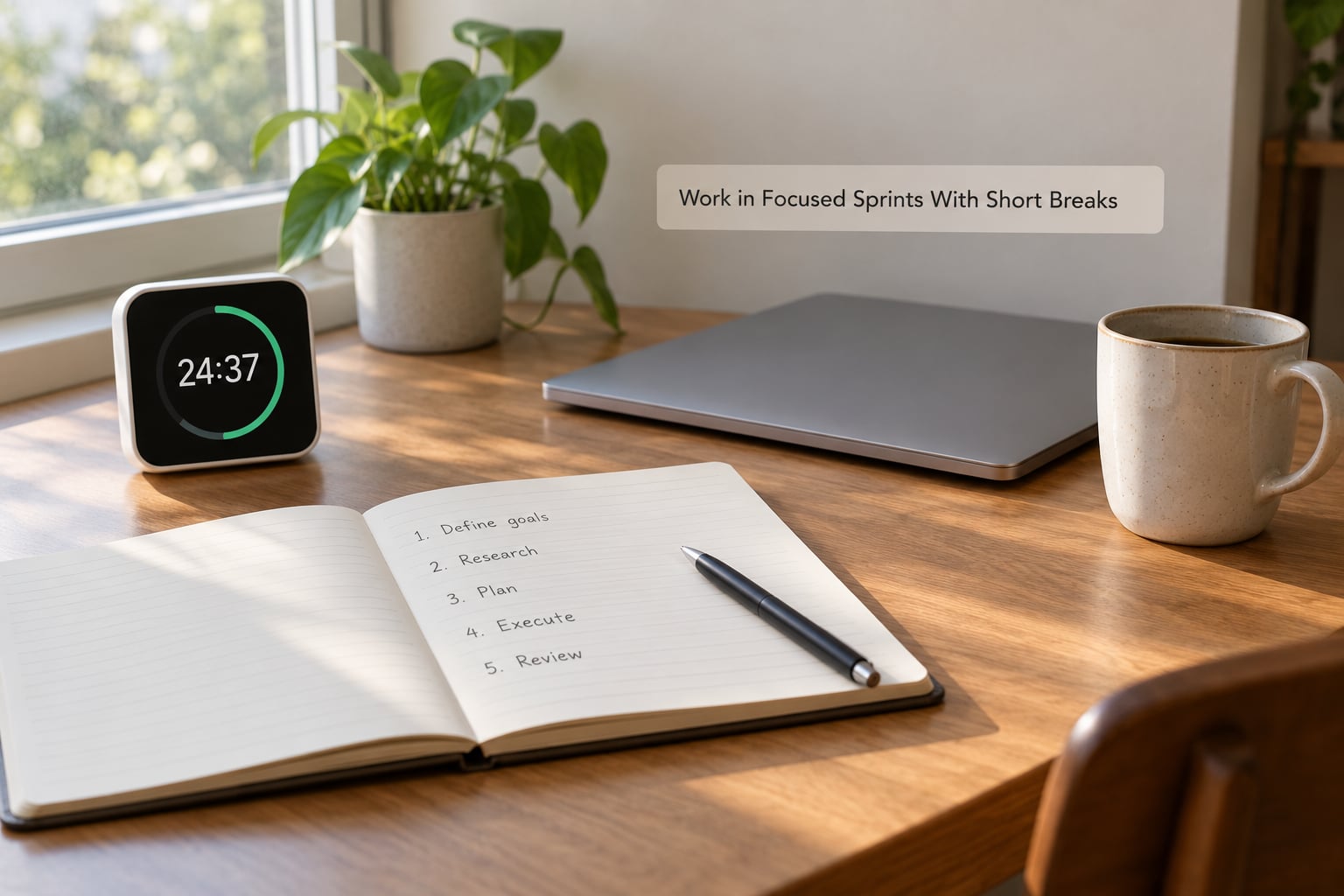
Run 45 minutes of work, then take 10. Some people do better at 25. The number matters far less than having a number, because the timer removes the decision of when to stop, and that decision is the one you keep making badly.
At the end of a sprint, write down where you stopped in one line. That line is how you restart in four minutes instead of reconstructing your whole train of thought the night before. Anyone who has lost a half-finished afternoon to “which part was I on” knows what that costs.
When a distraction pulls you away mid-sprint, do not restart from zero and do not write the session off. Stand up, drink some water, and re-read the single line you wrote at the end of the last sprint. Picking a thread back up is a skill, and it is far cheaper to learn than a full fresh start.
Time: 45 minutes plus a break. How you know it worked: you have one line on paper saying what happens next.
7. Track Visible Progress and Reward Completion
Tick items off as they finish, in ink, where you will see them. Keep the deadlines you hit, not just the ones you missed. Visible evidence of progress does real work on a large project, because it replaces the vague feeling that nothing is moving with a countable list that says otherwise.
Attach a small reward to each milestone, chosen by you and not requiring new purchases: your favourite coffee after the outline, an hour of something guilt-free on Saturday once the first draft is done, calling someone you enjoy when a phase closes. The reward has to arrive soon after the work, or it teaches you nothing. People who struggle with attention often need that kind of external hook more than willpower, and the principle holds well beyond ADHD.
Time: 10 minutes to set up. How you know it worked: your list has visible marks on it and at least one reward you would genuinely enjoy.
8. Review the Project at the End of Each Week
Block 20 minutes on a Friday or Sunday for four questions: what got finished, what is still open, what is blocked, and what is the single next action. Then check your deadline against real progress. If the two do not match, change the scope rather than the effort. Cut a feature, narrow the audience, publish a smaller version. A reduced project that ships teaches you more than an ambitious one that never leaves your notes app.
This weekly check is also what catches the guilt loop. A very common pattern is waiting until the deadline, rushing, and having the rushed version turn out fine, which teaches the brain that procrastination works. It works until the one project where it does not, and the cost is the whole deadline. Reviewing weekly turns that hidden pattern into a decision you make on purpose.
Stalled projects get the same treatment. Do not restart from the beginning. Open the last file you touched, read your own end-of-session line, and make the next deliverable 20 minutes of work.
Time: 20 minutes weekly. How you know it worked: your next action is specific enough to start tonight.
Common Mistakes
Nearly every stalled project I have come across shares one of these patterns.
Waiting for motivation to arrive first
Motivation tends to show up once the work is already moving, not before. Fix: schedule the session first, and let the feeling catch up to you mid-sprint.
Planning the entire project before starting
Building a complete plan feels like progress, so it substitutes for it. Fix: cap planning at 45 minutes, then move to the smallest deliverable.
Working without a deadline
An open-ended project has no finish to aim at, so urgency never arrives. Fix: pick a date and tell someone, or pay a small forfeit if you miss it.
Setting the scope too large
Setting an ambitious target and then missing it teaches you that plans are unreliable. Fix: aim at something you would be embarrassed to be surprised by finishing early.
Multitasking your “project time”
Doing three things badly produces none of them. Fix: one deliverable per sprint, and note the other two for later.
Checking progress constantly
Opening the file twenty times a day produces the feeling of working without the output of working. Fix: check your list on a schedule, not on a whim.
Abandoning the plan after one missed session
One missed session is normal. Treating it as failure is how a project dies. Fix: never miss the same day twice, and make the restart action 20 minutes.
Two implementation tips tie it together. Write your sessions into the calendar as real appointments with an end time, and keep a standing 45-minute block for your project until the project ends. And if your avoidance has lasted months, or shows up on every project including ones you love, consider talking to a therapist or your doctor. Procrastination is usually a scheduling problem, but it can also sit alongside depression, anxiety or ADHD, and a professional can tell you which one you are dealing with.
Frequently Asked Questions
What is the 5 4 3 2 1 rule for procrastination?
The 5-4-3-2-1 rule is a starting countdown. You count down out loud from five to one, and when you reach one you begin the smallest physical action on your project immediately, with no second decision in between. The count takes roughly ten seconds, which is short enough that it stops feeling like a negotiation. It works because it replaces the question whether to start with a fixed, pre-decided answer.
What is the 321 rule for procrastination?
The 3-2-1 rule is the short version of the same idea: count down from three to one and start on one. Where the 5-4-3-2-1 countdown gives you more runway to build momentum, the 3-2-1 version is designed for tasks where you keep walking past. Both work only when the action you start is tiny and defined beforehand.
Is procrastination a form of ADHD?
No. Procrastination is not itself a symptom of ADHD, but ADHD makes it far more likely. The reasons overlap heavily: difficulty starting tasks with unclear next steps, working only when a deadline arrives, drifting into easier or more stimulating work, and losing track of how long something has taken. If avoiding tasks has been a pattern for you since childhood and it shows up across school, work and home, it is worth asking your doctor for an assessment.
What is ADHD procrastination like?
It usually looks like near-total avoidance of dull or unclear tasks alongside intense focus on novel ones. You may be productive all day on work that is new and interesting while an unpaid invoice sits untouched for a month. Time blindness means the deadline feels abstract, and switching between tasks leaves each one unfinished. Many people say they need external structure, body doubling and interest-based framing, because effort alone rarely moves it.
Why do I procrastinate on things I really want to do?
Wanting the outcome and starting the work are separate systems. On a big project the first days have no visible payoff, the next step is unclear, and the task feels oversized, so a quick, easy substitute delivers a small reward immediately. That is task aversiveness meeting present bias, and it says nothing about how much you want the result. The fix is structural: shrink the next action until it takes under twenty minutes.
Start With One Small, Visible Action
Knowing how to stop procrastinating on big projects comes down to three moves you can complete today. Write your one “Done means” sentence. Pick the smallest deliverable that moves it forward and design a 20-minute version of that first action. Then put a start and an end time on your calendar and tell somebody about it.
Willpower is not the missing ingredient. A finish line, a task list and a protected hour are.