
You cannot change the relative. What you can change is how long you are around them, what you say when the comments start, and who is standing next to you when it gets bad. Most people who dread the holidays are not trying to win an argument, they are trying to get through a long afternoon without a blow-up at the end of it.
This plan covers the three levers that actually move the needle: reducing exposure, rehearsing your words, and deciding your exit before you walk in. It takes about 20 minutes to prepare and works whether you are hosting, dropping in for dinner, or staying three days. Most of what it takes to learn how to handle holiday stress with difficult relatives gets decided in the week before, not during the argument.
Table of Contents
- What You Need
- How to Handle Holiday Stress With Difficult Relatives Step by Step
- 1. Decide whether to go at all
- 2. Name your one boundary
- 3. Set a time limit and tell someone
- 4. Arrive already in neutral mode
- 5. Use your prepared phrases instead of defending yourself
- 6. Take your break the moment you need one
- 7. Leave on schedule, without a scene
- 8. Decompress on purpose afterwards
- Set Your Intention and Boundary Before the Gathering
- Prepare Neutral Phrases for Common Tensions
- Give Yourself Permission to Pause
- Have an Exit Plan You Can Use Without a Dramatic Confrontation
- Common Mistakes
- Frequently Asked Questions
- How can I leave a holiday gathering early without starting a fight?
- What should I say when a relative comments about my appearance or life choices?
- How do I handle a difficult relative who refuses to respect boundaries?
- Should I argue with a family member who is trying to upset me during the holidays?
- How can I manage holiday stress when I cannot avoid the family gathering?
- What can I do after a tense holiday visit to calm down emotionally?
- Conclusion
What You Need
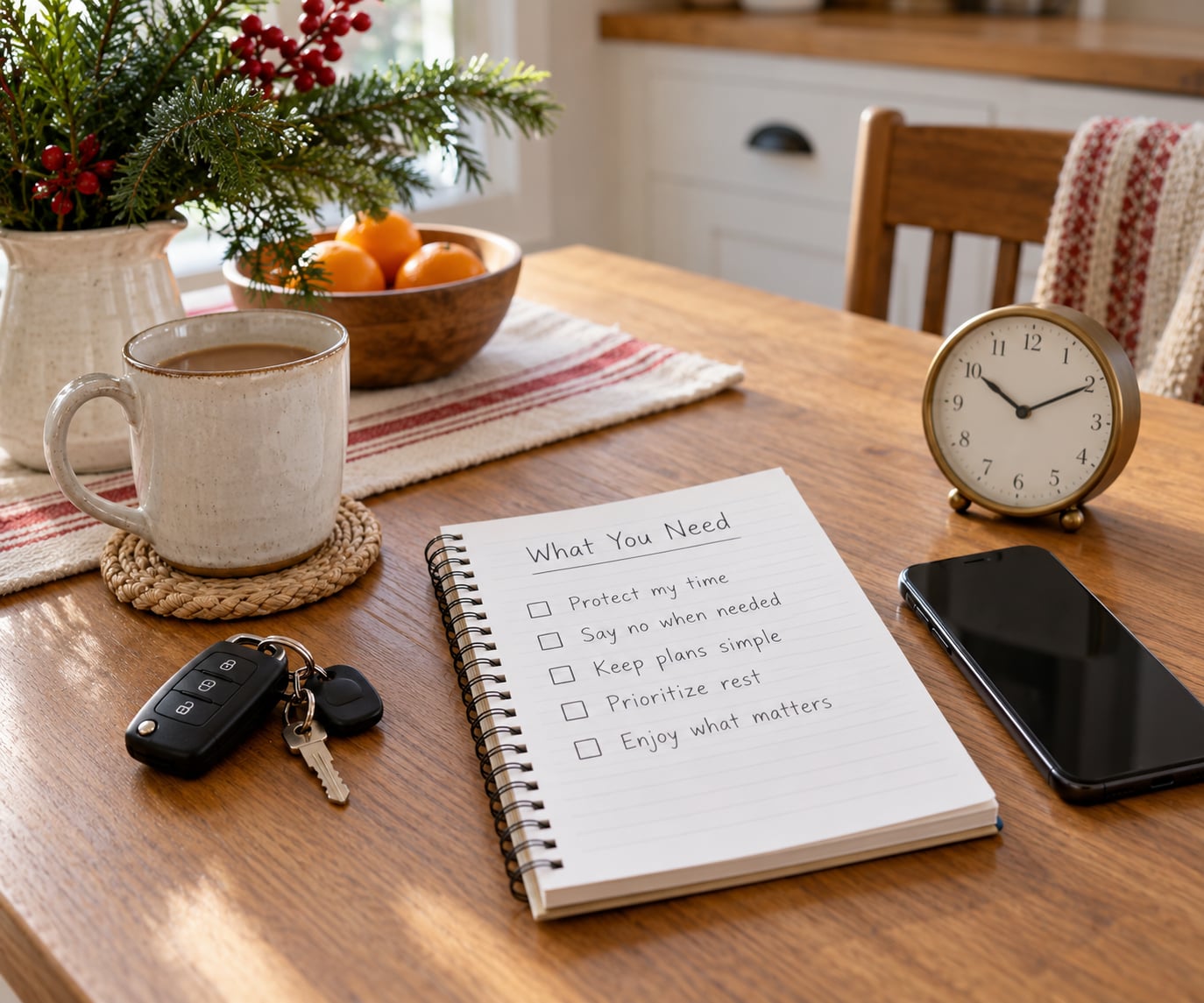
Preparation is what makes the difference between a tense afternoon and a ruined one. Most people arrive with nothing but good intentions, then improvise under pressure.
- A support person. One person who knows the plan, is not easily rattled, and will back you up if a comment lands badly. A sibling works better than a partner when the difficult person is your parent.
- Your own transport. Driving yourself means leaving is a logistics decision, not a negotiation.
- A planned exit. Decide the exact moment you are leaving before you leave. Put your coat by the door and your keys in your pocket at the start, not the end.
- A built-in reason. A dog to walk, a cake to drop off, a train to catch, an early start the next morning. A reason removes the need to announce anything.
- One grounding tool. Slow breathing, cold water on your wrists, or five named things you can see. Pick one now so you are not choosing mid-argument.
- Three or four short phrases. Written on your phone, not left to memory. You will not invent good wording under stress, and you do not have to.
How to Handle Holiday Stress With Difficult Relatives Step by Step
1. Decide whether to go at all
Before the date arrives, honestly answer one question: will this visit leave me worse off than not going? There is no correct answer here. Some people genuinely enjoy these gatherings and are the family glue, and for them going is right. Other people spend three weeks recovering from four hours, and skipping is the wise call.
2. Name your one boundary
Pick a single behavior you will not tolerate, and decide in advance what you do if it happens. One boundary that you hold is worth more than a page of rules you abandon. Most predictable blow-ups fall into familiar categories: comments about your body, your kids, your money, your relationship status, your drinking, or your choices.
3. Set a time limit and tell someone
Decide when you are leaving and who is holding you to it. Saying the time out loud to your support person is what makes it stick. A visit you decided to end at 4pm is a very different afternoon from an open-ended one.
4. Arrive already in neutral mode
The first ten minutes set the tone. Put your coat away, get a drink, sit near people you like, and put your phone on silent but visible. Do not wait to be handed to the difficult person; position yourself where you want the conversation to start.
5. Use your prepared phrases instead of defending yourself
Defending yourself is what opens the second round. Short, calm, non-arguing lines close it. Let a comment land, pause, then move to food, kids, a recipe, or the weather. The people who handle these gatherings best are not the most articulate, they are the least provoked.
6. Take your break the moment you need one
Do not wait for the fight. If your jaw tightens, your hands get hot, or you start rehearsing comebacks in your head, you are already activated. Move to the kitchen, the car, the bathroom with your phone, or step outside. Ten quiet minutes will do more than an hour of white-knuckle smiling.
7. Leave on schedule, without a scene
Use your reason, thank the host specifically, and go. Do not announce that you are fed up, do not deliver a verdict in the doorway, and do not explain more than one sentence. Quiet exits create far less drama than dramatic ones.
8. Decompress on purpose afterwards
Plan the ride home, the walk, or the call with your support person before you arrive. The comedown after a tense holiday is real and it hits harder when you go straight back to a full house. Give yourself an empty evening with nothing to be grateful for.
Set Your Intention and Boundary Before the Gathering
A boundary is a decision about your own behavior, not a demand about someone else’s. “I will not discuss my weight” is a boundary. “You will stop commenting on my weight” is an ultimatum, and ultimatums turn into fights.
Write your intention in one sentence before the visit. Mine is usually something plain like: I am going for the meal and the kids opening presents, I am leaving at four, and I am not taking the bait twice. Clarity here is what makes the rest survivable.
Then pick the one behavior that would genuinely end your good mood, and pre-decide the consequence. If it happens, you step outside. If it happens again, you leave. Deciding now removes the need to make a hard call while you are activated.
Say your boundary out loud to your support person before the day. Out loud matters, because a boundary nobody hears is only a thought.
Prepare Neutral Phrases for Common Tensions
Write these down now. Under stress, people default to sarcasm or silence, and both cost you more than a plain sentence.
Comments about your appearance or weight. “Thanks, that is nice of you to notice” or simply “Have you tried the potatoes yet?” Then move on. Do not confirm, deny, or joke. Any of those gives them an opening.
Criticism of your parenting. “That is one way to do it” or “He is doing fine, thanks.” Defending your kids to a critic turns you into the subject of the room. Short, unbothered, and moved on.
Money, gifts or borrowing. “That is not something I can help with this year.” No reasons, no apology, no softening story. A request with a clear no attached does not need a paragraph.
Your relationship status. “We are doing great, thanks. Where is the salt?”
Politics and religion. “We disagree on that one” or “I would rather not get into that.” Agreeing to disagree is not surrender, it is just an efficient exit.
Unsolicited advice about your life. “I hear you” said with a nod, followed by a subject change. You are not required to agree, and you are not required to debate.
The pattern across all of them: acknowledge, do not engage, redirect. If you also get the “you are being dramatic” or “that is just how family is” response, hold the same line. “Okay” and nothing more is a complete answer.
Give Yourself Permission to Pause
You are allowed to leave a conversation without ending it. Most people push through because leaving feels like a confession that they cannot cope, but it is simply a break.
Try this when the pressure rises: breathe out for longer than you breathe in, six times. Then name five things you can see in the room. It takes about sixty seconds and it is a genuine grounding technique, not a vague suggestion to relax more.
Decide before you leave whether you are coming back. If the person has settled, come back. If not, stay out. Coming back after twenty minutes of quiet is usually fine. Coming back into the same argument is not.
Have an Exit Plan You Can Use Without a Dramatic Confrontation
Length of exposure matters more than any single confrontation. Shortening the visit is consistently the change people say made the biggest difference. The same logic runs through the rest of how to handle holiday stress with difficult relatives: shorten the visit, prepare your words, and step out before you are activated.
Give yourself a job that creates exits. Offer to drive someone somewhere, be responsible for the dog, handle the early-morning run, or take the dishes. When the moment arrives, you are leaving to do the job, not fleeing a fight.
For longer visits, stay somewhere of your own. A hotel or a friend’s place twenty minutes away turns an exhausting evening into a manageable one, and it shortens the goodbye that usually causes the friction.
When you leave, thank one person specifically. A warm, narrow compliment, then out. Leaving well is what lets you come back next year without a lecture about your attitude.
Common Mistakes
Arguing for respect. Explaining that your comment was hurtful rarely changes the person and reliably costs you the afternoon. Fix: use one short line and change the subject.
Overexplaining your decisions. The more reasons you give, the more there is to argue with. Fix: one sentence, no justification.
Making your exit a dramatic statement. The longer goodbye speech you plan is a bigger invitation to escalate. Fix: no announcement, just your coat and the door.
Staying past the point of stress. White-knuckling the last two hours is what people replay afterwards. Fix: leave early enough that the memory is decent.
Expecting the difficult relative to change. They have behaved this way for years and they are not doing it because of your holiday dinner. Fix: manage your expectations, not their character.
Spending the whole visit worrying about the gathering instead of being in it. Pre-loading every possible worst case robs you of the good hour. Fix: preparation capped at 20 minutes, then let it go.
One more: if you are hosting, put your partner or a friend in charge of the kitchen so you are not the one cooking, hosting and absorbing every comment.
Frequently Asked Questions
How can I leave a holiday gathering early without starting a fight?
Give yourself a reason before you go. Offer to drive someone, walk the dog, or drop something off, then leave when the task is done. Thank the host specifically, say one warm sentence, and go without announcing that anyone upset you. Quiet exits get far less grief than dramatic ones.
What should I say when a relative comments about my appearance or life choices?
Acknowledge without engaging, then redirect. Try thanks, that is nice of you to notice, or simply, have you tried the potatoes yet. Do not confirm, deny, joke or defend yourself. Every opening you give is an invitation for round two. A short neutral line plus a subject change ends it fastest.
How do I handle a difficult relative who refuses to respect boundaries?
You cannot enforce a boundary on someone else, only on your own behavior. Decide what you will do if the comment happens and do that consistently. Most people get called dramatic once, then adjust. If the disrespect is ongoing and heavy, limiting or skipping the gathering is a legitimate response, not a failure.
Should I argue with a family member who is trying to upset me during the holidays?
No. Arguing rarely changes the person and reliably takes hours out of your day. You get far more by being boring. Short answers, no eye contact escalation, no jokes at their expense, and a steady redirect to neutral topics. Save your energy for the people you actually want to talk to.
How can I manage holiday stress when I cannot avoid the family gathering?
Reduce exposure and rehearse your words. Set a firm end time and tell someone what it is. Write three or four short phrases for the comments you expect. Sit near your ally, take a real break the moment you feel activated, and give yourself a built-in reason to leave. Shorter visits are the highest-leverage change.
What can I do after a tense holiday visit to calm down emotionally?
Plan the comedown in advance. Take the long route home, walk for twenty minutes, or call the one person who gets it. Do not debrief the whole argument with everyone, it keeps the loop running. Keep the next day deliberately empty, because post-holiday stress shows up hardest when you go straight back to a full schedule.
Conclusion
Start with one thing: pick your boundary, your support person and your exit before the day arrives. That single hour of preparation is what turns a long, tense visit into a manageable one, and it is the shortest reliable way to handle holiday stress with difficult relatives.
You are allowed to go, to leave early, or to stay home, and none of those choices makes you the difficult one in the family. Protecting your peace is worth more than winning every conversation at the table.
A note on scope: this is practical coaching guidance, not mental-health treatment. If holiday stress is affecting your sleep, your health or your relationships most days of the year, a licensed therapist or your doctor is a good next step. If you are in crisis, contact your local emergency number or a crisis line in your country.