
Raising a financially responsible teenager is mostly a matter of handing over small pieces of real money and letting your teen live with the results. Set clear family agreements, give them ownership of an actual budget, and add one new skill every few months instead of holding a single lecture about the dangers of debt. Most teens are ready to start around age 13, and by 18 they should be running their own banking, bills and monthly plan with light supervision.
This guide walks through that progression in seven steps, with a check for how you will know each one is working. Budget a couple of hours to set it up and a weekly slot that repeats for the next several years.
Table of Contents
- What You Need
- Step-by-Step: How to Raise a Financially Responsible Teen
- 1. Establish Family Money Expectations
- 2. Build a Simple Weekly Money Routine
- 3. Give the Teen Ownership of a Real Budget
- 4. Practice Earning, Saving, and Giving
- 5. Teach Needs, Wants, and Thoughtful Purchases
- 6. Introduce Interest, Credit, and Borrowing Safely
- 7. Prepare for Financial Independence
- Common Mistakes
- Frequently Asked Questions
- At what age should parents start teaching a teenager about money?
- Is it better to give teenagers an allowance or encourage them to earn money?
- Should a teenager have a debit card, credit card, or both?
- How much control should parents keep over a teenager’s spending?
- What should parents do when a teenager repeatedly overspends?
- Conclusion
What You Need
None of this requires a special program or a specific product. You need a few things, and most families already have some of them.
- A written set of family money agreements. Half a page is plenty: what the teen pays for, what the family covers, and what happens when the teen wants to borrow.
- Somewhere to track money. A notebook, a simple spreadsheet, or a budgeting app your teen actually chose. Ownership of the tool matters more than the tool.
- Real records. A recent pay stub, an actual phone bill, a bank statement with the fees printed on it. Fake numbers do not teach anything.
- A small starter amount. Enough for the teen to make choices with and lose a little over. The size of the pot matters far less than who decides how it is split.
Write the agreements down rather than repeating them during an argument. Rules that exist in writing can be reviewed calmly; rules that live only in your head turn every disagreement into a referendum.
Step-by-Step: How to Raise a Financially Responsible Teen
1. Establish Family Money Expectations
Start with one family meeting and a one-page document. Cover what the family covers, what your teen covers from their own money, and how borrowing works.
The borrowing rule is the one most parents skip, and skipping it causes the trouble later. My preferred version: nothing above a small set amount without a conversation, and nothing at all for anything that gets consumed. Clothes, food, entertainment and subscriptions come out of teen money. Phone protection, health coverage, a bed and a roof do not.
You know it worked when your teen can explain the rules back to you, including the reason for them. If they can argue with the rule using logic rather than volume, you did your job.
2. Build a Simple Weekly Money Routine
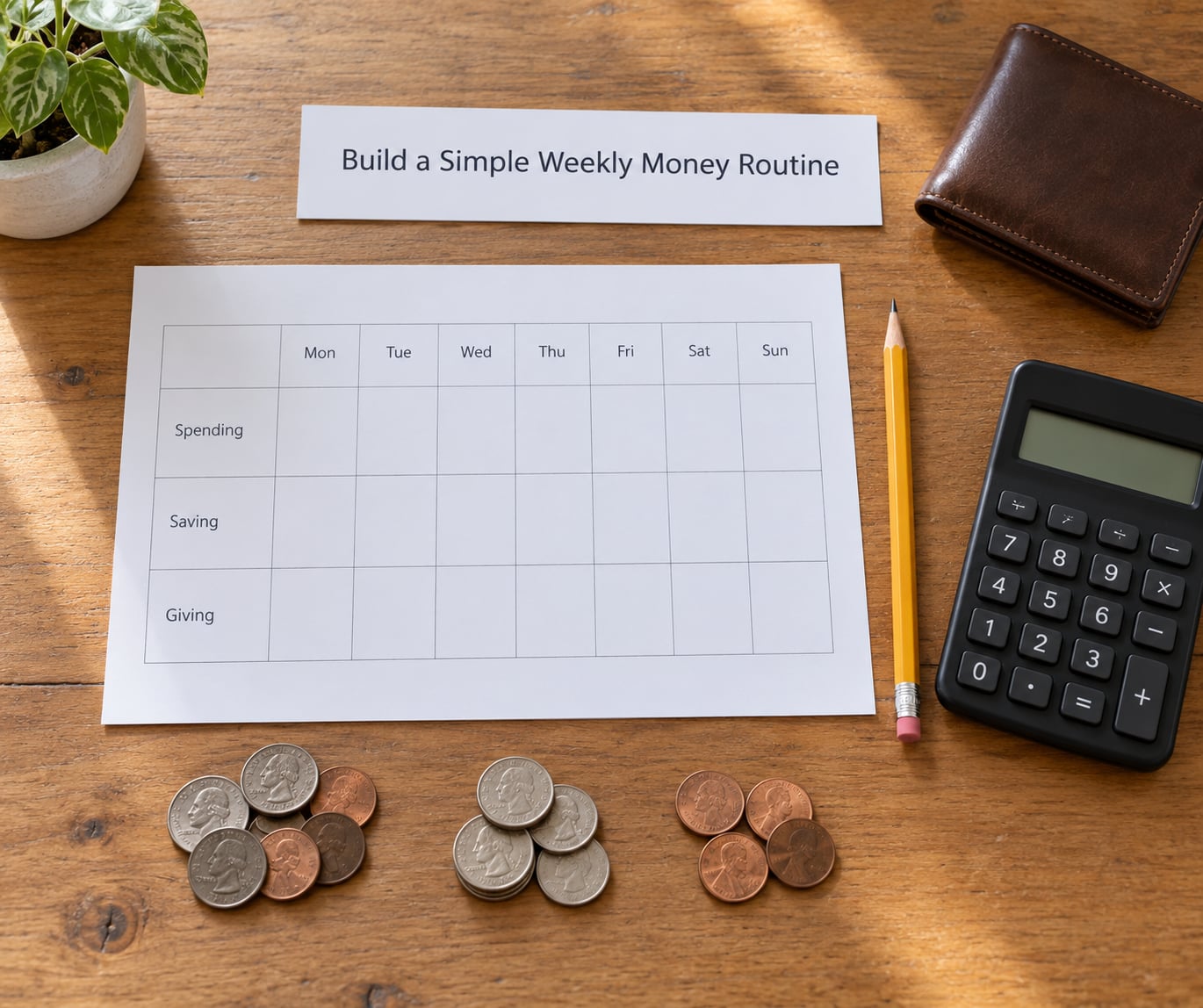
Pick a fixed 20 minutes and keep it there. Sunday evening after dinner works well for most families, because the week is still fresh and nothing has been spent yet.
The routine has four moves. First, write down everything that came in that week. Second, list what went out and sort it into spending, saving and giving. Third, compare the totals to the plan. Fourth, choose exactly one adjustment for the coming week.
One adjustment is the part that matters. Not a lecture, not a new spreadsheet, not a withdrawal of privileges. One change, chosen by the teen. Maybe the streaming service they never watch gets cancelled, maybe the savings transfer moves to the day they get paid.
A completed weekly cash-flow review is the success test. It is not a perfect week, it is a week where the money is visible and the teen made one deliberate choice.
3. Give the Teen Ownership of a Real Budget
Ownership means a limit they set within a range you approve, and money they actually control. A monthly spending limit tied to what they earn and what they are responsible for is the cleanest version.
Say the limit out loud and then stop policing individual purchases. You can ask questions, you can be curious about whether something was planned for, but you do not approve each item. The whole exercise collapses the moment a teenager realises they have a budget but no say in it.
When the money runs out early, the natural consequence is that the rest of the month is leaner. That is the lesson, and it is a much stronger one than a lecture you deliver afterward. You know it worked when the teen adjusts next month instead of arguing about this one.
4. Practice Earning, Saving, and Giving
Income matters because it separates earning from receiving. Any source counts: a part-time job, babysitting, tutoring, dog walking, lawn work, freelancing, selling things they make, or being paid for real household work rather than the invisible kind.
Treat paid yard work and paid chores as genuine income rather than as a favour with a token attached. That framing matters more than the rate you pay, and it keeps the teen from treating money as something the family owes them.
Then split it. A portion saved, a portion spent freely, a portion given to a cause the teen picks. A widely used trick is matching what a teen saves themselves, one dollar for every dollar, up to a cap you set in advance. That doubles the habit without giving away the motivation.
Success looks simple: a named short-term goal reached on schedule. A specific target with a date beats a vague instruction to save more.
5. Teach Needs, Wants, and Thoughtful Purchases
Most teen spending is not a moral failure, it is a decision made too fast. Slow it down rather than forbidding it. Four questions, in this order: is this a need or a want, what does it cost compared to two alternatives, does the budget have room, and would you still want it tomorrow?
The waiting period does the heavy lifting. A twenty-four hour pause before anything discretionary kills a surprising amount of impulse buying, and it costs you nothing to enforce. The same pattern plays out constantly: the teen agrees to the delay, then forgets the item entirely by morning.
There is a useful translation trick here too. Take a purchase and price it in hours of work at the teen’s own rate rather than as an amount. The comparison does the persuading for you, because the number came from their own job, not from your lecture.
You know it worked when the teen talks you out of something themselves. That is a far better signal than the purchase being blocked.
6. Introduce Interest, Credit, and Borrowing Safely
Teach this before the first credit card arrives, not after. Explain what interest means in plain language, what an annual percentage rate does to a balance carried for a year, and why paying only the minimum payment keeps you paying for a very long time.
Cover the parts teens actually hit. Credit utilisation, and why keeping a small balance relative to the limit matters. Installment buying, and why a plan that looks affordable monthly is often the most expensive way to buy something. Overdraft fees, which quietly charge for the privilege of spending money you own. And a credit card as a tool for building a record, not a tool for buying stuff you cannot pay for.
Rules and rates vary by country and state and change over time, so have them check current terms themselves rather than reciting numbers from memory. Nothing here is individual financial advice, and no one can promise a teenager approval on a card or a score.
Use your own statements as the teaching material. A real late fee or a real interest charge on a small balance beats any abstract example.
7. Prepare for Financial Independence
The last stretch is a handover, and it works better as a sequence than as a single event. Move through banking, then subscriptions, then bills, then transportation, then taxes, with an emergency cushion built alongside it.
By sixteen or seventeen, a teenager should be running their own account with you as a viewer rather than an owner. Some parents keep joint access, which is sensible, but agree in advance on what you will actually look at. A parent who checks every transaction teaches a teenager that money is private, which is the opposite of what you are trying to build.
Then add the less fun items: withholding on a pay stub, why the number on the cheque is not the number that landed in the account, and what fixed costs look like once you are paying for your own phone, insurance and transport.
Agree on a date for the handover of expenses. A specific month beats “when you are ready”, which drifts. Your teen should be running the routine with limited supervision before you stop paying for something.
Common Mistakes
Waiting until they are eighteen. By then there is no time left to practise. Start at thirteen with small amounts and small consequences, and the habits have five years to compound.
Using money as punishment. Taking away the teen’s spending money for a bad week destroys the association between effort and reward. Reserve allowances for finances and use consequences for behaviour.
Paying without explanation. Silently covering an overdraft teaches nothing. Refuse to pay, sit down, and work out which part of the plan failed. Families who walk through the actual household bills report a clear shift in how teens talk about money.
Setting an unrealistic budget. A limit based on what you wish they earned will fail every month. Base the limit on their real income and real fixed costs, and adjust the target, not the teen.
Rescuing every mistake. Some mistakes are expensive and need covering for safety. Others are tuition. Know in advance which category each one falls into, and tell your teen which category it is in before you act.
Modeling habits you do not have. If the household runs on credit and there is no cushion, your teen learns that. Talk honestly about the family repairing its own money situation, which is a more useful lesson than pretending everything is fine.
Two family habits help more than any app. Keep money and treats separate, because mixing them is the most common way money lessons get sabotaged. And review the family budget together once a month so your teenager sees that everyone has trade-offs, including yours.
Frequently Asked Questions
At what age should parents start teaching a teenager about money?
Start around age 13, when a teenager can handle a debit card and read a receipt but still needs guidance. Begin with a fixed allowance and a weekly review, then add skills every year: budgeting at 14, earning at 15, credit at 16, independent bills at 17. Earlier than 13 usually produces listening without responsibility, and later than 15 leaves less practice time.
Is it better to give teenagers an allowance or encourage them to earn money?
Most families do best with a hybrid: a small fixed allowance that covers predictable spending, plus the teen’s own earned income for everything else. A fixed allowance teaches planning because the amount never changes, while earned income teaches effort and real limits. Chores for pay should be real work a non-family member would have done, not the invisible labour that keeps a household running.
Should a teenager have a debit card, credit card, or both?
Start with a debit card tied to their own account, since spending from real money is the lesson. Credit is better introduced later and with a limit, an agreement about paying in full each month, and a clear exit date. If they are under 18 and cannot open an account alone, a teen or joint account with parental access works well as long as you agree on what you will actually review.
How much control should parents keep over a teenager’s spending?
Enough to set the budget and the boundaries, not enough to approve every purchase. Ask questions instead of saying no, and let the natural consequence of an overspent budget teach the rest. Supervision that turns into surveillance tends to push teenagers toward cash or app payments you cannot see at all, which is a worse outcome than a month of making their own choices.
What should parents do when a teenager repeatedly overspends?
Stop adjusting their budget upward and treat the pattern as the problem. Sit down together, list everything spent over three weeks, and sort it into needs, wants and forgot. Then change one thing: cancel a subscription, move a payment to payday, or set a smaller limit for one month. Consistency usually outperforms a single serious conversation delivered once.
Conclusion
The goal is not a teenager who never overspends. It is a teenager who notices, adjusts and keeps going, because they have run the routine enough times to trust their own judgement.
Start today with two things. Hold a family money meeting and write the agreements on one page, then put a recurring twenty-minute weekly review in the calendar. That single repeat is the habit doing the actual work, and the rest builds on it.