
Recovering from a long engagement breakup takes longer than most people expect, because you are not only losing a person, you are dismantling a future that was already half built. A shared lease, a merged savings account, a friend group that only exists because you were both in it, a date on the calendar that meant something to everyone you know. Here is how to handle the first week, then the months that follow, at a pace that does not require pretending you are fine.
Long engagements break differently from ordinary breakups. If a relationship ends after a year, you at least have shared history to hold. When an engagement ends after eight years, most of what you lose is a plan: the apartment you were going to move into next spring, the budget you built together, the version of your life you had already started rehearsing. There is no photo album to console you. That absence is exactly why the grief feels so strange, and why people who have been through it describe it as mourning something that never existed.
So yes, this is grief. And knowing how to recover after a long engagement breakup is less about a tidy sequence of stages than about getting the practical wreckage cleared first, then letting the feelings arrive in an order you did not choose.
Table of Contents
- What You Need
- Step-by-Step
- How to Recover After a Long Engagement Breakup: Stabilize Your First Week
- Handle the Shared Life You Built
- Housing
- Money
- Vendors and deposits
- Belongings, gifts and shared purchases
- Social media and family
- Process the Loss Without Rushing Closure
- Know the difference between ordinary grief and something that needs more care
- The original wedding date will arrive
- If you are the one who ended it
- Letters you will want to write and should not send
- Rebuild Your Routine, Identity, and Support System
- Set Boundaries and Avoid the Rebound Decision
- Create a Future That Is Not Defined by the Relationship
- Common Mistakes
- Tips
- Frequently Asked Questions
- How long does it take to heal after a broken engagement?
- Should I stay in contact with my ex after a broken engagement?
- How do I tell friends and family the wedding is off?
- How do I handle mutual friends who knew us as a couple?
- When is it okay to start dating again?
What You Need
Before anything else, gather six things. Most people who struggle in month three were missing one of them.
- One safe person. Not the whole friend group. One person who will answer the phone at 2am and who will not immediately try to fix it. Ask directly: “I don’t need advice yet, I need someone to talk to.”
- A private place to feel things. Grief that gets performed for an audience turns into a performance. A car, a walk, a locked bathroom, an hour alone on the sofa.
- The document folder. Lease or mortgage, joint account details, insurance, wills or beneficiaries, both parties’ tax filings if you were together long enough to file jointly, any shared subscriptions or gym memberships.
- Access to money you control alone. A bank account in your own name with money in it that your ex-partner has no visibility into.
- Professional help, at least booked. A therapist or counsellor who works with relationship loss. You do not have to walk in this week, but having the first appointment in the diary changes the shape of the next month.
- A body-care baseline. Sleep, food, water, movement. Breakups disrupt appetite and sleep, and grief that is chemically unhelped feels about twice as heavy as it is.
If faith is part of your life, add a community or a pastor. If it is not, leave it out. Grief does not require a belief system to process, and the most useful support is simply other people who have been through the same thing.
Step-by-Step
How to Recover After a Long Engagement Breakup: Stabilize Your First Week
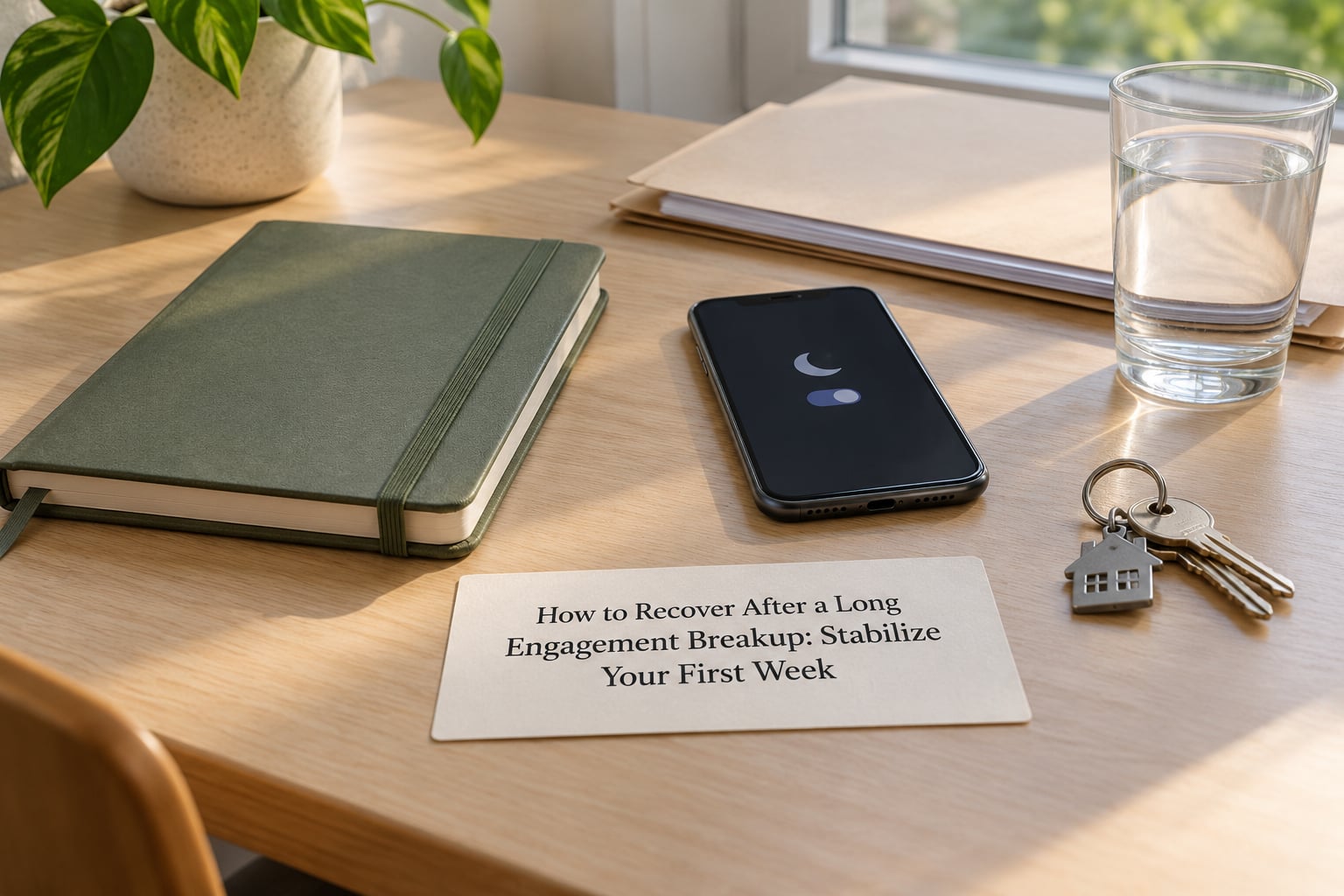
The first week is not for processing. It is for damage control, because grief makes people unreliable at decisions and most regretted choices happen in the first 48 hours.
Mute the group chat. Do not read the long message they sent at midnight; you are allowed to read it in six weeks when it can land as information instead of a wound. Put one simple structure on your days: wake time, one meal, one walk, one work task, one call to someone safe. Structure does not heal you, but it keeps your nervous system from spinning on decisions at 1am.
Then handle the admin that cannot wait. Photograph every document you need. Confirm the deposit position with each vendor in writing. Check what is in your name and what is in both your names. Do not have the painful conversation about the ring, money or the lease until you have slept on it, and write down what you actually want before you walk into that conversation.
One more thing: ask for help in the specific form you need it. “Could you bring dinner on Thursday” is easier for a friend to say yes to than “I’m really struggling.” Specific requests get met.
Handle the Shared Life You Built
People who were engaged for five, ten years tell me the logistics were harder than the feelings. They are right, and it is the part everyone skips in advice articles. Build a written list and work through it item by item rather than in one exhausting conversation.
Housing
Get the lease terms in front of both of you. Who is named on it, what notice period applies, what the exit costs are. If you are moving out, agree a date in writing before you start packing, and put your deposit and moving costs in the written plan so it does not become a monthly argument.
Money
List the joint accounts, who each is authorised on, and what the closing balance is. Splitting a savings account is harder than splitting a bill because you have to decide what proportion of the balance belongs to whom. The common approach: each takes out an equal share of what the account held before you combined finances, and the rest is divided down the middle. Whatever you agree, write it down and both keep a copy.
Vendors and deposits
Contact the venue and suppliers yourself rather than waiting for your ex-partner to do it. Ask directly what the cancellation window is and whether any deposit moves to a new date. You are owed a straight answer, and you are allowed to ask for it in writing.
Belongings, gifts and shared purchases
Make one list, photograph it if you are living together, and give each other a date to have it done. Family heirlooms get returned regardless of who paid for the wrapping. Gifts received for the wedding get returned or kept, your call, but decide once and do not relitigate it.
Social media and family
Unfollow first, talk later. Agree privately on one neutral line, because people will ask and you should not have to improvise. “It did not work out and we are both okay” is complete. Then tell the families on the same day, so one side is not hearing it from a cousin before the other side hears it from you.
Process the Loss Without Rushing Closure
Closure is not a moment you can force, and the demand that you should feel resolved by a certain date is one of the cruelest parts of a broken engagement. What you can do is let the loss be real instead of manageable.
Grieving a future that never existed has a name: ambiguous loss. There is no body, no funeral, no shared history to summarise, just the strange specific ache of a date that is now an ordinary Tuesday. Naming it helps, because it explains why you feel grief without a story that justifies it.
Know the difference between ordinary grief and something that needs more care
Ordinary grief comes in waves and still lets you have ordinary days in between. You can function, and occasionally you do. Get help from a professional if several weeks pass with no relief at all, if you cannot sleep most nights for more than two weeks, if you have lost a lot of weight, if you are drinking more than usual, if you cannot do basic tasks, or if you feel physically unsafe or have thoughts of harming yourself. That last one is an emergency: contact a local crisis line or emergency service and tell one person you trust right now.
The original wedding date will arrive
Almost everyone describes the same pattern: a stretch of feeling fine, then a hard crash when the date lands on the calendar. Plan it. Do not spend that week alone, do not book anything you cannot cancel, and do not decide in advance that you must be healed by then. If the date matters to you ritually, mark it deliberately, even if the only marking is a walk you take alone.
If you are the one who ended it
Regret after calling off an engagement is common and it is not proof that you made the wrong choice. The person who ends it often grieved the relationship quietly for months beforehand, sometimes alone, then walks into a breakup day that looks like relief to everyone else. That gap is where the shame comes from. You did not fail at loving someone. You answered a question about your own life honestly, and the timing is uncomfortable.
Letters you will want to write and should not send
Write them anyway. The unsaid version is the thing that keeps you cycling at 2am, and putting it on paper moves it from a loop to a fact. Then close the notebook.
Rebuild Your Routine, Identity, and Support System
The second half of recovery is quieter and slower. You stop surviving the day and start shaping one.
Fix sleep first. Keep the same wake time even on bad nights, because an unstable sleep cycle is the single thing that most reliably drags mood down. Then add movement you barely have to think about, a walk at lunch counts. Eat on a schedule even when appetite is low.
Then rebuild your support system in a deliberate way. With a long engagement, the hardest social problem is not strangers, it is the couple friends. They have to adjust too, and some will pick a side.
Tell the mutual friends closest to you yourself, before they hear it from the ex-partner, and give them a template: “The engagement ended, we are both okay, please keep asking us both out.” If someone keeps inviting you both to the same thing, say plainly, once, that you are not able to keep doing that, and then stop going. You are not obliged to stay friendly with your former fiancé forever, and you are also not obliged to declare war.
On identity: a broken engagement removes a title you have been carrying for years, and it can feel like losing a version of yourself. Name what was yours before the relationship and what you are choosing that is not. Rebuilding is not about deciding who you were. It is about noticing that you have interests, friendships and ambitions that were never on the wedding plan.
Set Boundaries and Avoid the Rebound Decision
A no-contact rule is a boundary with a duration. For a long engagement, most people need six to eight weeks with no contact beyond logistics, and some need longer.
No contact means no texting, no calling, no social media, no mutual friends as go-betweens. It is not punishment. It works because every contact resets the healing clock, and because you cannot think clearly while you are being pulled back in. If logistics require a message, keep it short, factual and about the matter itself. There is a version of this sometimes called no response, where one person asks the other to stop initiating. Choose the one you can actually hold, and tell your contact clearly which one you are in.
Social media is its own battle. You cannot control whether they post, but you can control what appears on your feed. Mute, unfollow and remove from close friends. Do not read comments from people who think they know your relationship. Reading their posts at 1am is not research, it is a self-inflicted wound with a search function.
Dating again is the decision people rush, usually because a new person makes the quiet unbearable. There is no correct number of months. A better question: can you talk about the engagement without your voice shaking? Can you be around their friends without performing? Have you moved somewhere, emotionally, that you would not go back from just because someone showed up and looked like a solution? When all three are yes, dating becomes an exploration. When they are not, a rebound relationship tends to cost you the healing you already did.
Create a Future That Is Not Defined by the Relationship
Recovery has a shape, even though it is not a staircase. People describe the first two or three months as brutal, a slow lift through the middle, and still feeling it a year later. Most long engagements land somewhere in the six-to-eighteen-month range for meaningful recovery, with the length driven more by how much shared life has to be untangled than by the strength of your feelings.
- Stabilise (0 to 3 months). Survival is the goal. Fewer decisions, more structure, minimal contact. You are not rebuilding, you are not doing anything except getting through the days.
- Process (3 to 6 months). The feelings arrive in waves. Untangle the practical life, tell the people who need telling, start therapy if you have not. This is where most rumination happens.
- Rebuild (6 to 12 months). Routines return, friends re-enter your life, the story of what happened stops being the main story. You start having weeks you do not think about it, then a bad week, then more good weeks.
- Reframe (12 months and beyond). The engagement becomes part of your history instead of your present problem. You can think about the future without checking it against what you lost.
Milestones are useful as self-checks, never as deadlines. At 30 days: is the admin handled and is there one person you can call? At 90 days: can you hold a conversation about it without a spiral, and have you made at least one decision that was purely your own? At a year: are you making plans that do not include recovering from this? If the answer at any checkpoint is no, that is information, not failure. Give it another season and get more support.
Longer term, put the practical pieces in place. A bank account of your own, a retirement or investment contribution in your own name, a document that names you as beneficiary where that is missing. Financial independence after a long engagement is not about austerity. It is about never again feeling unable to leave.
Common Mistakes
- Deciding everything in the first 48 hours. The fix: nothing irreversible for two weeks. Sign nothing, move nothing, promise nothing.
- Isolating because it is “our thing.” The fix: one person, told in advance what kind of support you want. Grief kept private reliably gets heavier.
- Arguing to win instead of to resolve. The fix: every conversation ends with an action and a date. If it has no endpoint, it is just noise.
- Agreeing to vague arrangements. “We’ll sort the money out later” is how the same fight happens in month eight. The fix: amounts, dates and a written copy for both of you.
- Watching their posts. The fix: unfollow, mute, remove from close friends. Then block if you need to, without announcing it.
- Using a new relationship to escape. The fix: wait until the three readiness questions above come back yes.
- Rushing a decision about the ring, the lease or moving out. The fix: write down what you want, sleep, then write to them.
- Waiting until you are “better” to get help. The fix: ask for support in the first month. It is much less expensive emotionally than in month nine.
Tips
- Keep one small daily win visible. Water, a walk, one email sent. Small and countable beats big and vague.
- Write the ex-partner out of the story you tell yourself. Not “they were wrong” but “here is what I want now.”
- Name the feeling out loud once a day. Grief that gets spoken tends to move; grief that stays in a loop does not.
- Return to places that were only theirs by going with someone else or going alone on purpose.
- Keep the original date and the anniversary of the engagement in your calendar, labelled as difficult, so you stop being ambushed by them.
- Measure progress by feeling, not by the calendar. Better days are the unit, and they do not arrive in a straight line.
Frequently Asked Questions
How long does it take to heal after a broken engagement?
Most long engagements land somewhere in the six-to-eighteen-month range for meaningful recovery. The first two or three months are usually the hardest, with a slow lift through months three to six, and a longer tail where you feel good for weeks and then crash at an anniversary. Length depends more on how much shared life has to be untangled than on how strongly you feel about it.
Should I stay in contact with my ex after a broken engagement?
For most people recovering from a long engagement, a no-contact rule of six to eight weeks is the right starting point, purely to stop the healing clock from resetting. Keep any necessary logistics in writing, short and factual. There is no obligation to remain friends with your former fiance, especially where a shared friend group makes that impractical.
How do I tell friends and family the wedding is off?
Tell the family on both sides on the same day, so nobody hears it from a cousin first. Say it plainly: the engagement has ended, you are both okay, and you do not need details yet. Agree one short line for everyone outside the family, then tell your mutual friends yourself before they hear it from anyone else.
How do I handle mutual friends who knew us as a couple?
Tell the closest ones yourself, before they hear it from your ex, and give them a clear request: keep inviting you both out rather than treating you separately. If someone keeps inviting you both to the same thing, say once that you are not able to keep doing it, then stop going. You are allowed to step back from that friendship while you heal.
When is it okay to start dating again?
There is no correct number of months. Ask yourself three things: can you talk about the engagement without your voice shaking, can you be around their friends without performing okay, and have you moved somewhere you would not walk back from just because someone appeared? When those are yes, dating is an exploration rather than a rescue, and a rebound relationship is much less likely.
Start where you are today, not where you think you should be. Clear the practical life, name the loss for what it is, put a real no-contact rule in place, and give the process six months before you judge it. Healing after a long engagement breakup is slow because there was a lot of life in it, and that is not a failure of your progress.