
To help a kid build reading habits, pick books they actually want to read, set one short daily reading routine, and keep the pressure off. Fifteen to twenty minutes a day, most days, beats an hour once a week. This plan is for parents and caregivers of children from toddler age through the elementary years, and it works even when your child has already said they hate reading.
This is not a reading curriculum and it does not ask you to become a teacher. It is eight practical moves you can start tonight, whether your child is four or fourteen.
Table of Contents
- What You Need
- Age-appropriate books the child can reach
- A comfortable reading spot
- A reading record
- Library access and free digital tools
- Your own reading time
- Step-by-Step: How to Help a Kid Build Reading Habits
- Step 1: Choose Books That Match the Child’s Interests and Reading Level
- Step 2: Set a Short, Predictable Reading Routine
- Step 3: Read Together Without Taking Over
- Step 4: Make Reading Enjoyable and Low Pressure
- Step 5: Create a Simple Reading Environment
- Step 6: Notice Progress Instead of Demanding Perfect Performance
- Step 7: Track Small Wins and Build a Reading Record
- Step 8: Celebrate Effort and Keep Reading Supportive
- Common Mistakes
- Treating reading as punishment
- Pushing a book that is too hard
- Correcting every mistake
- Making reading a fight
- Only counting chapter books
- Subtracting screen time without replacing it
- Saying reading matters but never being seen reading
- Starting a streak and quitting when it breaks
- Ignoring a possible skill problem
- Frequently Asked Questions
- How long should a child read each day?
- My child says they hate reading. What do I say?
- Do audiobooks and comics count as reading?
- How do I know if my child has a reading difficulty or is just unmotivated?
- Should I read chapter books or workbooks to build a reading habit?
- Conclusion
What You Need
Everything required is cheap, and most of it is already in your house. The point of gathering it first is that a reading habit forms faster when nothing has to be negotiated at reading time.
Age-appropriate books the child can reach
Enough books to choose from, stored where small hands can pull them out without asking. A sturdy basket of twenty to thirty books beats a locked shelf of two hundred. Include picture books, early readers, graphic novels, magazines, and whatever the child is currently obsessed with.
A comfortable reading spot
A chair, a couch corner, a beanbag, a spot on the floor. It needs decent light and few competing screens. You do not need a dedicated reading room; you need one place that the child associates with reading and that is not also the place where they do homework.
A reading record
Anything that lets a child mark progress: a paper reading log, a calendar with a sticker per session, a reading chart taped inside a closet door, or a notebook where the child writes one line about each book. Keep it low-effort. If logging takes more than two minutes, it will stop happening.
Library access and free digital tools
A library card for every child in the house, and a bookmarked set of free reading resources. Public libraries in the United States and the UK lend books, audiobooks, and often e-books through a free card. Free reading apps for kids such as Oxford Owl, Epic, and Reading Rockets give you leveled nonfiction and decodable texts at no cost.
Your own reading time
Children copy what they see. If every book in the house is closed and the adults are always scrolling, reading looks like homework. Keep a book, a magazine, or an e-reader where the child can see you using it.
Step-by-Step: How to Help a Kid Build Reading Habits
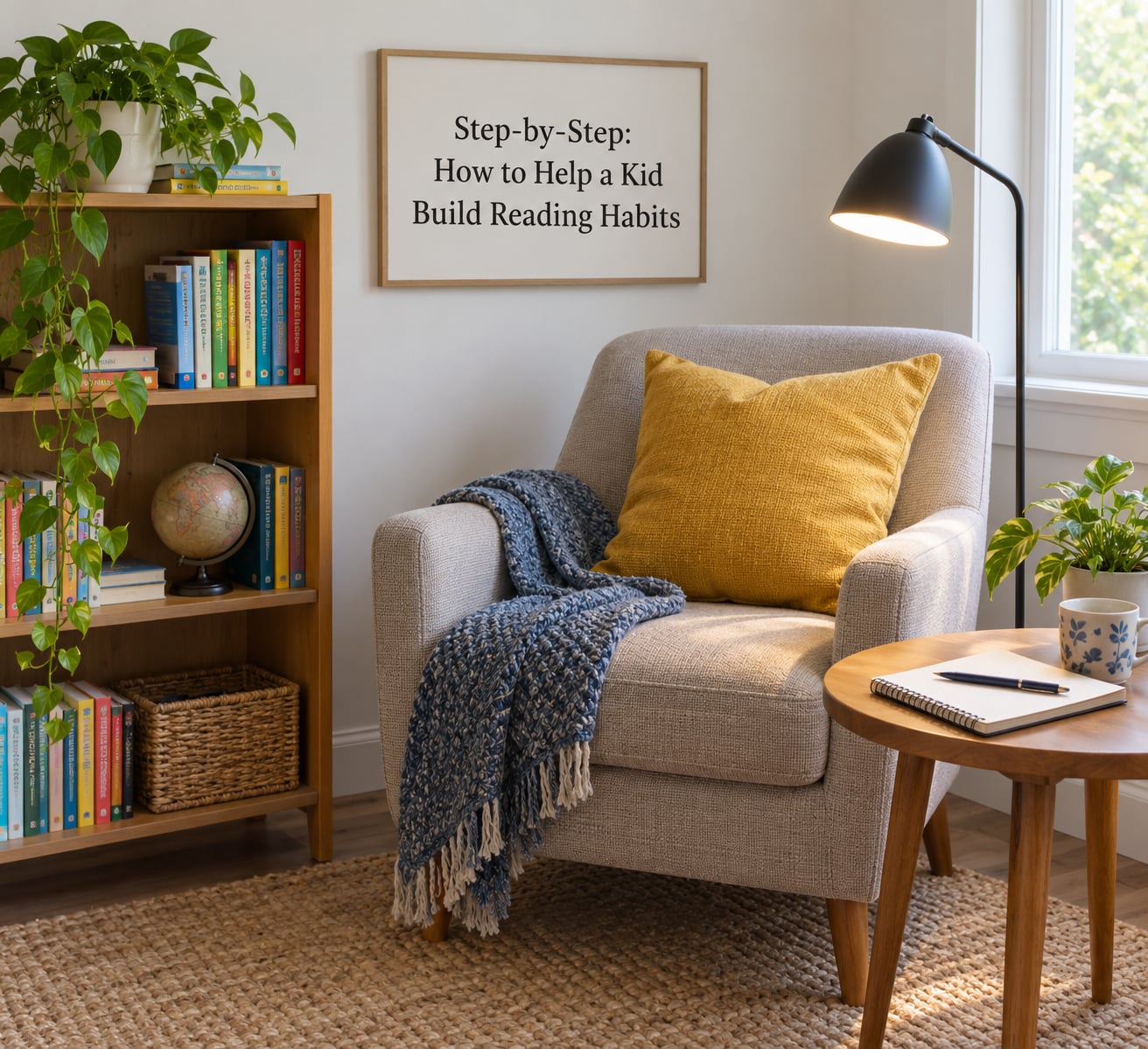
Read these in order over the first month rather than all at once. Each step assumes the one before it is already running smoothly.
Step 1: Choose Books That Match the Child’s Interests and Reading Level
Choice is the strongest lever you have, and most parents underestimate it. Let your child pick the book. The only rule worth enforcing is that they can read the text comfortably, or that you will read it aloud to them.
Use interests as the filter. A child who will not sit still for a classic may read a graphic novel about soccer, a magazine about animals, or a manual for a game they play every day. Interest carries them through words they would otherwise give up on.
To find the right level, watch what the child does when they hit an unfamiliar word. If they sound it out, the level is right. If they guess from the picture or skip whole lines, the book is too hard and you should step in or switch to something easier.
You will hear a lot about reading levels for your child’s age. Treat that as a rough guide rather than a scorecard. A ten-year-old reading a book meant for a seven-year-old is not behind; they are building confidence and volume, and both matter. Parents on r/Parenting repeatedly name this as the biggest single lever, and Montessori parents in the same conversations stress that following the child’s lead beats pushing a level.
How to tell it worked: the child brings you books without being asked, and complains when you run out of time rather than when you make them stop.
Step 2: Set a Short, Predictable Reading Routine
Pick one time that repeats most days and defend it. Bedtime, after dinner, or right after school all work. The specific hour matters far less than the predictability.
Start with a duration your child can finish successfully. Fifteen to twenty minutes suits most children ages four to seven. For a child who resists reading, begin with five minutes and grow into it. A daily reading routine that ends on success every single night will hold together longer than an ambitious one that ends in tears twice a week.
Anchor it to something that already happens. “After the bedtime brushing” is more reliable than “before bed,” because brushing teeth is not negotiable and bedtime drifts.
Here is a reasonable starting point by age and stage, based on what pediatric guidance and reading specialists generally suggest:
| Age or stage | Daily reading time | Best activity |
|---|---|---|
| Toddlers, birth to 3 | 5 to 10 minutes | Parent reads aloud, same books on repeat |
| Preschoolers, 3 to 5 | 10 to 15 minutes | Shared reading with talk and pointing |
| Early readers, 5 to 7 | 15 to 20 minutes | Child reads independently, parent nearby |
| Elementary, 8 to 12 | 20 to 30 minutes | Independent reading plus one read-aloud |
| Teens | 20 to 40 minutes, flexible | Reading tied to their interests, often audio plus text |
Parents on Reddit note that bedtime reading can turn into drama every single night, and that drama is usually a sign the session is too long, too hard, or too supervised.
How to tell it worked: the child starts getting ready at the reading time without a reminder.
Step 3: Read Together Without Taking Over
Shared reading works when the child is doing real work. Take turns with pages, let them hold the book, and stop rescuing them so fast that decoding never happens.
When a child hits a hard word, wait five seconds. If they do not move, sound it out yourself in pieces so they hear the blending rather than receiving the finished word. Telling a child the word turns reading into dictation; walking them through it builds the skill.
Ask questions that do not have one right answer. What do you think will happen next? Why do you think she did that? What would you have done? Use the pictures and the author’s choices, and wait through the silence.
Keep your read-aloud lively. Use character voices, change your pace for dialogue, and point at words as you read so print and sound stay connected. This matters most for young children, and it costs nothing.
Let the child end each session on a book they want to keep reading. Never close on the last page of something hard.
How to tell it worked: the child argues with you about what a character meant, which is comprehension happening out loud.
Step 4: Make Reading Enjoyable and Low Pressure
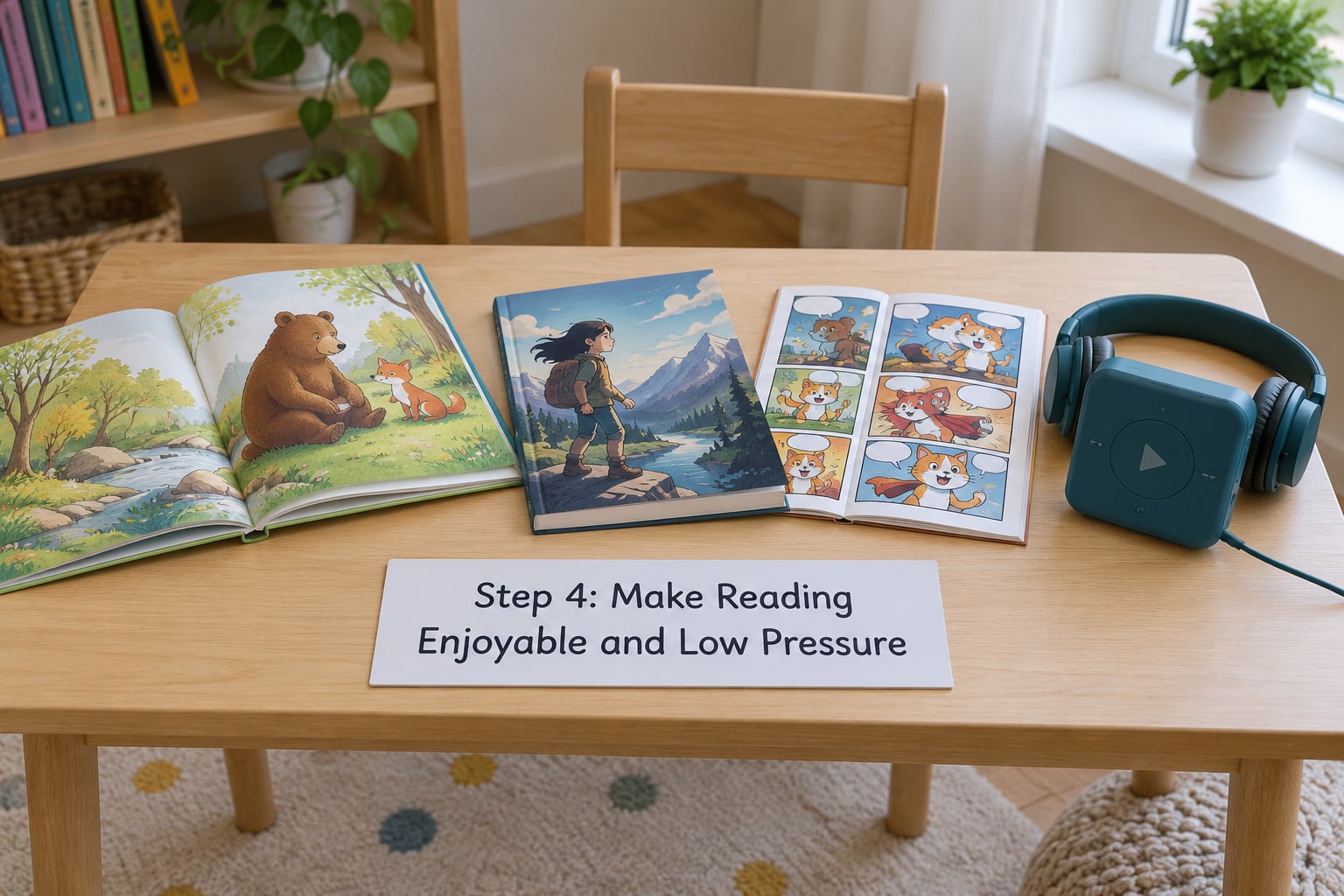
Expand what counts as reading. Most family arguments about reading are really arguments about the definition of the word, and the narrow definition loses.
| Format | Why it helps | Best for |
|---|---|---|
| Picture books | Builds vocabulary and discussion with almost no decoding load | All ages, especially 0 to 5 |
| Decodable and early readers | Practice that does not feel like practice | Ages 5 to 8 |
| Graphic novels | High image support, huge vocabulary range, kids finish them fast | Ages 7 to 12, reluctant readers |
| Comics and manga | Genuinely dense text in short bursts; kids collect them | Ages 7 to 14 |
| Magazines and nonfiction | Feels grown-up, feeds a specific obsession | Ages 8 and up |
| Instructional text | Recipes, manuals, game guides, repair instructions | Ages 9 and up |
| Audiobooks | Listening comprehension runs ahead of reading comprehension | All ages, especially reluctant readers |
| Read-alouds above level | Children can handle harder ideas when someone else does the decoding | All ages |
Audiobooks deserve a specific defense. A child who can follow and enjoy a story by ear is building vocabulary, pacing, and comprehension, and that vocabulary transfers straight into decoding. If your child wants to listen instead of read the same book, let them, and follow along with the printed copy when you can.
Visit the library. Browsing shelves is often where reluctant readers find their thing, and a library card removes every cost argument.
How to tell it worked: the child asks for a library trip or asks to keep reading something they chose themselves.
Step 5: Create a Simple Reading Environment
Make books physically easy to reach. Put a basket by the sofa, one in the car for waiting times, one beside the bed, and low shelves in the playroom. If a child has to ask a grown-up to get a book, the habit stalls.
Reduce competing noise in the reading spot rather than everywhere in the house. One room without screens is enough. Many families have found that cutting screen time directly increases a toddler’s spontaneous interest in words and books.
Handle screens additively rather than subtractively. Saying no to a game teaches a child that reading is what you get instead of fun, so put something in its place: the audiobook of the same story, a graphic novel they queued up, or a trip to the library after screen time. Replacing is easier than subtracting.
How to tell it worked: the child retrieves a book unprompted and reads without being watched.
Step 6: Notice Progress Instead of Demanding Perfect Performance
Watch for growth that is easy to miss: more words read without stopping, longer stretches of smooth reading, new vocabulary, willingness to attempt an unfamiliar book, and finished books sitting around the house.
Stop grading. Correcting every mistake interrupts the flow and teaches a child that reading is a performance under judgment. Let a misread word sit for a moment; readers self-correct far more often than parents expect.
Comprehension is a separate skill from fluency. A child can read every word on the page smoothly and still miss what happened. Notice when your child can tell you the point of a chapter, retell a plot, or explain why a character chose something. That is the skill that matters later.
Expect uneven progress. Readers move in plateaus and then jump, and a bad week is not a lost week.
How to tell it worked: you can describe three specific things your child does better than two months ago.
Step 7: Track Small Wins and Build a Reading Record
A visible record turns invisible progress into something a child can see, and seeing the streak is what keeps the routine alive through a boring month.
Pick one method and keep it simple. A paper calendar with a sticker or initial per session works well for ages four to eight. For older children, a reading log with the book title, date, and a one-line reaction works better. A simple chart taped on the fridge keeps everyone honest without turning into a scoreboard.
Log the session, not the performance. “Read for 12 minutes” or “finished Bluey and the Snow Mountain” beats a star chart with rules attached.
Never let the log become leverage. If the child can lose privileges for missing a session, the chart is a punishment with stationery.
How to tell it worked: the child marks the chart themselves, without being asked.
Step 8: Celebrate Effort and Keep Reading Supportive
Praise the specific thing, not the general trait. “You read that whole chapter on your own” tells a child what to repeat. “You’re so smart” tells them nothing about what to do next.
Recognize persistence, curiosity, and personal choice. Thank them for picking a hard book, for asking a good question, for finishing a series, for recommending a book to you.
Watch out for rewards that turn reading into a transaction. Paying per page or per finished book trains a child that reading is a chore performed for income. Sticky charts, choosing the family dinner, and an extra bedtime story cost nothing and keep the meaning inside the activity.
On the other side, never use reading as punishment. Extra reading for misbehavior makes a child associate reading with being in trouble.
How to tell it worked: the child picks up a book when nobody is watching.
Common Mistakes
Most reading habits stall on a handful of predictable errors. Each one below comes with the fix that usually gets a stuck routine moving again.
Treating reading as punishment
Extra reading as a consequence, or reading as something confiscated. The fix: reading only ever happens as a pleasant activity. Consequences belong to behavior, not to books.
Pushing a book that is too hard
A book above the child’s level turns every page into a wall, and the wall wins. The fix: drop two levels, get them comfortable, and move up gradually. If a book is frustrating to read, read it aloud together instead.
Correcting every mistake
Interrupting on each stumble teaches a child that reading is about avoiding an adult’s reaction. The fix: pause, wait, and let the error sit unless it blocks meaning.
Making reading a fight
Dragging a child to the chair every night trains avoidance. The fix: shrink the session until it is small enough to end well, then grow it back. A five-minute win is worth more than an abandoned twenty minutes.
Only counting chapter books
Rejecting comics and graphic novels as not real reading removes the exact formats that hook reluctant readers. The fix: use the table above and treat all of it as reading.
Subtracting screen time without replacing it
Taking something away without putting something in creates a void the child fills another way. The fix: swap one screen activity for one reading activity, same length, same time slot.
Saying reading matters but never being seen reading
Praise the behavior while modeling the opposite. The fix: read in the same room, on purpose, where the child can see it.
Starting a streak and quitting when it breaks
Perfect streaks collapse, and then the chart gets thrown away. The fix: restart the chart the same day it breaks, and praise the restart.
Ignoring a possible skill problem
Motivation and skill are different problems with different fixes. The fix: know which one you are dealing with.
If a child avoids books but reads a menu, a text, or an instruction booklet happily, it is a motivation problem. Reduce pressure, add choice, read aloud, and use the formats that already work.
If a child tries hard and still struggles, watch for these signs of a reading difficulty: rhyming, guessing words from pictures, memorizing text as shapes rather than decoding it, heavy guessing on unfamiliar words, and reading aloud with flat, effortful rhythm. Talk to the classroom teacher and ask about a school reading assessment or a specialist evaluation. Early support makes a real difference, and schools screen for this routinely.
And when your child says they hate reading, you need words ready. Parents on r/Parenting describe this moment as the hardest part of the whole process, so here are four scripts that work:
- “You don’t have to love it. You only have to try it for fifteen minutes, and you can stop after that.”
- “Reading is boring for me too some days. I read anyway because it goes faster that way.”
- “Want the graphic novel version, the audiobook version, or the one I read to you? Pick one.”
- “I noticed you read three pages without stopping. That was hard and you did it anyway.”
Two more adjustments worth knowing. For a child learning in a second language, reading aloud in the home language builds vocabulary that transfers, and bilingual children often need more time in front of any text rather than less. For a child who reads fluently but does not understand what they read, ask them to retell the chapter in their own words or explain a character’s choice; that gap closes through conversation, not more decoding practice.
Frequently Asked Questions
How long should a child read each day?
Most children ages four to seven benefit from 15 to 20 minutes of reading a day, and children ages eight and up usually manage 20 to 30 minutes. What matters more than the number is consistency: short daily sessions build the habit, while long weekly sessions rarely do. For a reluctant reader, start at five minutes and lengthen the session only after several successful nights in a row.
My child says they hate reading. What do I say?
Do not argue with the statement or demand they keep going. Try lowering the pressure and offering a choice instead: you read the first page, they take the second, or they choose between two books they already like. Praise the specific effort they made, such as finishing a page without stopping. Children who say they hate reading usually mean the book was too hard or the session too long.
Do audiobooks and comics count as reading?
Yes, and they build real skills. Listening comprehension runs ahead of reading comprehension, so an audiobook grows vocabulary that later supports decoding. Comics and graphic novels carry dense text, heavy vocabulary, and high motivation, which is why reluctant readers often finish one when chapter books defeat them. Reading the same story as an audiobook while following the printed copy combines both benefits.
How do I know if my child has a reading difficulty or is just unmotivated?
A motivation problem shows up as avoidance: the child reads signs, menus, and instructions happily but avoids books. A skill problem shows up as effort: guessing words from pictures, losing meaning in the middle of a line, reading aloud with flat and heavy rhythm, or memorizing words as shapes instead of decoding them. If you see effortful struggle, ask the classroom teacher about a school reading assessment.
Should I read chapter books or workbooks to build a reading habit?
Read chapter books. A habit forms around pleasure, not around practice, and workbooks teach a child that reading is a worksheet with consequences. Decodable readers are the exception worth keeping, because they give early readers practice that still reads like a real story. Once a child can sit with a chapter book, keep the practice material to a few minutes and return to the enjoyable reading.
Conclusion
To help a kid build reading habits, you are running eight moves: books they chose, one short predictable routine, shared reading without taking over, a wide definition of what counts as reading, books within reach, attention to progress instead of perfection, a simple record of small wins, and specific praise that never turns reading into a transaction.
Do not wait until you have everything in place. Tonight, put one genuinely enjoyable book within your child’s reach and set a fifteen-minute reading time you can keep. Consistency is what builds the habit, and the habit is what builds the reader.