
Keeping your marriage strong with small kids comes down to a handful of small habits, not grand gestures: divide the work where it’s actually invisible, build a weekly rhythm you can survive, protect a daily window for each other, learn to repair small arguments within an hour, and hold a 20-minute check-in every week. It takes a few weeks of steady practice, and the hard part is doing it while you’re both running on about six hours of sleep.
I want to be honest about the season first. The first few years with a baby or toddler are genuinely one of the harder stretches of most marriages, and the strain is not a sign that something is wrong with you. Sleep loss shrinks the part of your brain that tolerates a messy kitchen, and the same part that remembers your partner forgot to ask how your day was.
What makes the difference is whether the two of you are running a team or running two separate households that share a mailing address. Everything below is built around that idea. Pick the parts that fit your family and ignore the rest.
Table of Contents
- What You Need
- A Shared Calendar Both People Actually See
- A Written List of the Jobs
- A Fixed Weekly Check-In Slot
- A Simple Way to Track Childcare, Work, and Rest
- Step-by-Step: How to Keep Your Marriage Strong With Small Kids
- Step 1: Share the Work Before It Becomes a Conflict
- Step 2: Build a Predictable Weekly Rhythm
- Step 3: Protect Your Marriage Strong With Small Kids From Daily Distraction
- Step 4: Use Fair Teamwork, Not Perfect Parenting
- Step 5: Repair Small Arguments Quickly
- Step 6: Check In on the Marriage Every Week
- Common Mistakes
- Quick Tips for Busy Parents
- Frequently Asked Questions
- How do I start rebuilding my marriage when resentment is already there?
- What if my partner is the one who feels disconnected?
- Is it normal to feel like I do not like my spouse after having a baby?
- How do we get time alone with small kids and no babysitter?
- When should a couple go to marriage counseling?
- Conclusion
What You Need
None of this needs a specific product or a big investment. It needs four things, and three of them cost nothing.
A Shared Calendar Both People Actually See
Not two separate calendars. One that lives somewhere you both glance at, whether that’s a paper planner on the fridge, a shared note on your phone, or a whiteboard in the kitchen. If work shifts, drop-offs, and pediatrician appointments live in one person’s head, they will eventually slip, and that becomes an argument about effort rather than about the appointment.
A Written List of the Jobs
Write down every recurring task in the household, including the ones nobody thinks of as tasks: tracking diaper sizes, remembering the dentist, knowing when the car registration is due, noticing the toddler is out of socks. Most couples who feel the imbalance have never actually compared lists. The written version ends the argument fast because it turns a vague feeling into a specific item you can hand over.
A Fixed Weekly Check-In Slot
Twenty to thirty minutes, same time each week, on the calendar before you schedule anything else. Sunday evening after the early bedtime works for some people. Saturday morning coffee works better for others. What matters is that it recurs and that nobody is allowed to cancel it twice in a row without replacing it.
A Simple Way to Track Childcare, Work, and Rest
You need to know where the hours actually go before you can redistribute them. A rough tally for one week is enough: sleep hours, work hours, commute, childcare blocks, and any free time each of you got. Most parents are surprised by the answer, and the surprise tends to do more than any conversation about fairness would have done.
Step-by-Step: How to Keep Your Marriage Strong With Small Kids
Step 1: Share the Work Before It Becomes a Conflict
Split ownership instead of splitting hours. The single most useful change most couples make is moving from “we each do half the dishes” to “you own the kitchen, I own the laundry,” because ownership removes the need to keep score.
Start by writing out every recurring job, then sort it into three buckets: jobs one of you will own outright, jobs that get split by a clear shift, and jobs that get outsourced. The outsourcing bucket is the one couples skip, and it’s the one that creates actual rest. A laundry service, one cleaning visit a month, or two hours a week from a relative are what free up the time that makes date night possible.
How do you know it’s working? A few weeks in, the answer to “who handled the dentist this time?” should be obvious to both of you. It isn’t a sign that the work got equal. It’s a sign that the work got visible, and invisible work is where resentment breeds.
One caution: don’t do this exercise during a fight. The whole value is in the calm version, when you’re both tired but not angry. If the list turns into a verdict, park it and come back the next day.
Step 2: Build a Predictable Weekly Rhythm
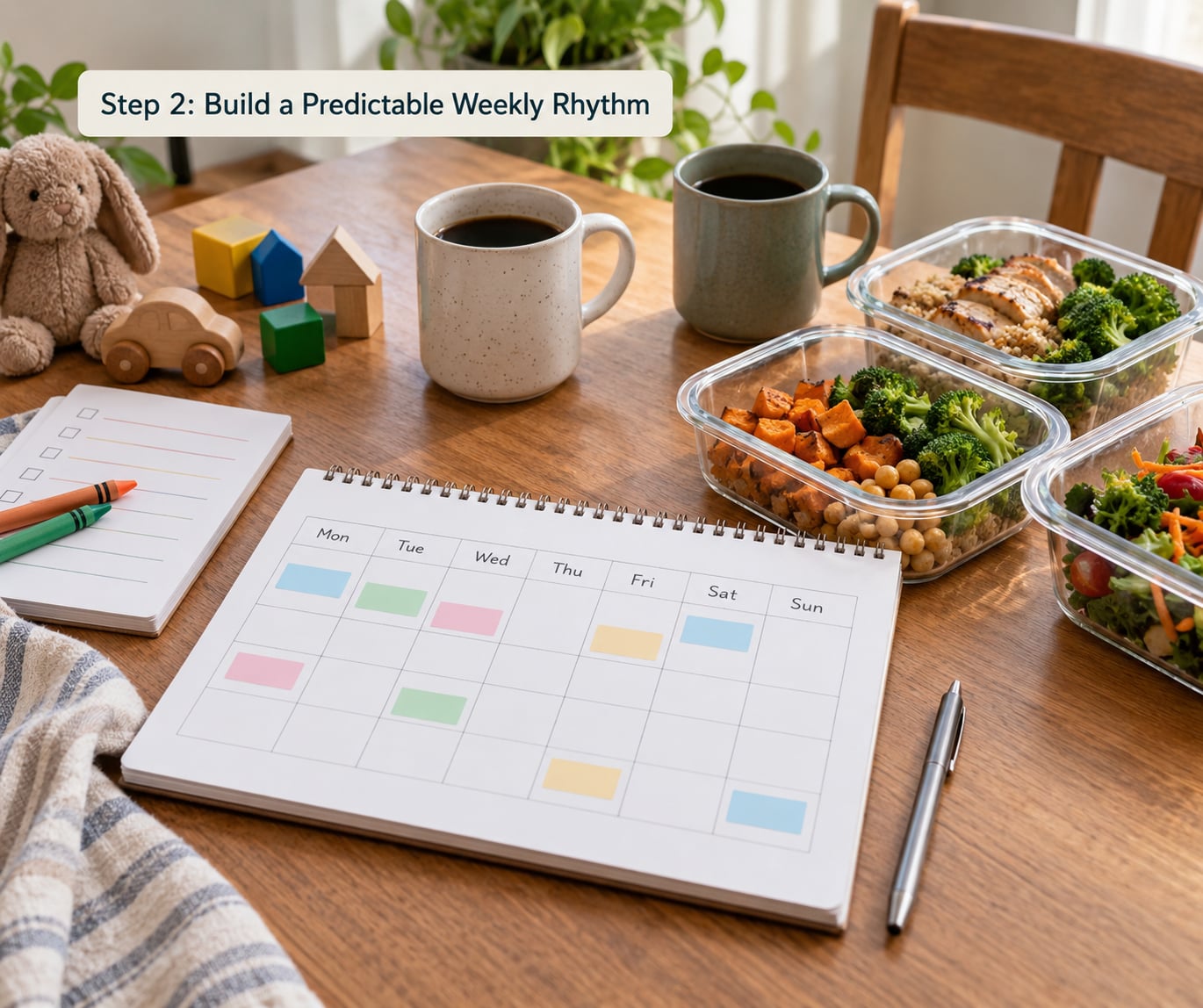
Unpredictability is more corrosive than workload. When neither of you knows when the other finishes, every evening becomes logistics instead of connection, and logistics is the least romantic conversation two adults can have at 8pm.
Build one weekly template instead of a daily one. Wake windows for both parents. Meal blocks, ideally with leftovers on the nights neither of you wants to cook. Chores in fixed slots. Chores, laundry, and admin get assigned to specific days, not floated.
On a sample week, for example, mornings belong to whoever is up first, dinner is block-cooked on Sunday for two nights, laundry runs Tuesday and Friday, and the toddler’s bath is a fixed job rather than whoever’s nearest. The rest of the week is left open on purpose, because a rigid seven-day plan is exactly the thing that collapses the first time a kid gets a fever.
Then layer on the shifts that make sleep possible. If the baby wakes every two hours and both of you are wrecked, decide in advance which one is on for which block of the night, and protect the off parent’s whole next day as recovery. The shift is a plan, not a negotiation at 3am, and the difference in how that night goes is enormous.
How do you know it’s working? You get through a normal Tuesday without either of you asking the other to just handle things. That’s the signal.
Step 3: Protect Your Marriage Strong With Small Kids From Daily Distraction
Small kids generate more interruptions than you can count, and most of them arrive during the exact minutes you had set aside for each other. The fix is not a longer block. It’s a ritual short enough that you will actually keep it on the worst days.
Two habits do most of the work here. The first is a daily check-in of about two minutes: one question each, asked while you’re both still in the kitchen, before the phones come out. Ask something real. How are you feeling about the day ahead, what’s the thing you’re dreading, what do you need from me tonight. The third question is the useful one, and it’s the one couples forget.
The second is a protected couple window of 20 to 30 minutes on most days. Not every day. A 20-minute walk after dinner while the child plays, or a show the two of you actually want to watch instead of scrolling in separate rooms. The point isn’t the activity. It’s that you’re both looking in the same direction for half an hour, and your child learns what that looks like.
For touch, low-stakes physical affection matters more than you might think. Sixty seconds of actual contact, unhurried, does more for a tired marriage than a long conversation at the end of a hard day.
How do you know it’s working? You start to finish sentences about your days, and you catch small things about your partner you’d otherwise miss. And if it slips, that’s information, not a character flaw. Reschedule it rather than declaring the ritual dead.
Step 4: Use Fair Teamwork, Not Perfect Parenting
Fair doesn’t mean identical, and it never did. It means the mental load, the planning, the anticipating and remembering, is shared rather than concentrated in one person.
Make handoffs explicit. “I need you to handle bath tonight” gets a different response than “can you get bath?” One is a clear handoff and the other is an open question that can quietly become the other person’s job. Try naming the job and the time, then letting go of it. If you end up checking anyway, you haven’t actually handed it over.
Use a visible list for everything that doesn’t have a slot. A shared list on the door, a note on the fridge, whatever gets seen. The invisible mental load is precisely the work that has no list: knowing the toddler needs new shoes, noticing the formula is nearly out, remembering the flu shot. Write those things down and let either of you pick them up. That’s the whole system.
On discipline, you don’t have to agree on everything. Pick your two or three non-negotiables as a couple, agree on the consequence, and let whoever is present carry it out. Two parents arguing in front of a toddler about whose approach is right teaches the child something none of you wanted to teach.
How do you know it’s working? You can name the last three things you each took care of without either of you having to think hard. If one of you can’t list three, the load is still lopsided, whatever the spreadsheet says.
Step 5: Repair Small Arguments Quickly
Couples rarely break on the big fight. They break on the same four or five small arguments that get rerun every week, each one a little more corrosive than the last.
Use a pause-and-return process. When either of you feels the volume rising, say the phrase, out loud, before you leave the room. Something like “I need 20 minutes and then I want to finish this.” Then actually come back in 20 minutes. The part people skip is the return, and without it the pause just teaches the other person that walking away is how you end things.
When you do return, aim for repair over winning. Say what you were trying to get at, in one sentence, without the case history. Say what you heard, even if you disagree. Then ask for a specific change next time. Concrete requests get answered; character assessments get defended.
For the recurring arguments, write the actual subject down and solve it once. If it’s about bedtime, decide the exact bedtime and what happens when the child stalls, in advance, and stop renegotiating it nightly. Couples who do this report that a surprising number of their arguments evaporate, because the argument was about an open question rather than a real disagreement.
How do you know it’s working? Arguments end slightly earlier, and neither of you is bringing up last month’s fight three weeks later. Both are good signs.
Step 6: Check In on the Marriage Every Week
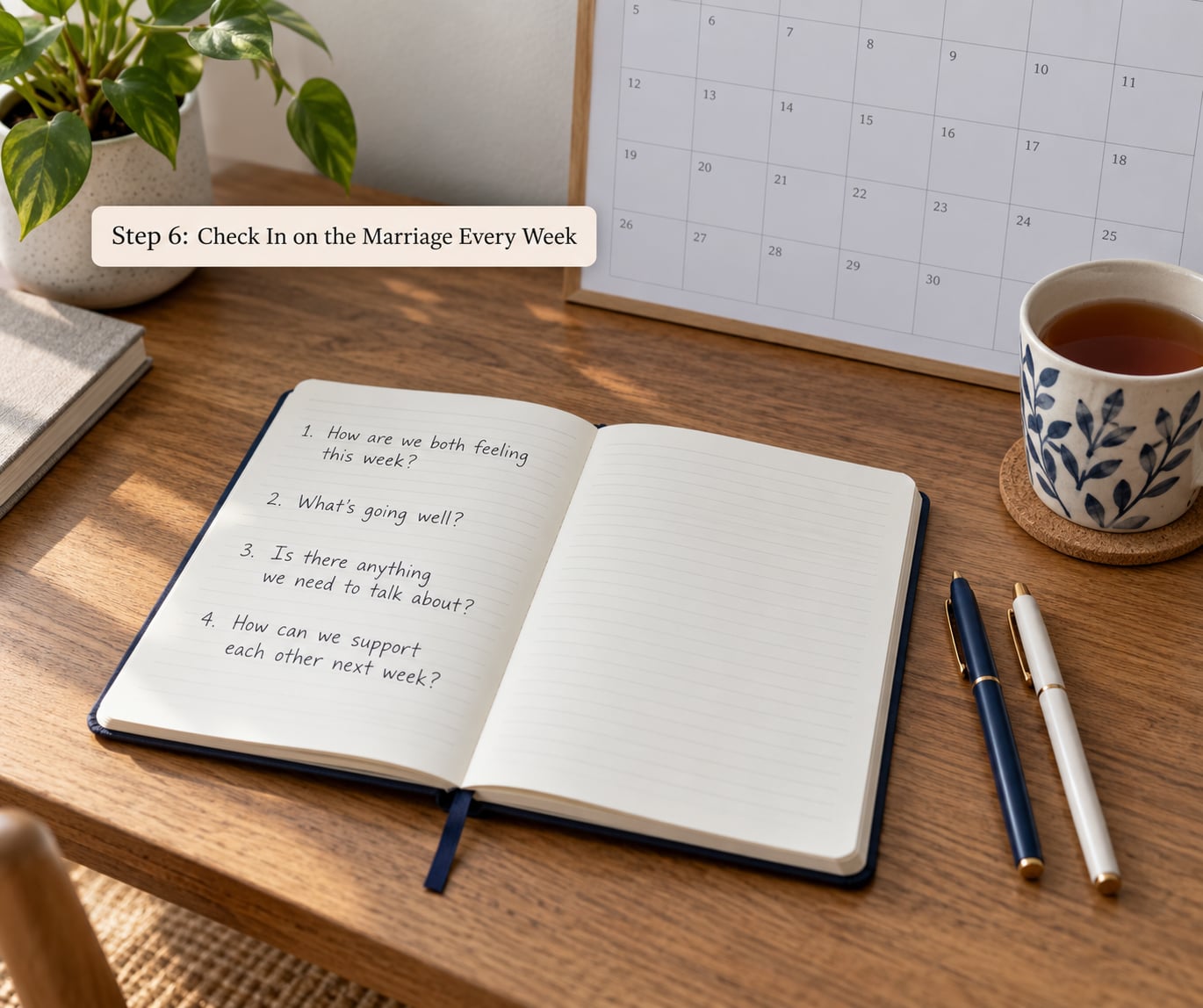
The weekly meeting is the habit everything else hangs on. It’s the one place you get to talk about the marriage instead of the kids, the jobs, and the money.
Run it with a short list so it doesn’t turn into a grievance session. Five questions cover it:
- What felt heavy for you this week?
- What did you handle that you didn’t tell me about?
- What do you need more of from me next week?
- What do you need less of from me next week?
- What’s one small thing we’re going to do differently next week?
Keep it to one thing. Habits built in meetings with six action items die within a month, and the point of the last question is that you leave with exactly one change to test.
Two rules make it work. Neither of you brings up a fight the other raised, and the one who scheduled it takes the first five minutes. And when someone is genuinely depleted, the meeting is still fifteen minutes rather than cancelled, because cancelled meetings are how good habits quietly disappear.
How do you know it’s working? The change you picked actually happened at least half the time. If it didn’t, the question isn’t whether the meeting is working. It’s whether the change was too big, and the answer is almost always yes.
Common Mistakes
Most of what damages a marriage with small kids isn’t dramatic. It’s a handful of ordinary assumptions, repeated for years. Each one has a fix you can apply this week.
Contributions should be equal at every moment. They never are, because days and seasons are uneven, and the mismatch turns into a scorecard. Compare weeks rather than hours, and judge the split by whether it’s visible and workable.
Real couples get time alone. Couples with young kids often go months without a genuine evening out, then treat that as a personal failing. Set a low bar instead: a 20-minute walk counts, and swapping a monthly sitter with another family is realistic.
Exhaustion explains everything. It explains a lot, but it also works as a convenient shield for habits that have calcified. Name the exhaustion out loud, then ask what you’d change if you got two extra hours.
Resentment is useful leverage. It reliably turns into delayed replies, short answers, and physical distance. Say the need in the week it’s small, not the month it’s enormous.
Hard conversations should happen at bedtime. Both of you are at your worst and the child is the audience. Move hard talks to the check-in or to a walk, never to the 9pm crunch.
The relationship can wait until the kids are older. By the time the kids are older, the habits of disconnection are well established. Keep the smallest version of the habit alive now, even in a bad week.
Being a good partner means never being tired. It produces a spouse who performs instead of a spouse who relates. Set expectations out loud so the tired version of you isn’t a surprise.
One more deserves its own mention. A lot of parents in this stage describe a period where they don’t recognize their own feelings toward their spouse, particularly in the first year postpartum, when sleep debt and hormonal shifts stack on top of each other. That is common, it is temporary for many people, and it is worth talking to someone about. If persistent low mood, panic, or thoughts of harming yourself or the baby show up, that is a medical matter, not a character flaw, and a doctor or mental health professional is the right call rather than a marriage exercise.
Quick Tips for Busy Parents
- Say thank you for a specific thing rather than a general one. “Thanks for taking the 6am shift” lands; “thanks for everything” doesn’t register at all.
- Ask for help early. Waiting until you’re at the end of your reserves turns help into a favour with conditions attached.
- Schedule your shifts the way you’d schedule a meeting, with a start and an end, so nobody has to guess whether the other one is off duty.
- Use the visible list even for things that feel too small to write down. Those are exactly the ones that accumulate into resentment.
- Pick flexible dates for couple time. Book the sitter window before you book anything that depends on it.
- Keep one low-effort ritual that survives bad days, and let everything else be optional. A two-minute check-in that happens 200 days a year beats a nice date night that happened twice.
- Keep a rule against interrupting your conversation to answer a child more than once. “Mom, a minute” is a sentence worth teaching.
- When one of you is out of capacity, say so as a status report rather than a complaint. “I’m running empty until Thursday” gets you help; “you never help” gets you a fight.
Frequently Asked Questions
How do I start rebuilding my marriage when resentment is already there?
Don’t start with the big conversations. Start with a small, specific change you can complete in a week, like taking ownership of one household job entirely, and let it be visible. Resentment builds from small, repeated evidence that effort goes unnoticed, so the repair is usually a series of concrete demonstrations rather than one honest conversation. When you do talk, name the pattern and one request you would both recognize as fair.
What if my partner is the one who feels disconnected?
Disconnection has two common causes with young kids: a lopsided invisible load, and a buildup of unsaid needs. A spouse who is carrying the planning and the remembering often withdraws, and the withdrawal gets read as indifference rather than exhaustion. Give the check-in a specific question, like what they need more of and less of next week, and listen without defending yourself for the first ten minutes.
Is it normal to feel like I do not like my spouse after having a baby?
Many new parents describe this, and it usually tracks with sleep debt and the intensity of the postpartum period rather than with the marriage itself. Sleep loss reliably reduces emotional tolerance, and the effect is strongest in the first year. If the feeling is fading as sleep improves, it is likely a season. If it is paired with persistent low mood, panic, or frightening thoughts, contact a doctor or mental health professional rather than waiting it out.
How do we get time alone with small kids and no babysitter?
Lower the definition of alone. A 20-minute walk after dinner, a bath where one of you handles the child while the other sleeps in, or a monthly swap with another family who have kids a similar age all count. The swap is the most underrated option because it costs no money and removes the decision fatigue of finding a sitter. Keep the bar small enough that you will still do it on a hard week.
When should a couple go to marriage counseling?
Go when the same argument keeps returning and you have already tried talking about it, when conversations about the relationship always end in blame or shutdown, or when one partner has stopped raising concerns entirely because nothing changes. Couples often wait years past the point where a few sessions would have helped. Counseling during the parenting years is not a sign of failure, and a therapist who works with young families can shorten the path considerably.
Conclusion
If you do one thing this week to keep your marriage strong with small kids, pick a single responsibility and give one partner full ownership of it, book a 20-minute check-in in the calendar, and set a two-minute end-of-day question you both actually ask. Three small changes, repeated, will do more for your marriage than any single conversation you haven’t had yet.
And if the small changes don’t reach the bigger problem, that isn’t failure on your part. Couples who get help during the parenting years are simply buying themselves time. Whatever your family looks like, the goal is the same: a home where the two adults are still a team, because that’s the version of yourself your child grows up copying.