
A long distance relationship can work when two people keep their word, communicate on a schedule they actually hold, and are both actively working toward a point where the distance ends. If you are asking how to tell if a long distance relationship can work, judge behaviour over promises: the plans that get made, the visits that get kept, and how you handle the hard conversations in between.
Distance by itself rarely ends a relationship. What tends to end them is an open-ended wait with no plan, contact that quietly fades, jealousy that gets managed by avoidance instead of honesty, and two people slowly replaced by a fantasy of each other.
None of that is fate. Most of it is visible early, and most of it is fixable if you both want to fix it. The nine signs below are the ones worth watching.
Table of Contents
- What Makes a Long Distance Relationship Work?
- How to Tell: 9 Signs Your Long Distance Relationship Can Work
- 1. Communication Is Reliable, Not Just Frequent
- 2. You Can Talk About Difficult Issues Without Retaliation
- 3. Your Expectations Actually Match
- 4. There Is a Real Plan to Close the Distance
- 5. Trust Is Backed by Actions, Not Just Promises
- 6. Both of You Are Building Full Lives
- 7. You Both Show Up for the Visits You Planned
- 8. You Talk About the Future in Specifics
- 9. The Relationship Improves Rather Than Drains You
- What to Ask Before You Make a Long Distance Decision
- When Distance Is Not the Main Problem
- How to Know If You Are Just Telling Yourself It Is Fine
- How Long Should You Test a Long Distance Relationship?
- Frequently Asked Questions
- How often should you talk to your long distance partner?
- What are the signs a long distance relationship is not working?
- What is the 777 rule for long-distance relationships?
- What destroys a long distance relationship?
- Should I end my long distance relationship?
- How can I tell if my partner is committed from far away?
What Makes a Long Distance Relationship Work?
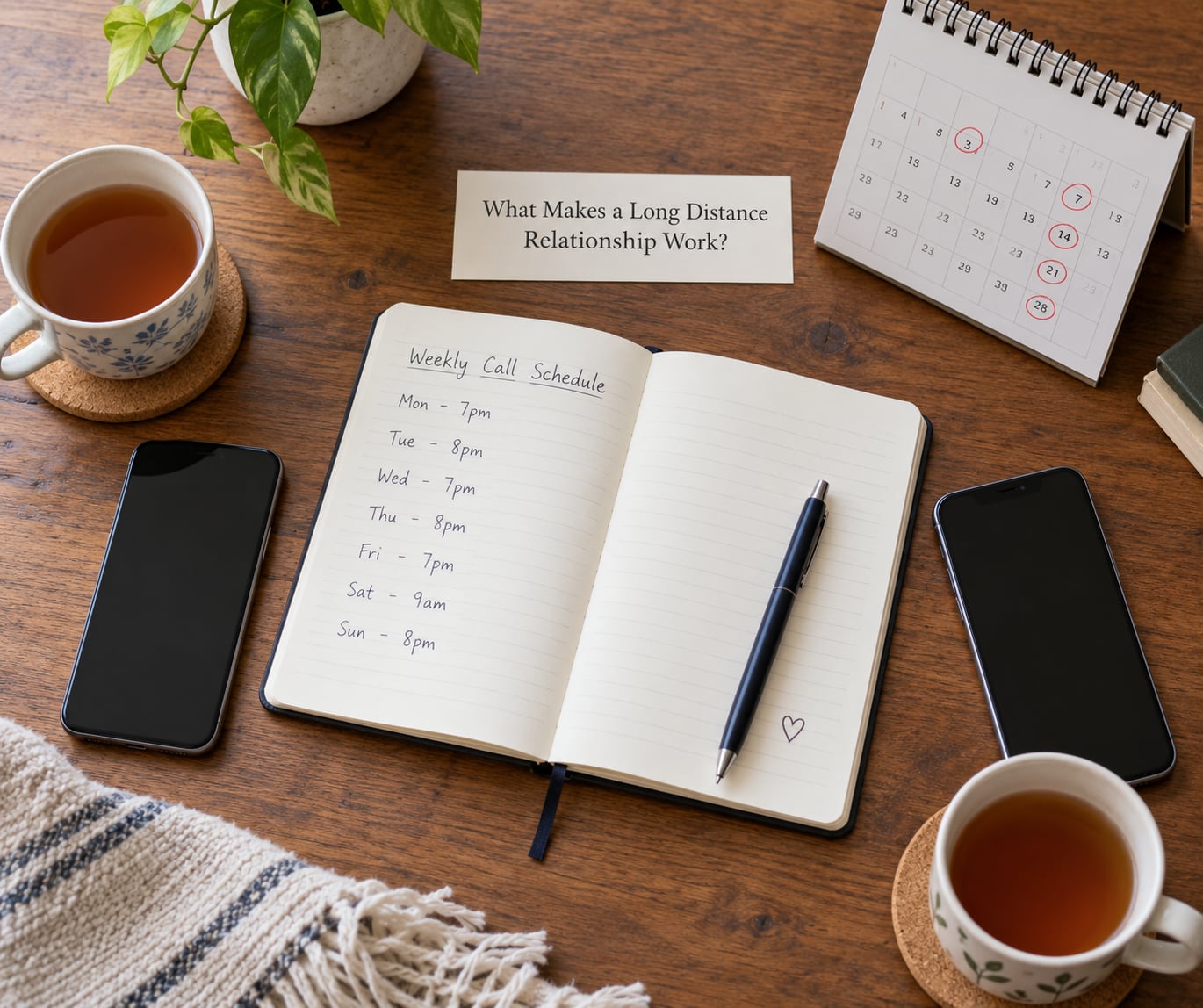
Three things have to be true at once: the communication holds, the trust holds, and there is a plausible route to the distance ending. Miss one and the other two stop carrying much weight.
The type of distance matters more than most people expect. A twelve-month separation with a job that ends and a shared city at the end of it is a very different situation from an open-ended arrangement that both people find comfortable because nobody has to define it.
| Type of distance | What healthy looks like | What to watch |
|---|---|---|
| Temporary and near | A specific reason with a known end, visits every few weeks, calls on a fixed rhythm | The end date keeps sliding forward without a new one being set |
| Medium-term and cross-country | A shared timeline built around work, study or immigration steps | Money, visas and time zones treated as obstacles not to plan around but to ignore |
| Open-ended | Both people are honestly content to keep going and can say why | Nobody wants to be the one to ask when this finishes |
Most research on long distance relationships points the same direction: the couples who do well tend to have a shared vision, regular contact and a positive read on the future. Krapf’s 2018 work found that distance does not by itself predict poorer relationship development, and Dargie and colleagues (2015) identified relationship quality, partner responsiveness and commitment as stronger predictors than physical proximity. Cameron and Ross (2007) likewise modelled survival on attitudes and commitment rather than mileage.
How to Tell: 9 Signs Your Long Distance Relationship Can Work
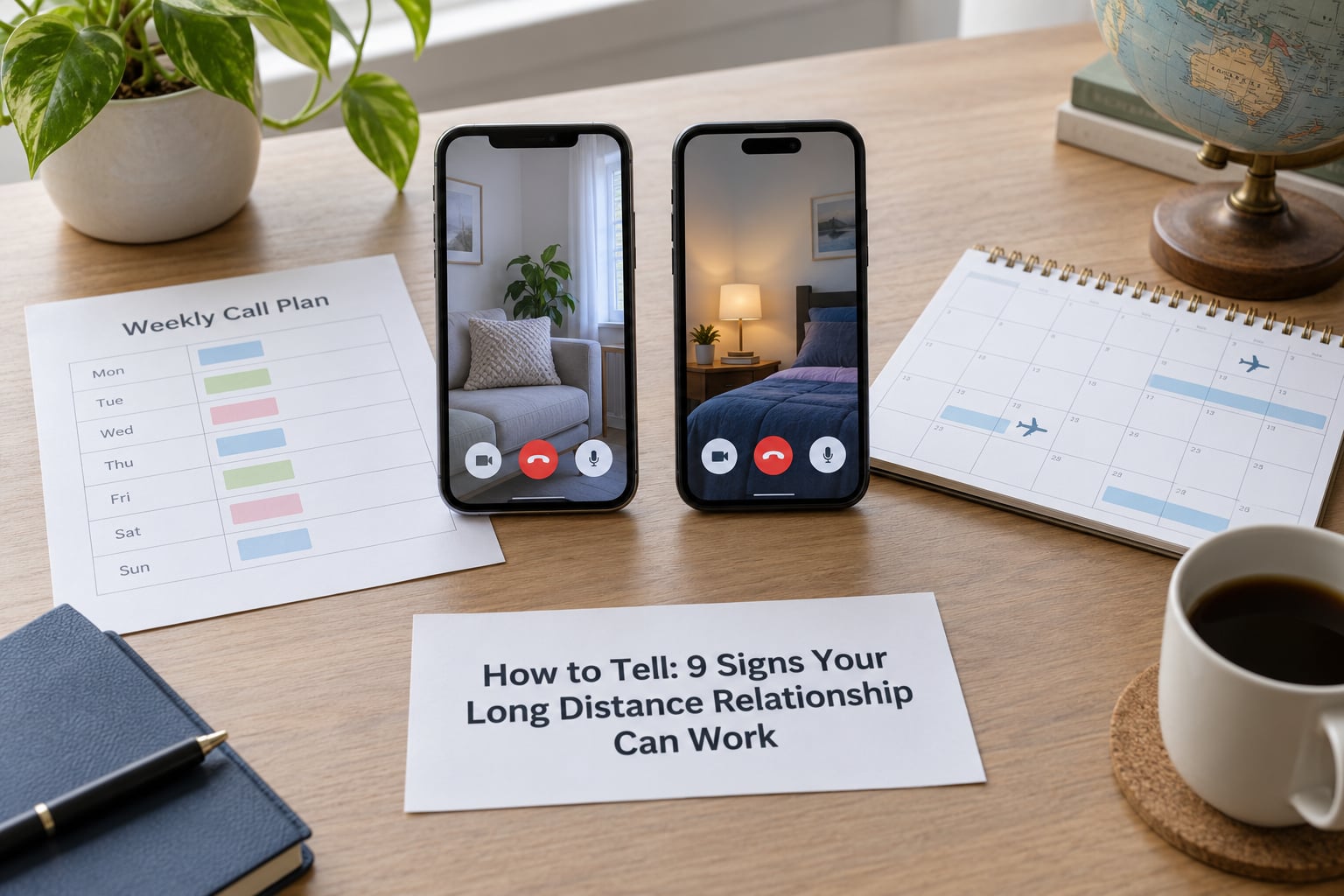
1. Communication Is Reliable, Not Just Frequent
Frequency gets talked about because it is easy to count. Reliability is what actually matters. Your partner answers when they said they would, tells you in advance when they cannot, and does not leave you guessing for two days because something came up.
Scheduled calls beat constant availability. Couples who fixed a set time and stuck to it do better than couples who spend all day texting and never have a real conversation.
2. You Can Talk About Difficult Issues Without Retaliation
Bring up the jealousy, the money, the missed visit, the disagreement about where you both want to be in three years. Watch what happens next. If the conversation turns into punishment, guilt, a shutdown, or a punishment-by-indifference, that is the answer.
Healthy conflict has three moves: each person gets to say their piece, each person can acknowledge the other’s part, and the conversation ends with something decided or at least understood. Gottman’s work on couples puts conflict management above conflict avoidance for a reason.
3. Your Expectations Actually Match
Compare the boring logistics, not the big romantic gestures. Exclusivity. How often you talk and who decides. Whether marriage is on the table and on what timeline. Children, and when. Religion and how it will show up in daily life. Money, savings, and who pays for the flights. Whose apartment is home base. Who does the driving.
Two people can both be reasonable and still be expecting different relationships. Most long distance breakups trace back to a mismatch that neither person thought to say out loud.
4. There Is a Real Plan to Close the Distance
This is the single strongest differentiator between relationships that survive and relationships that fade. One person in a Reddit thread described it plainly: it worked for two years and fell apart when they stopped having a plan, and having an end date made the difference.
A real plan has four parts: what has to happen, who does what, roughly when, and what happens if it slips. “We’ll figure it out eventually” is a feeling, not a plan.
5. Trust Is Backed by Actions, Not Just Promises
Look at transparency that is offered rather than extracted. Phones unlocked and not hidden. Location shared willingly. No deleted messages and no suspicious secrecy about who else is in the picture. Past relationships discussed without contempt or total avoidance.
Trust is not the absence of jealousy. It is the ability to be honest about the jealousy, set a boundary you both agree on, and then let the behaviour settle the worry rather than repeating reassurance.
6. Both of You Are Building Full Lives
People who describe successful long distance relationships almost always mention the same thing: keeping busy, staying independent, having their own friends and goals. A partner with a life outside you is not competing with you. They are the reason you stay a person instead of becoming a waiting room.
The sign to watch is the opposite: your world shrinking. Cancelling friends, dropping hobbies, waiting by the phone. That pattern shows up in threads about relationships going quiet.
7. You Both Show Up for the Visits You Planned
Travel is where plans meet reality, and it is where money, time zones and work schedules get tested. If a visit is postponed twice for vague reasons and no new date is set, that is not bad luck. That is information.
Waterman and colleagues (2017) linked time spent together and adjustment to how long distance relationships hold up, and Guldner and Swensen (1995) found that shared time predicts relationship quality. The visits are not a break from the relationship. They are the test.
8. You Talk About the Future in Specifics
“Someday” is not a plan. Specifics means which city, which month, whose job moves, what it costs, what happens to the lease. Specifics also means you can disagree about the specifics without the conversation collapsing.
Refusing to discuss the future, or calling it too soon after a year of distance, tells you something. So does the opposite: someone building a detailed plan with you in it.
9. The Relationship Improves Rather Than Drains You
After a hard week, do you feel steadier or more anxious? Long distance amplifies emotion because you read tone from a screen, so take your own state as data rather than dismissing it.
The relationship should feel like somewhere you get energy, not somewhere you go to be managed. Anxiety that does not settle after a good conversation, or needing the same reassurance repeatedly with no change, is a sign worth taking seriously rather than analysing.
What to Ask Before You Make a Long Distance Decision
Before you decide to stay, set an end date, or step away, work through these together. Answering them about your partner, then about yourself, takes about half an hour and gives you more clarity than a month of worrying.
On commitment: are we exclusive, and what does exclusive mean to each of us? Are we building toward being in the same place, and what is the latest we would both be okay with still being apart?
On the plan: what specifically has to happen for the distance to end? Who moves, or who does not? What does it cost, and who can carry that cost? What is our backup plan if one job falls through?
On expectations: how many days a month do we actually see each other, and how many hours a week do we actually talk? What do we each expect the other to do when one of us is struggling?
On boundaries: what are we comfortable with in terms of friendships and social media? What would count as a breach, and what would we do about it? Do we each have people we can talk to about this relationship who are not the other person?
On the hard part: if this argument happens again in six months, how will we handle it differently? What does each of us need when we are jealous, and can the other person actually deliver that?
When Distance Is Not the Main Problem
Plenty of people describe distance as the reason a relationship failed when distance was the setting rather than the cause. Mistrust, mismatched values, weak conflict skills, or someone who has quietly stopped participating will break up in any zip code.
A useful test is to ask whether you would be happier with this person in the same city. If the honest answer is no, relocating will not fix it. It will just move the problem somewhere with better weather.
How to Know If You Are Just Telling Yourself It Is Fine
This is the question that runs through most of the honest writing on long distance relationships. Several people in the same Reddit thread asked how couples know they are actually doing okay rather than reassuring themselves.
Relational uncertainty describes exactly this state: you cannot observe the relationship directly, so you fill the gap with your own hopes and fears. It tends to rise when contact is inconsistent, and it makes small messages feel enormous. Attachment anxiety amplifies it further, which is why a delayed reply can feel like rejection rather than a scheduling problem.
Some checks that help. Compare this month to last month: are calls more frequent, less frequent, or identical? Are you having new conversations or the same loop? Would you describe the relationship the same way if a friend asked you about someone else’s? If the honest description has been shrinking for months, you have your answer.
How Long Should You Test a Long Distance Relationship?
There is no honest waiting period, and anyone who gives you one is selling something. What works is a review schedule rather than a verdict date.
Set a real check-in at three months, six months and then twice a year. At each one, look at three things: is the plan to close the distance more concrete than it was last time, are visits happening at roughly the rate you agreed, and do you both still want this. If the answer to the first has been no twice in a row, the relationship is running on habit.
Change the review when circumstances change. A new job, a visa decision or a finished degree should trigger a new plan, not a new indefinite wait. If the end date has slipped three times and nobody has replaced it, treat that as the decision point rather than waiting for a fourth.
The 3-6-9 rule you may have heard about says to assess a relationship at three, six and nine months. It is a reasonable prompt for a new relationship generally, and it works here too as a reminder to check the plan instead of drifting.
Frequently Asked Questions
How often should you talk to your long distance partner?
Aim for consistency rather than volume. Fixed call times, even two or three a week, beat being available all day with nothing real to say. Text throughout the day for ordinary contact, then keep one longer call or video session for the things that matter. Researchers studying long distance couples consistently find that partner responsiveness predicts outcomes better than raw contact hours.
What are the signs a long distance relationship is not working?
Watch for contact that decays without either person mentioning it, visits that get repeatedly postponed with no new date, secrecy around phones or social media, a refusal to discuss the future, and one person’s world shrinking as they wait. Growing contempt or cynicism matters more than any single missed call. Distance is rarely the cause, so look at what is happening underneath it.
What is the 777 rule for long-distance relationships?
The 777 rule refers to spending seven days together, staying in touch for seven hours a day, and going seven months without seeing each other. People mention it as a way to describe the effort involved, sometimes as a target for commitment. Treat it as a rough description of the pressure rather than a rule: no single ratio predicts success, and couples with different needs build different rhythms that work fine.
What destroys a long distance relationship?
An open-ended wait with no plan to close the distance is the most commonly reported killer. After that come quiet drift in communication, jealousy handled by avoidance, unaddressed money or logistics stress, and slowly replacing real knowledge of each other with an idealised version. Most of these show up as behaviours months before anyone decides to end things, which is why watching them early matters.
Should I end my long distance relationship?
If there is a shared plan, contact that holds, and the relationship leaves you steadier rather than more anxious, there is nothing in the distance itself telling you to leave. If you have no plan, cannot raise hard topics without punishment, or have spent months shrinking your own life while waiting, the honest answer is usually yes. Write the reasons down before deciding so you are reacting to facts rather than a bad week.
How can I tell if my partner is committed from far away?
Watch reliability rather than words. Do they answer when they said they would, reschedule early when plans change, and put specific dates and places on a plan to close the distance? Commitment at a distance shows up as inconvenience absorbed rather than avoided. Someone who cannot commit to a visit date, a call time or a conversation about the future is telling you something about the bigger commitment too.
Start with the one you already suspect. Write down which of the nine signs are genuinely there, and which ones you are grading generously because you want a different answer. Then have the conversation in the question list above, with the answers written down.
If the plan to close the distance is real, specific and shared, you have something most long distance relationships never have. If it is not, you have your answer too.