A cleaning schedule that works is a written plan that gives every recurring household task a frequency, a time slot and an owner, then gets reviewed on a fixed rhythm. Build it in five steps: list everything, sort by frequency, match tasks to the week you actually live, split big jobs into 15-30 minute pieces, and test it before you commit.
Most schedules that fail were built for an imaginary household, not the one you live in during 2026. Somebody designed a plan for someone with two free hours on a Saturday morning and no children, then wondered why it lasted nine days.
The shift that matters is small: stop treating cleaning as a mood and start treating it as a set of appointments. Appointments get moved when they conflict. Moods get skipped.
Table of Contents
- What You Need
- Step-by-Step
- Step 1: List Every Recurring Cleaning Task
- Step 2: Group Tasks by Frequency
- Step 3: Match Tasks to Your Real Schedule
- Step 4: Assign Ownership and Accountability
- Step 5: Test, Adjust, and Repeat
- Common Mistakes
- Frequently Asked Questions
- What is the best cleaning schedule for a busy household?
- How often should I clean each room in a typical home?
- How do I make a cleaning routine stick when I have little time?
- How should I split cleaning responsibilities with family or roommates?
- What should I do when my cleaning schedule gets interrupted?
- Start Small and Build From There
What You Need
You need less than most guides imply. A pen, a calendar and about 30 minutes of honest thinking will get you further than an app or a stack of printed planners.
- A master task list. Every job that recurs in your home, written down in plain words. Vague entries like “tidy up” are useless here.
- A calendar or weekly planner. Paper works if paper is what you will actually look at. So does a shared spreadsheet.
- Time estimates. A rough honest guess per task, because most schedules fail on time, not motivation.
- Your supplies. Dish soap, an all-purpose surface cleaner, a glass cleaner, microfiber cloths, a broom or vacuum, a mop, bin bags, and a bathroom cleaner. Buy the basics before building the routine, not during.
- Your constraints. Work hours, school runs, shift patterns, pets, young children, a partner who travels, a home with stairs. Write these down too. A schedule that ignores them is fiction.
Also decide what “done” means to you. A house where surfaces are wiped and floors are vacuumed reads as cared for. Chasing a show-tour-level finish is how people end up cleaning for four hours and resenting it.
Step-by-Step
Step 1: List Every Recurring Cleaning Task
Write down every task that repeats. Walk room by room rather than trying to remember in the abstract, because memory misses the things you do on autopilot.
For each room, ask three questions: what gets dirty here, how often, and how long does it take to reset? A typical list for a three-bedroom home lands somewhere between 30 and 45 tasks.
- Kitchen: dishes, wipe counters, load and run the dishwasher, empty the food scraps, clean the stovetop, mop the floor, clean out the fridge, wipe cabinet fronts.
- Bathroom: wipe the sink, scrub the toilet, clean the mirror, mop the floor, restock soap and toilet paper, change the towel.
- Living area: tidy cushions, dust surfaces, vacuum, wash the dishes from the side table, clear the floor of shoes and bags.
- Bedroom: make the bed, change the bedding, clear surfaces, vacuum, wash bedding.
- Entryway and laundry: take out rubbish and recycling, wipe shoes down, wash and dry a load, fold it, put it away.
- Whole house: dust, vacuum or mop floors, change bed linen, wash the kitchen and bathroom mats, clean the inside of windows, check outside gutters and drains.
Next to every task, write a number: how many minutes, honestly. A toilet takes three minutes. A toilet plus the wall behind it takes twelve. That difference is where most weekly time budgets quietly break.
Step 2: Group Tasks by Frequency
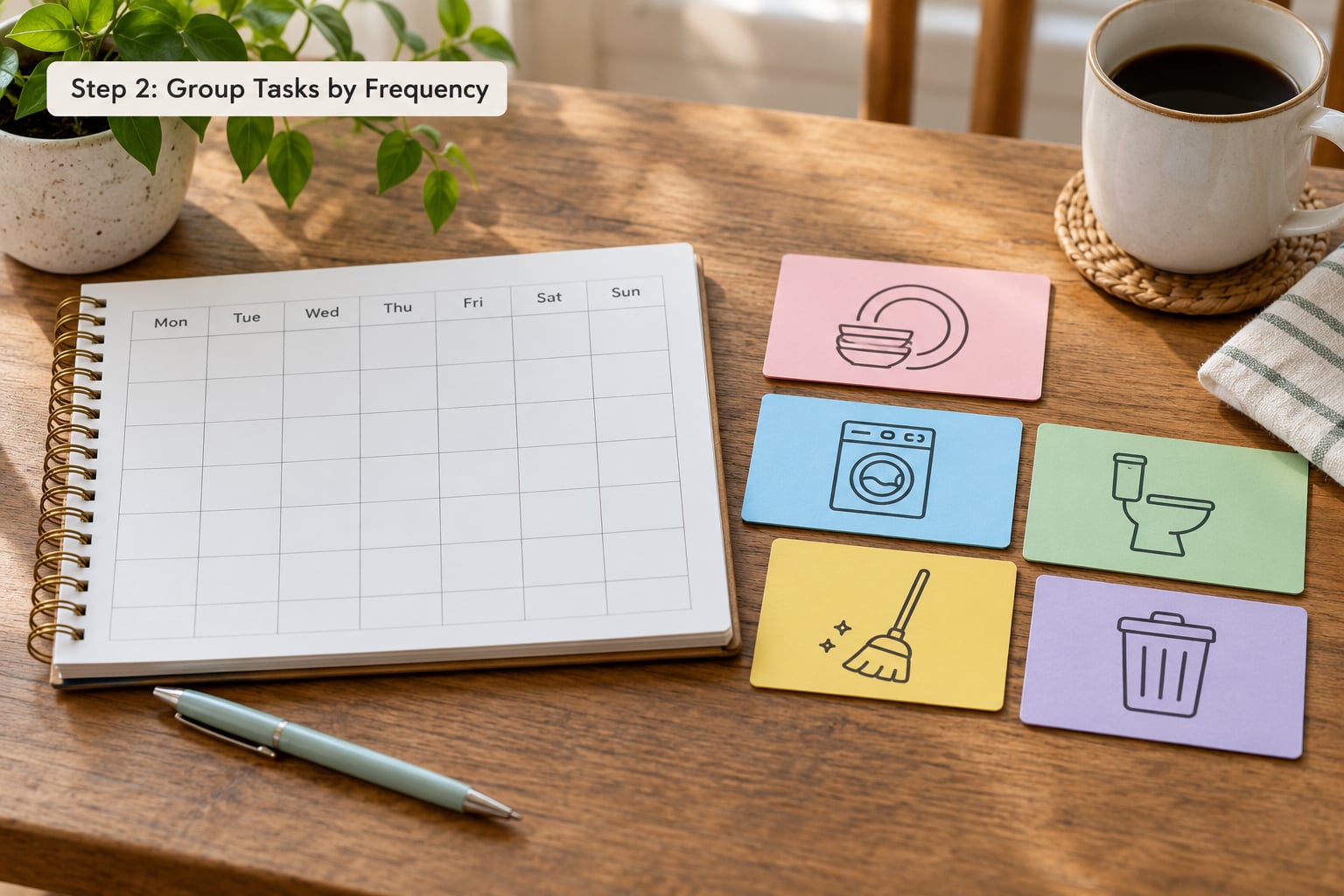
Sort the list into buckets: daily, every other day, weekly, biweekly, monthly, seasonal. Grouping works because it removes the daily question of what to clean. Nobody has to decide at 7pm whether tonight is towel night.
Daily. Dishes, counters, food scraps, bathroom sink and toilet, one load of laundry started, floors kept clear of clutter, beds made.
Every other day. Vacuum the living area, mop hard floors, clean the shower, take rubbish out, wash bedding.
Weekly. Floors throughout, bathroom deep clean, mirror and taps, kitchen surfaces and appliance fronts, dust, empty the vacuum, change all towels and bedding, wipe the light switches and door handles.
Monthly. Inside of the oven, fridge shelves and drawers, underneath furniture, baseboards, windows, the bathroom cabinet interiors, filters, the pantry.
Seasonal. Gutters and drains, the exterior of windows, the airing cupboard, the dryer vent, the garage or loft, cushions and soft furnishings, pressure-washed paths if you have them.
Two rules keep this honest. A task that is not assigned to a specific day has not been scheduled, it has only been thought about. And if the daily bucket holds more than about 20 minutes of work, something in it is not actually a daily task.
Step 3: Match Tasks to Your Real Schedule
This is where schedules live or die. Put the tasks into windows you genuinely have, at a time of day when you have the energy for them. A 20-minute session after the kitchen is quiet at 8pm works far better than a heroic Saturday block nobody protects.
Use three kinds of window:
- Short reset periods. Five to ten minutes between other things: clear the kitchen counters after dinner, run one load of laundry, wipe the bathroom sink on the way out of the shower.
- A morning routine. Make the bed, clear the nightstand, run the dishwasher, take rubbish out. Ten minutes, done before the day starts competing for attention.
- A weekend block. One longer session for floors, the bathroom, and the monthly job. Two hours with a podcast on handles most of a weekly list.
Work top to bottom and high to low within each room. Dusting top-down stops you from dusting a surface you are about to dirty again, and a top-to-bottom pass means dirt falls onto floors you have not done yet, not ones you already finished.
Match the size of the session to the size of the home. A one-bedroom apartment needs about 15-20 minutes a day plus one weekly hour. A family home needs 25-40 minutes plus two hours. A house with three bathrooms and a lot of stairs needs closer to an hour daily. Do not copy someone else’s number because it was written for a different building.
Never start a task you cannot finish. If it does not fit in the time you have, shrink it until it does. Wipe the counters, not the whole kitchen. Vacuum one room, not the whole house. A task left half-finished is worse than a task never started, because now there is a visible reminder that you failed.
One household I read about years ago made this point the hard way. Two adults, toddlers and a newborn, neither of them taught to clean, and every routine they tried collapsed for the same reason: they started tasks and did not finish them. A husband who ran a schedule around his own working day kept his consistently. The difference was never discipline. It was a plan sized to one person’s actual capacity.
Design for the worst day, not the best one. Decide in advance what a minimum viable cleaning day looks like: dishes loaded, counters wiped, rubbish out, bathroom sink wiped, laundry started. On a bad day, do that and stop. Ten minutes that always happens beats an hour that happens twice a month, and it keeps the routine alive rather than resetting it.
Then pick how you will track all of this.
- Paper chart on the fridge. Zero setup, visible to everyone, and the fastest option for a household that does not use shared devices.
- Spreadsheet. Best for sorting by frequency, owners or rooms, and for anyone who wants to see a month at a glance. Columns for room, task, frequency, day, owner and minutes.
- Cleaning app. Useful when you want reminders that ping, or when several adults need the same list on their phones. Check the privacy settings before you put a whole household’s routine into one.
- Chore chart. Necessary once children are involved, mostly because the reward structure is the point.
For neurodivergent households, a few design choices help more than any app. One task on the page at a time. A visible timer so the session has an end. Body doubling, cleaning alongside a podcast, a video or another person. An open-then-close loop, so every session ends with something put away rather than something merely started. A minimum viable day, written down in advance, so a low-capacity day has instructions rather than requiring a decision.
Step 4: Assign Ownership and Accountability
Shared homes fail on a specific issue: one person does the cleaning while another person holds the schedule in their head. Fix it by separating who does a job from who tracks it.
Assign rooms, not tasks. “Bathrooms are yours, all three, including the restocking” is a job a person can finish. “Someone should do the bathroom this week” is a job nobody finishes. Room ownership also removes the negotiation that happens when three people each assume a different person handled the kitchen.
Split by availability and preference, then rotate the jobs nobody wants. Toilets, the oven and the bins are the classic three. A rotation on a four-week cycle keeps the same person from getting stuck with them forever, and it gives you a natural slot for a monthly review.
Put the list somewhere shared and keep it simple: task, day, owner, done. A physical tick or a coloured dot is enough. Skip anything that becomes a performance review, because the moment cleaning turns into something being judged, the weakest person in the household stops volunteering.
For children, match the task to their age and their actual attention span rather than a chart that says so. A seven-year-old can sort laundry and water plants. Nobody needs to be assigned the bathroom.
Step 5: Test, Adjust, and Repeat
Run the schedule for two weeks before judging it. One week is too short to see a pattern, and three weeks is long enough to start resenting it.
Track four things, and keep tracking simple enough that you will actually do it:
- Completion. Which tasks got done, which were skipped, and which got skipped twice.
- Actual time. Compare your estimate with reality per session. Most people are off by 50 percent on at least one task.
- Overload days. Which day of the week consistently collapses.
- Mental load. Whether one person is still absorbing every unplanned job that nobody claimed.
You will know the schedule worked if three things are true: the main living spaces stay uncluttered without a weekend rescue, laundry gets handled before it becomes a pile, and you are doing fewer frantic cleaning sessions. You do not need a perfect score, and you will not get one.
Adjust in this order. First, move tasks off the day that always fails, before changing anything else. Then shrink the tasks that get abandoned rather than the ones that are unpopular. Then change frequency, moving something from daily to twice a week before you delete it. Change ownership last, since the owner is usually the only variable you control least.
Once the schedule survives two weeks, treat it as the new normal and add the monthly and seasonal anchors to your calendar. A good year has roughly twelve deep-cleaning anchors spread across it: oven one month, fridge the next, windows and gutters in the milder months.
Common Mistakes
Overloading one day. Everything lands on Saturday, Saturday gets skipped, and the whole plan takes a hit. Correction: spread weekly tasks across three or four different days. The goal is a rhythm, not a marathon.
Scheduling everything at night. Cleaning at 9pm after a full day works for about two weeks. Correction: move what you can to mornings and to the gap after dinner, and cap the evening session at 20 minutes.
Writing tasks too vaguely. “Do the kitchen” is a mood, not a task. Correction: name the object and the stop point. “Wipe counters and load the dishwasher, 10 minutes.”
Ignoring what people prefer. Some people will happily do the bathroom and never want to touch the bins. Ask once, take the answer seriously, and stop relitigating it every week.
Skipping the supply setup. Hunting for a cloth at 9pm is a reason to stop. Correction: one caddy per floor or per room, pre-filled. Keep it simple: a spray bottle, a cloth, gloves, and bin bags.
Treating one missed day as failure. A skipped day feels like proof the system does not work, so you abandon it entirely. Correction: have a recovery rule. Missing a day means doing the minimum viable day next time, not restarting on Monday.
Assuming motivation will carry it. Cleaning rarely feels rewarding in the moment. Correction: pair the session with something you enjoy, a podcast, music, a show that is only allowed while cleaning. People who set a visible timer also finish more often, because the finish line is visible rather than imagined.
Three habits make the difference for most households. Attach tasks to things that already happen, run the dishwasher straight after loading it rather than as a separate evening decision, and set a default minimum so a bad day still produces something. Write the plan where you can see it, since a schedule you have to remember is a schedule you will skip.
One more option worth considering: if the schedule is consistently failing because two full-time adults are both exhausted, that is a workload problem, not a discipline problem. Hiring help a few times a month for the deep-cleaning jobs, and keeping the daily tasks for the family, is a common pattern that costs less effort in planning than it recovers.
Frequently Asked Questions
What is the best cleaning schedule for a busy household?
Keep daily tasks to 15-30 minutes spread across three or four short sessions, not one long evening block. Group tasks by frequency, assign each one a day and an owner, and schedule one longer weekly session for floors and the bathroom. The schedule that works is the one you can complete on your worst day, not your best one.
How often should I clean each room in a typical home?
Kitchen and bathroom surfaces need daily attention: dishes, counters, the sink and the toilet. Floors need vacuuming or mopping every other day in busy homes, weekly in quieter ones. Dust, mirrors, taps and light switches are weekly. Inside the oven, fridge shelves, baseboards and windows are monthly tasks. Start there and adjust to how your home actually dirties.
How do I make a cleaning routine stick when I have little time?
Shrink the routine until it fits the time you really have, then run it for two weeks before changing anything. Never start a task you cannot finish in the session, set a timer so the end is visible, and define a minimum viable cleaning day: dishes loaded, counters wiped, rubbish out, laundry started. A short routine you repeat beats a long one you abandon.
How should I split cleaning responsibilities with family or roommates?
Assign rooms rather than individual tasks, so each person owns a complete, finishable job. Rotate the jobs nobody wants, such as toilets, the oven and the bins, on a four-week cycle. Keep one shared list with the day and owner for each task, and separate who does the cleaning from who tracks it, since an untracked chore usually falls to one person.
What should I do when my cleaning schedule gets interrupted?
Do not restart from scratch and do not write the week off. Run your minimum viable cleaning day to get back on track, then resume the schedule on its normal slot rather than doubling up. Note what broke the run, usually an overloaded day or an undersized time window, and fix that one variable before testing the routine again.
Start Small and Build From There
Pick one daily task, one weekly reset and one monthly deep-cleaning job today. Write them on the calendar in the exact slot, give each one an owner, and leave everything else off for now.
Run that version for two weeks. At the end, ask one question: what did not happen? Move that task, shorten it, or drop it, then test again.
A schedule you can keep for a year beats a schedule you abandon in a month, and the only way to find the one that lasts is to test it against your actual week rather than an imagined one.