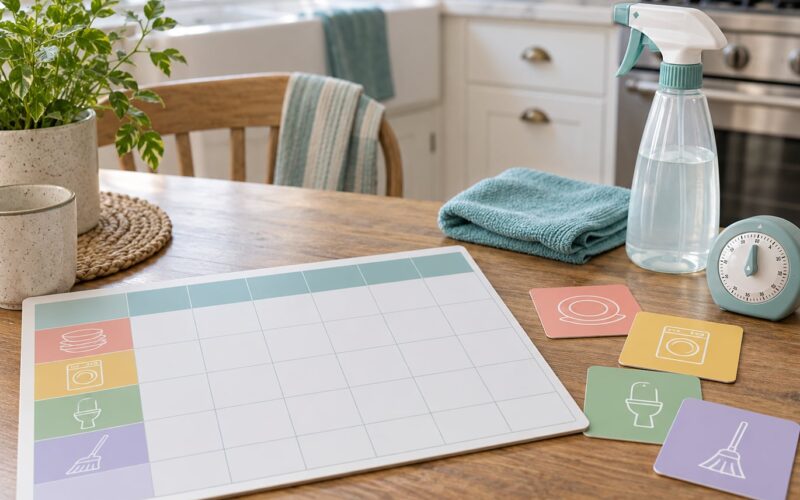
You stick to a laundry routine by keeping the total amount of dirty clothes small enough that one short load a day is always enough. That takes three things: a home for clothes in every room, one fixed time tied to something you already do, and folding put away the same day. The setup takes about an hour. After that it is a fifteen-minute job that mostly disappears into the rest of your day.
Laundry is harder to systematise than dishes or making a bed for one specific reason: it never visibly finishes. Dishes go into a cupboard and the counter is clear. Laundry goes into a drawer and produces a new pile of dirty clothes in the same hour. There is no end state to reach, so nothing signals that today is the day.
That is also why the fix is not more determination. Almost everyone who keeps up with laundry does it the same way, with small loads, fixed triggers, and a hard rule about wet clothes. Here is how to stick to a laundry routine that survives a bad week, not just a good one.
Table of Contents
- What You Need
- Step-by-Step
- 1. Create a Simple Sorting System
- 2. Set Trigger-Based Laundry Times
- 3. Run the Smallest Possible Load
- 4. Make Folding and Put-Away Fast
- 5. Use a Weekly Reset and Flexible Backup Plan
- Common Mistakes
- Frequently Asked Questions
- How many loads of laundry is normal a week?
- How do you keep laundry organized?
- Why do ADHD people struggle with laundry?
- How do you stick to a routine with ADHD?
- What do you do when the laundry basket is overflowing?
- How do you stop wet laundry from sitting in the machine?
- Conclusion
What You Need
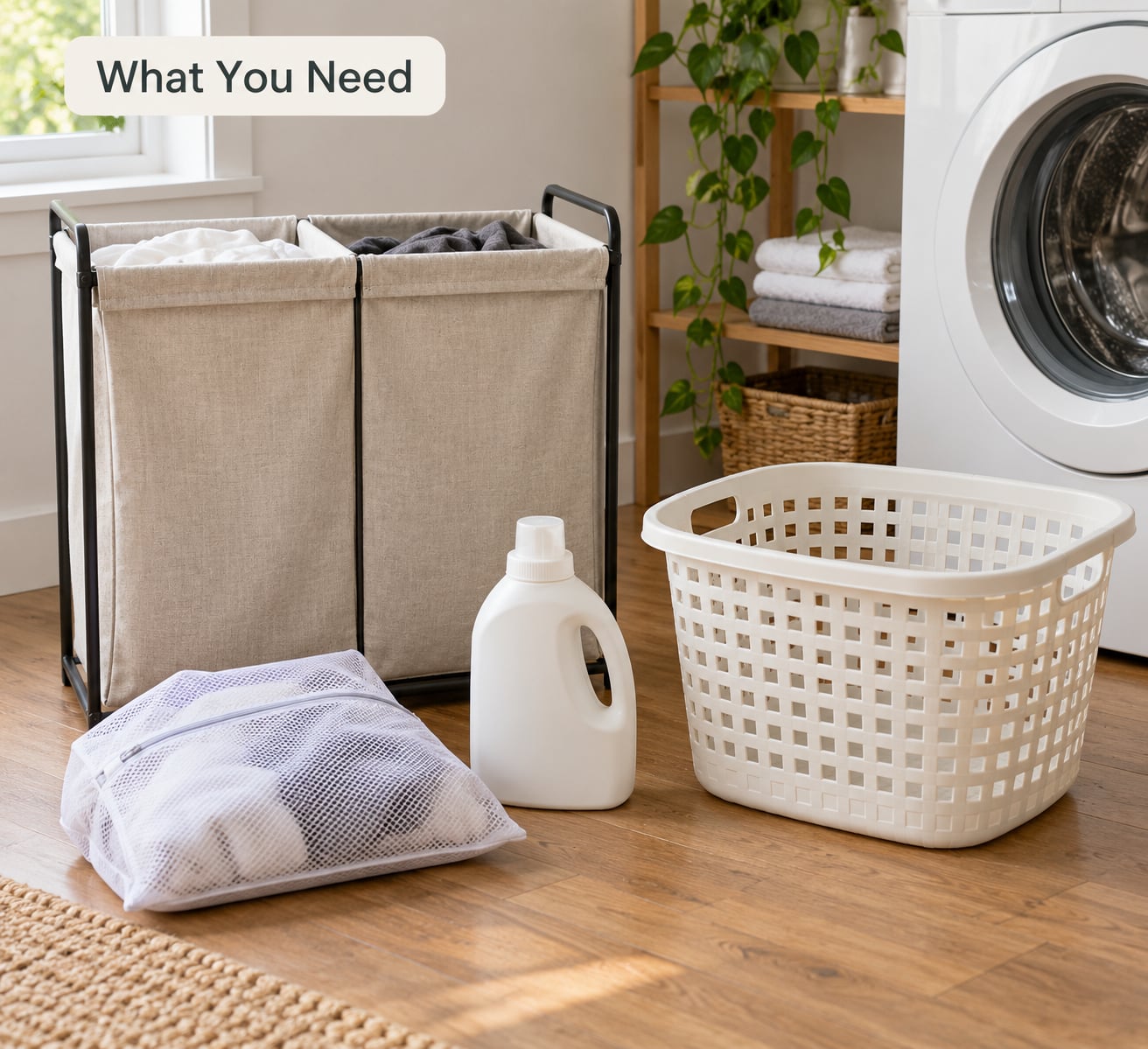
None of this costs much and almost all of it is ordinary household kit. The point of gathering it before you start is that a routine fails on logistics far more often than it fails on effort.
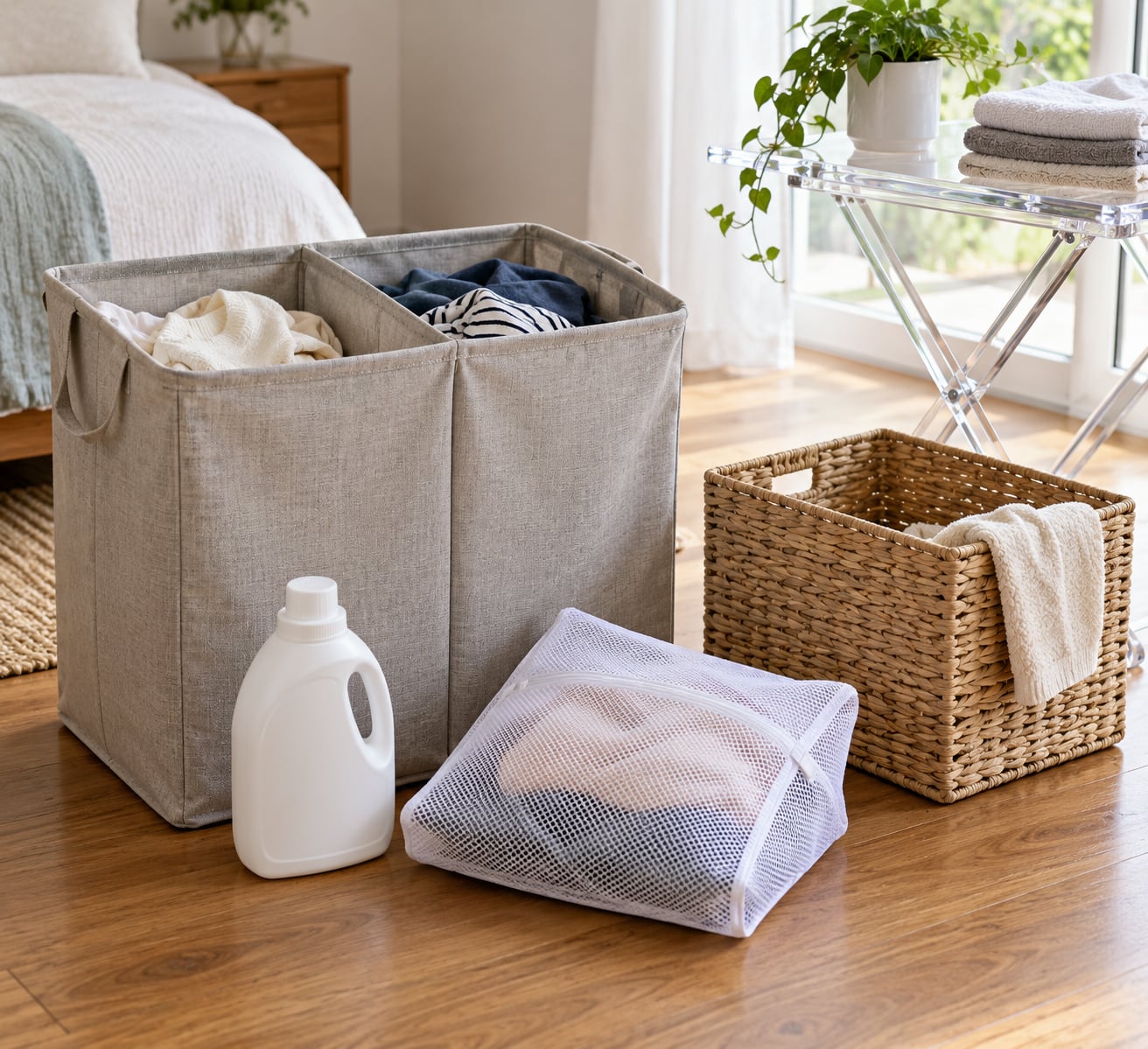
- A hamper in every room where clothes come off. Bedroom, bathroom, entryway. If someone has to carry clothes to the laundry room, some days they will not.
- One basket per person. This is the single change that makes putting away fast, because clean clothes get sorted once instead of three times.
- Detergent, and a mesh bag for delicates. Delicates that vanish into a hot wash take the whole load with them.
- A timer or phone alarm. You need one alert for the end of the wash and one for the end of the dry. This is not optional if you want to stop smelling musty clothes.
- A folding spot that is already clear. A bed, a dining table, a mat on the floor. It has to be a surface you are willing to clear twice a day.
- A drying rack or clothes horse if you have anywhere to put one. It is the difference between a workable routine and a broken one in homes without a tumble dryer.
If you use a laundromat, have a wash bag per person and a folding trolley or a large tote, because the folding table at the laundromat is the only place the habit can happen. If you have no washing machine at all, the same system still works, with hand-wash batches for urgent items and a weekly laundromat trip for the rest.
Step-by-Step
1. Create a Simple Sorting System
Sort in the order that saves you decisions later. First by person, because that decides where the clean clothes go. Then by colour, then by fabric, then by urgency.
Most people sort by colour and wonder why putting away takes twenty minutes. If every load contains four people’s socks, the whole basket gets re-sorted at the drawer. Sorting by person instead means the basket comes out of the machine and goes straight into that person’s cupboard.
Keep the categories few. Three covers nearly every household: darks and colours, lights, and delicates or anything needing a cooler wash. Bedding, towels and sports kit get one extra slot and run once a week rather than daily, because nobody generates a full load of sheets a day.
Your check for this step: sorting a day’s worth of clothes should take under three minutes. If it takes longer, you have too many categories.
2. Set Trigger-Based Laundry Times
Pick a time that already happens in your day and attach laundry to it. The anchor has to be something you never skip, which usually means a meal, the kettle boiling, or the last person going to bed. Doing laundry once the kids are asleep is the most common parent anchor because it is the one unclaimed window in the evening.
Set a real end point. Fifteen minutes is honest for a small load, and twenty-five is fine on a weekend. Put the timer on for that length and stop when it goes off even if the folding is not quite finished, because a session that always overruns becomes a session you start dreading.
Stack it onto something you already tolerate. Laundry does not need new willpower; it needs a fixed slot. People who keep it up usually run it alongside something else, folding while a podcast or an episode plays, which turns dead time into tolerable time.
Your check for this step: you can name the day of the week and the clock time without hesitating. If you cannot, the trigger is not specific enough to hold.
3. Run the Smallest Possible Load
Do not wait for a full hamper. Wash whatever is in the basket today. One load a day works for most people, but the useful number depends on how many people are generating clothes:
- One or two people: 3 to 5 loads a week, most days with a single small load.
- Three or four people: 5 to 7 loads a week, roughly one on most weekdays.
- Five or more people: 7 to 10 loads a week, which usually means daily loads plus a fixed catch-up slot.
These are load counts, not basket counts, and they assume everyone is putting clothes straight into a hamper rather than on the floor. The fix for a big household is delegation rather than longer sessions, which is covered in step 5.
In a small apartment machine, resist overfilling the drum. Clothes need room to move for a proper wash, and a packed drum ends up costing you a second wash anyway. A partial load on a short cycle is faster than a full load that needs redoing.
Your check for this step: you hang or transfer the load the moment the machine stops. Anything else is how laundry quietly rebuilds while you sleep.
4. Make Folding and Put-Away Fast
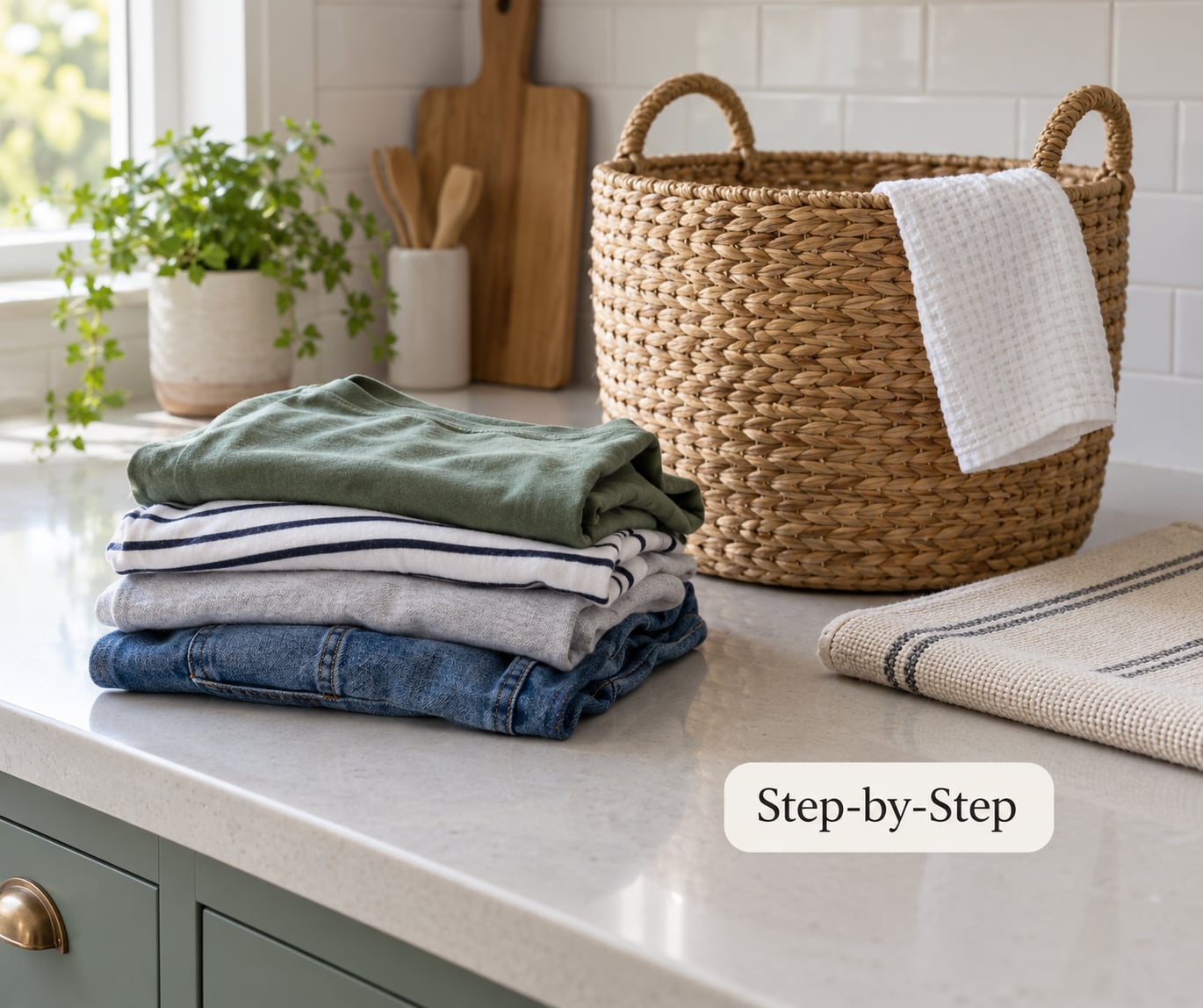
Fold the load before you sit down, sit down for anything, or open anything else. This is the do-it-now rule and it is the reason most routines hold: clean clothes that stay in a basket are still a task waiting for you, just a nicer-looking one.
Have a sequence so you never re-decide mid-load. Pull out matching pairs first, then singles, then anything that does not pair, then towels and bedding. Set aside the two items that need hanging and deal with them last, once everything else is in the cupboard. Fifteen items is usually one load; fifteen minutes is usually enough.
Put away by person, not by category. Each basket gets carried to that person’s room and emptied in one go. Your check for this step: no basket of clean clothes survives the evening.
5. Use a Weekly Reset and Flexible Backup Plan
Once a week, spend ten minutes looking at the system rather than the clothes. Empty the hampers, wipe the machine door seal, check you have detergent and enough bags for the next few loads, and glance at whether anyone in the house is still abandoning clothes on the floor.
Set a backup slot for the week rather than a second daily slot. One fixed window where anything that did not get done happens, on a day you choose in advance. People who skip two days in a row are the ones who end up with a pile; one missed day is noise, two is a spiral.
Delegate by age, starting at the age when sorting and hanging is realistic. Younger children fill one basket and hand it over. Older children sort, wash, fold and put away their own clothes, paid a fixed weekly amount for the whole job rather than per load, so a light week is not a pay cut. Adults get their own basket and their own load, no exceptions.
Cut volume where it actually is. Wearing an item a second time before washing it is the fastest reduction available and it costs nothing. Fewer categories means fewer baskets and fewer decisions. Declutter anything that has not been worn in six months, because every item in the wardrobe is a future load.
Your check for this step: your weekly load count matches your household size and nobody in the house owns a job you are still quietly doing yourself.
Common Mistakes
Waiting until you feel motivated. Motivation is a variable and the pile is not waiting for it. The fix is a trigger attached to something you already do, which is why step 2 matters more than any product or technique.
Waiting for a full hamper. A full hamper means a longer session, and a longer session is exactly what gets skipped. Small loads beat big ones because you can finish one on a bad evening.
Leaving damp clothes in the washer or dryer. This is the most common cause of a house smelling musty, and the fix is boring: two alarms, one for the end of the wash, one for the end of the dry. Ten minutes of fold time is worth more than rewashing everything.
Skipping the put-away step. Clean laundry in a basket is not progress, it is storage. Fold and put away in the same session, even if it takes longer.
Making the schedule too ambitious. A two-hour Sunday wash is a schedule that fails every busy week. Fifteen minutes a day is smaller, easier to keep, and adds up to more than the marathon ever did.
Trying to fix it alone from day one. If you share laundry, you share the job. Set up the baskets, hand out the ownership, and stop absorbing.
Frequently Asked Questions
How many loads of laundry is normal a week?
One or two people usually manage 3 to 5 loads a week. Three or four people need around 5 to 7, and households of five or more often run 7 to 10. These figures count loads, not baskets, and they only work if clothes go into a hamper straight away. If your number is double these and you are spending more than an hour a day on laundry, the problem is volume or delegation, not your routine.
How do you keep laundry organized?
Keep it physical and shallow. A hamper in every room where clothes come off, one basket per person, three sorting categories at most, and a clear folding surface already set up. Sort by person first so clean clothes skip the drawer-level sort. Fold the same day you wash and put each basket straight into that person’s cupboard. Ten minutes on the weekly reset keeps hampers empty and stops piles from rebuilding.
Why do ADHD people struggle with laundry?
Laundry is a multi-step task with no visible finish line, which is two things executive function struggles with: starting without a clear trigger and stopping when the task does not declare itself done. The backlog then grows quietly, and an intimidating pile makes starting harder still. Timers, one load at a time, and removing any decision you can remove from the task usually do more than motivation does.
How do you stick to a routine with ADHD?
Attach the routine to a fixed cue rather than a decision, because deciding to do laundry each day is where routines collapse. Use visual cues in the same place every time, one basket per activity so no sorting decision is needed, and a timer to end the session. Keep the minimum version genuinely tiny: one basket, one load, folded and put away. Repeat that for two weeks before adding anything.
What do you do when the laundry basket is overflowing?
Do not try to clear it in one session; that is how people end up on the sofa surrounded by clean laundry. Triage instead: deal with underwear, socks and basics first, then workwear, then bedding and anything seasonal. Run one load a day until the pile is gone, and drop your categories to two so each load takes less sorting. Have one basket ready by the machine so you always start from the same place.
How do you stop wet laundry from sitting in the machine?
Set a phone alarm for the end of the wash and another for the end of the dry, and treat them as hard stops. Wet clothes sitting for hours pick up a smell that means redoing the whole load, which is the fastest way to build a backlog. If you hang laundry out, set the second alarm for when you expect it to be dry rather than relying on noticing.
Conclusion
Pick one time of day you already keep, put a hamper in the room where clothes are abandoned most, and run one basket through the machine. Fold it and put it away before you sit down, and repeat tomorrow. That single repeat is the whole routine; everything else in this guide is there for the weeks when a load goes wrong.