To buy a used car without getting ripped off, negotiate the out-the-door price rather than the monthly payment, and pay only after an independent mechanic has inspected the car and the VIN, title and history records check out. Slow down on the seller’s schedule. Your schedule, your inspector, your numbers.
Getting a fair deal comes down to preparation before you ever walk onto a lot: know what the car is worth to other buyers, know what you can spend all-in, and know what evidence you need before money moves. Getting cheated usually means skipping one of those three steps, not bad luck.
The whole process takes a few weeks if you do it properly, and two or three hours on a Saturday if you don’t. This guide walks through what to gather first, an eight-step process from budget to bill of sale, the mistakes that cost first-time buyers the most, and how to negotiate when the seller is used to holding firm.
One note before we start: taxes, fees, inspection costs and market conditions vary by state and change over time. Treat the numbers here as planning ranges, not quotes.
Table of Contents
- What You Need
- Step-by-Step
- 1. Set a firm budget before you shop
- 2. Compare listings before viewing a car
- 3. Verify the VIN and ownership records
- 4. Inspect the car inside and outside
- 5. Take a test drive and get an independent inspection
- 6. Use comparable sales to negotiate the price
- 7. Put every term in writing
- 8. Complete a safe, final transaction
- Common Mistakes
- Tips for Negotiating and Paying Safely
- Frequently Asked Questions
- Is it safe to buy a used car without a mechanic inspecting it?
- What should I check before signing a used-car purchase agreement?
- Can a clean vehicle-history report guarantee a car is safe?
- Should I buy a used car from a dealer or a private seller?
- What should I do if I discover major problems after buying the car?
- Conclusion
What You Need
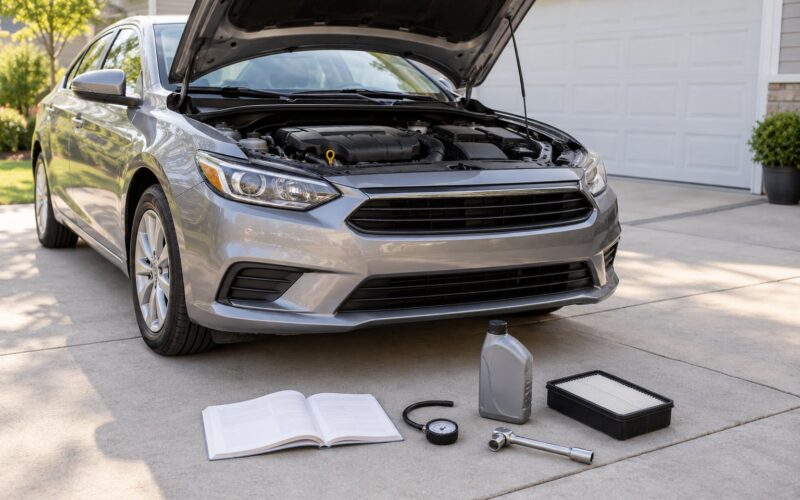
Getting your materials together first does something no negotiation tactic can do: it removes the pressure of deciding in the moment. A buyer without a printed budget and an appointment with a mechanic has nothing to say when the seller asks for an answer.
- A written all-in budget. One page, one number at the top. Include tax, title, registration, insurance, fuel, maintenance and repairs, plus a reserve of 5 to 10 percent.
- Financing arranged, or proof of funds. A credit union pre-approval takes an afternoon and turns your rate into a fact you can compare later.
- The VIN. Ask for it by text or email before you travel. Every listing should have one, and not knowing it early is itself a signal.
- Title and registration records. You want to see the current owner’s name on the title and confirm it matches the person selling you the car.
- A vehicle history report from the VIN. Carfax and AutoCheck are the common ones; NICB and NMVTIS also serve this purpose for insurers and large buyers.
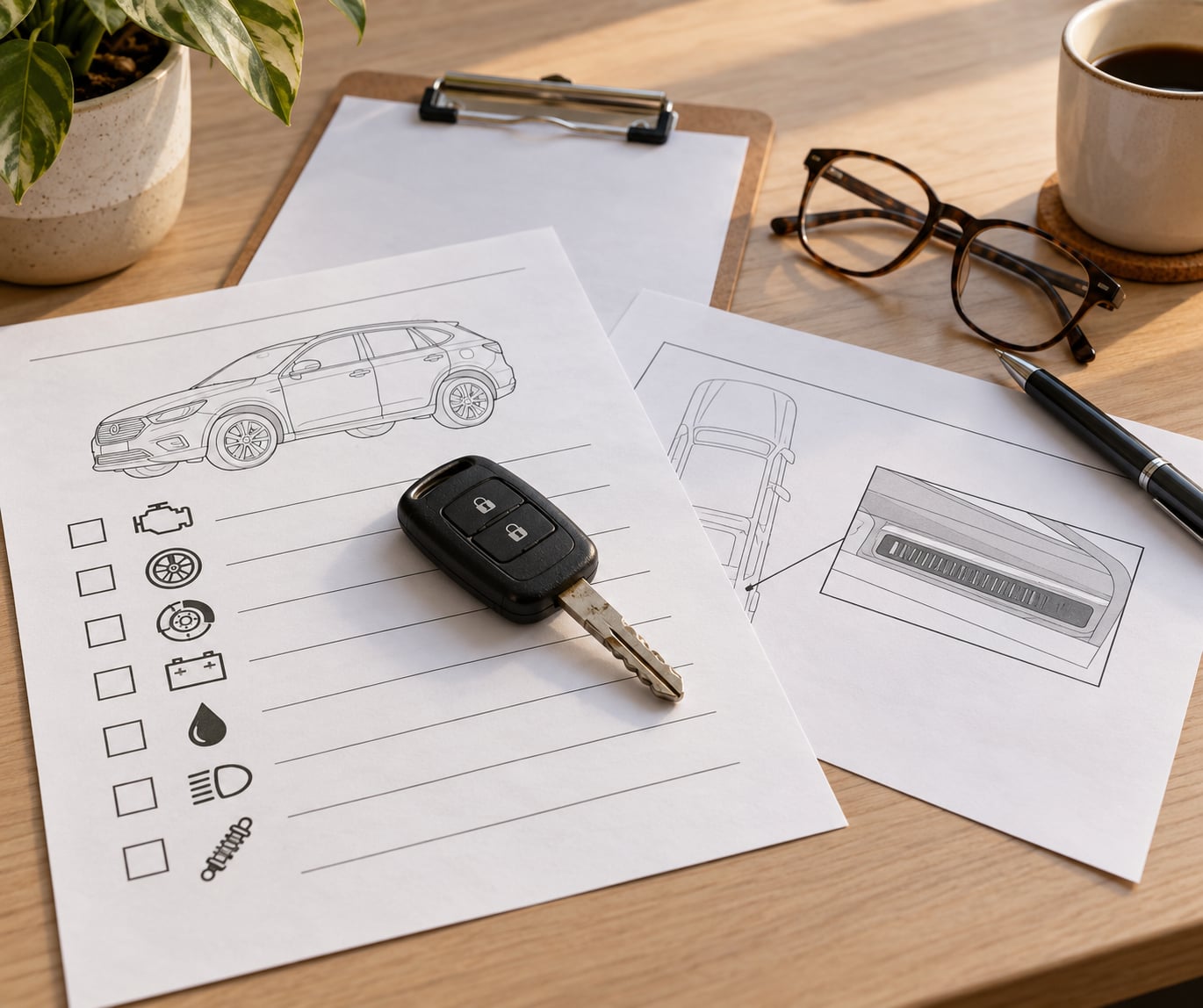
- An inspection checklist. Printed or on your phone, so you are not relying on memory at the curb.
- A phone, a flashlight and a small magnet. The magnet tells you instantly if a panel has been resprayed and pulls metal chips out of gaps.
- An independent mechanic who will inspect a car you have not chosen yet. Ask what they charge for a used-car inspection before you shop.
- A safe meeting place. A well-lit public spot, ideally a bank or the mechanic’s parking lot, never an isolated address.
Having all of this also protects you from the oldest trick in the trade: creating a problem so you solve it with money. If you can pay cash, prove it. If you cannot, show the pre-approval letter. Never let a conversation about your budget happen before you have one.
Step-by-Step
1. Set a firm budget before you shop
Your budget is the total cost of owning the car for a year, not the number on the listing. Add sales tax, title and registration fees (often a few hundred dollars combined), insurance, fuel, and a realistic maintenance allowance.
Then separate three numbers that people constantly blur together: what the seller will accept, what a lender will finance, and what you can truly pay. They are different, and the gap between the last two is where financing deals go wrong.
A common rule of thumb is to keep all car costs under roughly 20 percent of take-home pay, keep the payment near 10 percent, and put 10 to 20 percent down. These are guardrails rather than laws, and a credit union can tell you what your budget actually supports before you fall in love with a car.
How you know it worked: you can state your maximum out-the-door number out loud without hesitating, and it is lower than the asking price of anything you have looked at.
2. Compare listings before viewing a car
Before you drive anywhere, pull up comparable listings for the same year, trim, mileage and region. Kelley Blue Book and Edmunds give you a range; private-party listings in your own city tell you what a buyer is actually paying today, which matters more than any book value.
Flag the listings that do not hang together. Descriptions that contradict the photos, prices far below the market for that mileage, photos you recognize from other listings, sellers who dodge questions about the VIN, and inventory that disappears after two days all point the same direction.
Dealer listings often omit the real price. Watch for the number that only appears after you arrive, which usually means documentation fees and additions.
How you know it worked: you have three to five comparable vehicles saved with price, mileage, location and condition noted, so you can price this one against something rather than against hope.
3. Verify the VIN and ownership records
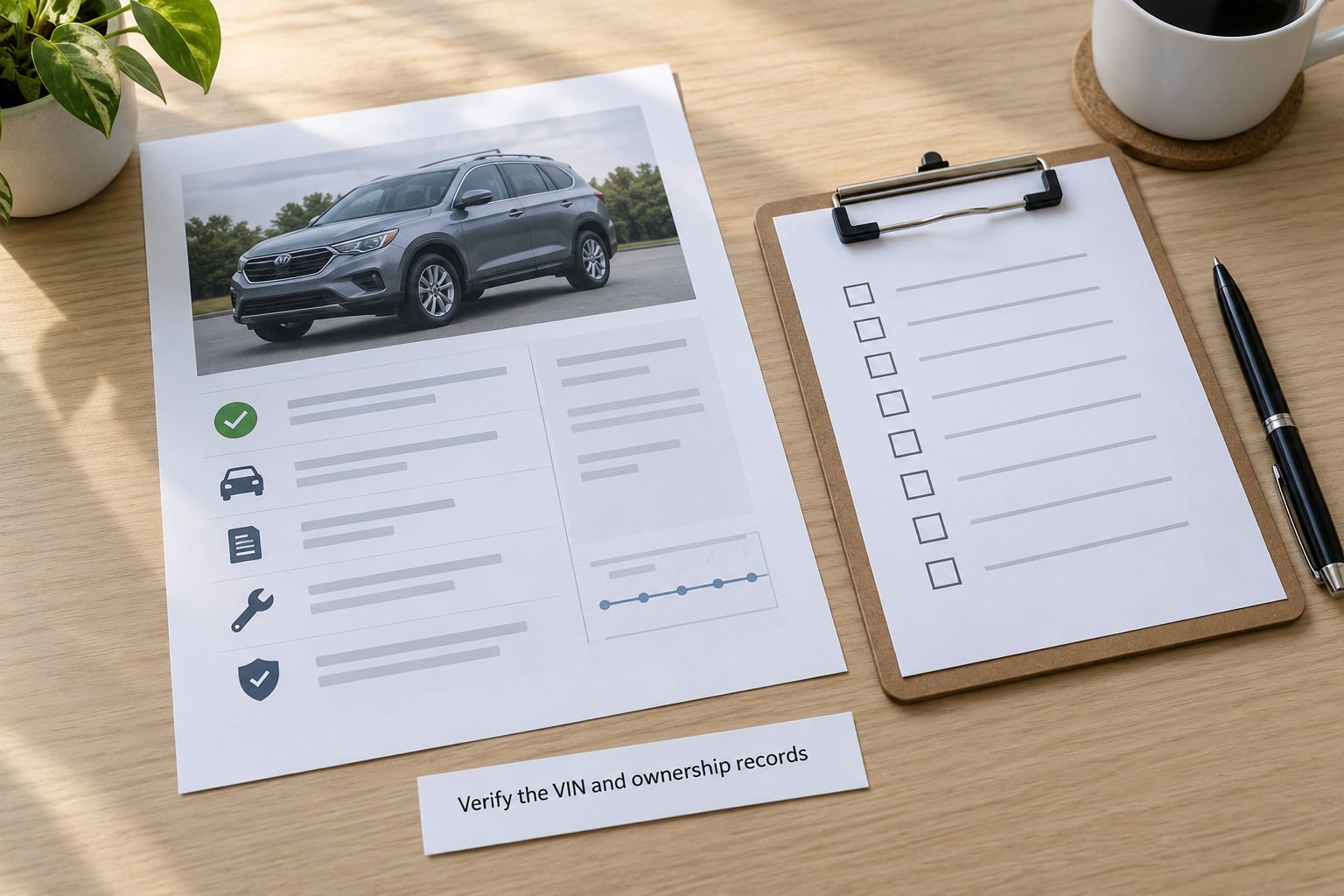
Read the VIN off the dashboard through the windshield, then match it character by character to the plate on the driver’s door jamb. After that, compare it to the title, the seller’s ID and the listing. Mismatched numbers, a VIN that looks sanded or restamped, or a seller who cannot produce the car for you to inspect are reasons to leave.
Run the VIN on a history report and read the whole thing rather than the summary. Look for title brands (salvage, rebuilt, flood, lien), odometer discrepancies, accident and damage records, theft history, and whether the car was used commercially. A commercial vehicle or a rental fleet car has been maintained on a schedule; a salvaged car has a permanently reduced resale value you are the one absorbing.
An unavailable report does not mean a clean car. It usually means the report is too thin to be useful, which is itself information.
How you know it worked: the VIN on the car, the title and the report are the same string of characters, and you can say aloud what the report’s damage disclosures mean for the price.
4. Inspect the car inside and outside
Ask for a cold start. A car that has been warmed up in the driveway hides noise, smoke and warning lights.
Walk it in daylight. Check panel gaps for uneven spacing, look for paint overspray on door seals, wheel wells and the muffler, and run the magnet along every panel and door edge to feel for chips under filler. Look under the car for rust, mismatched undercoating or fresh fluid on the ground.
Inside, check tire tread depth across all four, brake pad wear through the spokes, every light, every window, the horn, mirrors, seat adjusters and the air conditioning at both heat settings. Read the odometer and note any warning lights, then check the fluid levels and dates on the oil life monitor.
A clean exterior is not evidence. Steam cleaners and fresh tire tread on a high-mileage car are cheap and hide a lot.
How you know it worked: nothing on the list came back with an unexplained question mark, and you photographed anything you intend to use as negotiating evidence.
| What you see | What it usually means | What to do |
|---|---|---|
| Paint overspray on seals or a repaired panel edge | Accident damage or a repaint after corrosion | Cross-check the history report, get an independent inspection |
| Panel gaps wider on one side | Body work or a replaced cover panel | Compare all four gaps, inspect the structure |
| Fresh tires on a high-mileage car | Short-term fix before sale | Ask for receipts and the tire date codes |
| New undercoating that stops abruptly | Hiding rust or flood damage | Ask why, and have a mechanic look underneath |
| A warning light that stays on after start | Unresolved fault | Get it scanned before you negotiate |
| Air conditioning barely cools on one side | Low refrigerant or a failed component | Price the repair into your offer |
| Over-tightened fasteners or overspray on bolts | Engine or suspension removed | Ask what came apart and why |
| Odometer reading lower than the listing promised | Rollback, or a reporting error | Compare every photo and record against the report |
How you know it worked: you have a written list of defects with photos, which is the raw material for a fair offer.
5. Take a test drive and get an independent inspection
Give yourself 15 to 20 minutes and pick a route deliberately: city streets with stop-and-go, a rough or patched road, and then a stretch where you can reach a legal speed limit and hold it. Cold starts and warm engines both matter, so if possible drive the car twice at different temperatures.
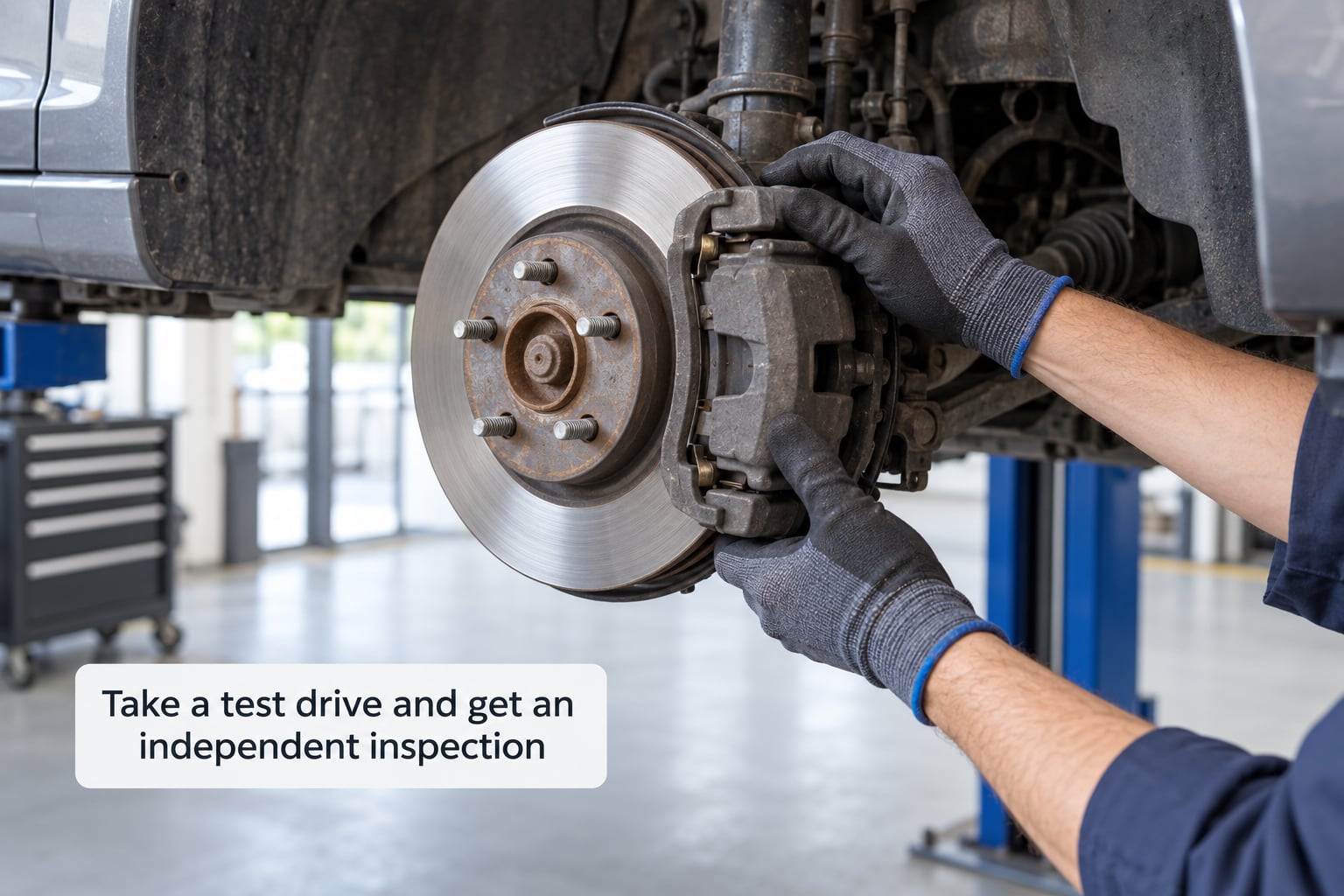
Brakes, steering and the engine are the three things a test drive exists to check. Listen for a knock, a hum that changes with speed, a rattle over bumps, or a whine on acceleration. Feel for a pull to one side, brake shudder, or a steering wheel that no longer centers. Then confirm the car holds speed without bouncing or hesitating, and that nothing rattles when you lift off the gas.
Then have a mechanic you chose look at it. Pre-purchase inspections typically cost somewhere around 100 to 200 dollars and routinely catch brakes, suspension, cooling and engine issues worth several times that. Buyers on Cartalk and driving.ca threads describe the same pattern repeatedly: they trusted a dealer’s own multi-point check, skipped the independent look, and paid for a major repair within weeks.
Some findings mean renegotiate, and some mean walk away. Negotiate for worn pads, a neglected service, tires at 4/32, or cosmetic issues the seller clearly missed. Walk away from structural rust, a salvaged title the seller hid, transmission shudders, head gasket symptoms, brake fluid that smells burnt or fluid leaks that are growing.
How you know it worked: you have a mechanic’s written report in hand, and your offer or your decision is based on it rather than on how the car felt.
6. Use comparable sales to negotiate the price
Anchor your offer to evidence, not to a percentage. Buyers on r/askcarsales keep landing on the same principle: your only real bargaining position is comparable vehicles selling cheaper in the same market, so build your number from those listings adjusted for condition, mileage, trim, options, and how far you are from the seller.
Open with your number and your reason. “Based on three comparable cars within 50 miles listed between X and Y, and the tires and brakes the inspection flagged, I’d like to start at Z” is much harder to argue with than an arbitrary discount.
Two tactics to prepare for. First, monthly-payment anchoring: a seller who says a price is 600 a month will happily raise the price and add fees if it lowers the payment. Reply that you are negotiating the out-the-door number and only the out-the-door number. Second, the manager walk-in, which is designed to make you feel the deal is expiring. On r/carbuying, buyers report that a pre-arranged price by email or phone, before any appointment, removes most of that pressure.
TractorByNet members are blunt about the current market: dealers hold firmer on used pricing than they used to, and the old videos promising thousands off at the desk are mostly outdated. Expect less room, and decide whether this car is worth chasing before you spend an hour on it.
How you know it worked: you can state the comparable listings your number came from, and you know your walk-away price before you enter the room.
7. Put every term in writing
Nothing agreed in a showroom counts if it is not on the buyer’s order. The written purchase agreement should carry the agreed out-the-door price, the specific vehicle identification (year, make, model, trim, mileage and VIN), the accessories included, the payment method, a pickup deadline, and any contingency that lets you cancel if the inspection or financing falls through.
Watch the as-is language. Used vehicles are generally sold as-is, and the FTC Buyer’s Guide is an acknowledgment of that rather than a warranty. Know what you are signing before you sign it, and never sign a page with blanks in it.
Three lines that should stop you cold: a deposit demanded before you have seen the car or verified the title, any term letting the seller substitute a different vehicle, and any promise made verbally only. Walk away from all three.
How you know it worked: the contract, the numbers on the window sticker and the number you negotiated are the same number, and you have a copy before you pay.
8. Complete a safe, final transaction
Recheck the VIN one last time on the car in front of you, and confirm the name on the title matches the person signing the bill of sale and the person who showed you ID. Get a bill of sale with the purchase price, the date, both names and signatures, and the odometer reading. Complete any required title transfer and registration at your DMV, and keep copies of everything.
Pay in a way that does not hand over your banking details to a stranger. A bill payment or cashier’s check made out to the seller named on the title is safer than wiring money, and never send a deposit to a number a seller texted you for an unseen vehicle.
Only drive away with proof of insurance, the signed title, the keys and any included accessories. Removing plates yourself is a state-by-state question, and doing it where it is not allowed is a legal problem, so check before you assume.
How you know it worked: you drive home insured, titled in the right name, with paperwork that matches the car you inspected.
Common Mistakes
Buying before an independent inspection. A dealer’s own check is a sales tool, not an inspection. Book your mechanic before you commit, and treat any refusal to allow it as a full stop.
Relying on a single history report. Two reports from different providers, plus NMVTIS where applicable, catch discrepancies that one misses.
Negotiating the monthly payment. It hides the total, and it lets the seller add fees while keeping payment constant. Work in out-the-door dollars.
Waiving protection to save a few hundred dollars. A declining balance of records is your protection, and it is more reliable than a product the seller is selling.
Rushing to beat a fabricated deadline. “Another buyer is here” is the oldest line in the business. Price the deal by email and let the deadline expire.
Paying before the title is verified. A deposit or full payment ahead of VIN and title checks is how title-washing and clone scams work. Verify first, always.
Signing incomplete documents. Every blank gets filled in later, often with terms you would not accept. Cross out blanks and initial corrections.
Tips for Negotiating and Paying Safely
Stay willing to leave, and mean it. A walk-away price decided in advance is the strongest tool you have, and the only one that cannot be worn down by an hour in the showroom.
Separate price from fees. Ask for the out-the-door number, fees included. Dealers will sometimes cut the price and add a documentation charge to recover it, which is why the total is the only figure you negotiate.
| Add-on | Typical range | Accept or decline |
|---|---|---|
| Documentation fee | Often a few hundred dollars | Decline or negotiate it into the price; it is a paperwork charge |
| Market adjustment or add-on markup | Hundreds to over a thousand dollars | Decline outright and ask for the base price |
| Nitrogen fill, etching, key protection, tint, wheel locks | Small amounts each, usually bundled | Decline; none of these protect the car |
| GAP or debt cancellation coverage | Often 500 to 1,500 dollars | Decline unless you price it separately and understand the terms |
| Extended warranty or protection plan | Hundreds to over a thousand dollars | Decline as-is; read exclusions for the parts most likely to fail |
| Paint and fabric protection | Varies, often bundled at signing | Decline unless you already planned it and priced it separately |
| Dealer financing | Markup over your own rate | Decline if you hold a better pre-approval; you can always refinance later |
Send deposits only after verifying the vehicle and the seller, never before. Meet in daylight at a public location, and take someone with you on the first purchase, both for a second set of eyes and because it is harder to pressure two people at once.
Never let a financing product hide a costly car. If a long term stretches the payment down to a number that feels comfortable while the total cost climbs, the loan is doing the negotiating for the wrong side.
For private sellers, pay at a bank or credit union, name the payee exactly as the title shows, and complete the title transfer at the DMV promptly. Sellers who insist on a strange payment method, a meeting at a private address, or a quick cash deal are telling you something.
Frequently Asked Questions
Is it safe to buy a used car without a mechanic inspecting it?
It is possible, but it is a gamble with your savings. A pre-purchase inspection typically costs around 100 to 200 dollars and regularly finds brakes, suspension, cooling and engine faults worth several times that. Sellers who discourage it usually have a reason. If you skip the inspection, stay on a newer car with full service records, an open recall check and a clean history report, and keep a repair fund ready.
What should I check before signing a used-car purchase agreement?
Confirm the VIN on the dashboard, door jamb, title and history report all match, and that the seller’s name on the title matches their ID. Check that the out-the-door price on the contract matches what you agreed, that the vehicle is described by year, model, trim and mileage, and that no lines are blank or allow a vehicle substitution. Read the as-is language before you sign, not after.
Can a clean vehicle-history report guarantee a car is safe?
No. A history report records what owners, insurers and service businesses reported, which means it misses unreported collisions, flood exposure with no claim filed, and parts failures that were fixed quietly. It also cannot see a cloned VIN from a salvaged donor car. Treat a clean report as a reason to keep looking, then confirm with a cold-start inspection and an independent mechanical inspection.
Should I buy a used car from a dealer or a private seller?
A dealer usually costs more but handles the title transfer, and many offer a short exchange or return window. A private seller is often cheaper and you can inspect the car yourself, but you carry more fraud and paperwork risk and rarely get any recourse. Neither guarantees a good car. The deciding factor is whether you get an independent inspection and verified records in either case, not the sign on the lot.
What should I do if I discover major problems after buying the car?
Most used cars are sold as-is, so your recovery usually depends on what you agreed to in writing. Act quickly: document the problem, keep every repair invoice, and check whether the vehicle had an open recall or a warranty you accepted. If the seller concealed a known defect or misrepresented the history or mileage, contact the state attorney general or consumer protection office, and file with the FTC or a local BBB. Keep your purchase documents and the inspection report.
Conclusion
Start with two decisions before you look at a single listing: write down your all-in number, and book the mechanic who will inspect whichever car you end up wanting. Those two steps remove most of the pressure the rest of the process depends on.
Then verify the VIN, the title, the history report and the physical condition before any money becomes binding. Knowing how to buy a used car without getting ripped off is not about outsmarting a seller. It is about refusing to make a decision before you have the evidence to make it.