To stop comparing yourself to people on social media, do four things: name your triggers, unfollow and mute what makes you feel smaller, set real limits on when you scroll, and keep a running record of your own progress to read instead of someone else’s feed. That is the honest answer. You are not eliminating the feeling. You are making your attention harder to hijack.
I want to be straight about the pace of this before we start. Most people report a slow improvement, not a switch. The comparison reflex is roughly as old as human beings, and social media simply turned it into a full-time job with better lighting. A week of unfollowing can feel like nothing, then something clicks in week three. People who expect a week-one transformation usually quit before that.
This guide is written for Black adults specifically, because the pressure lands differently in communities where family group chats, church networks, and professional networks all live inside the same apps. The advice is general and it works. The contexts are the ones many of us actually live in.
Table of Contents
- What You Need
- Step-by-Step: How to Stop Comparing Yourself to People on Social Media
- 1. Notice what you are comparing
- 2. Check the story you are telling yourself
- 3. Curate and limit your feed to stop comparing yourself to people on social media
- 4. Change when and how you scroll
- 5. Replace comparison with an evidence check
- 6. Build a healthier relationship with achievement
- Common Mistakes and Simple Fixes
- Frequently Asked Questions
- Is it normal to compare myself to people on social media?
- Should I delete every social media app to stop comparing myself?
- What do I do when comparison is affecting my sleep and mood?
- How do I stop comparing myself to people I know in real life?
- Why do I keep comparing myself even when I know the posts are edited?
- Conclusion
What You Need
None of this requires a purchase. You need a private notes app or a paper journal, ten quiet minutes, and about an hour once a week for the feed work.
Start with a notes app that nobody can see. The privacy matters because the point of step one is writing down the things you would never say out loud, including the parts where you are embarrassed that you still care about a high school classmate’s career.
Then gather access to the controls themselves, because most of the useful changes are already built into the apps and hidden a few taps deep. On Instagram, TikTok, Facebook, and LinkedIn you want the feed and story controls open. On your phone you want Screen Time (iPhone) or Digital Wellbeing (Android) open. On YouTube you want the watch history and recommendation settings open.
Block out one short block for the notifications work too. Doing it in one sitting beats trying to remember it later.
Step-by-Step: How to Stop Comparing Yourself to People on Social Media
Comparison is a habit with a trigger, a reaction, and a payoff. Interrupt any one of the three and the loop weakens. The six steps below work on all three, in order, because doing them out of sequence tends to feel like willpower and fail.
1. Notice what you are comparing
Open your notes app and write down the specific posts that get under your skin. Not “social media” in general. Name the account, the kind of post, and what you felt.
Most people fill a page quickly and find three or four patterns. Careers and promotions. Bodies and fitness progress. Travel and houses. Weddings and babies. Money, usually shown as an object rather than an amount. Each pattern has a particular flavor, and the flavor tells you which step matters most for you.
Write down the emotion underneath each one too. Shame feels different from longing, and longing feels different from anger. People who track the emotion tend to catch the comparison earlier, which is the whole point of doing step one before step three.
You know it worked when you can name a trigger in under a second. Before, it was a vague feeling with no address.
2. Check the story you are telling yourself
Psychologists call this social comparison theory, and Leon Festinger proposed it in 1954. The short version: people evaluate themselves by measuring against other people, and most of that measuring is upward, toward whoever appears to be doing better.
Social media breaks that system in two ways. It selects the people who look good, and it lets you compare your ordinary Tuesday against their best moment, forever, at no cost to them. The old neighborhood comparison had a limit. This one scales.
So separate what you know from what you assume. You know she posted a promotion. You assume it happened on her own schedule, without the rejections, the year of doubt, or the help she never mentions.
| What the post shows | What is usually missing |
|---|---|
| The finished result | The three failed attempts before it |
| The good day | The ordinary ones, which run longer |
| The staged photo | Ten seconds of setup nobody sees |
| The reply that got no mention | Most replies, including the discouraging ones |
| The announcement | The year of work and the help received |
One line I keep coming back to, from a piece that circulates a lot: people post the best shot of fifty. It is simple and it lands, because it is true. A second line helps more: the posts you envy are also data about what you want. Hold both.
3. Curate and limit your feed to stop comparing yourself to people on social media
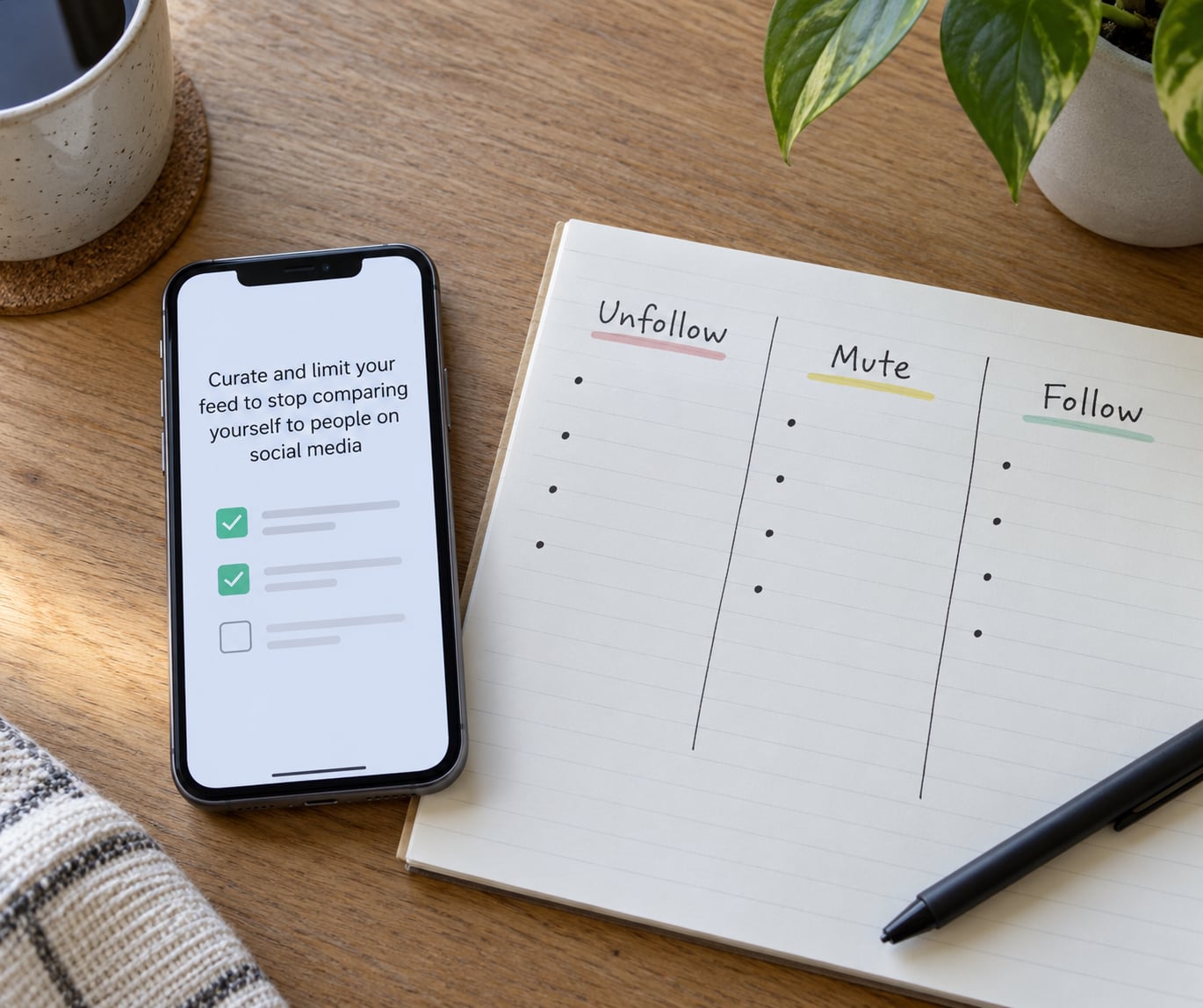
Mute first, unfollow second. Mute keeps the friendship intact while removing the posts from your home feed, which takes far less willpower and is easier to undo later. Unfollow is a fine tool too, but people treat it as a moral verdict and then go looking for replacement accounts that trigger the same reaction.
Then handle the two places most of us forget: stories and recommendations. Stories expire and stop accumulating pressure once you no longer see them first thing. Recommendation feeds are where the algorithm does the work for you, so curating there has an outsized effect for the least effort.
| Platform | What to change first | Where it lives |
|---|---|---|
| Mute or restrict accounts, and turn off suggested posts | Profile, menu, Close Friends and Hide options | |
| TikTok | Restrict individual creators, manage topics | Profile, menu, Privacy settings |
| Snooze, unfriend, and change your default feed order | Feed settings, Privacy shortcuts | |
| Unfollow or mute, and change the notification digest | Following list, Notifications settings | |
| YouTube | Stop recommendations, turn off autoplay | Watch history, Recommendations settings |
Check every couple of weeks and add a few accounts that teach you something. A feed made only of people who make you feel inadequate leaves you with nothing to look at, and an empty feed is not the goal. The goal is a feed that leaves room for you.
4. Change when and how you scroll
Most comparison is not a decision. It is a reflex, and reflexes are governed by time and setting more than by intention.
Protect the first and last half hour of your day. Morning is when people are raw and the feed is full of other people’s mornings, which are mostly staged. Night is worse, because doomscrolling before bed shows up in sleep quality the next morning. Put the phone across the room and charge it there.
Keep the phone out of meals, out of the bedroom, and out of the bathroom if you can manage it. Those three are where most people’s checking actually happens.
Then use the limits your phone already has. A hard stop at a set time works better than a target, because a target lets you negotiate with yourself at the exact moment you have the least willpower. Set the daily limit below what you currently use, not at what you wish you used.
You know it worked when you catch yourself checking at a normal human interval instead of every four minutes.
5. Replace comparison with an evidence check
This is the step that outlasts the feed changes, because unfollowing only helps until a new account shows up. The most repeated advice in the forums, and the one people say they trust most, is to measure yourself against your own past self.
Keep a simple record. A note with a date and one line is enough. What finished, what got easier, what you said no to, what you handled without dreading it. A list of things you can do now that you could not do last year is a much fairer portrait than a stranger’s vacation.
Add outside evidence too, because memory is not neutral. Pull the emails where someone thanked you for your work, the reviews, the messages from people who relied on you. One competitor page made this point and it holds up: a folder of real praise beats a reel every single time.
When the reflex fires, the question changes from “why am I not there yet” to “what did I clear in the last six months.” That question still has an answer you control.
6. Build a healthier relationship with achievement
Comparison at its worst makes other people’s wins a verdict on your life. At its least harmful, envy is a compass, pointing at something you want and have not admitted you want yet. A promotion, a fitness habit, a trip you keep postponing, a quiet Sunday. All of those are useful if you treat them as information rather than evidence of failure.
So set goals that belong to you. Write down three things that would count as a good six months, phrased in your own words and not borrowed from someone else’s post. Then celebrate the small ones out loud, because wins nobody witnesses tend not to register as wins at all.
And put effort into offline life, since face-to-face connection is very hard to compare against. A weekly call, a class, a regular walk with somebody. It does not have to be dramatic. It has to be recurring, because recurrence is what makes a life feel like yours.
Common Mistakes and Simple Fixes
Most people who struggle with this do not fail because the methods do not work. They fail on one of these six.
Waiting until you feel better before you change anything. Feeling better is the result, not the starting condition. Fix: do step one today, while the feeling is still low. Ten minutes of writing, then change one setting.
Arguing with yourself about the highlight reel. You can know a post is edited and still feel inadequate, because the argument runs in words and the feeling runs somewhere else. Fix: stop debating and use step five instead. Evidence about your own life beats a reminder about someone else’s editing.
Waiting for willpower instead of a system. Willpower is the last resort, not the plan. Fix: change the environment so the good choice needs less of you. Phone in another room, notifications off, feeds cleaned once a month.
Deleting every app and calling it solved. Most people come back within weeks and feel worse for the gap, because the problem travels with them. Fix: use limits and curation first. A full deletion can be a useful break, but it is a break, not a cure.
Only measuring the big days. Comparing your everyday to everyone else’s best day is rigged and you will lose every time. Fix: keep the wins log, and check it more often than you check a feed.
Treating the feeling as a character flaw. This is the one that delays asking for help the longest, and the most repeated question in forums is whether this level of comparison is normal. It is common, and common is not the same as harmless. If it is costing you sleep, appetite, focus, or the ability to enjoy things you used to enjoy, that is a reason to talk to a therapist or counselor. Nothing about that is an overreaction, and you do not need to be in crisis to go. If you are having thoughts of harming yourself, contact a crisis line or emergency services in your area right away.
Frequently Asked Questions
Is it normal to compare myself to people on social media?
Yes. Comparison is close to universal, especially upward comparison on a feed where the people you see have already been filtered for how their life looks. Most people experience it without it interfering with daily life. It becomes a problem when it keeps showing up for weeks and affects your sleep, mood, or willingness to start things. At that point it is worth talking to someone.
Should I delete every social media app to stop comparing myself?
Most people find deletion helps briefly and then return, often feeling worse because the habit was never the whole problem. Limits, muted accounts, and curated feeds tend to hold because they keep you connected without handing the algorithm your attention. A full break can still be worth a month if you use the time to build offline routines. Treat it as a reset, not a fix.
What do I do when comparison is affecting my sleep and mood?
Treat it as a signal rather than a mood. Start with the first and last thirty minutes of your day, keep the phone out of bed, and set a hard daily screen limit slightly below your current use. If low mood, poor sleep, or loss of interest in things you used to enjoy continue past a few weeks, speak with a doctor or therapist.
How do I stop comparing myself to people I know in real life?
Mute the accounts you cannot unfollow without damaging a relationship, then stop engaging with the content. A real-life comparison stings harder because the information is accurate, so shift what you do with it. Ask the person one genuine question about how they got there instead of scrolling their posts. And judge your own progress against your own record, not their announcements.
Why do I keep comparing myself even when I know the posts are edited?
Because reasoning and feeling run on different systems. Knowing a post is staged does not stop the upward comparison from registering. Instead of repeating the reminder, create distance by naming the thought in one line without arguing with it, then switch to evidence from your own life. That shift is more effective than reminding yourself again, and it takes less energy.
Conclusion
Do one thing today. Name the trigger that fires most often, and write it in a single line. Then change the setting that feeds it: mute the account, or turn off the story notifications, or move the phone out of reach for the first thirty minutes of tomorrow morning.
Finally, write down one goal that is yours, in your own words, and put it where you will see it this week. Keep a short record of what you clear. That record is the thing that will still be there in a month, and it is the only version of your life that is actually accurate.