To speak up when you get interrupted, stop apologising and say one short, level sentence: name that you were not finished, then finish your point. Something like “I wasn’t finished, let me land that, then I’ll come back to you.” Ten seconds of preparation before the meeting makes those ten seconds in the room easy.
Most people don’t get interrupted because their point is weak. They get interrupted because they took too long to signal it. Whoever names the frame first tends to set the agenda, and whoever goes quiet gets read as agreeing with whatever is being said next.
What follows is the version I use when someone cuts me off mid-sentence, plus the words that keep it from turning into a fight. Copy them into your own voice before you need them, because the phrase bank is useless if you’re forming sentences while your heart is going.
Table of Contents
- What You Need
- Step-by-Step: How to Speak Up in Meetings When You Get Interrupted
- Use a Grounded Opening to Speak Up in Meetings With Clarity
- Acknowledge the Interruption Without Losing Momentum
- Redirect the Conversation Back to Your Point
- Name the Decision or Next Step You Need
- Close the Recovery Smoothly
- Common Mistakes
- Frequently Asked Questions
- How do I respond when I get interrupted in a meeting?
- What are good phrases to use when interrupting someone else?
- How do I get a word in when senior people keep talking over me?
- How do I speak up on Zoom when I am unmuted and still get talked over?
- How do I speak up in meetings when I am nervous?
- What is the 40/20/40 rule for meetings?
- Conclusion
What You Need
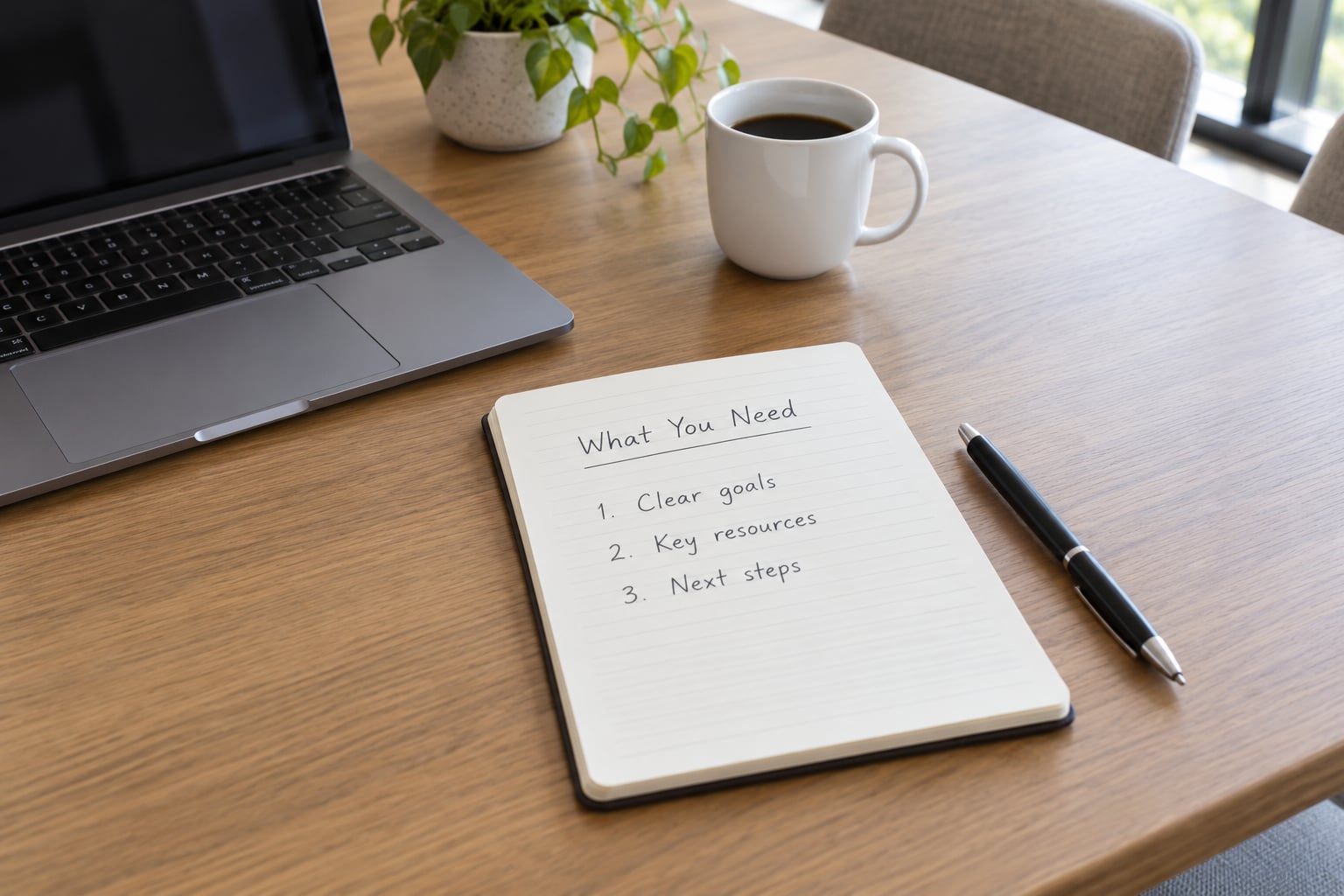
You need five things before the meeting starts, and all of them take under five minutes to set up.
One point written in a single sentence. If you can’t write it in one sentence, it isn’t your meeting point yet. “The onboarding drop-off is an email problem, not a product problem” is a point. “Onboarding is a bit of a mess” is a topic, and topics get interrupted.
One number or fact attached to it. A figure is what makes people wait. Even a rough one, flagged as rough, keeps attention on you longer than adjectives do.
One bridge phrase, rehearsed out loud. This is the sentence that carries you back from the interruption to your point. Practise it once so your mouth knows where it starts.
Two trigger words on the page. Write them next to your point. When the freeze hits and your prepared thought slips away, those two words pull it back. This trick comes up again and again in workplace advice threads and it works because retrieval beats invention under pressure.
One decision you want out of the meeting. A recommendation, a question for a named person, or an ask for a follow-up. Points with a destination behind them land harder.
Step-by-Step: How to Speak Up in Meetings When You Get Interrupted
The whole recovery takes about fifteen seconds, and it runs the same way every time so you stop improvising under pressure.
First, stop mid-word. Silence is what makes people think you have finished. Then say the reclaim phrase at the same volume you were already using. Then name what your point was in one sentence. Then close with a specific ask. Then give the floor back.
That is it. No apology at the front, no explanation of why you were talking, no trailing “but” that signals you are about to concede something.
Use a Grounded Opening to Speak Up in Meetings With Clarity
Open with the frame, not the throat-clearing. The first sentence should tell the room what kind of thing they’re hearing: a result, a recommendation, a problem, or a question. “Three things came out of the user interviews” does more work in five seconds than “so, yeah, I was looking at the interviews we did last week, and, you know, there was some interesting stuff.”
Speed gets read as uncertainty. Slow down the first sentence slightly, drop your pitch at the end of it, and pause. The pause is what tells the room you are not asking permission to continue.
People who get interrupted constantly often open with hedged filler that gives a listener no signal about when to start listening. Drop the “I just wanted to” and the “it’s just that”. Start at the noun.
Acknowledge the Interruption Without Losing Momentum
Acknowledge, then reclaim. Ignoring someone makes the room take a side, and the side is usually not yours. Use one of these:
- “I hear you. I was mid-point, can I finish this?”
- “Good question, and I’ll come to it. First, one sentence on the number.”
- “That’s related. Let me finish the thought, then it’s yours.”
- “Noted, and I want to respond to that. Give me ten seconds.”
Delivery matters more than wording here. The same sentence said quietly gets ignored; said at the level you were already using, it stops the interruption most of the time. You are not raising your voice, you are not speeding up, and you are not apologising.
Redirect the Conversation Back to Your Point
The bridge is a paraphrase. You restate what the other person just said in six words, then attach your own unfinished point to it. This signals that you listened and are still in the conversation, not starting a duel from the sidelines.
“You’re asking about cost, and the cost question sits right where I was going. We found three drivers, and the biggest one is onboarding time.” That is a bridge. It sounds natural, and it puts you back in your own sentence.
Be careful with “let’s circle back to that” if you have no intention of circling back. People hear it as a way to be polite while dropping the topic, and they start discounting everything else you say.
Name the Decision or Next Step You Need
General commentary gets cut off because it can be resumed later. A specific ask cannot, so it survives interruptions better. “So I’d suggest we hold the launch for two weeks, and Sam owns the comms plan” is very hard to talk over because it assigns work.
Then stop talking. The silence after a question feels like ten seconds to you and about two to the room, and the first person to fill it usually says something you can use.
If you genuinely need one named person, ask them directly. “Priya, does the vendor contract allow that?” moves the conversation without you having to hold the floor at all.
Close the Recovery Smoothly
Sum up what you restored, invite one specific response, and hand it over. “So that’s the ask, two weeks and a comms plan. Does anyone see a reason that won’t work?” Then stop. Do not add a last word, and do not explain that you were only trying to make your point.
The temptation is to finish with a small comment about the interruption, usually a joke. Jokes about being talked over reward the behaviour and remind the room it was funny.
Common Mistakes
Speaking louder. Volume escalates and it invites the room to treat you as the difficult one. Level tone at unchanged pace is what reads as authority.
Criticising the interrupter. “You always do this” turns a turn-taking problem into a personal conflict, and you lose the point you were trying to make.
Over-explaining. Restarting the whole argument from the beginning after an interruption is a sign you’ve lost your thread. Restarting takes fifteen seconds; the single-sentence version takes two.
Going quiet and apologetic. “Sorry, never mind, it’s fine, go ahead” hands your point to the person who took it. This is the politeness trap: you stay technically correct and completely unheard.
Phrasal hedges. “Sort of”, “kind of”, “I might be wrong but” and “it’s just a thought” pre-empt the argument before anyone makes it. Cut them and the same sentence lands as a position.
Waiting for a natural pause. In fast meetings the pause you are listening for is not coming. Enter in the gap after someone finishes a sentence, not during a comfortable lull you imagined later.
Some situations need more than a phrase. When the same person interrupts every week, move up the ladder: reclaim in the meeting first, note the pattern, raise it privately in a one-to-one, and if nothing changes, put it to the facilitator or your manager as a meeting-flow problem rather than a personality clash. Being a person who speaks up in every meeting is a fair ambition; being the person who always has to be the one is what wears people down.
If you are the most junior person in the room, buy your floor the same way seniors do, with a clear opening and a specific ask, and skip the caveats about why you might be wrong about something you actually know. If English is not your first language, build a personal inventory of five or six sentences that come out easily and reuse them word for word every time; fluency is not the thing being measured in the room, and a rehearsed sentence in plain words beats an improvised one in perfect grammar.
If the meeting leader is the interrupter, stop trying to win the turn. Send a short written summary afterwards that names your point and the ask, addressed to the person who makes the call. Put the idea in the notes in plain sight and it becomes shared rather than stolen.
On Zoom, the mechanics work against you: latency, overlapping audio, and a mute button that punishes hesitation. Join a few seconds early to check the audio, stay unmuted unless you are listening for a long stretch, use the raise-hand button so you are visible when your audio is not winning, and drop anything important into the chat as a backup. On workplace Stack Exchange, the fix that keeps coming up is blunt and still correct: “Excuse me, I haven’t finished yet,” said firmly, usually ends it.
Frequently Asked Questions
How do I respond when I get interrupted in a meeting?
Say it immediately, at the same volume, without apologising: u0022I wasn’t finished, let me land this one point and then it’s yours.u0022 Acknowledge what they said in six words, restate your point in one sentence, and name the ask you need. The whole recovery takes about fifteen seconds. Waiting to rejoin politely is what usually loses the point, because the room has already moved on and assumes you agreed.
What are good phrases to use when interrupting someone else?
Use a bridge phrase that connects their sentence to yours: u0022Can I add one thing to that?u0022 or u0022Picking up your last point, the data says something slightly different.u0022 Acknowledge, then take the floor: u0022That’s a fair read, and there’s a wrinkle.u0022 Avoid opening with u0022Sorry,u0022 which weakens what you say next, and avoid phrasal hedges like u0022just a thought,u0022 which invite the room to treat it as one.
How do I get a word in when senior people keep talking over me?
Do not compete on volume or seniority. Open with a structured first sentence so they have nothing to interrupt yet, then reclaim with a firm, level u0022Can I finish this thought?u0022 and deliver the point in one sentence with a specific ask attached. If it keeps happening with the same person, stop trying to win every turn: put the point in writing in the follow-up, and if the pattern continues, raise it as a meeting-flow issue with your manager.
How do I speak up on Zoom when I am unmuted and still get talked over?
Join a few minutes early to check your audio and camera, stay unmuted through most of the call, and use the raise-hand button when the conversation is moving faster than your audio. If you are cut off mid-sentence, unmute and say u0022I didn’t get to finish that point, going once moreu0022 rather than re-joining apologetically. Keep one key point in the chat as a backup, because latency and overlapping audio will sometimes beat you.
How do I speak up in meetings when I am nervous?
Nervousness is usually about the sentence, not the idea. Write your point as one sentence before the meeting, attach one number to it, and rehearse a single reclaim phrase out loud once. In the moment, slow the first sentence and pause at the end of it. If your prepared point disappears, glance at your two trigger words on the page. Most people who freeze are not unprepared, they are just trying to speak without a script.
What is the 40/20/40 rule for meetings?
The 40/20/40 rule describes a healthy balance of airtime in a conversation: roughly 40 percent listening, 20 percent speaking, and 40 percent responding or reflecting on what was said. It is a pacing guide rather than a strict rule, and it is useful precisely because it shows how little speaking time is normal. If your turn never happens, the problem is usually structural, such as fast turn-taking or senior airtime, rather than something wrong with your contribution.
Conclusion
Do one thing before your next meeting: write your main point in a single sentence, and practise saying “I wasn’t finished, let me land this” out loud once so the words are already familiar. Then use them the first time someone cuts in this week.
Nobody masters this by reading about it. The people who look comfortable in meetings are usually the ones with a handful of phrases they no longer have to think about, which is exactly what the fifteen seconds in this guide is for.