
A business plan for a small service business is a written roadmap: what you sell, who you serve, how you charge for it, how clients find you, what it costs to run, and what you expect the numbers to look like. Most solo providers can build a usable version in one long weekend — one page if nobody is funding you, fifteen to twenty pages if a bank will read it.
This guide walks through how to write a business plan for a small service business in eight parts, with pricing and capacity math instead of the inventory talk that fills most business plan templates. That gap matters. A consultant’s constraint is hours, not stock, and a plan built around stock shelves tells a lender nothing about whether the idea works.
One honest note before we start. A plan does not make a business succeed, and anyone who tells you otherwise is selling something. What it does is expose the assumptions you are running on — how much you can charge, how many clients you can actually serve, what it costs you to deliver — while changing them is still cheap.
Table of Contents
- What You Need
- Business and financial records
- Legal, credential and insurance documents
- Market and customer evidence
- Tools
- Step-by-Step: How to Write a Business Plan for a Small Service Business
- 1. Write a Clear Executive Summary
- 2. Describe Your Service Business
- 3. Identify Your Ideal Customer
- 4. Analyze the Market and Competition
- 5. Outline Your Marketing and Sales Plan
- 6. Build Your Operations and Management Plan
- 7. Build Financial Projections for a Small Service Business
- 8. Review and Use Your Business Plan
- Common Mistakes
- Frequently Asked Questions
- Do I need a business plan if I am a solo consultant?
- How long should a small business plan be?
- What should be included in your business plan?
- Can ChatGPT create a business plan for me?
- What are the 5 C’s of a business plan?
- What font and format should I use for a business plan?
- Conclusion
What You Need
Gather these before you open a blank document. Most stalled plans stall because the writer is missing one of them, not because the writing is hard.
Business and financial records
- Three to twelve months of real numbers, if the business is already trading: monthly revenue, what came in, what went out, and what was left.
- Bank statements and credit card exports for the same period. Owners routinely misremember their own revenue; the bank does not.
- A list of every recurring cost with the amount and the date it started: software, phone, insurance, workspace, contractor fees.
- Any debt — student loans, a vehicle payment, an existing credit line. Lenders look at this early.
Legal, credential and insurance documents
Your registration paperwork, any state license or professional certification your field requires, and proof of liability coverage. Trades, health and wellness services, childcare, and financial advice all carry state licensing rules; check yours before writing a plan that assumes you can start immediately.
Market and customer evidence
A rough list of competitors with their published pricing where they publish it, plus any reviews you can find. Then talk to five current or recent clients and ask what they were searching for when they found you and what nearly stopped them. That five-conversation hour is worth more than any market report you will not finish.
Tools
A word processor or document, a spreadsheet for the financial model, and either a business model canvas or a plain one-page template. That is the whole kit. You do not need a consultant, a branding package, or a forty-page deck to begin.
So do you actually need a plan? If you are validating a brand-new idea with no revenue, a one-page lean plan is enough, and you can skip straight to the steps below. If you are applying for an SBA loan or a bank loan, a written plan with financial projections is effectively mandatory, and the bank will ask for the supporting documents in the list above. Everyone in between benefits most from the internal version: it exists to sharpen pricing and capacity decisions, not to impress anyone.
Step-by-Step: How to Write a Business Plan for a Small Service Business
Eight parts, and the order is deliberate. Each one feeds the next, and the summary gets written at the end once the substance exists. If you try to write them front to back you will stall on the executive summary for a week.
| Format | Length | Best for | Time to build |
|---|---|---|---|
| Lean / one-page plan | 1 page | Solo operators validating an idea, internal planning, a pitch to a partner | One weekend |
| Traditional plan | 15 to 20 pages plus appendices | Bank or SBA loan applications, investor conversations, a business with staff | Two to four weeks |
If you are not seeking outside money, write lean and skip the table of contents. If a lender is involved, they will tell you the format they want — ask before you start, because their required layout is not negotiable.
1. Write a Clear Executive Summary
The executive summary answers four questions in under a page: what the business does, who it serves, why it wins, and what it needs. Write it last, once the other sections are finished, and then paste it at the front.
For a service business, keep it concrete. “Brand strategy for independent healthcare practices in a three-county radius, delivered in six-week engagements at three price points, with two referral partnerships already in place” tells a reader more in one sentence than a paragraph about mission. State the funding ask and the use of funds in the same breath — a lender should not have to hunt for either.
Test: if someone reads only that page and asks a sharp question, does the answer appear somewhere in it? If not, rewrite.
2. Describe Your Service Business
This section turns the idea into something a stranger could describe accurately to someone else. It covers the service offering, the service area, the business model, the ownership structure, and a mission statement short enough to be useful.
Be specific about the offering. A tiered structure is common in service businesses and it makes this section easier to write: a paid diagnostic session, a mid-tier defined project, and a monthly retainer for ongoing work. Naming the three makes the rest of the plan — pricing, capacity, staffing — much easier to model, because each tier consumes a predictable number of hours.
On ownership, say what it actually is. A sole proprietorship is the default and the simplest. An LLC adds liability separation and costs more to maintain. An S-corp election changes payroll treatment and matters once you have payroll. Do not describe the structure you intend to have in two years; describe the one you have this month.
For day-to-day operations, write the ordinary week: what happens on a Monday, who does it, and what a typical client week looks like. Owners skip this because it feels too mundane to include, and it is exactly what a lender is trying to picture.
3. Identify Your Ideal Customer
Define one customer closely enough that you could describe them to a stranger without saying “anyone who needs this.” A useful profile includes their situation, the trigger that makes them start looking, the location they can be served from, what they have already tried, and what budget range they operate in.
The trigger matters more than people expect. Customers do not buy a bookkeeping clean-up on a calm Tuesday; they buy it after a failed audit, a business sale, or a year of messy books. Knowing the trigger tells you when to show up and what to say, and it makes your marketing costs easier to forecast because you know which moments produce demand.
Estimate demand from the bottom up rather than the top down. Total addressable market figures are usually flattering and usually useless for a three-county service area. Instead count what is reachable: how many qualified clients exist in your radius, what share you could realistically serve at your capacity, and what they currently pay. If the reachable number is small, that is information you needed before signing a lease, not a reason to inflate the plan.
4. Analyze the Market and Competition

Your market analysis answers three things: whether demand in your area is real, who you are up against, and what specific gap you are positioned to fill.
Start with local demand rather than national trends. National numbers tell you a sector exists; they say nothing about whether anyone on your block is buying. Search your own service category and count the competitors within your travel radius, then read what their reviews complain about. Complaints are the cheapest market research available — a repeated mention of slow response times, poor communication, or unclear pricing is a gap you can name in your positioning and price for.
Note pricing where it is visible. If competitors hide their rates, call as a prospective customer or read their package pages. You are not looking for an exact match; you are looking for the range and the packaging, because your plan needs a defensible place inside it.
Finish with a short SWOT pass. Four lines is enough. The strengths and weaknesses are internal and mostly yours to fix; the opportunities and threats are external and mostly yours to watch. Owners tend to write a SWOT that is really a compliment, which wastes the exercise.
5. Outline Your Marketing and Sales Plan
Connect each acquisition channel to a number. A marketing plan that lists “social media, referrals, and networking” without costing any of them cannot be tested later, which defeats the purpose of writing it down.
| Pricing model | How you bill | Where the risk sits | Best for |
|---|---|---|---|
| Hourly | Per hour worked | With you — slow work eats your margin | Undefined or emergency scope |
| Project-based | Fixed fee for a defined deliverable | With you once scope is fixed | Repeatable work with a clear finish line |
| Retainer | Fixed monthly fee for ongoing access | With the client if capacity is not capped | Predictable revenue and steady workload |
| Value-based | Fee tied to the result delivered | With you during delivery | Work where the outcome is measurable |
Most small service businesses need at least two of these. A discounted diagnostic that leads into a project, with a retainer attached to the clients who stay, is a common and workable shape.
Then calculate customer acquisition cost: total monthly marketing spend divided by new clients won. Do this once you have real numbers, and keep the formula in the plan so future you can rerun it. Referrals usually carry the lowest acquisition cost for service businesses, which is one reason a referral partnership in section four shows up again here.
Finally, tie sales activity to capacity. If your plan projects eight new clients a month and you have room for four, the marketing plan is wrong, not the capacity model.
6. Build Your Operations and Management Plan
This is the section product-based templates get wrong for you, because there is no supply chain to diagram. Your operations plan covers who delivers the service, what it takes to deliver it, and what has to be true legally.
Staffing is a capacity decision. Decide which work you keep, which you subcontract, and what your realistic billable hours per week are after admin, marketing, and travel. Contractors and subcontractors belong in your cost of services line, not hidden in overhead — that distinction is what makes your gross margin meaningful later.
Also list the tools the work depends on: scheduling software, project management, invoicing, a booking system, a client intake form. Small service businesses lose weeks to systems that were never chosen deliberately.
Legal and insurance is a checklist, not a paragraph. Registration, any required license or certification, general liability, professional liability where your field exposes you to client-data or advice errors, and a clear written contract template with a cancellation clause. Note renewal dates. An expired policy discovered mid-pitch is a bad afternoon.
Close with quality standards and a delivery timeline. How long does a client wait, what happens when something goes wrong, and who tells them. Small service businesses live or die on the second one.
7. Build Financial Projections for a Small Service Business
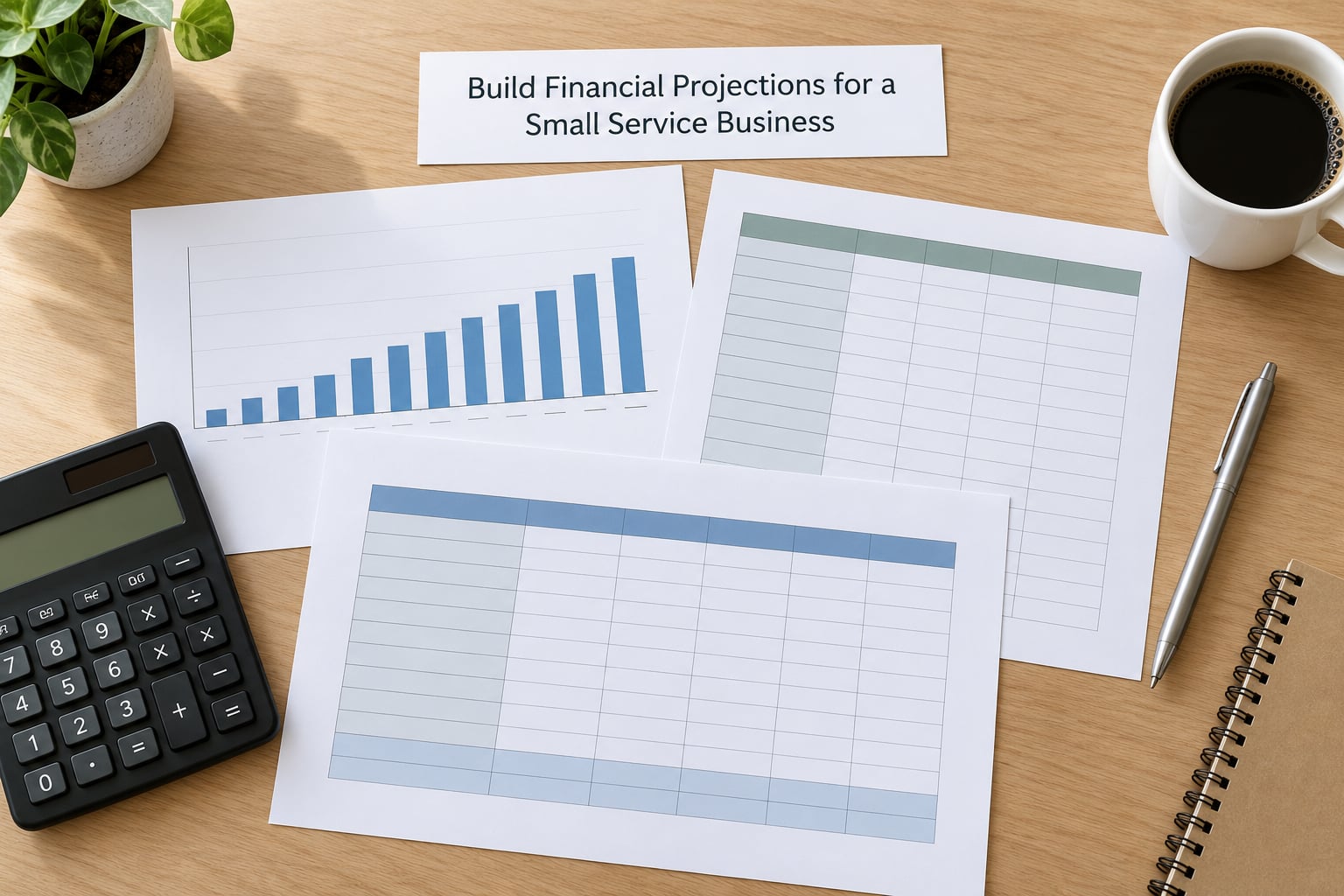
Start with capacity, not with revenue. Every service business projection begins with the hours you actually have to sell.
Step 1: Billable hours. Take your working hours in a month, roughly 170 for a full-time schedule. Subtract admin, marketing, invoicing, and the gaps between client calls. If that leaves 100 billable hours and you plan at 60 percent utilization to stay sane, you have 60 hours a month to sell. Planning at 100 percent is how owners end up exhausted and behind by month four.
Step 2: Revenue from hours. Divide your usable hours by the average hours a typical engagement consumes. If engagements run 12 hours and you have 60 usable hours, you can deliver five a month. Multiply by your blended price. That product is your revenue ceiling, and it is a number your market may disagree with — which is useful to learn before you sign anything.
A worked example, for a solo brand consultant:
- Usable billable hours per month: 60
- Average engagement: 12 hours at a blended 850 per project
- Capacity ceiling: five projects a month, or 4,250 at full capacity
- Subcontractor and contractor cost at 30 percent of revenue: 1,275 at that ceiling
- Gross margin: roughly 70 percent
- Fixed monthly overhead: software, insurance, phone, workspace at about 1,400
Break-even sits at 1,400 divided by 850 multiplied by 70 percent, which is 597 in gross profit per project — call it two to three projects a month. That is the number to know: it is the point where the business stops costing you money.
Step 3: Startup costs. Registration and licensing, professional and liability insurance, equipment, software for the first year, website and domain, business phone, deposits, and three months of overhead covered before the first payment lands. Hold back 10 to 15 percent for what you will forget.
Step 4: Twelve months of projections. Month one rarely looks like month twelve. Model a ramp — a new owner often closes a third of the target in the first quarter — and show the low, expected, and high case rather than a single line. A lender trusts a range that you can explain over a fantasy number.
Step 5: Cash flow. Revenue is not cash. If invoices go out on the 15th with net-30 terms, money arrives about 45 days after the work. Model when cash arrives, not when you bill. Watch burn rate and runway: the number of months your available cash covers your expenses. Those two figures decide how long you can wait for a slow quarter.
8. Review and Use Your Business Plan
A plan that sits in a folder is a document, not a tool. The last step is deciding how it gets used after the writing is done.
Edit it once before anyone else reads it. Cut anything that repeats, and mark every projection with the assumption behind it — “five projects per month at 60 percent utilization” tells a reader exactly what to check against reality later.
Then give each target an owner and a date. A twelve-month plan with no dates attached is a wish list. Assign each marketing action, each credential, each hiring step to a person and a week.
Set two review rhythms. Compare actuals against projections monthly, because service revenue swings and you want to catch a pricing problem in month three rather than month nine. Review the whole plan quarterly for assumptions that have shifted — new competition, a changed service area, a subcontractor rate increase.
Ask a second pair of eyes to read it. The most repeated free piece of advice on small business forums is also the most useful: a person who runs a business elsewhere will spot an assumption you cannot see. Then rewrite. Revising a plan is normal and expected, not a sign that the first attempt failed.
Common Mistakes
These are the errors that most often cost a service business its funding or its first year.
- Unrealistic sales projections. Fix: build from billable hours, and show the ramp. Nobody believes month-one revenue that ignores how long trust takes to build.
- A vague customer profile. “Small businesses” is not a customer. Fix: one profile with a trigger, a location, and a budget range.
- No capacity model at all. Fix: state usable billable hours per month and the hours each engagement consumes.
- Hiding contractor costs in overhead. Fix: split cost of services from fixed overhead so gross margin means something.
- Treating every tier the same in the financial model. Fix: model each offer with its own hours, price, and margin. Tiered offerings behave very differently.
- Tactics with no numbers attached. Fix: give every channel a monthly cost and an expected client count, then compute customer acquisition cost.
- Generic projections lifted from a template. Fix: fill every figure from your own records. Generic numbers are the fastest way to lose a lender’s trust.
- Never updating it. Fix: monthly actuals against projections, quarterly full review, and a written record of what changed.
Two more worth naming. Writing the plan to be impressive rather than to be read leads to padding, and padding is obvious. And deferring the pricing question — the hardest part of the document, and the part most likely to be skipped — leaves the whole model resting on a number you never examined.
Frequently Asked Questions
Do I need a business plan if I am a solo consultant?
Usually a short one, yes. Most solo providers who write one say its value is internal: it forces decisions about pricing, capacity, and who the customer is. Skip the long traditional format unless you are applying for an SBA loan or bank loan, where a written plan with projections is effectively required. A one-page lean plan takes a weekend and catches the assumptions that cost money later.
How long should a small business plan be?
One page if you are planning for yourself or a partner, and fifteen to twenty pages if a lender or investor reads it, excluding appendices. Lean plans are not lesser versions; they are the same content without the padding. Length follows the audience. If a reader will act on the document, it needs enough to answer their questions and not much more.
What should be included in your business plan?
A service business plan covers nine things: executive summary, company overview, service offering, customer definition, market and competitive analysis, marketing and sales plan, operations and management plan, financial projections, and the funding request with use of funds. For service businesses the sections that matter most are pricing structure, capacity, and contractor costs, because those determine whether the business is viable.
Can ChatGPT create a business plan for me?
It can produce a decent first draft of structure and wording, and it cannot produce the numbers, which are the part that matters. Any figure it generates for your market, costs, or pricing has to be verified against your own records and real quotes before it goes in front of a lender. Treat it as an assistant that saves you typing, never as a source.
What are the 5 C’s of a business plan?
The five C’s are a memory device rather than an official framework: Company, Customers, Competition, Cash, and Concept, sometimes listed as Cash flow in place of Concept. They map onto a standard plan as an overview, a customer definition, a competitive analysis, and a financial section. Use the C’s as a checklist while drafting, then organize the finished plan under headings a lender will expect.
What font and format should I use for a business plan?
Use 11 or 12 point body text in a clean serif or sans-serif, one to two typefaces, one-inch margins, numbered pages, and a table of contents for any traditional plan over ten pages. Keep headings visually distinct so a reader skimming for the financial section can find it in seconds. Formatting matters less than clarity, but an unreadable document gets skimmed and skipped.
Conclusion
Eight parts, one weekend, and the summary written last. The document itself is simple; the value sits in the decisions it forces you to make in writing, especially about pricing and how many hours you can actually sell.
Start today with four things and nothing else: the services you offer and how each one is priced, the one customer you serve best, what it costs you to open, and what a realistic first-year sales ramp looks like. Write those four down, and the rest of the plan has something to sit on. Reopen it this 2026 and again next 2026, when you can see which assumptions held and which ones did not.