
The short answer is simple: contribute enough to your 401(k) to capture the full employer match, then put whatever you can still afford into a Roth IRA. They are not competing accounts. You are allowed to hold both in the same year, the limits apply separately, and for most employed people the winning move is both, funded in that order. Knowing how to choose between a 401k and a Roth IRA comes down to three things: whether your employer puts money in, which tax bracket you are in now, and what you expect to be in when you stop working.
For most people the decision takes about twenty minutes once you have your last two pay stubs and the summary of your plan’s match formula. This guide walks through the rules, the numbers, and the order of operations. It is general information for US workers, not individualized tax or investment advice, and limits change annually, so verify the exact figures for 2026 at IRS.gov before you set your contribution.
Table of Contents
- How to Choose Between a 401k and a Roth IRA at a Glance
- 401(k) vs. Roth IRA: What Is the Key Difference?
- How Eligibility and Contribution Limits Affect Your Choice
- How Taxes Work Now and During Retirement
- How Employer Matches Can Favor a 401(k)
- How Investment Choices and Fees Affect Both Options
- How to Compare Fees When Choosing Between a 401k and a Roth IRA
- Can You Contribute to Both a 401(k) and a Roth IRA?
- How Higher Earners Get a Roth IRA Anyway
- Watch for the Pro-Rata Rule
- What to Do When Your Employer Has No 401(k)
- Which Should You Choose?
- Frequently Asked Questions
- Can I have a 401(k) and a Roth IRA at the same time?
- Is a Roth IRA always better than a traditional 401(k)?
- Should I pay off debt before contributing to a Roth IRA?
- What is the best order for 401(k) and IRA contributions?
- What happens to my 401(k) and Roth IRA if I change jobs?
- Conclusion: What to Do First
How to Choose Between a 401k and a Roth IRA at a Glance
| What to compare | 401(k) | Roth IRA |
|---|---|---|
| Who sets it up | Your employer, through a workplace plan | You, with an IRA custodian you pick |
| Where the money comes from | Payroll deduction, pre-tax or Roth | Money you contribute after tax |
| Tax treatment now | Traditional lowers your taxable income now; Roth does not | No deduction now |
| Tax treatment in retirement | Traditional withdrawals are taxable; Roth withdrawals are not | Qualified withdrawals are tax-free |
| Annual contribution limit | About 24,500 dollars, plus a larger catch-up at 50 | About 7,500 dollars, plus a smaller catch-up at 50 |
| Employer contributions | Yes, match and profit sharing are common | No employer can contribute |
| Investment choices | Whatever the plan menu allows, sometimes narrow | Any stock, fund, or ETF at your custodian |
| Fees | Plan administration fee plus fund expense ratios | No plan fee, but custodian and fund fees apply |
| Money you put in | Locked until retirement in most cases | Locked until retirement in most cases |
| Early withdrawal penalty | 10 percent plus income tax before 59 and a half, with hardship exceptions | 10 percent plus income tax before 59 and a half, plus a five-year rule for earnings |
| Required minimum distributions | Yes, from your late seventies onward | Original Roth IRAs: none; inherited ones: yes |
| Access to money | Some plans offer loans against the balance | First-home and disability exceptions exist |
| When you leave your job | Stays with the old employer or rolls over to an IRA or the new plan | Yours to move between custodians anytime |
| Income limit on contributions | None for most plans; high earners may be capped on Roth salary deferrals | Phases out above a set modified AGI |
| Best fit | Anyone with a match, or a higher tax bracket today | Lower-bracket savers and anyone who wants tax-free withdrawals |
The IRS resets contribution limits and the Roth income phase-out every fall, so treat the numbers above as current ranges rather than fixed facts. The structure of the choice does not change: the 401(k) has the higher ceiling and the match, the Roth IRA has the wider investments and the cleanest retirement withdrawal.
401(k) vs. Roth IRA: What Is the Key Difference?
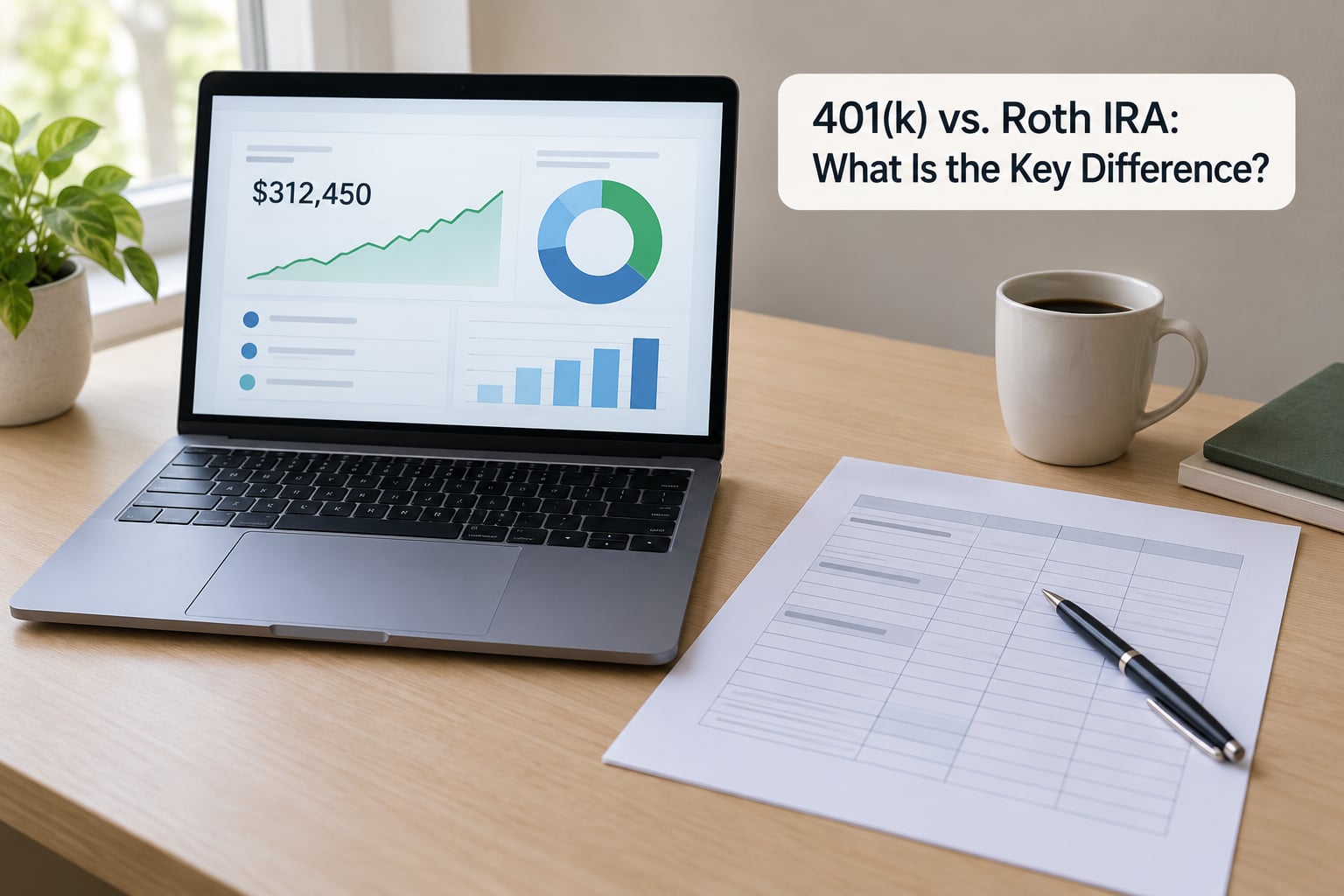
A 401(k) is a retirement account your employer sponsors. You elect a contribution before each payroll, the money comes out of your paycheck, and the plan administrator handles the administration, the investments, and the reporting. Many plans also have a Roth 401(k) option where contributions come out after tax and qualified withdrawals in retirement are tax-free, which makes it behave more like a Roth IRA on the tax side.
A Roth IRA is an individual retirement account you open yourself with a brokerage or bank that is approved to hold IRAs. You choose the investments, you choose the amount up to the annual limit, and no employer can contribute to it. Contributions are made with after-tax dollars and qualified withdrawals after the rules are met are completely tax-free.
So the key difference is who controls the account and when you pay tax. The 401(k) ties your saving to a job and gives you access to employer money. The Roth IRA gives you total control of the investments and a tax-free withdrawal, but only if you qualify under the income rules and you do it on your own.
How Eligibility and Contribution Limits Affect Your Choice
You need earned income to fund either account, and the amount you can put in is capped by both the IRS limit and, for a 401(k), your employer’s plan rules. The IRS limit for 2026 is around 24,500 dollars for 401(k) salary deferrals and around 7,500 dollars for IRA contributions, with catch-up amounts layered on top for people 50 and older. Those figures are adjusted most years, so confirm them on the IRS retirement plans page before you automate a contribution.
Your employer can set a lower limit than the IRS allows. Plenty of plans cap contributions at a percentage of your salary, and many exclude overtime, bonuses, and commissions from the calculation. If your plan matches only base pay, a big bonus year produces a smaller match than you would expect from the headline formula.
Roth IRAs carry an income restriction that 401(k)s mostly do not. Direct Roth contributions phase out above a set level of modified adjusted gross income, and recent years have put that single-filer threshold somewhere in the range of 150,000 to 170,000 dollars depending on the year. Joint filers get a higher phase-out. If you earn above your limit, the direct Roth contribution is not available, though a conversion route exists and is covered below.
Other eligibility details worth checking: Roth IRA contributions require earned income, so a year of unemployment usually means no contribution for that year, and Roth 401(k) salary deferrals can be capped for highly compensated employees when a plan fails nondiscrimination testing.
How Taxes Work Now and During Retirement
Traditional 401(k) contributions come out of your paycheck before tax, which lowers the taxable income reported to the IRS. Growth compounds without yearly tax, and withdrawals in retirement are taxed as ordinary income. That is a trade: a smaller tax bill now, a bigger one later.
Roth 401(k) and Roth IRA contributions are made with after-tax dollars. Nothing comes off your paycheck now, growth is not taxed, and qualified withdrawals are tax-free. For a traditional 401(k), the IRS distinguishes principal from earnings, so you can generally take your own after-tax contributions back without tax or penalty. For a Roth IRA, earnings withdrawn before you turn 59 and a half can carry the 10 percent early withdrawal penalty plus income tax, and a separate five-year clock applies to earnings regardless of your age.
Required minimum distributions are the other half of the retirement picture. A required minimum distribution, or RMD, is the amount the IRS requires you to withdraw from traditional accounts starting in your late seventies, and the amounts scale with the size of your account. Traditional balances have no lifetime RMD rule, which is one of the quieter arguments in favor of Roth money. You can give yourself an RMD on a schedule you choose, since the rules simply permit it earlier.
That leads to the honest part of the decision. If you expect your tax rate to be higher in retirement than it is today, Roth money is valuable. If you expect it to be lower, traditional money wins. Plenty of retirees pay a lower rate in retirement by design, which is the strongest argument for traditional contributions, and plenty of others spend decades in a low bracket early and know retirement savings will be their biggest taxable income, which is the strongest argument for Roth.
How Employer Matches Can Favor a 401(k)
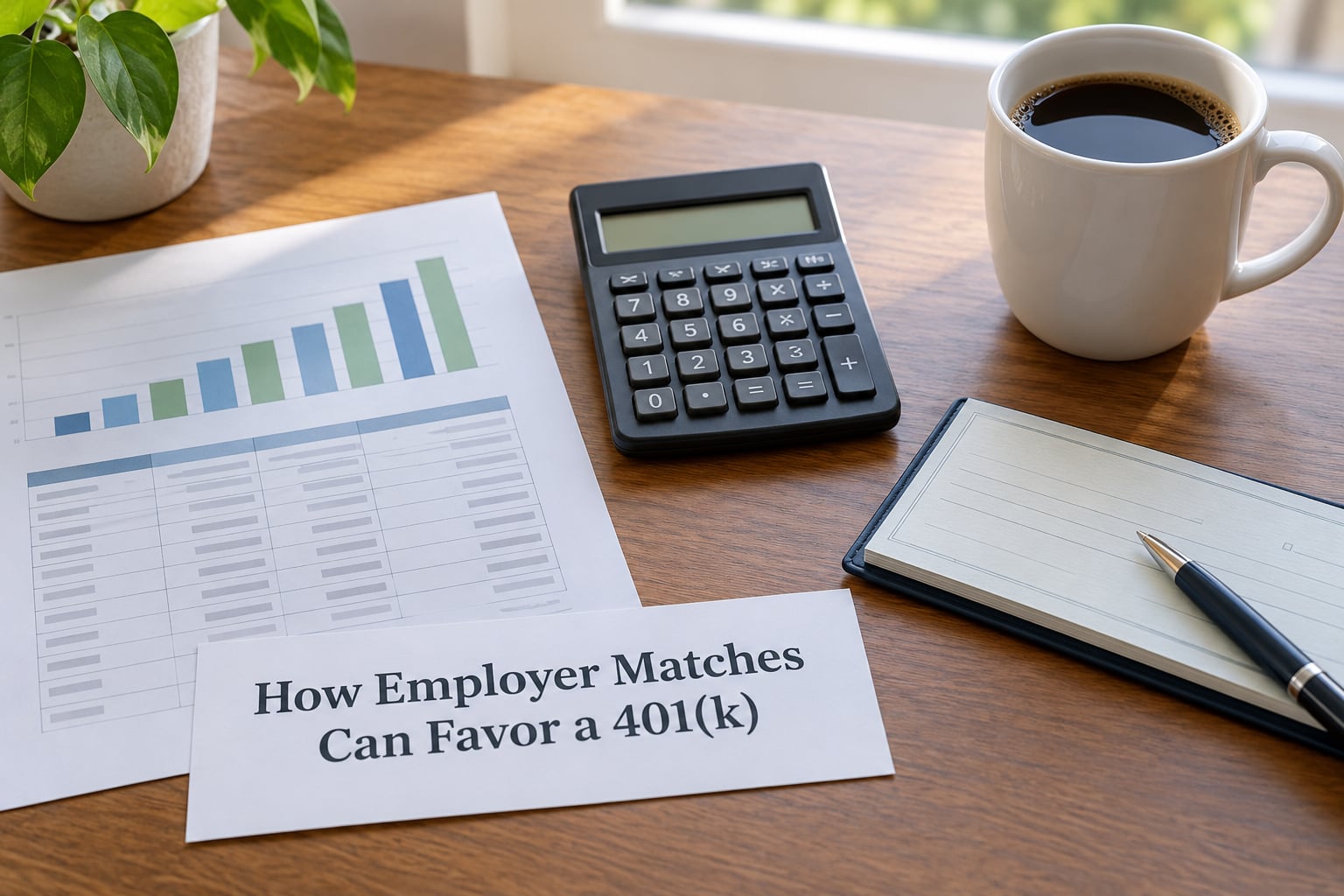
An employer match is the closest thing to free money in personal finance, and it should drive your order of operations. If your employer matches 100 percent of the first 3 percent you contribute, and you make 50,000 dollars a year, contributing 1,500 dollars brings 1,500 dollars with it. That is a 50 percent immediate return on the portion you put in, before any market growth at all.
Two details decide whether that money is actually yours. First, vesting tells you when the match becomes yours. Immediate vesting means it is yours from the start. Three-year or six-year cliff vesting means you leave without the vesting date and forfeit everything the employer put in, which is a large loss. Second, the match itself only counts while it lands inside the IRS limit, so on a high-income year the last part of your salary is often not matched.
That is why the practical rule is to hit the match before anything else. Contribute enough to your 401(k) to capture the full match, then split whatever is left between a Roth IRA and additional 401(k) contributions. People who open the IRA first and leave the match unclaimed end up paying the price years later, and forum discussions about this mistake come up again and again in personal finance communities.
How Investment Choices and Fees Affect Both Options
Plan menus are usually the weakest part of a 401(k). Large employer plans can hold thousands of funds, but small plans often offer a dozen mediocre options with high expense ratios and no low-cost index fund. IRAs have no menu restrictions at all, so you can hold broad index funds at a fraction of the cost.
Fees are the one line item that compounds against you. Every tenth of a percent of annual expense cost removes roughly a tenth of your final balance, and over a working life the difference between a cheap index fund and an expensive active fund can be six figures. Cash sitting uninvested in a 401(k) is the worst version of this, because it often earns a small interest rate while the plan charges you anyway.
How to Compare Fees When Choosing Between a 401k and a Roth IRA
Compare costs in dollars, not just percentages, and once a year. Take the balance in each account and multiply it by the annual fee to see what the cost looks like in actual money. For a 401(k), read the plan’s annual fee disclosure and check the expense ratio of the specific funds you hold. For an IRA, look for an account with no annual account fee, then check the expense ratio of the fund inside it. If the 401(k) is materially more expensive, a common move is to keep enough in the 401(k) to capture the match, then hold the core of your savings in low-cost IRA funds.
Can You Contribute to Both a 401(k) and a Roth IRA?
Yes, and the limits are separate, so filling one does not reduce your room in the other. The widely used order is: capture the full employer match, then max the IRA, then return to the 401(k) if you still have money to invest. That sequence is recommended so often in investing communities because the match is an immediate return that the IRA cannot offer you, while everything after that is your own money either way.
How Higher Earners Get a Roth IRA Anyway
Earners above the direct Roth income limit can still use a Roth IRA through a backdoor Roth conversion. You contribute to a traditional IRA, then convert that balance to a Roth IRA shortly after, and qualified Roth withdrawals are tax-free from there on. The conversion is taxable as ordinary income in the year it happens, so the size of that bill depends on your bracket that year. Converting in stages across two tax years often keeps more of the amount in a lower bracket.
Watch for the Pro-Rata Rule
The pro-rata rule is the trap that catches people who convert without reading. If you hold a traditional IRA with pre-tax money on December 31 of the conversion year, the IRS treats your conversion as partly a pro-rata withdrawal, and you pay tax on the earnings proportional to the pre-tax money in that traditional IRA. One stray traditional IRA balance can turn a tax-free conversion into a taxable bill of thousands of dollars. Rolling old 401(k) money into a traditional IRA right before converting is a frequent way people trigger it by accident.
What to Do When Your Employer Has No 401(k)
Self-employed people and workers at small employers often have no plan to join. Open an IRA directly with a low-cost custodian, and when you later have access to a 401(k), ask your plan administrator whether it accepts rollovers from an IRA or a 403(b). Rolling existing 401(k) money into an IRA gives you access to a wider investment menu, though the trade-off is losing access to plan loans and, depending on your plan, some higher contribution limits.
Which Should You Choose?
| If your situation looks like this | Start here |
|---|---|
| Your employer matches contributions | 401(k) until the match is fully captured, then a Roth IRA |
| Your employer has no plan at all | Open an IRA yourself and invest the difference |
| You are in a high tax bracket now and expect less later | Traditional 401(k) contributions |
| You are early in your career in a low bracket | Roth IRA, because growth and withdrawals will stay untaxed |
| Your income is above the Roth limit | Traditional 401(k) first, then a backdoor Roth conversion |
| You are 50 or older | 401(k) catch-up contributions plus IRA catch-up contributions |
| You plan to leave your job soon | Stay until vested, then decide between a rollover and leaving it with the old plan |
| You want the widest investment menu | Keep the match in the 401(k) and hold the rest in an IRA |
Some priorities sit above this whole debate. An employer match outranks everything else. After that, high interest debt usually does, since paying off 22 percent credit card interest is a guaranteed return and a retirement contribution is not. Employer stock, life insurance, and disability coverage can matter more than either account if they are badly missing. Keep a real emergency fund before you max anything, and treat the order of contributions as something you revisit annually rather than a decision you make once.
One more practical note on job changes. A 401(k) stays with your old employer unless you roll it over to an IRA or transfer it into your new employer’s plan, and cashing it out instead triggers income tax plus the 10 percent penalty before 59 and a half. A Roth IRA needs no action at all, you just move it to a new custodian whenever you like.
Frequently Asked Questions
Can I have a 401(k) and a Roth IRA at the same time?
Yes. No rule stops you from holding both accounts in the same year, and the contribution limits are calculated separately, so maxing one does not reduce your room in the other. The usual order is to contribute enough to your 401(k) to capture the full employer match, then put the rest of your savings into the IRA. Plenty of people max both in a single year whenever their income keeps them eligible for direct Roth contributions.
Is a Roth IRA always better than a traditional 401(k)?
No. A Roth IRA gives you tax-free qualified withdrawals and a much wider investment menu, but it offers no current tax deduction and it has an income limit on contributions. A traditional 401(k) often carries a higher limit, accepts an employer match, and can lower your taxable income right now. Which one wins depends on your tax bracket today, the bracket you expect in retirement, and whether your employer contributes.
Should I pay off debt before contributing to a Roth IRA?
High interest debt usually comes first. Credit card balances often charge well into the twenties percent, and paying that off is a guaranteed return that no retirement account can match. Low interest debt is different, since paying off a 4 percent student loan while missing an employer match means giving up money to save money. A good middle path is to capture your full 401(k) match, keep your emergency fund intact, and attack the highest balance with everything else.
What is the best order for 401(k) and IRA contributions?
Capture the full employer match in your 401(k) first, because that is an immediate return nothing else offers. Then contribute to your Roth IRA until you reach the annual limit, since it gives you tax-free growth and withdrawals. After that, put remaining savings back into the 401(k) if your plan lets you exceed the match, then keep any leftover money in a taxable brokerage account. Review the order each year as your pay and your plan change.
What happens to my 401(k) and Roth IRA if I change jobs?
Your 401(k) balance stays with your former employer, and you then choose between leaving it there, rolling it into an IRA, or transferring it to your new employer’s plan if that plan accepts transfers. Cashing it out is the expensive option, since it triggers income tax and a 10 percent early withdrawal penalty before 59 and a half. Your Roth IRA is unaffected, you simply move it to the new custodian if you want to change where it is held.
Conclusion: What to Do First
Open your plan’s summary today and find the match formula. If there is a match, raise your 401(k) contribution until every dollar of it is matched, then open a Roth IRA with a low-cost custodian and automate a contribution for the same payday. If there is no plan and no match, the Roth IRA is simply where your retirement savings live until your employer or your own business offers one. Check the current IRS limits and your plan’s rules before you commit, and reread the choice each year, because your pay, your bracket, and your employer’s plan all move.