
Checking your credit report for errors takes about 45 minutes the first time, and the whole process is free. Pull your report from all three bureaus, read it section by section, compare every account against your own paperwork, and dispute anything unfamiliar or wrong before you apply for a loan, an apartment, or anything else that cares about your credit. You do not need to pay anyone to do this.
Most people check one report, glance at a score, and stop. That is how a two-year-old collection from a debt that was never yours keeps tanking loan offers for another decade.
Table of Contents
- What You Need
- Step-by-Step: How to Check Your Credit Report for Errors
- Step 1: Obtain Your Reports from the Three Credit Bureaus
- Step 2: Check Your Personal Information and Account Statuses
- Step 3: Check Your Credit Report for Errors in Balances and Payment History
- Step 4: Look for Collections, Judgments, and Public Records
- Step 5: Document and Dispute Every Error
- Step 6: Follow Up Until the Report Is Corrected
- Common Mistakes
- Frequently Asked Questions
- Is it necessary to check all three credit reports?
- How often should I check my credit report for errors?
- What information should I dispute on my credit report?
- Can I dispute a credit report entry online?
- How long does a credit report dispute take?
- Will checking my own credit report lower my credit score?
- Conclusion
What You Need
Before you start, gather a few things so you are not scrolling back and forth between screens.
- Government-issued ID. A driver’s license or state ID with your address on it. AnnualCreditReport.com asks for this to verify your identity before it releases the file.
- Your account numbers. Credit card, loan and mortgage account numbers, plus the phone number for each lender. Write them on paper, phone numbers included, next to the last four digits.
- Recent statements. At least one statement per open account. A PDF from your email is enough.
- Proof of anything you already paid or settled. Paid-in-full receipts, settlement letters, court record copies, paid medical bills. This is the evidence that wins disputes.
- A pen and a notebook, or a spreadsheet. You are going to track every dispute: the date, the method, the tracking number, the deadline.
Set aside an uninterrupted block of time. Rushing this is how people miss the one account that does not belong to them.
Step-by-Step: How to Check Your Credit Report for Errors
To check your credit report for errors, request your file from Equifax, Experian and TransUnion through AnnualCreditReport.com, then read each report line by line: personal information, account status, balances, payment history, collections and public records, and inquiries. Anything you cannot match to your own records is a candidate for a written dispute.
Step 1: Obtain Your Reports from the Three Credit Bureaus
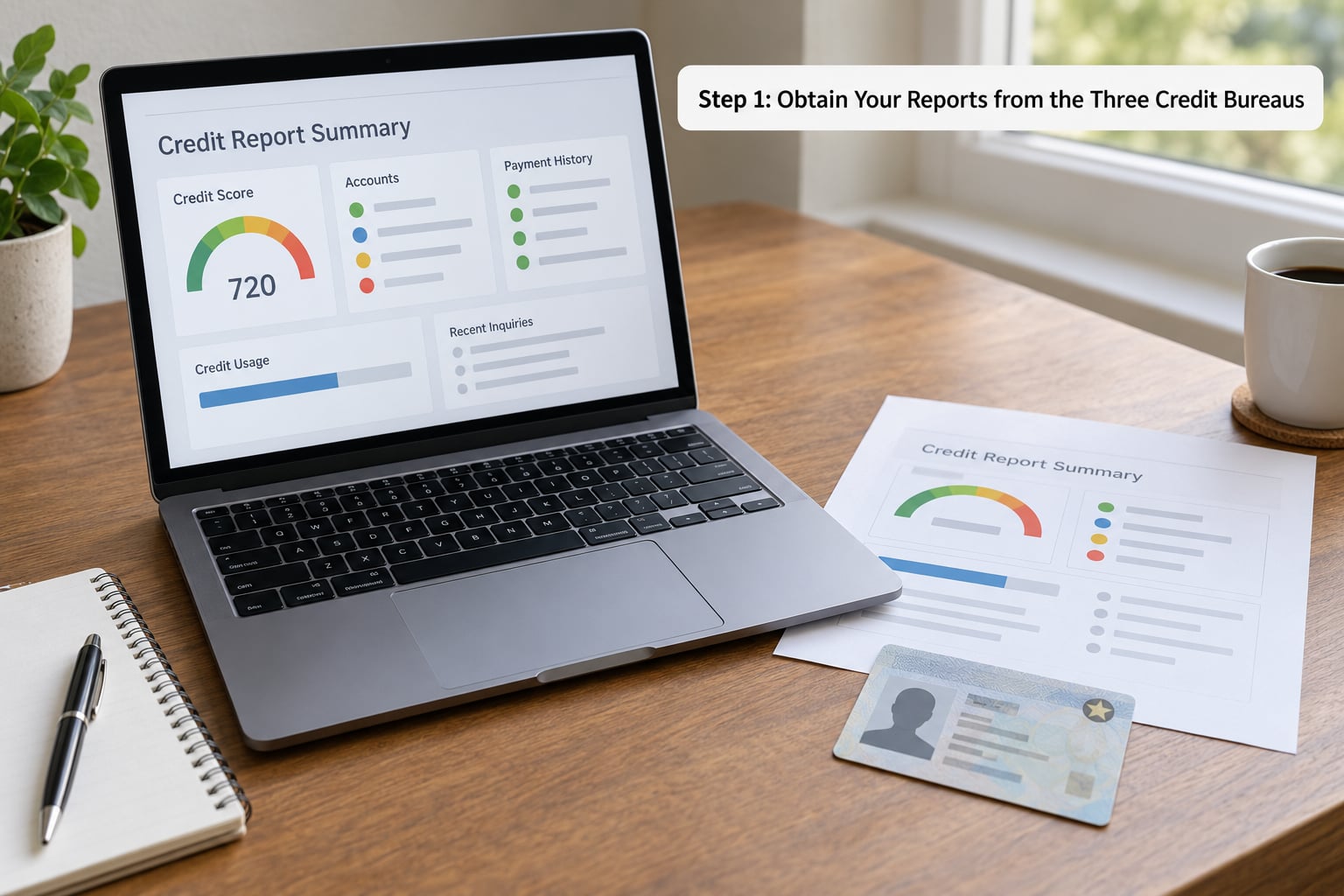
Equifax, Experian and TransUnion each keep a separate file on you, and an error can sit on one report and never appear on the other two. That is why pulling all three is not optional.
Go to AnnualCreditReport.com, the only federally authorized free source, and request all three reports at once. Type the address carefully, because the site will match it against your ID. You get one full report from each bureau every 12 months at no cost.
One important note: the pandemic-era program that offered free weekly reports has ended. Any site charging you for a “free weekly report” is not the real thing. Type the web address yourself rather than clicking a link from a search ad.
Two things that confuse people. A credit report is the record of your accounts; a credit score is a number calculated from that record. Your report is free by federal law. A score is not, and many people pay for scores they already get free from their bank or card issuer. Skip the score and read the report.
There is a second free route. If a lender denied you credit, or took adverse action based on your file, write to them within 60 days of the notice. They have to tell you the specific reason, and they have to give you a free copy of the report they used. This is the fastest way to find out what is actually holding you back.
Step 2: Check Your Personal Information and Account Statuses
Start at the top of the report, where the bureaus list your name, addresses, phone numbers and employment history. Every variation of your name that you have legitimately used belongs there, so a maiden name or a middle initial is not an error.
What is an error: an address where you have never lived, a phone number that is not yours, an employer you never worked for, or a name belonging to someone else. Those are identity theft fingerprints, and they need to go today, not eventually.
Next, look at each account’s status. Confirm the accounts you opened are listed and the ones you closed are marked closed. A card you closed years ago should not show a current balance. An account showing open that you closed, with a high credit limit still counting, directly lowers your available credit.
Step 3: Check Your Credit Report for Errors in Balances and Payment History
Pull your latest statement for each account and hold it next to the report. Compare four fields: the balance, the credit limit, the payment history and the account open date.
The most common timing error is a payment that posts a month late because of a mailing delay, or a 30-day late that your lender reported twice. Duplicates are a real and well-documented problem. If you were never more than 30 days late, and the report says 60 or 90, that is a dispute.
One thing that is not an error: a low balance. A paid-off card sitting at a small balance is doing your credit no harm, and lenders generally treat revolving balances differently from installment loans. Do not spend a dispute on it.
Check the open date too. A card you have held for years that shows an open date from last year is not a clerical typo, and it usually means the account belongs to someone else.
Step 4: Look for Collections, Judgments, and Public Records
This section is where the damage usually lives. Read every collections entry and ask three questions: was this debt mine, did I pay it, and is the status still accurate.
Paying a debt does not erase it. A collection can legitimately report as paid in full, and the negative history stays on the file for about seven years. That is accurate reporting, not an error, and disputing it wastes your one clean shot at the bureau.
What you do dispute: a collection for a debt you never owed, a collection from a company that cannot prove it owns the debt, a balance you already paid in full, a judgment you satisfied, or a bankruptcy that was discharged. Bring documentation. A paid-in-full receipt dated before the collection went to an agency is the single strongest piece of paper you can send.
Watch for collections that list your name slightly wrong, a different middle initial, or a birth year that is off by a year. Small mismatches are how duplicate accounts appear, and one debt you owed can show up as two when a collector has merged your file with someone else’s.
Also read the public records section: judgments, liens, evictions, bankruptcies. If anything there is unfamiliar, it needs the same written dispute as a collection.
Step 5: Document and Dispute Every Error
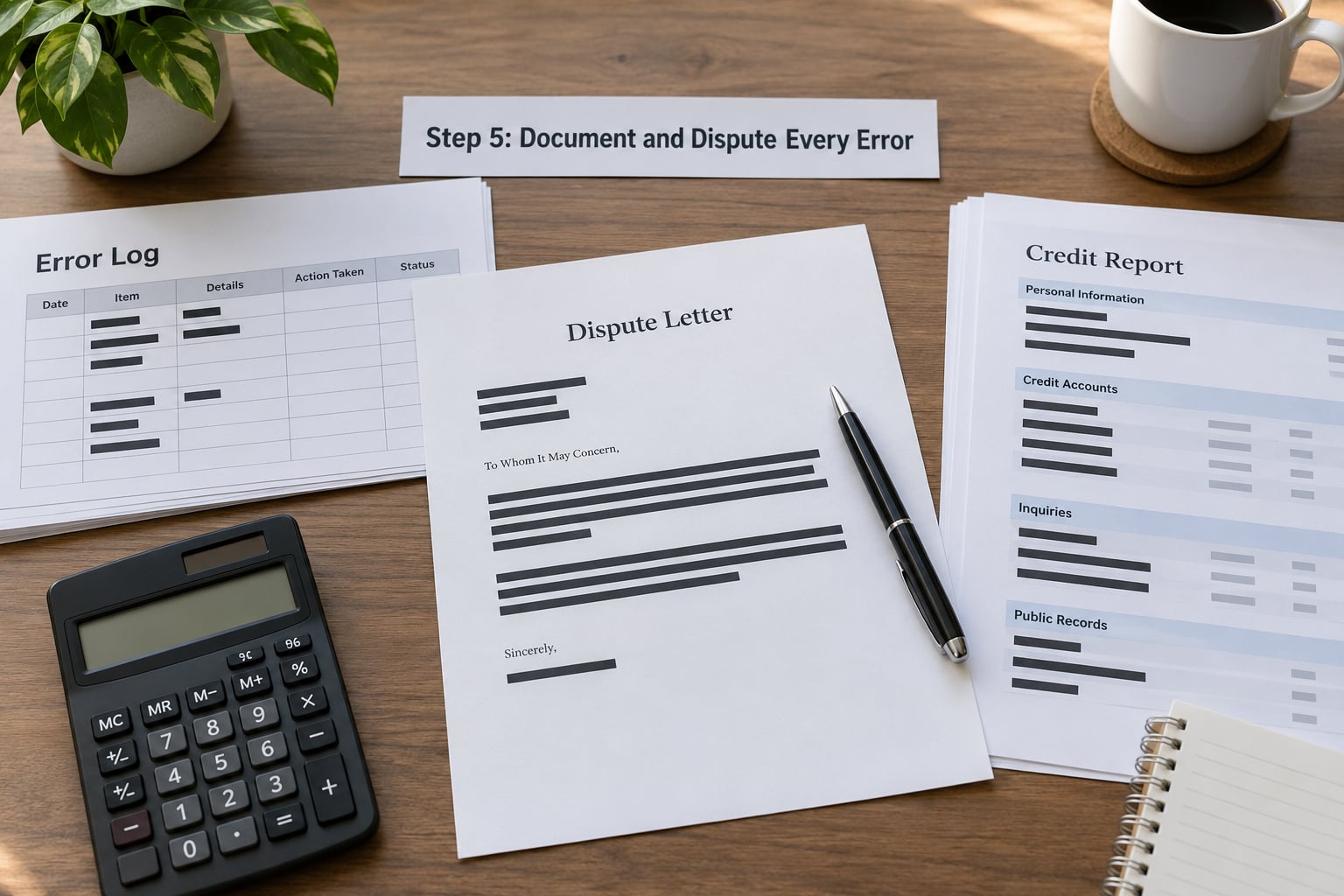
Write one letter per error. A letter disputing four items is far more likely to be dismissed as a batch than four letters that each name one item and one fix.
Each letter needs four things: the specific item and the section it appears in, the reason it is wrong, the correction you want, and your contact information. Attach photocopies of your evidence, never the originals, and list the attachments in the letter itself.
Send it two places. Write to the furnisher, the company that supplied the data, because they are the only ones who can correct the source. File separately with each credit bureau that shows the error. Both tracks are needed; the bureau often just asks the furnisher the same question, and the furnisher rarely answers if nobody has chased them directly.
Certified mail with a return receipt is the safer choice, for one reason: paper. Online portals give you no confirmation of what was actually submitted, and the phone and web systems regularly contradict each other. Certified mail gives you a delivery date and a signature.
Step 6: Follow Up Until the Report Is Corrected
Bureaus have 30 days to investigate a dispute, and the clock starts when they receive it, not when you mail it. Mark that date in your log.
Around day 30, expect either a corrected report or a written results letter explaining the decision. The results letter is where readers give up, and it is where the process usually turns. A dispute denied for lack of documentation can be refiled with more evidence, and people frequently win on the second or third attempt once they attach the document they did not have the first time.
If the bureau calls your dispute frivolous, it has to send that notice separately, and you still have the right to dispute that claim.
Two more tools before you escalate. If an item is accurate but you want your side of the story on file, add a statement of dispute, which is a short paragraph attached to the report. If the furnisher refuses to fix anything, file a complaint with the Consumer Financial Protection Bureau, which is free and carries real weight with bureaus.
Expect a small drop in your score in the weeks after a dispute. It is temporary, and it usually reflects the negative item being removed and the rest of your history re-weighting. Your score usually recovers at the next reporting cycle.
A credit freeze does the opposite. It blocks new accounts from being opened in your name, which stops fraudulent reinsertion, but you have to unfreeze it yourself when you apply for credit. A fraud alert is lighter: it asks lenders to verify your identity before approving anything, and it runs for one year.
Common Mistakes
- Checking only one bureau. Errors live on single files. Fix: pull all three, compare them side by side, dispute each one that carries the error. Prevention: a calendar reminder twice a year.
- Confusing a score with a report. A number tells you nothing about which account is wrong. Fix: read the file, not the number. Prevention: get your score free from your bank and spend your attention on the report.
- Treating accurate negative history as an error. Paid collections and closed accounts are supposed to stay. Fix: dispute only what is factually wrong, and use a statement of dispute for what is accurate but unfair. Prevention: know the difference before you write.
- Not documenting anything. If you cannot say when you mailed what, you cannot prove you met the deadline. Fix: log the date, the method, the tracking number and the deadline. Prevention: one spreadsheet, updated the day you send.
- Bundling every error into one letter. Fix: one letter per error, each with its own evidence list. Prevention: print the letter template fresh for every item.
- Giving up after the first denial. A denial is a request for more evidence, not a verdict. Fix: read the results letter for the stated reason, then refile with exactly that evidence attached. Prevention: keep every receipt and letter in one folder from day one.
- Paying someone to fix it. Legitimate help is free. Fix: use the FTC’s sample dispute letter and the bureau’s own process. Prevention: be skeptical of any offer to remove accurate history for a fee.
Rules and deadlines around credit reporting change, and they differ by state, so check the current terms on the CFPB and FTC sites before you file. Nothing here is individual financial advice, it is the process that works for most people.
Frequently Asked Questions
Is it necessary to check all three credit reports?
Yes. Equifax, Experian and TransUnion hold separate files, and an error frequently appears on one report and not the others. A collection that one bureau never heard of can still be the account that lowers your score, because lenders often pull all three. AnnualCreditReport.com lets you request all three at once at no cost, so there is no reason to check only one.
How often should I check my credit report for errors?
At minimum, twice a year, and more often after any life event that touches credit: a denied application, a collection you did not expect, a move, a new phone number, or a lost wallet or stolen identity. If a lender takes adverse action, you have 60 days from the notice to request a free copy of the report they used, plus the specific reason for the decision.
What information should I dispute on my credit report?
Dispute anything factually wrong: an account you never opened, a debt you already paid, a 60-day late when you were never more than 30 days late, a collection with the wrong balance, a judgment you satisfied, or personal information that belongs to another person. Do not spend a dispute on accurate history, such as a collection you genuinely owed and paid. A statement of dispute is the better tool for accurate but unfair entries.
Can I dispute a credit report entry online?
Yes, and each bureau has an online dispute portal. Plenty of readers prefer it because it is faster than printing a letter. Others use certified mail with a return receipt, because a paper trail proves exactly what was submitted and when. If you go online, save the confirmation email and screenshots of every page you submit, and check the status tracker on a weekly basis.
How long does a credit report dispute take?
A bureau has 30 days from receipt to investigate and report results, and the furnishers it contacts have their own 30 days to reply. Corrections usually show on your file within a week of the results letter. If nothing has changed after 45 days, contact the bureau for a status update, and at 60 days escalate with a Consumer Financial Protection Bureau complaint or a second dispute with additional evidence.
Will checking my own credit report lower my credit score?
No. Pulling your own report and checking your own score are soft inquiries and have no effect on your credit. Only hard inquiries, created when you apply for credit and a lender pulls your file, can affect your score, and the effect of a single hard inquiry is small. Monitoring services that claim otherwise are selling you something, and free report access is guaranteed by federal law.
Conclusion
Start tonight: pull all three reports from AnnualCreditReport.com and read them with your account numbers in front of you. Knowing how to check your credit report for errors takes one hour, it costs nothing, and it is the first action worth taking.
Once corrections land, keep the file clean by pulling your reports twice a year, keeping statements and paid-in-full receipts in one folder, and placing a credit freeze at each bureau if new accounts are being opened in your name. Review the current rules at the CFPB and FTC sites, since reporting timelines change and vary by state.