To start strength training at home for beginners, pick six basic movements, do them for 1 to 2 sets of 8 to 12 controlled reps, and repeat that full-body session two or three times a week with a rest day between. No gym membership and no equipment needed for the first few weeks, and a 20 to 30 minute session is enough to build real strength.
That is the honest version of the answer. Most people stall in the first month because they try to follow a 60-minute plan with 15 exercises and abandon it, or because they load up with heavy weight before they own the movement. Both are fixable, and the fix is boring: fewer exercises, more repetitions, more weeks.
This guide covers the setup, the six movements worth learning, a printable weekly schedule, how to add difficulty over time, and the mistakes that quietly cost beginners months.
Table of Contents
- What You Need
- Step-by-Step: Build Your First Home Strength Routine
- How to start strength training at home for beginners with a two-week setup
- Perform a beginner full-body workout
- Progress without overtraining
- Common Mistakes
- Frequently Asked Questions
- What are examples of strength training for beginners?
- How many sets and reps should a complete beginner do?
- How often should beginners strength train per week?
- Can I build muscle at home with no equipment?
- Is 20 minutes of strength training a day enough?
- How do I know if my form is right when training alone?
- Conclusion
What You Need
The honest list is short. Most beginners can train effectively for six to eight weeks with what they already own.
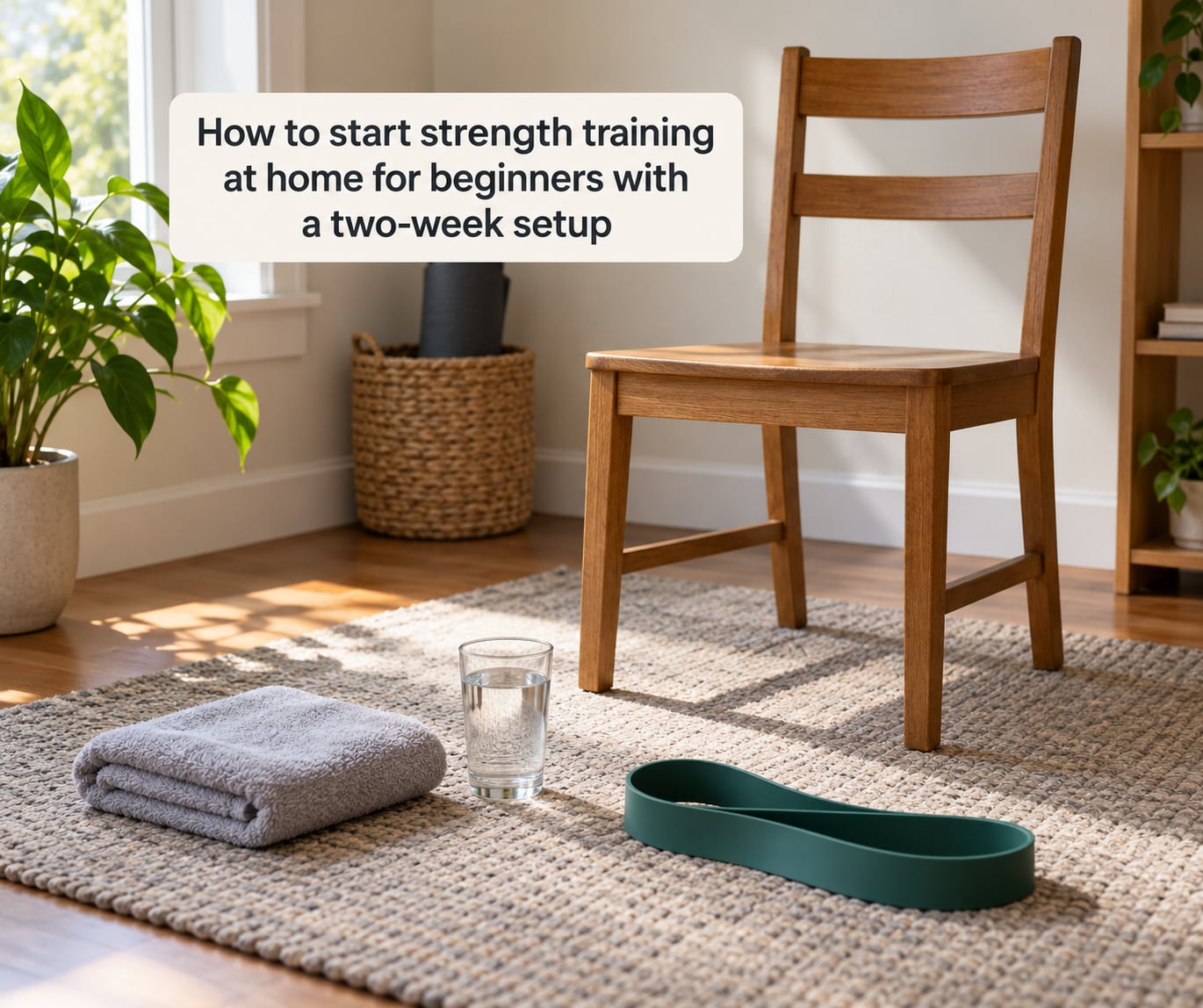
- A clear floor space about 6 by 8 feet, ideally with a rug or mat. Carpet is fine. A hardwood floor without a mat is the one thing worth buying first.
- A stable chair, counter or sturdy table for incline push-ups and to sit down for squats. Test it by pushing hard on it before you lean on it.
- A wall for wall push-ups, the easiest first pulling and pressing movement there is.
- Water within reach and clothing you can move and sweat in.
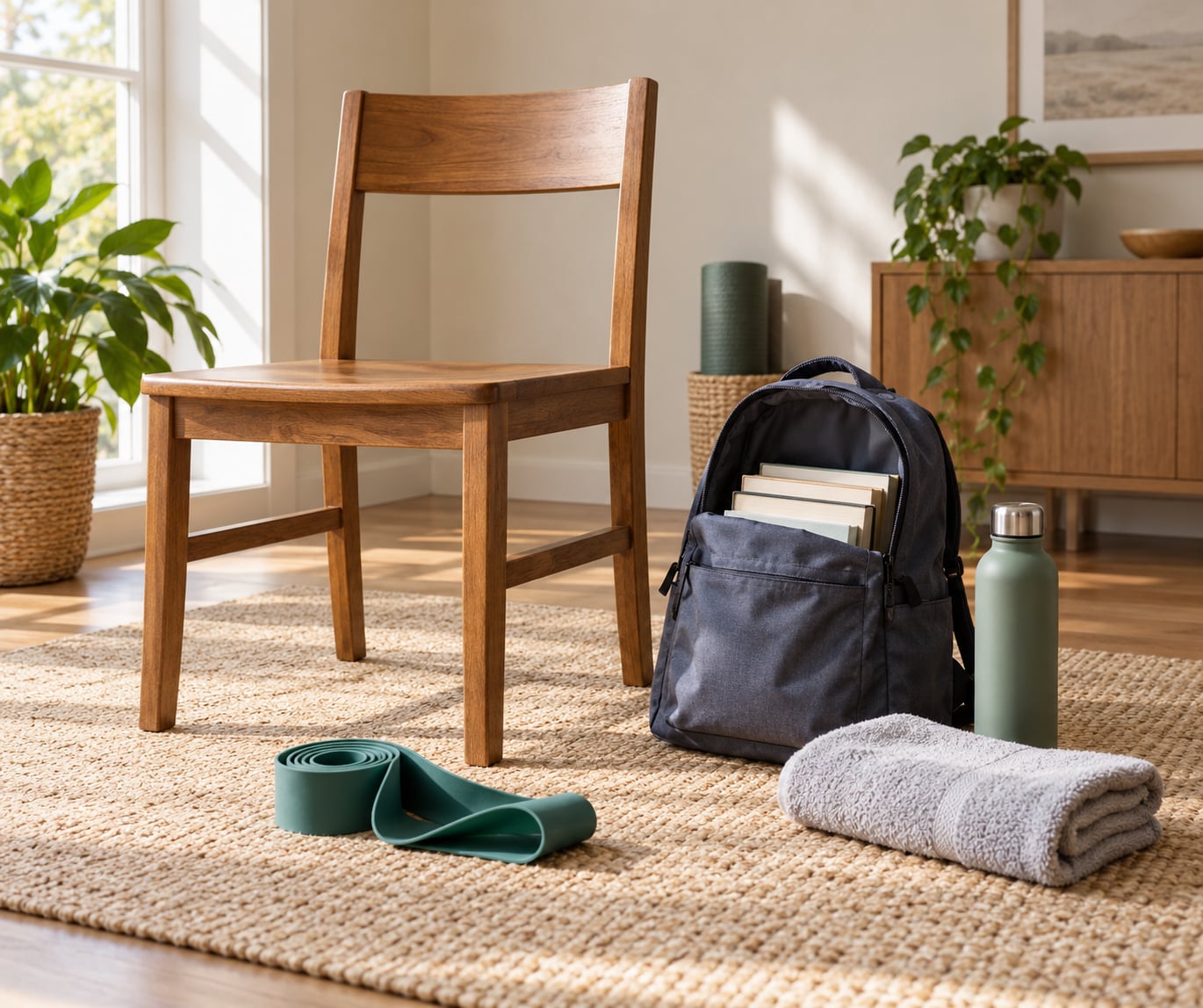
- Optional: a resistance band, a backpack with books in it, or two filled water bottles.
Bodyweight-only training is enough for the first several weeks, and this is not a soft claim. A bodyweight squat, a push-up and a glute bridge still load the muscle hard enough to grow it when you get close to failure.
The American College of Sports Medicine and the HHS Physical Activity Guidelines for Americans both frame resistance training around two or more days a week of work against resistance. Nothing in that guidance requires a machine.
What bodyweight-only training cannot do is keep giving you new reasons to progress. That is where bands and a backpack full of books come in, and you do not need them today.
Step-by-Step: Build Your First Home Strength Routine
How to start strength training at home for beginners with a two-week setup
Week one and week two are about learning six movements, not about training them hard. That sounds like a soft approach, but it is the approach that lets you add load later without hurting yourself.
First, prepare the area. Move anything you might trip over, check the chair does not wobble, and put your phone somewhere you can prop it against to film. Decide on your training days before you start, because a session that is not on the calendar usually does not happen.
Then learn the six foundational movements. Each one covers a movement pattern your body needs for daily life, and together they hit every large muscle group:
- Squat – legs and hips, plus core control.
- Hinge – the back of the legs and hips, the pattern behind deadlifts and good posture.
- Push – chest, shoulders and triceps.
- Pull – back and biceps.
- Brace – the core, which steadies every other lift.
- Carry or core hold – grip, shoulders and trunk endurance.
These are called compound movements because several muscles work together. Experts generally favour them for beginners because they give you more return per minute spent.
Before session one, run a readiness check. Can you squat down to a chair and stand back up without pain in your knees, hips or back? Can you hold a wall push-up for a clean 10 reps? If either answer is no, start with the easier version and stay there until it is yes.
Now run the first two sessions. Use bodyweight or something very light, do 1 to 2 sets of 8 to 12 reps per movement, and rest 60 to 90 seconds between sets. Leave two or three reps in reserve on every set. You are not testing yourself, you are rehearsing.
Your success measure for those two weeks is simple and worth writing down: controlled repetitions with no pain. If you finish a session and your form got worse rep by rep, it was too much. If you finish and feel like you could have done five more, that was right.
Perform a beginner full-body workout
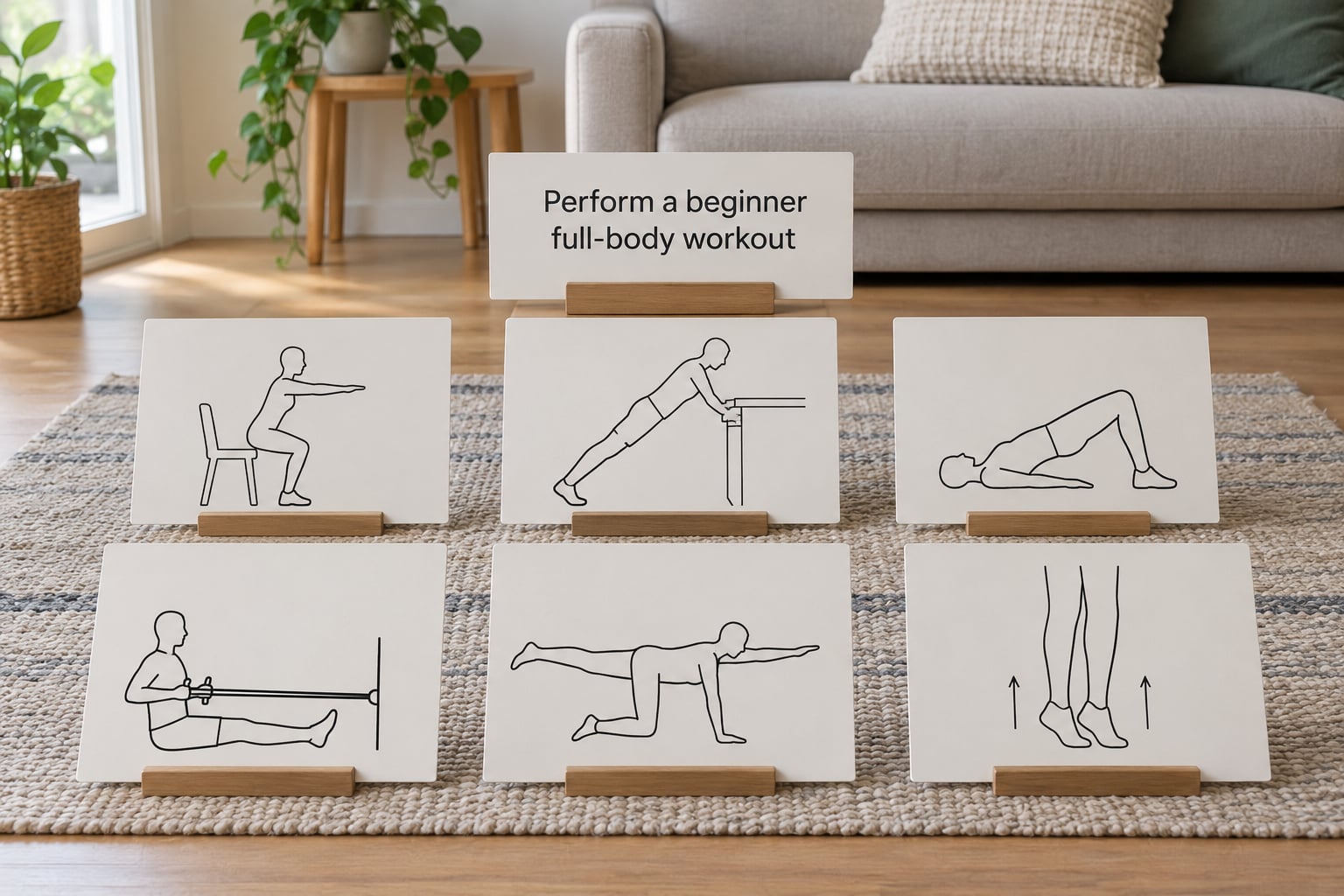
Here is a full session you can run three times a week without repeating an exercise the next day. Everything in it can be done in a small living room.
- Squat to a chair – 2 sets of 10 reps.
- Wall or countertop push-up – 2 sets of 8 to 12 reps.
- Glute bridge – 2 sets of 12 reps.
- Band or towel row – 2 sets of 12 reps.
- Bird dog – 2 sets of 8 reps each side.
- Calf raise – 2 sets of 15 reps.
Rest 60 to 90 seconds between sets and around 2 minutes between exercises. The whole session lands between 20 and 30 minutes once you have learned the movements.
Scale each one rather than dropping it. For the squat, sit to a deeper chair, then a lower one, then a squat to a box. For the push-up, start flat on a wall, then a countertop, then the floor on your knees, then the full floor version. For the row, use a thick resistance band, then a thinner one, then a backpack.
Full-body versus split workouts comes up constantly, and for a beginner the answer is straightforward: do full-body work two or three times a week. Every muscle gets trained each session, each muscle gets rest days, and you only need to remember one short list instead of four.
A simple weekly pattern is easier to keep than an ambitious one:
| Day | What happens | Time |
|---|---|---|
| Day 1 | Full-body session A | 20-30 min |
| Day 2 | Walk or light mobility | 15-20 min |
| Day 3 | Full-body session B | 20-30 min |
| Day 4 | Rest | 0 |
| Day 5 | Full-body session A again | 20-30 min |
| Day 6 and 7 | Rest or a walk | Optional |
Rest days are part of the program, not time wasted from it. Muscles grow while they recover, not while you train them.
Progress without overtraining
Progressive overload means gradually asking your body to do more than it did before, in any one of three ways. That is the whole concept, and it is what separates training from repeatedly exercising.
- Add reps first. When 12 controlled reps feel easy across all sets, move to 15. This is the safest step and the one beginners should use most.
- Add sets next. Go from 2 sets to 3, then rest 90 to 120 seconds.
- Add resistance last. A thicker band, a heavier backpack, or a slower tempo. Tempo is the free option, since a 3-second lowering phase makes any exercise harder.
A four-week version of that looks like this:
| Week | Sessions | Prescription | Focus |
|---|---|---|---|
| Week 1 | 2 | 1 set of 8-10 reps, light | Learn the movements |
| Week 2 | 3 | 2 sets of 10-12 reps | Clean reps, full range |
| Week 3 | 3 | 2 sets of 12-15 reps | Own the harder variation |
| Week 4 | 3 | 3 sets of 10-12 reps, or add load | First real progression |
Adjust the plan when your body tells you something. Mild soreness in the muscles you trained 24 to 48 hours ago is normal, especially in the first two weeks. It usually fades as you keep training.
Sharp pain, joint pain, pain that shows up during a rep rather than after, dizziness or numbness are not soreness. Stop the exercise and see a doctor or physiotherapist if any of those appear.
Reduce the session rather than quitting it. Two sets instead of three, or swapping a floor push-up for a wall one, keeps the habit alive. Missing a week is also fine. Strength comes back faster than most beginners expect once you restart, because the movement patterns are still there.
Common Mistakes
These five account for most stalled beginners, and each has a simple correction.
Skipping the warm-up. Five minutes of easy movement first, such as marching in place, hip circles and arm swings, plus 5 to 10 slow repetitions of your first exercise, does more for your reps than anything else in this article.
Rushing the repetitions. Lowering the weight fast is the most common form error at home. Count a slow 2 to 3 second phase on every rep and your form usually fixes itself.
Using too much resistance on day one. Starting with the heaviest thing you can lift is how beginners end up sore for a week and quit. Add resistance only after 12 to 15 reps feel genuinely easy.
Changing the program every few days. Jumping between routines feels productive and delivers nothing, because the body never gets hard enough to adapt. Give any program four weeks before judging it.
Confusing soreness with injury. DOMS, or delayed onset muscle soreness, is broad, dull and symmetrical, and it peaks a day or two after training. Injury pain is sharp, specific to a joint or one side, and it changes the way you move. When you cannot tell the difference, take a rest day and get it looked at.
A few habits cover most of the rest. Train on the same days each week, keep a note of your sets and reps, and take progress photos every four weeks rather than weighing yourself daily. If your joints or back feel delicate, swap the hinge for a glute bridge and keep moving.
Nobody gets injured by starting where they are. On protein, most beginners do fine with a protein food at each meal, and more matters mainly if your calories are too low. If you want a specific target, ask a registered dietitian rather than copying a number from a stranger online.
Before you start, be honest about your health history. If you are over 40, smoke, are pregnant, have a heart condition, high blood pressure, diabetes, a joint problem, or are returning after an injury or surgery, talk to a doctor first. That is a 10-minute conversation that makes every session safer, and no written guide can replace it.
Frequently Asked Questions
What are examples of strength training for beginners?
Six movements cover almost everything a beginner needs: the squat, the hip hinge or glute bridge, the push-up, the row, the plank or bird dog, and the calf raise. Each targets a major muscle group and can be done at home with no equipment. Add a band or a backpack of books later to make the same movements harder.
How many sets and reps should a complete beginner do?
Start with 1 to 2 sets of 8 to 12 controlled repetitions per movement, and rest 60 to 90 seconds between sets. Aim to finish each set feeling like you could have done two or three more reps. Adding reps before adding weight is the safest route to progress, and most beginners need several weeks at these numbers.
How often should beginners strength train per week?
Two or three full-body sessions a week, with at least one rest day between them, is the standard starting point. This matches mainstream guidance from the American College of Sports Medicine and the HHS Physical Activity Guidelines for Americans, which recommend muscle-strengthening work on two or more days per week.
Can I build muscle at home with no equipment?
Yes, for your first several months, and more if you train close to failure. Bodyweight squats, push-ups, glutes bridges and rows grow muscle effectively when you perform them well and progress over time. Bodyweight-only training plateaus eventually, which is when resistance bands, household weights or dumbbells become useful.
Is 20 minutes of strength training a day enough?
Twenty minutes is enough to build strength if the session is well structured and you train two or three times a week. Six movements, two sets each, with 60 to 90 seconds of rest, fits that window. Consistency matters far more than length, and a short session you repeat beats a long one you skip.
How do I know if my form is right when training alone?
Film three reps from the side with your phone and watch them back slowly. Check that the lower back stays neutral, the knee tracks over the middle toes, and the movement finishes where you started it. Counting a slow 2 to 3 second lowering phase and breathing out during the hardest part also exposes most form errors.
Conclusion
Here is your first move. Pick six movements from the list above, set two days this week for a 25-minute full-body session, and write down what you did. That is the whole start.
Progress only when the current version feels comfortable, and keep going for a month before you judge whether it is working. Two or three short sessions a week, done consistently at home, will change how you move and how you feel long before it changes how you look.
If you have a medical condition, are pregnant, are over 40, smoke, or are returning after an injury, talk to a doctor or qualified professional before you start, and stop any exercise that produces sharp pain, dizziness or numbness.