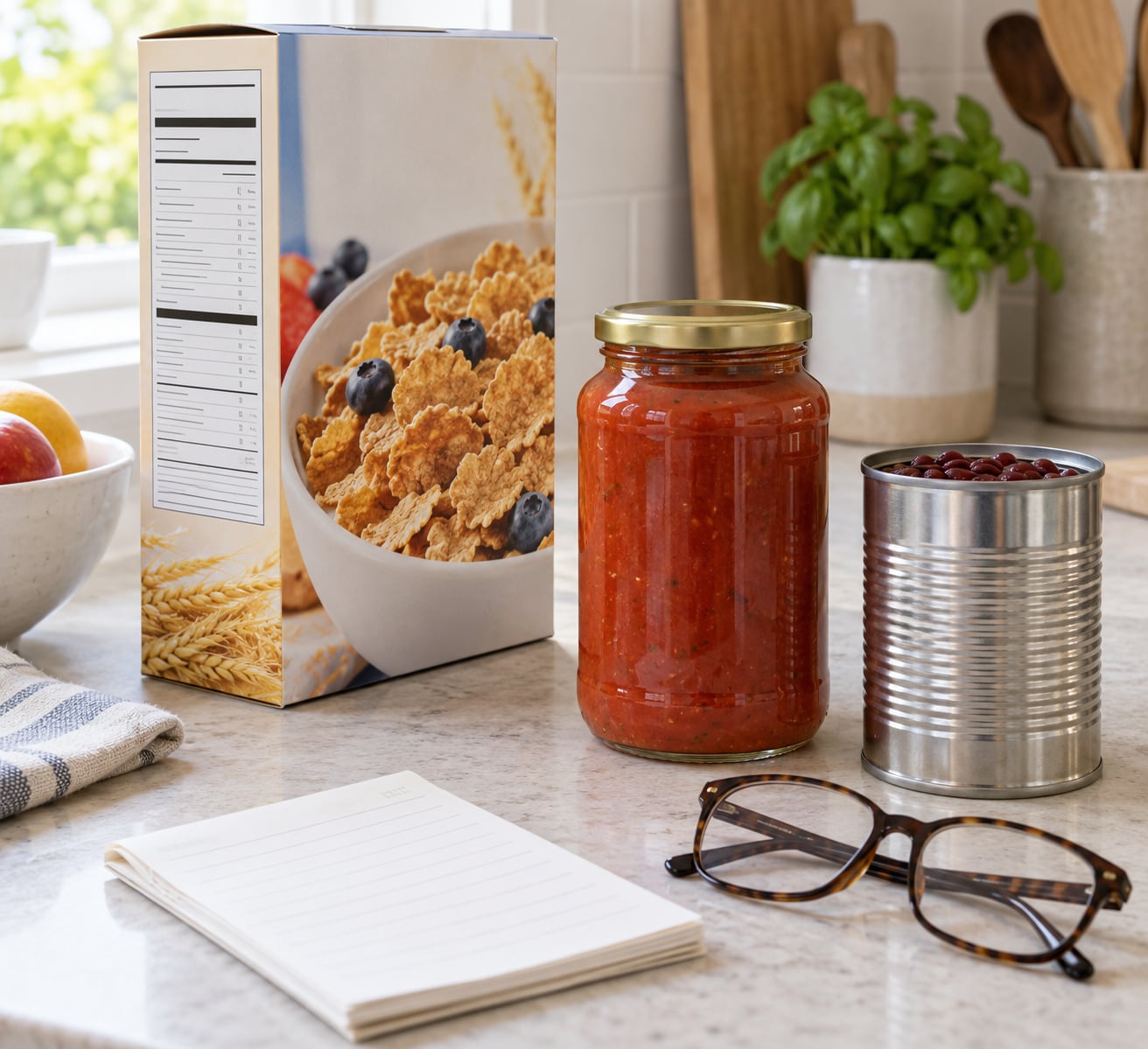
To read a nutrition label quickly, start at the top-left corner and work down in one direction: serving size, calories, the % Daily Value column, then the few nutrients that matter for what you are trying to do, then the ingredient list. Thirty seconds is enough once you know the order.
The reason the scan is fast is that the panel is not free-form. The Food and Drug Administration standardized the Nutrition Facts panel through the Nutrition Labeling and Education Act of 1990, so a cereal box in Maine and a cereal box in Oregon put the same numbers in the same spots. Once your eye learns the layout, the numbers stop being clutter.
Everything here is general education about a label, not a personal eating plan. Individual needs differ a lot, and for a specific condition or a diagnosed diet change, a doctor or registered dietitian is the right person to ask. This guide reflects the current U.S. label format as of October 2026.
Table of Contents
- What You Need
- How to Read a Nutrition Label Quickly
- Start With the Serving Size
- Check Calories and % Daily Value
- Look for Sodium, Added Sugars, Fiber, and Protein
- Skim the Ingredient List: How to Read a Nutrition Label’s Second Half
- Common Mistakes and How to Fix Them
- How to Read a Nutrition Label Quickly in 30 Seconds
- Frequently Asked Questions
- How do I read an ingredient list?
- What does 5% daily value mean?
- Is the serving size the same as the whole package?
- What is the difference between total sugars and added sugars?
- Does organic or natural on the front of the package mean the food is healthy?
- What is the 4 4 9 rule in nutrition?
- Quick Conclusion
What You Need
Three things, and only one of them is the food itself.
- The Nutrition Facts panel on the back or side of the package. Front-of-package claims are marketing; the panel is the regulated part.
- A serving-size reference for your own meals — a plate, a measuring cup, or the portion you actually eat. This is what lets you scale the numbers later.
- Optional: a note on your own priority. Watching sodium? Building muscle? Managing blood sugar? The priority tells you which rows to read and which to ignore.
That last item is what turns a quick read into a useful one. A cereal with 12% daily value of iron and a granola bar with 40% daily value of added sugars are not comparable at all until you decide what the comparison is for.
How to Read a Nutrition Label Quickly
The scan has five moves. Do them in this order and the numbers stay attached to the right amount of food the whole way through.
One framing note before the steps: % Daily Value is a general guide built on a 2,000-calorie reference diet, not a personal prescription. It tells you how much of a typical day’s nutrient this serving delivers. Your own needs may be higher or lower.
Start With the Serving Size
The serving size line tells you how much food all the other numbers describe. Everything under it — calories, sodium, added sugars — is for that amount only.
Just below it, servings per container tells you how many of those servings are in the package. A bag that lists 8 servings per container at 150 calories a serving is a 1,200-calorie bag. I have made that mistake in a grocery aisle more than once.
Two formats trip people up. A dual-column label shows one column for the labeled serving and a second for a larger amount, usually double, which makes the “for people who eat more” comparison fast. A single-unit container, like a bottle of soda or a small yogurt, lists the whole container as one serving, so there is no multiplication to do.
Package size and serving size are separate numbers. The net weight at the bottom of the label tells you the total food in the package; the serving size tells you what the panel is counting. They are often very different.
Check Calories and % Daily Value
Calories come first because they are the only number on the panel with no Daily Value percentage beside it. They are also the number people over-trust: federal rules allow a small tolerance between the listed calorie count and the measured value, so treat calories as a solid estimate rather than a laboratory figure.
Then find the % Daily Value column on the right. Here is the rule worth memorizing: 5% Daily Value or less is low, and 20% Daily Value or more is high. Anything between those two sits in the middle and rarely deserves a second look.
The percentages come from Daily Reference Values, which the FDA sets for a general adult. They are not based on 2,000 calories of the food you are holding; they are a fixed yardstick so every label can be compared against every other one.
Look for Sodium, Added Sugars, Fiber, and Protein
Now scan the nutrient rows for the ones tied to your goal. Four cover most cases.
- Sodium, in milligrams. Watch the % Daily Value, not the milligram number — 400mg looks small until you see it is 15% of the reference daily value.
- Total sugars and added sugars. They are two separate lines. Total sugars includes sugar naturally present in fruit and dairy; added sugars are the ones put in by the manufacturer. Fruit yogurt often has a high total and a low added number, which is the opposite of most packaged snacks.
- Dietary fiber, in grams. It sits indented under total carbohydrate. A serving with 5 grams or more carries a high Daily Value on most current labels.
- Protein, in grams. Useful when you are comparing two products for a higher-protein choice.
Total fat, saturated fat, and cholesterol sit above these rows. Scan their Daily Values quickly, but if you are trying to fix a single number in your week, the four above are usually where the trade-offs actually live.
Skim the Ingredient List: How to Read a Nutrition Label’s Second Half
The ingredient list is ordered by weight, from most to least, so the first ingredient is the one the product contains the most of by mass. Read the first three and you have a good picture of the whole product.
Where it gets tricky is names. Sugar hides under a long list of aliases — cane sugar, dextrose, sucrose, maltose, fructose, corn syrup, invert sugar, cane juice, fruit juice concentrate, malt syrup, brown rice syrup, evaporated cane juice, and others. Salt hides under salt, sodium chloride, sea salt, and monosodium glutamate. Fat aliases include hydrogenated oil, partially hydrogenated oil, and cottonseed oil alongside the more obvious ones.
If sugar appears three separate times in an ingredient list, treat it as three separate additions. That is how a product can print no added sugar on the front and still contain sweetener in the list — check both halves of the label before you trust either.
Allergens are declared in a specific way in the United States: the common allergen names appear in the ingredient list, and the major ones are also restated after a Contains statement. Ingredients present only as incidental additives — amounts too small to have a technical effect on the finished product, such as sanitizers or anti-caking agents — do not have to be broken out the same way.
Common Mistakes and How to Fix Them
Five errors account for most of the confusion, and every one of them has a simple correction.
- Comparing whole packages. One bag lists 5 servings, the other 2, and the numbers on the panel are not comparable. Fix: either equalize to a single serving or multiply both by servings per container before you compare.
- Treating a front-of-package claim as the whole story. Multigrain, natural, free range, non-GMO, and no added sugar each describe one narrow thing, and none of them describes the Nutrition Facts panel. Fix: read the claim for what it claims, then read the panel for everything else.
- Reading total sugars as added sugars. A jar of jam can show high total sugar and near-zero added sugar. Fix: read the added sugars line specifically.
- Deciding a product is good or bad in the aisle. A label describes a serving. It cannot tell you whether that serving fits your day. Fix: compare two products on the same rows instead of ranking one product overall.
- Skipping the ingredient list because the panel already looked fine. Fix: read the first three ingredients and the Contains line before you commit.
How to Read a Nutrition Label Quickly in 30 Seconds
When you have no time for the full scan, run this sequence in order:
- Serving size — how much food does this number describe?
- Servings per container — how many of those are in the package?
- Calories — for one serving, not the package.
- % Daily Value — flag anything at 20% or above, and notice anything at 5% or below.
- Sodium and added sugars — the two most commonly compared rows.
- Fiber or protein — whichever one matters for what you are buying today.
- First three ingredients — and the Contains line if you have an allergy.
Frequently Asked Questions
How do I read an ingredient list?
Read it from top to bottom. Ingredients are listed in descending order by weight, so the first one is present in the largest amount. Reading the first three gives you most of the picture without reading all twenty. Then look for the words that hide sugar, fat, and salt under other names, and check the Contains statement if you are avoiding a major allergen.
What does 5% daily value mean?
Five percent Daily Value or less is considered low. The FDA sets the thresholds so you can scan a column instead of reading every row: 5% or less means low, 20% or more means high, and anything between is in the middle. The percentage is based on Daily Reference Values for a general adult following a 2,000-calorie reference diet, so treat it as a comparison tool rather than a personal target.
Is the serving size the same as the whole package?
Usually not. The serving size is the amount all the nutrient numbers describe, and the servings per container line tells you how many of those servings are in the package. Multiply to find the whole package. Some containers are the exception: single-unit items like a soda bottle or a small yogurt list the entire container as one serving.
What is the difference between total sugars and added sugars?
Total sugars count every sugar in the serving, including sugar that occurs naturally in fruit, vegetables, and milk. Added sugars are the sweeteners added during processing, and they have their own line on the panel. Fruit with no sweetener can show high total sugar and zero added sugar, while many packaged snacks show the reverse.
Does organic or natural on the front of the package mean the food is healthy?
Neither term says anything about calories, sodium, or added sugars. Organic is a regulated production and processing standard verified through the United States Department of Agriculture, and natural is a looser marketing term with no calorie or nutrient meaning at all. Both describe how something was made or marketed, so you still need the Nutrition Facts panel for what it contains.
What is the 4 4 9 rule in nutrition?
It is not a diet rule. Under the Nutrition Labeling and Education Act of 1990, a food may make a nutrient content claim such as low, reduced, or high only when the nutrient meets a specific threshold per serving size, per reference amount customarily eaten, or per 50 grams, whichever the claim is based on. It governs whether a front-of-package claim is legally allowed, not whether the food is good for you.
Quick Conclusion
Start at the serving size, because every other number on the panel is written for that amount and no other. Then let the % Daily Value column do the work: anything at 20% or above is high, anything at 5% or below is low. After that, read only the rows that match your goal — sodium, added sugars, fiber, protein — and finish with the first three ingredients.
That is how to read a nutrition label quickly without memorizing anything beyond one rule. The label describes a serving of food; it does not decide whether that serving is right for you. If you are working with a diagnosis, a medication, or a specific dietary requirement, bring the label to your doctor or registered dietitian and let them interpret it for you.