
You can discover your strengths without a test by gathering evidence instead of guessing: write down the moments you performed well, name the skills you used, ask five people what they rely on you for, test your best guesses in small real situations, then write a short profile. The whole process takes about an hour of writing and five short conversations, and it needs nothing more than a notebook.
Most people asking this question have already tried a quiz and felt oddly described by it. A personality test can hand you a label, but it cannot show you your own history. Reflection and other people’s observations can, and they usually feel truer because the evidence is yours.
This guide walks through five steps in order, with the exact questions to ask and a fill-in profile at the end. Budget roughly an evening to start and a few weeks to run the experiments properly.
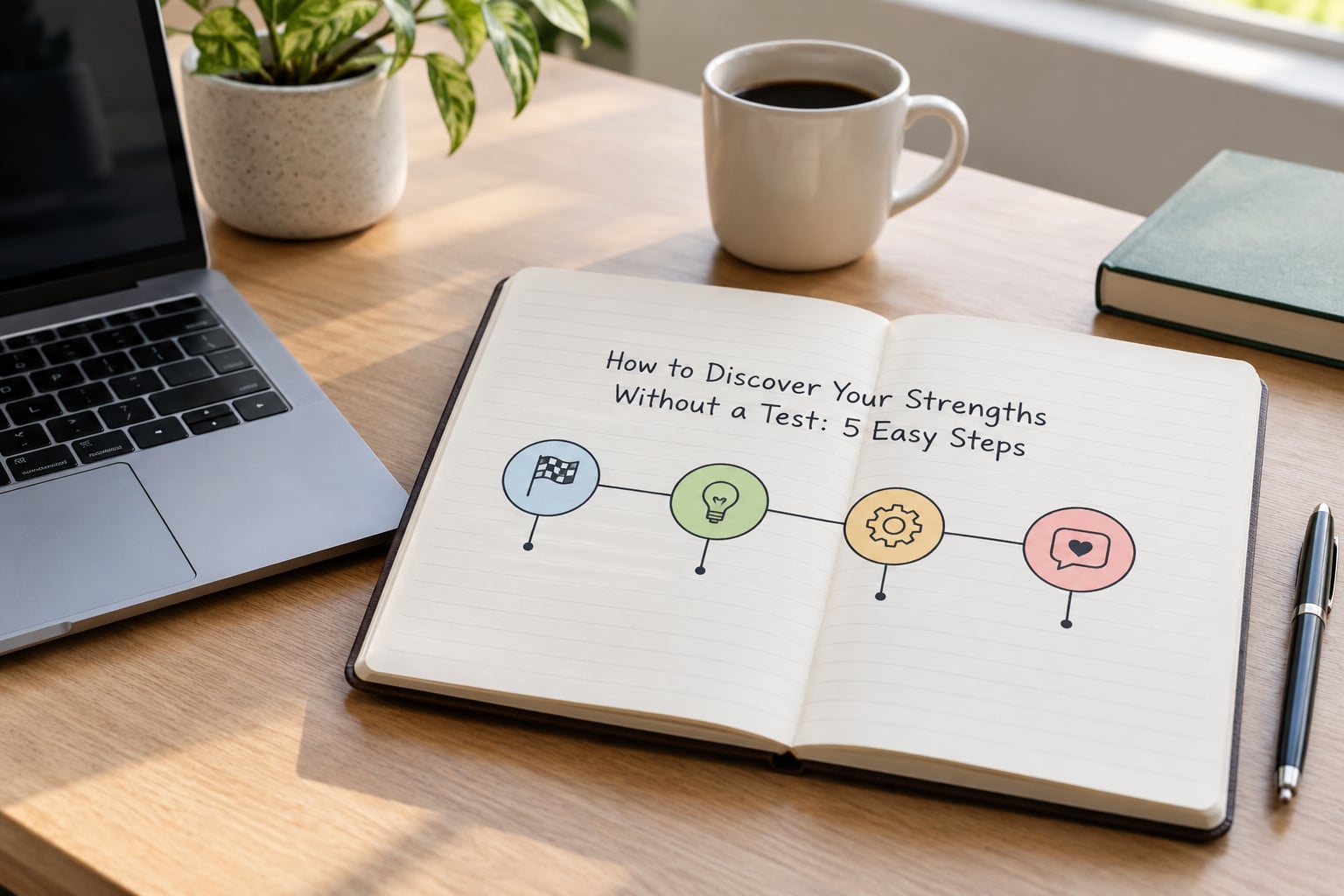
Table of Contents
- What You Need
- Step-by-Step: How to Discover Your Strengths Without a Test
- Step 1: Collect Evidence From Your Best Moments
- Step 2: Identify the Skills You Used
- Step 3: Ask Other People for Specific Examples
- Step 4: Run Small Strength Experiments
- Step 5: Write Your Personal Strengths Profile
- Common Mistakes
- Frequently Asked Questions
- Is it possible to find your strengths without an assessment?
- How long does it take to discover your strengths?
- How do I find my strengths when I feel I have none?
- How do I use my strengths at work or in a career decision?
- When is a formal strengths assessment still worth taking?
- How do I tell the difference between a strength and a skill I got good at?
- Conclusion
What You Need
The materials are deliberately small. Most people already own everything on this list and don’t realise it.
- A notebook or document — paper works well if you think faster by hand, a document works better if you plan to keep updating it.
- One quiet 20-minute block for the first pass through Step 1. Set a timer so you keep moving instead of overthinking.
- Examples of past accomplishments — projects finished, problems solved, situations you handled, feedback you received. Three to five is enough to start.
- Optionally one or two trusted people who can answer specific questions in Step 3. This is a bonus, not a requirement.
You do not need an assessment, an app, or any prior self-knowledge. If you have never been told what you are good at, that is the normal starting point for this method, not a disqualification.
Step-by-Step: How to Discover Your Strengths Without a Test
Each step feeds the next. Step 1 gives you raw material, Step 2 turns it into words, Step 3 tests those words against outside opinion, Step 4 tests them against reality, and Step 5 locks in what survived.
Step 1: Collect Evidence From Your Best Moments
Start with moments when you felt capable, energised, useful or proud. Write three to five of them, and describe each one in four parts: what you actually did, who benefited, what was difficult, and what came afterwards.
Vague entries don’t work. “I’m good with people” tells you nothing. “I ran the monthly staff meeting when my manager was on leave, kept it to 40 minutes, and the team used the new rota I put in place” tells you almost everything.
Include anything, not just paid work. Coordinating a family reunion, teaching a Sunday school class, fixing a leaking sink, running a collection for a neighbour, or getting a neighbour’s teenager through a school project all count. Strengths show up outside the job title as often as inside it.
Ask yourself a second question while you write: which of these moments would I want more of? The answer is usually closer to a strength than the answer to “what am I good at?”
Step 2: Identify the Skills You Used
Now translate each story into a repeatable skill. The test is whether someone else could do the same thing again next month. “Explained a confusing policy so it made sense” becomes explaining clearly. “Kept four moving parts from colliding” becomes organising. “Stepped in when two people were arguing” becomes calming conflict.
Read across your five stories and look for the skill that appears more than once. Repetition is the signal. One unusual skill in a single story is probably a coincidence; the same skill in three different contexts is a pattern.
Turn your list into three to five short phrases and write them down. Common ones include organising, explaining, taking initiative, solving problems, building trust, learning quickly, staying calm under pressure, connecting people, and finishing what gets started.
Wording matters. Write “takes initiative and follows through” rather than “hard worker”, because you can test the first one in a real week and the second one means nothing on its own.
Step 3: Ask Other People for Specific Examples
You are the worst possible judge of your own strengths, mostly because you remember the difficulty and forget that you did it anyway. Other people watched the same thing and noticed something different.
Ask five people: a manager or former manager, a colleague, a friend, a family member, and someone who has seen you work unpaid — a volunteer coordinator, a church leader, a team captain. Keep it short and ask these exact questions:
- What do you consistently rely on me to do?
- What have you seen me do well that others find hard?
- When something went wrong around me, what did I usually handle well?
- What would you warn a new person not to ask me to do?
- What is one thing I do that makes the people around me better?
Never ask “what are my strengths?” That question produces compliments, and compliments are useless here. You need behaviour, context and impact.
When the answers conflict, do not average them. Look at what the people who see your work most often said, and check whether the outlier described a skill you rarely use. Someone who sees you once a month is describing potential, not pattern.
Step 4: Run Small Strength Experiments
Reflection gives you a hypothesis. An experiment gives you an answer. Pick one candidate strength and put it into a low-risk, real situation for one week.
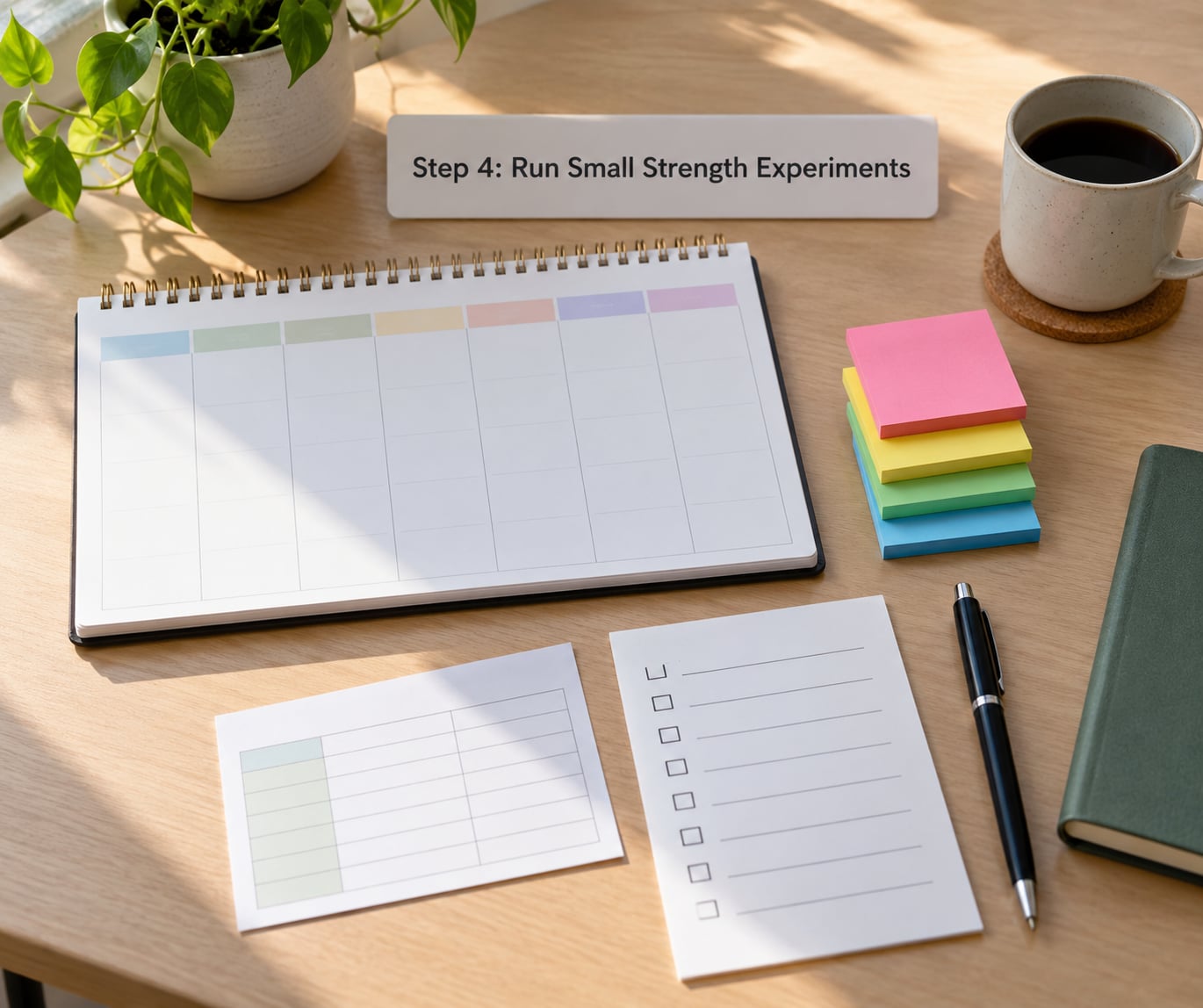
Examples that work: lead the meeting, mentor a newer colleague, plan an event, manage a small budget, solve the problem everyone else avoided, or organise information the team keeps misplacing. Keep it small enough that a bad week doesn’t damage your reputation.
Rate four things at the end of the week on a simple one-to-five scale: how much you enjoyed it, how confident you felt going in, how well you performed, and how useful it was to someone else. Write one sentence on what to repeat and one on what to change.
Two useful signals stand out. You performed well and enjoyed it, which usually means push the strength further. You performed well and felt flat, which means it’s a skill you have, not a strength you want to build a career on. That distinction is the whole point of the experiment.
Step 5: Write Your Personal Strengths Profile
Combine what survived into a single page with three to five strengths. For each one, write three lines: the situation where it shows up, the result it produces, and the next context where you could use it more.
Here is a short example of what finished looks like:
- Explaining clearly — Shows up when a process is confusing or new. Result: fewer repeat questions and fewer mistakes. Next: take over the onboarding notes for new starters.
- Calming conflict — Shows up in meetings when two priorities clash. Result: decisions made in the room instead of after three days of email. Next: volunteer as the facilitator for the team retro.
- Organising — Shows up whenever several people need the same information. Result: fewer missed deadlines caused by missing detail. Next: take ownership of the shared calendar and the document library.
Test each line with one question: could a stranger read this and know what to give me to do? If the answer is no, it is still a compliment rather than a strength. Rewrite it as behaviour.
Keep the profile somewhere you will see it. A note in your phone, a page in your planner, or the first page of your CV. Strengths you never write down stay invisible to the people deciding what to give you next.
Common Mistakes
Confusing a job title with a strength. Being a manager is a role. Deciding quickly when a decision cannot be delayed might be the strength underneath it. Correction: rewrite every title in your history as a verb.
Listing traits without evidence. “I’m resilient and a good communicator” is a wish list. Correction: attach one dated story to each trait or delete it.
Choosing strengths because they sound impressive. Strategic thinking reads well on a CV and might be the one thing you have never once been praised for. Correction: only list what at least two other people independently described.
Ignoring context. The same person can show follow-through at work and creativity while cooking, and neither version is less real. Correction: name the situation next to each strength, as in the profile format above.
Trusting one person’s opinion. A partner who loves you is not a neutral observer of your working style. Correction: ask five people and look only at overlaps.
Doing it once and never again. Strengths shift as your role, health and season of life change, and overusing one trait without rest turns it into a liability. Correction: set a recurring 30-minute review twice a year, add the last experiment to the same page, and cut anything you have not used in months.
Frequently Asked Questions
Is it possible to find your strengths without an assessment?
Yes, and most people get a clearer answer this way than from a quiz. The methods that work without a test rely on three sources of evidence: your own record of moments you handled well, the skills those moments required, and what other people consistently rely on you for. A paid assessment can add a shared vocabulary, but it cannot see your history, so it works best after you have your own evidence in front of you.
How long does it take to discover your strengths?
The writing takes about an hour spread over a few sittings, and the interview step adds five short conversations of ten minutes each. The experiments then take two to four weeks, because that is how long it takes to get a real result rather than a good intention. Altogether, most readers have a working profile in about a month.
How do I find my strengths when I feel I have none?
Start with the smallest evidence you have, not a career highlight reel. Caregiving, volunteering, church or community work, a school group, a side project and a hard family season all leave traces of skill. Write down three things other people asked you to do recently, even small ones like drafting a message or fixing a form. If nothing comes to mind, ask one person what they would call you for.
How do I use my strengths at work or in a career decision?
Put one strength into a real task for a week, then rate your enjoyment, confidence, performance and usefulness to others. That score tells you whether to invest or to leave it as a background skill. For a job decision, favour the role that lets you use your top two strengths in your first three months, and mention a specific example in the interview rather than naming the trait on its own.
When is a formal strengths assessment still worth taking?
A formal assessment is useful when you want a named framework to share with a manager, when you are applying for a role that uses a specific language, or when your own reflection keeps producing five different answers and you need a structured prompt. It is less useful as a substitute for evidence. Paid options cost money and vary in validity, so treat the results as one input alongside your own record and other people’s observations.
How do I tell the difference between a strength and a skill I got good at?
A strength usually appears across unrelated contexts, comes with less effort, and leaves you energised rather than flat. A skill you practised for years shows up in one context and costs you something to use. The practical check: score the same four things — enjoyment, confidence, performance, usefulness — on a task you have done a hundred times and a new one using the same ability. Similar scores point to a strength.
Conclusion
Discovering your strengths without a test is an evidence exercise, not a personality exercise. Start today by writing three moments when you performed well, name the skills those moments used, and pick one strength to put into a real situation this week.
Review the page twice a year, add what worked and drop what did not. Strengths get clearer through practice and evidence, and they shift as your life does. The person who keeps evidence is the person who can name what they are good for when it matters.